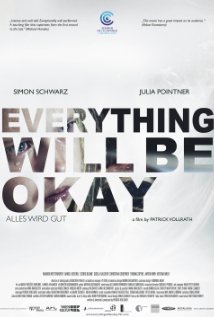
Greetings again from the darkness. Dramatic short films are challenged with generating an ultra-quick connection with viewers. German director Patrick Vollrath begins the film by showing a man anxiously pacing and buzzing the gate bell outside a suburban home. Our instincts that tell us he must be in some kind of trouble fade a bit when an 8 year old girl runs into his arms exclaiming “Daddy!”
Lea (newcomer Julia Pointer) clearly loves her father, and we quickly figure out this must be the scheduled every other weekend visit resulting from a recent divorce. Lea’s excitement is palpable as they stop off at a toy store where her dad tells her she can pick out any two items she wants. A simple gesture that’s probably repeated thousands of times each weekend, re-ignites the instincts we felt in the opening scene. Some “little” hints confirm our suspicion as the two hurriedly rush to an appointment at a government office and then on to the airport.
Simon Schwarz plays Michael Baumgartner, the dad who transitions from anxious to warm/loving to purely desperate. His performance, and that of young Ms. Pointer, are realistic and so spot on that we as viewers are sympathetic to both. It’s an exceptionally tense and dramatic half-hour reminding us that in a broken family, it’s rarely the case that “everything will be okay”, and sometimes things escalate into a literal tug-of-war that is heart-breaking. This is expert work from a filmmaker that understands the magic of short films, and it’s little wonder the film has been so well received at AFI, Cannes and numerous other festivals.
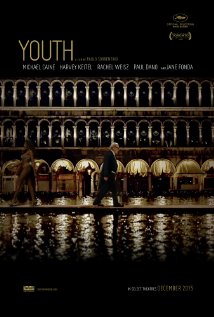
Greetings again from the darkness. With a Best Foreign Language Oscar for his previous film The Great Beauty(La grande bellezza), expectations were sky high for this one from writer/director Paolo Sorrentino. Cinematographer Luca Bigazzi is also back and the two create yet another artistic entrée that is a visual extravaganza, worthy of the admission price even if no dialogue existed. Combine the visual artistry with a commentary on age and emotions, and the result is a film that will either enchant or stultify … with probably no middle ground.
Michael Caine stars as Fred Ballinger, a renowned Orchestra conductor, who is vacationing at a stunning Swiss Alps spa with his daughter Lena (Rachel Weisz) and his long-time best friend, screenwriter Mick Boyd (Harvey Keitel). Fred, a self-professed retiree, is being pursued by Queen Elizabeth’s representative to perform one last concert. Fred is adamant in his refusal … for personal reasons we later learn are due to his nostalgic belief that his wife (no longer able to sing) is the only one who will sing his “simple” songs as long as he is alive. In the meantime, Mick is working with a group of ambitious young writers in an attempt to leave a legacy with his most important film ever. So you can already see that both men are working through their golden years in different ways.
Lena is devastated when her husband dumps her for a young pop singer (played by the real pop singer, Paloma Faith). Oh, one other detail … Lena’s husband is also Mick’s son (Ed Stoppard). This makes for some awkward (but entertaining) moments, and also leads to one of the film’s best scenes – Lena spilling her emotional guts to Fred while they are both covered in a mud bath. Director Sorrentino is a master at twisting these poignant moments with dashes of levity or irony. Another example is when Miss Universe (Romanian model Madalina Diana Ghenea) puts a condescending movie actor (Paul Dano) in his place with a devastating shift in tone and a comeback for the ages.
Sorrentino executes a couple of bizarre dream or fantasy sequences – one with Fred conducting a cow pasture (replete with cows and other bits of nature), and another with Mick being haunted in a meadow by all the female stars from his films (each in costume of their character). Suffice to say, this is not a conventional look at aging. What’s also clear is that Sorrentino believes our emotions drive our actions. The most jarring example is the aftermath when Mick’s long-time leading lady Brenda Morel (played by Jane Fonda) declines to appear in his latest film.
Even the most bizarre segments are presented with a visual artistry that forces our brains to process overtime. How about an obese Diego Maradona (played by Roly Serrano) repeatedly kicking tennis balls into the air? Or big time actor Jimmy Tree (Dano) struggling with his decision to sellout by appearing in a popular robot movie instead of pursuing his desire to be taken seriously as an actor? Or Lena bouncing back with a socially awkward mountain man? Or the seemingly minor role of a young masseuse (played by Luna Zimic Mijovic) who has us yearning for more? In addition to how each of these segments is startling to look at, Jane Fonda’s role has so many nuances that an entire movie could be made about her.
As with The Great Beauty, the film will have the most profound impact on those of us old enough to be looking through the binoculars and noticing how far away the past looks … and wondering just how long until “Life’s Last Day”.
Greetings again from the darkness. Success on the film festival circuit is much deserved for this first feature film from writer/director Jonas Carpignano, as he expands his short film A Chijana(2012). It’s based on the true story of a young man who migrated from Burkin Faso to the southern Italy town of Rosarno. What makes this special is that the real immigrant, Koudous Seihon, stars in the film and recreates much of what he went through.
We witness the obstacles facing those trying to leave Africa … they need money and assistance and a whole lot of luck. Mr. Seihon plays Ayiva, and he is traveling with his brother Abas (Alassane Sy). The rickety boat they pile into is one most of us wouldn’t consider sea-worthy enough to cross the Mediterranean Sea (especially through a storm), but it’s their only option.
They are certainly disappointed in the shanty town that becomes their new home. However, soon enough they realize sleeping on the ground in cold weather with but a thin quilt is no hardship compared to the everyday risk of violence and racism. Most of the locals are not welcoming in the least, and the hatred often escalates. It’s what led to the riots of 2010, which director Carpignano touches on here.
The film has a no-frills docu-drama feel to it, and Seihon has a real screen presence. Ayiva’s survival skills are enhanced by his ability to blend into his environment – he becomes what he needs to be to persevere. Unfortunately his brother rebels and lets his anger affect his actions. The real world struggles of migrants and refugees are a global issue these days, and the film brings into focus some of the struggles faced by those who see no other option.
For an introduction to the French New Wave, the first feature film from director Louis Malle is a good place to start. The neo-realism in this crime drama (based on the novel from Noel Calef) was new to film goers at the time, and even more startling was the natural lighting and minimal make-up used to photograph lead actress Jeanne Moreau. Beyond that, the haunting score from the legendary Miles Davis has been best described as “the loneliest trumpet”.
The film jump starts with an emotional and desperate phone call between lovers shown in extreme close-up: Florence (Ms. Moreau) and Julien (Maurice Ronet). The two have plotted to kill her husband (his boss) – war profiteer Simon Carala (played by Jean Wall) – so that they can be together. The details of the perfect murder plan are carried out with the intention of making it appear like a suicide. Unfortunately for Julien, a frantic attempt to hide some evidence leaves him trapped in an elevator. The fallout from this bad break finds Florence believing he has deserted her, and creates a secondary story line involving the theft of his car by a couple of youngsters out for a good time.
It’s here that the film bounces between the three sequences and really capitalizes on Malle’s expertise with a camera. Julien’s frustration in trying to escape the elevator generates the necessary tension, while the exploits of the young couple Louis and Veronique (Georges Poujouly, Yori Bertin) find them in a bad-situation-gone-worse when their impromptu party with a German couple (Ivan Petrovich, Elga Andersen) turns tragic. It’s easy to see how Jean Luc Godard was influenced by this young couple for his classic Breathless (1960). But best of all is the wandering woman of despair … we follow Florence as she tries to track down Julien on the rainy late night city streets. These shots of Ms. Moreau are truly spectacular thanks not just to the lighting, but also the realistic emotions of her facial expressions … we never doubt her feeling of resignation.
Mr. Malle was only 26 when he directed this film, and the follow-up (also with Ms. Moreau) entitled The Lovers, also released in 1958. He had worked as an underwater photographer for Jacques Costeau and referenced this in the film. Malle had a long time marriage to Candice Bergen, and an incredible career that featured three Academy Award nominations (including Atlantic City, 1980). This was Ms. Moreau’s breakthrough film and led to her best known role in Francois Truffaut’s 1962 film Jules and Jim. She is still working today at age 87. She also had a successful singing career, as well as numerous love affairs (Malle, Truffaut, Pierre Cardin, and Miles Davis).
Although there are some details and plot points that might annoy those who pay close attention, it doesn’t take away from the groundbreaking work of a young director who helped change the tone of movies. It’s interesting to note that Florence and Julien don’t share a scene in this film, outside of the opening phone call split scene. Additionally, the contemporary influence lives on through the line “Never leave photos lying around” (or on social media). A special thanks goes out to The Texas Theatre in Dallas for bringing this classic back to the big screen.
Rather than post a clip or trailer, below is a video showing a young Miles Davis playing along to the film:
Greetings again from the darkness. We depend on documentaries to teach us things we don’t know, introduce us to interesting people, and take us places we will probably never visit. Co-directors Jillian Elizabeth and Neil Dalel accomplish all of these by taking us to south India and the jungle setting of Ashra Vidya Gurukaulam.
Filmed as far back as 2010, we go deep into an environment that would normally be off-limits to cameras. We follow students who have come to the ashram to learn from Swami Dayananda Saraswati and study the ancient wisdom of Advaita Vedanta.
The film alternates between following Dayananda and providing us a feel for the students and the overall life of quiet ritual, meditation and spirituality. The Swami is pretty fascinating as he constantly shares the wisdom, philosophy and insight that is not designed to raise funds, but rather to offer the process of discovering one’s self and life meaning.
Not only is this a different approach for a documentary … it’s very quiet (no narrator) and paced to mirror the movements from the ashram … but it is extraordinary to see the contrast versus our usual hectic daily lives in the Western world. A community of solitude may sound incongruent, but watching these folks find peace in their daily rituals while combining self-realization with supporting their neighbors, is something that must be witnessed to fully comprehend.
There are only a few shots that include cell phones or computers … another stark contrast to our daily lives of over-stimulation. Instead, the simplicity of the day and the tranquil setting permit a more open and uncluttered mind, heart and soul. This easily could have been a profile of Swami Dayananda, but the choice of the filmmakers to provide a more complete overview creates quite a unique viewing experience – one that quietly draws you towards introspection.
Greetings again from the darkness. Co-directors Olivier Nakache and Eric Toledano delivered one of the best movies of 2012 with The Intouchables, and reunite to adapt a novel from Delphine Coulin. It’s another “odd couple” story, this time focusing on Samba (Omar Sy) and Alice (Charlotte Gainsbourg). The familiar blend of drama and comedy is present, and the French immigration process takes a few shots.
Omar Sy exploded on the scene in The Intouchablesand again proves what a tremendous screen presence he has. However this time his turn is mostly dramatic, while the bulk of the comedy arrives courtesy of his friend Wilson (played by Tahar Rahim from A Prophet). Ten years ago, Samba immigrated to France from Senegal, and has been sending money home ever since. A police incident leaves Samba in danger of being deported, and he receives help from Alice, an inexperienced immigration worker who is dealing with her own issues … she’s a hard core corporate burn out (hide your cell phone fellas!).
Given the subject matter, the film is much funnier and pleasant to watch than one might expect. The actors listed above, along with Izia Higelin as another immigration worker, are all wonderful and interesting to watch as their characters struggle through the hand they’ve been dealt. Samba and Wilson steal moments of joy while living in constant fear of being discovered, while Alice is borderline depressive and insomniac. She and Samba spend much of the movie in clumsy flirtations while their stressful situations swirl around. It’s awkward to watch, but we do find ourselves hoping things work out for each of them.
A very promising opening sequence contrasts the attendees of a high-dollar wedding with the working class of those in the kitchen- of which Samba is one. Unfortunately, this contrast is mostly hinted at for the rest of the film, except for one terrific “back and forth/ him and her” segment. The best guess is that there is an outstanding dramatic story hidden by the overuse of comedy. While the laughs are legitimate and appreciated, the film leaves us feeling a bit empty, given the lack of information and insight we take away in regards to French immigration.
Greetings again from the darkness. Be honest … would you be excited to see a film if it were described as follows: “A grumpy 93 year old man struggles with his failing mind and deteriorating body as he tends to his beehives during retirement in a small coastal town”. Chances are that synopsis would cause you to skip on to whatever else is showing at the theatre. However, a single revelation would likely change your mind … the elderly man is actually legendary detective Sherlock Holmes.
Ian McKellen stars and holds little back as he portrays the elderly Holmes trying to reconcile the past, the present and his failing health. And yes, there is one last case to solve … only it’s the last case he actually solved 35 years earlier. Sadly, Holmes can’t recall how that case ended, and the fictionalized version written by his friend John Watson offers no resolution.
We first see Holmes as he returns from an international trip – a trip that seems a bit out of place with the rest of the movie; at least until it circles back near the end of the film. In fact, we get quite a bit of back and forth between the present and past, and McKellen pulls off both the elder and much younger Holmes … though his performance as the faltering, frail one-time genius is Oscar caliber.
Laura Linney plays his housekeeper, but it’s her son Roger (Milo Parker) who jells with Holmes and re-kindles that twinkle in the eye. The scenes with Roger and Holmes provide poignancy and humor, and also the dose of reality so necessary to a film focusing on a living legend.
Bill Condon (Dreamgirls, Gods and Monsters) directs the film, which is based on the novel “A Slight Trick of the Mind” by Mitch Cullin, and pretty quickly pulls the rug out from under us on the iconic deerstalker cap and the ever-present pipe. Still, only the staunchest, least-flexible fans of Sir Arthur Conan Doyle’s character will be turned off by this mostly gentle and insightful look at aging – and a reminder that even fictional geniuses grow old.
Baker Street makes an appearance, as does the charred and blackened Hiroshima site, and a blurry Dr. Watson. Don’t expect the frantic pace of Robert Downey, Jr or the elegant precision of Basil Rathbone and Benedict Cumberbatch. Instead, enjoy the subtle moments, the wry smiles and the valiant attempt to bring a mortal end to the seemingly immortal Great Detective … with a few clues tossed in for good fun.
Greetings again from the darkness. The best French films excel at showing how relationships and personality traits can get intertwined to create a big mess where only a small blip once existed. Based on the book by Renee LeRoux, this film from decorated director Andre Techine is self-described “fiction based on real events” and follows the events that began in 1976, and the fallout over a murder-mystery during the next thirty plus years.
Catherine Deneuve plays Renee LeRoux, the owner of a casino in Nice, and mother to Agnes (Adele Haenel). Agnes returns home from Africa after a split from her husband. She is strong-willed and free-spirited, and intent on cashing out her share of the casino to open her own little shop.
Mother and daughter are tormented by their lack of a close relationship, and this frustration intensifies due to the pressure on Mom’s casino business applied by local mobster Fratoni (Jean Corso), and even moreso thanks to the romantic relationship that brews between Mom’s trusted business advisor Maurice Agnelet (Guillaume Canet) and the much younger Agnes.
Maurice is a well-known (and admitted) Lothario and his business savvy manages to maneuver Agnes into betraying her mother at a crucial time. This betrayal leaves both Maurice and Agnes with a substantial financial gain, while Mom loses her casino. Agnes devolves into obsessed-lover and stalker, while Maurice is content to continue playing the field and enjoy his riches. Soon enough, Agnes disappears without a trace, and of course her mother suspects Maurice has killed her. With no body and no evidence, there can be no murder charges, and this sets Renee on a lifelong mission of proving him guilty.
It’s nice to see Ms. Deneuve take on this role, and the best scenes involve her interactions with Ms. Haenel and Mr. Canet (who wrote and directed the 2006 gem Tell No One). The interactions between these characters is fascinating to watch, and provides some insight to the not-always-positive side of human beings. It’s also a sign of the times as cigarette smoke is present (sometimes in mass quantities) in most every scene, and the French version of “Stand By Me” fits perfectly in a rare moment that lacks tension. The final act provides quite a statement on the justice system in France, though one hates to jump to conclusions based on a few minutes of a movie.
Greetings again from the darkness. Societal mores are always slow to change, but the slow acceptance of new cultural ideals pales in comparison to the evolution of religious beliefs and traditions, which can take multiple millenniums for even the smallest revisions. First time director Raj Amit Kumar co-wrote the script with Damon J Taylor, and they seem anxious to point out the out-of-step status of Muslims in regards to both pacifism and sexual orientation.
The structure of the film can be a bit tough to follow as a viewer since there are two seemingly unrelated stories, along with the corresponding flashbacks for character perspective. One story follows an angry idealist has he accepts his assignment for terrorism and travels from Pakistan to New York City. Mohammed Husain’s (played by Bhanu Uday) mission is to coerce (a word much too nice for his actions) pacifist Muslim scholar Fareed Rahmani (Victor Banjeree) into admitting on video that he is a fraud and not a true Muslim. The other story has Leela Singh (Preeti Gupta) as a frustrated lesbian woman in New Delhi who has refused ten marriages arranged by her devout father (Adil Hussain), and finally runs away to meet her choice of lover … artist Sakhi (Bhavani Lee), whose current boyfriend finds Leela’s passion comical – right up until he doesn’t.
A running theme for both storylines, as well as the numerous sub-plots, is specifically stated as “It’s the choice we make when we are most cornered in life that define us”. Solution through violence and torture is consistent through both stories, and as disgusting as the actions of terrorist Husain are, it’s the actions of Leela’s father that are the most stomach churning and confounding. There are a few shots taken at the power of Wall Street, but the actions of greed don’t compare to the more severe and unforgivable actions driven by religious beliefs. The film was originally entitled “Blemished Light”, but it’s difficult to find illumination in this well-acted film that exposes clouded thought processes.
Greetings again from the darkness. For those who found last year’s Birdman: Or (The Unexpected Virtue of Ignorance) to be too linear and overly coherent, be sure to track down the latest from writer/director Quentin Dupieux. You might recognize the name from his films that have developed cult followings – Rubber (2010) and Wrong (2012).
Dupieux seems obsessed with the blurred lines between the conscious and sub-conscious, so one can only imagine what he means by titling his movie “Reality”. To ensure that we remain in a constant cloud of confusion, there is a key character who is a young girl (Kyla Kenedy) acting in her own movie. Her name is … what else? … Reality.
One can’t really use the term plot when describing the film, but what follows is my best attempt. Jason Tantra (played by the always terrific Alain Chabat) is a camera man on a locally produced TV talk show about cooking that stars a rat costume-wearing host Denis (Jon Heder, Napoleon Dynamite). Jason wants to make his own movie starring a reluctant Denis (who suffers from eczema on the inside), and pitches his sci-fi idea of human-killing TV sets to film producer Bob Marshall (played by Jonathan Lambert). Marshall agrees to back the movie if Jason can come up with an award-winning perfect groan of pain within 48 hours. Meanwhile Reality (the girl) is being filmed by avant-garde director Zog (John Glover), and she finds a blue video cassette inside the gut of a wild boar killed by her father. In the process of trying to watch the tape, she spots a cross-dressing Eric Wareheim (from “Tim and Eric” fame) driving a military jeep through town. In one of his many dreams, Jason pictures himself at the awards ceremony where he wins for best groan … the award is presented by Oscar winning director Michel Hazanavicius (The Artist) and Roxane Mesquida (who was in Rubber). The topper of all sequences involves Jason having a phone conversation with producer Marshall while at the theatre watching his unmade movie while Marshall simultaneously has an in-person meeting with Jason. If you follow any of the above, this movie is made for you. If you didn’t follow any of it, congratulations on your continued socially acceptable level of sanity.
Inside jokes abound here, and Dupieux takes a few shots at the filmmaking business, and what constitutes creativity. Fellow French filmmaker Michel Gondry (The Science of Sleep, 2006) may be the closest comparison to Dupieux, but the latter seems more focused on pushing the boundaries of lunacy and yes, Reality.