FRIENDLY PERSUASION (1956)

December 29, 2013

friendly p Greetings again from the darkness. Released in 1956, this William Wyler film holds up today because some of the debate and dilemmas touched on remain unresolved 57 years (and numerous wars) later. The film takes place in 1860’s Indiana as the Civil War rages. The story is told from the perspective of a pacifist Quaker family and is based on the 1945 book by Jessamyn West.

The patriarch of this Quaker family is played by Gary Cooper, who was four years past his Oscar winning performance in High Noon, and five years from his death due to cancer. His wife, the Minister Eliza, is played well by Dorothy McGuire, who the following year would play the mother in Old Yeller. The film’s best performance comes from young Anthony Perkins (his second film) who of course made cinematic history as Norman Bates in the 1960 classic Psycho. Both of these Perkins characters share mommy issues and complicated decisions of conscience, and in this one he has a remarkable scene when he crosses that line.

The opposition to war and violence is the main theme here, and there have been many interpretations over the years. Is it religious belief or fear that prevents the men from joining the cause? At least Perkins’ character is honest enough to wonder. Cooper kind of plays against type here since he was so often a man of movie action, but in reality his strength of character and belief allows him to maintain his strong leading man image.

Comedy relief is at hand given the youngest son’s ongoing battle with Samantha the Goose, a family pet with devious attack modes. Daughter Mattie, played by Phyllis Love, falls madly in love with a soldier played by Peter Mark Richman. See, every character has their own personal battles and decisions regarding conscience and violence.

The great Margaret Main has a sequence as a single mother of three daughters (every one a gem!). The daughters introduce Cooper and Perkins to the joys of music … forbidden by the Quaker church. One of the daughters is played by Marjorie Durant, whose father was a writer and assistant to Charlie Chaplin. Her grandmother married EF Hutton, so Ms. Durant could have spent a great deal of time researching her only family stories.

While it’s difficult to understand these days, screenwriter Michael Wilson was not originally credited for his work. He was on the Hollywood Blacklist, and his screen credit was not reinstated until 1996. William Wyler was one of the most successful directors in Hollywood history and his resume includes Jezebel, Mrs Miniver, The Best Years of Our Lives, and of course, Ben-Hur. Though this movie was nominated for 6 Academy Awards, it didn’t win any and lost out to Best Picture winner Around the World in 80 Days.

**NOTE: This was Ronald Reagan’s favorite movie and he presented a copy to Mikhail Gorbachev in hopes the message would prove perspective and alternatives to a war between the super powers.

watch the trailer:

https://www.youtube.com/watch?v=xmK3iPSNtCQ


LAWRENCE OF ARABIA (1962) revisited

March 28, 2013

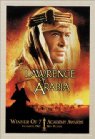
lawrence Greetings again from the darkness. It’s been over 50 years since the film’s initial release and more than 20 since I last viewed it on the big screen. When Cinemark announced it as part of the Classic Film Series, I circled the date on my calendar. While most movies are best viewed in a theatre setting, no other film absolutely demands such a setting.

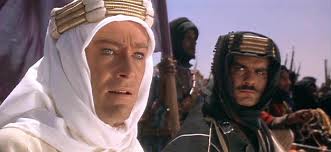
There are many elements that contribute to the well deserved “classic” label: David Lean‘s direction, Freddie Young‘s photography, the star-studded support cast, the historical significance, Maurice Jarre‘s iconic score, and of course, Peter O’Toole‘s standout and unusual performance. This is an action-adventure film with up close battle scenes filmed with no CGI aid. The famous shot of Omar Sharif‘s Sheriff Ali slowly making his initial appearance on the desert horizon is breathtaking on a 60 foot screen. Watching Lawrence’s victory dance on top of the train is majestic in the theatre, and the big screen provides the necessary ominous feeling as the Arabs slowly navigate the blowing sands of the Nefud Desert culminating in an amazing single shot of the attack on Aqaba.

lawrence2 T.E. Lawrence was a fascinating man, though there has been much debate about the film and his legend. Lawrence’s own writings in “Seven Pillars of Wisdom” provided many details used by screenwriters Robert Bolt and Michael Wilson, as well as the writings of American photo-journalist Lowell Thomas … depicted in the film as Jackson Bentley (Arthur Kennedy). The real life Thomas was looking for a hero and likely sensationalized his story of Lawrence, but most believe the foundation is fairly accurate.  As if to offer an upfront disclosure, Lean begins the film with notice that no one really knew the man.

While the story of T.E. Lawrence is incredibly interesting, the story in the film is somehow just part of the experience. Director David Lean’s movie is a true experience for movie lovers. This was Mr. Lean’s middle film of an incredible streak of three … The Bridge on the River Kwai (1957) and Doctor Zhivago (1965) being the others. Lean insisted on filming on location, rather than in studio despite the nearly four hour run time, and the nearly insurmountable challenges faced when filming in the desert. This decision drove the cost up, but allowed for the stunning visuals that set it apart … and influenced so many future films, not the least of which were Star Wars2001: A Space Odyssey, and of course the Indiana Jones franchise.

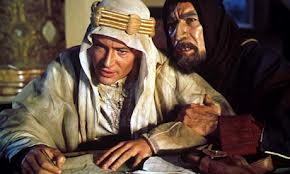
lawrence3In addition to O’Toole’s performance, it is quite exciting to see the dynamic Omar Sharif, the powerful Anthony Quinn (as Auda abu Tayi), the classy Alec Guiness (as Prince Faisal), the kinda creepy Jose Ferrer, the familiar Jack Hawkins and the slightly slimy Claude Rains. Missing from this list is any actress. The movie features exactly zero speaking roles for women … allowing for even more focus on the tendencies and mannerisms displayed by Lawrence.

Maybe the only two actors of the era who could have competed with this fabulous landscape were Peter O’Toole and Marlon Brando. Brando was actually first cast as Lawrence, but soon dropped out to star in Mutiny on the Bounty. O’Toole’s blue eyes and white robe create quite the contrast to the sandy desert. Speaking of contrast, the two times he admires his reflection in his knife are visual keys to his evolution from God complex to broken man. After attending the premiere, writer Noel Coward told O’Toole, “If you had been any prettier, the film would have been called Florence of Arabia.”

The movie received 10 Oscar nominations. It walked away with 7 wins including Best Picture, Director, Cinematogapher, and Score. O’Toole lost out to Gregory Peck (To Kill a Mockingbird). Mr. O’Toole has received 8 Best Actor nominations without ever winning (he does have an honarary Oscar). Watching this film (more than once) is a must for any movie lover. The opportunities to view it in a theatre setting are quite rare, so please seize the chance should it present itself. Your four hour commitment will be rewarded with a movie memory you’ll never lose.  And keep in mind, if the movie makes you feel small, “we can’t all be lion tamers“.

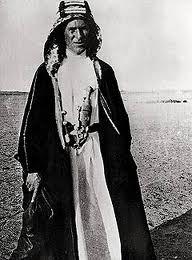
Here is a photo of the real T.E. Lawrence:

lawrence4


ZERO DARK THIRTY (2012)

January 5, 2013

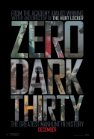
zero Greetings again from the darkness. Kathryn Bigelow entered the realm of elite directors when her war thriller The Hurt Locker exploded onto the Oscar scene a few years ago. Once again she proves why the critics adore her, and the movie going masses stay away. She is an expert filmmaker, a brilliant technician, though not much into the whole entertainment scene.

We always try to label films and this one doesn’t quite fit as thriller or action, or even war genre. It’s really a tense, procedural drama focusing on the behind-the-scenes CIA hunt for Osama bin Laden. In fact, it’s mostly the story of one obsessed CIA agent’s research and un-wavering pursuit of the one most responsible for the tragic events of 9-11-01 (as well as many others).

zero4 The film started out as a story of the nearly decade long pursuit and the failure to find him. Everything, including the movie, changed on May 2, 2011 when Navy SEAL Team Six pulled off the daring and historic mission to kill bin Laden. The book “No Easy Day” by Mark Owen (pseudonym for real life SEAL Matt Bissonnette) was released and many of the details became public. Bigelow and her writer Mark Boal (former journalist) went even deeper into research mode and now the film has instigated Congressional hearings in regards to some of the scenes.

Bigelow presents this as old school, hard core males vs the intellectual, instinctive and brazen Maya, played by Jessica Chastain. In the book, she is referred to as “Jen”, but her name matters not. What’s important is her laser-like focus for almost 10 years, despite the numerous attempts by her superiors to ignore her theories.

zero3 Much of the film deals with the group meetings and presentations to CIA mid-managers, who either don’t trust her or refuse to put their own careers on the line. Maya remains relentless. She finally gets a audience with CIA Director Leon Panetta (played by James Gandolfini) and introduces herself as “the M*****F****R who found this place, sir”. This comes across as confident, not disrespectful.

Bigelow and Boal refuse the temptation of providing any real backstory or personal life on these characters. We do learn that Maya was recruited right out of high school, so we can assume she wasn’t a typical 18 year old. The only thought of a romantic interlude is quickly shot down by Maya proclaiming (in so many words), she’s not that kind of girl.

zero5 Most of the men in the film are presented as near Neanderthals. Jason Clarke is the old school field agent who has mastered the use of torture, water-boarding and humiliation to gain information from detainees. The “60 Minutes” clip of Obama saying that America will no longer utilize torture is one of the few tips to national politics that the film offers up. The only other politics are those played by station chief Kyle Chandler, who is protective of his job, and Mark Strong, who seems relatively helpless without the support of his superiors. All the while Maya keeps pushing and pounding for action.

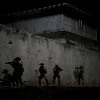
The Langley desk jockeys vs actual Field work provides a distinctive line in the sand between the two worlds, and emphasizes just how easy it is to make a mistake in judgment. What if we had been wrong on the location of bin Laden? What if the “fortress” had belonged to a drug dealer instead and the SEAL team had invaded a private home within the boundaries of our supposed ally zero2Pakistan? Jessica Chastain is believable and tough in her role, and Jason Clarke dominates the screen in his early scenes. Other fine support work comes courtesy of Edgar Ramirez, Mark Duplass, Harold Perrineau, and Jennifer Ehle. When we finally get to the strategy session for the mission, we meet SEAL’s played by Chris Pratt and Joel Edgerton. The 25 minutes or so dedicated to the helicopter mission are filmed as if we are wearing the same night-vision goggles worn by the brave souls storming the castle. It’s a very impressive sequence.

If you enjoy the details of a procedural drama, then you will find much to like here … knowing the ultimate outcome doesn’t affect the suspense one bit. However, if you seek an entertaining respite from your daily grind, this one will offer no assistance … despite another excellent and minimalistic mood score from Alexadre Desplat.

SEE THIS MOVIE IF: you get a kick out of the details involved in a CIA procedural OR you enjoy expert filmmaking, regardless of entertainment value OR you need further proof that Jessica Chastain is a major star OR you want to see Mark Strong’s best impersonation of Alec Baldwin from Glengarry Glen Ross.

SKIP THIS MOVIE IF: it’s still too soon after the actual event OR you can’t stomach the thought of torturing detainees

watch the trailer:

http://www.youtube.com/watch?v=cAtWcvCxPhc


GRAND ILLUSION (La Grande Illusion, Fr, 1937)

June 15, 2012

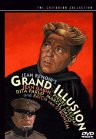
 Greetings again from the darkness. Often cited as one of the all-time great films, I was fortunate enough to catch this one again in a limited theatrical release … a staggeringly beautiful and crisp print. The picture is so clear it looks new, and the updated subtitles make sense and are easy to read. As amazing as it looks, the real value is in the film itself.

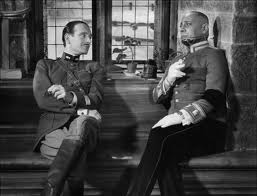
Directed by the great Jean Renoir, the story takes place during WWI and shows a much different viewpoint than what we would normally expect from a war movie. But then, this is not really a war movie … or a POW movie … or a Political statement. The real core of this story is the respect and gentlemanly nature exhibited by the men from opposing sides of the war. It is a reminder that war itself is the grand illusion. We also see the results of class differences. When German pilot von Rauffenstein shoots down a couple of French planes, he tells the recovery team to “invite them to lunch” if they are officers. And then we see the similarities of the aristocratic officers as von Rauffenstein and Captain de Boeldieu discover their common bonds.

 The influence of this film is quite obvious in two scenes. The digging of the escape tunnel and subsequent emptying of pockets on the prison grounds were “borrowed” in The Great Escape. Also, the singing of “La Marseilles” to annoy the Germans was used quite effectively in Casablanca. We also see a quite daring bedside death scene with the pure admiration between opposing officers who decide dying in war is “a good way out” for their types. Powerful stuff. There is also much commentary on differences: aristocrats, working class, Jewish, Germans, and career soldiers. We even see cross-dressing (with a purpose) in a couple of scenes, one of which provides an unforgettable visual as the soldiers sing “It’s a Long Way to Tipperary”.

 As great as the movie is, the backstory is almost as fascinating. Released as WWII was brewing, it was one of the first things Goebbels seized when the Germans took France. The original negative was shipped to Berlin and presumed destroyed. However, it ended up in Russian archives and was re-discovered in the 1990’s. This was after Renoir (pictured left) had personally restored the film in the 1960’s from what was thought to be the best available copy. Unfortunately, he did not live to see this most recent restoration that brought the film back to it’s original glory. Renoir’s camera work is something to behold – subtle movements for extended shots. By the way, Jean Renoir is the son of the famous French Impressionist Pierre-Auguste Renoir. I believe they call that good genes.

 Silent film director Erich von Stroheim’s iconic turn as von Rauffenstein is truly movie magic. You will recognize von Stroheim as the man servant in Sunset Boulevard. Boeldieu is played by Pierre Fresnay, Marechal is played by Jean Gabin, and Rosenthal by Marcel Dalio. Marechal and Rosenthal have a remarkable segment at Elsa’s farm house. Elsa is played by the stunning Dita Parlo. This sequence provides a nice contrast to the POW portions of the film.

This work of art is now 75 years old. It is highly recommended that you see it at least once. Also, check out Renoir’s other masterpiece The Rules of the Game.

rather than the trailer, here is video of Jean Renoir himself introducing the first re-release:


MY WAY (Mai wei, Korea 2011)

May 21, 2012

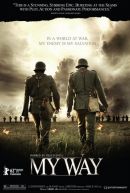
 Greetings again from the darkness. Was anxious to see a big-budget Korean take on WWII, and overall came away impressed … despite the shortcomings and annoyances. My history with Korean films has been limited to small, intimate stories told with quiet manner, or frenetic action flicks with sub-standard stunt work. Director and co-writer Je-kyu Kang attempts to combine an intimate story of two young men with an epic war film with a record body count and an excruciatingly frequent number of cuts/edits.

The movie starts off by showing us how the lives of two boys first intersect. Jun-shik Kim (by Dong-gun Jong) is a farmer’s son whose dad works on the estate of Tatsuo Hasegawa’s (Jo Odagiri) grandfather. A wide class difference separates the boys, but their love of running generates a severe feud … a rivalry that won’t die easily. All of this takes place in Japan-occupied Korea, and it’s clear early on that the filmmaker sets out to defend all Korean actions.

Inspired by a real life 1944 photo that shows Korean soldiers being captured while wearing a Nazi uniform, the fictional story here is as strange and complex as any you have seen … unfortunately, it is handled with the manipulative touch of Kathy Bates swinging a sledge hammer. As their marathon-running rivalry reaches a crescendo, both boys are drawn into the Japanese Army, albeit via substantially different routes. Tatsuo is an officer, while Jun-shik is an enslaved line soldier. Their bitter rivalry does not stop for a little thing like WWII and it leads to many moments of near insanity.

What really is impressive about the film is the three main battle scenes, especially the storming of Normandy Beach. If you have seen Saving Private Ryan, then you know the model … however, this one takes it even further. It is intense, loud and brutal. The question of whether the rivalry can survive capture by Russians and then Nazi’s, or whether survival instincts take over is really the heart of the story.

As terrific as the battle scenes are, it is impossible not to mention the hyper-editing that lasts most of the film’s 142 minutes. It is hard on the senses and makes the action difficult to follow … which is a shame for a film that offers so much realism in war scenes. Still, it’s not an easy film to watch, yet we care enough about the two characters to put up with the eyeball attack we get in most scenes.

SEE THIS MOVIE IF: you would like to see war footage from Korea that is as epic as any ever seen on film

SKIP THIS MOVIE IF: you don’t wish to read subtitles for two and a half hours

Watch the trailer:


WINGS (1927)

May 3, 2012

 Greetings again from the darkness. This film holds the prestigious position of forever being the answer to a favorite Academy Awards trivia question: Name the first Best Picture winner. Of course, there should be an asterisk attached as the film officially won Most Outstanding Production. There was no Best Picture award that first year. It was also the first and last Silent Film to win the award until The Artist won this year (2012).

Rarely have a film and director been so perfectly matched. William Wellman was known as “Wild Bill” thanks to his actual WWI flying experience and his penchant for fighting and partying in Hollywood. Wellman handled some of the stunt flights in the film and is also seen as the dying soldier near the end who shouts the “buzzards” line. Much of the film was shot at Kelly Field in San Antonio, and its popularity was certainly assisted by the patriotism of the time and the recent aviation excitement created by Charles Lindbergh‘s transatlantic flight.

The story is based on the WWI Army Air Corps and features some stunning aerial photography and combat flying missions, with an incredible-for-the-times 3500 soldiers, 65 pilots and 165 aircraft. The lead actors are Richard Arlen (David) and Charles “Buddy” Rogers (Jack). They are local rivals battling over the heart of the same woman played by Jobyna Ralston (Sylvia). It’s a pretty interesting love story as Jack thinks Sylvia loves him, Sylvia loves David and David knows it, and Mary loves Jack, and Jack has absolutely no clue.

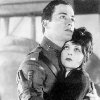
 Mary is played by the always outstanding Clara Bow (pictured left with Rogers). She truly lights up the film and screen in her scenes. Not only does she have the expressive eyes necessary for silent films, her physical presence is wonderful for such a tiny lady. Other interesting cast members include El Brendel as Herman Schwimpft. His German sounding name and somewhat effeminate manner are constant sources of comic relief. Hedda Hopper plays Jack’s mother. You might recognize her name as the founder of Hollywood gossip columns … she started out doing some acting.

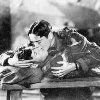
 Beyond the “Wild Bill” fun, there was also some romantic shenanigans on set. Richard Arlen and Jobyna Ralston ended up getting married after meeting during filming. Also, Clara Bow started an affair with a new actor named Gary Cooper. Yes, THAT Gary Cooper (pictured below, standing). It is startling to see such a young Cooper when he makes his first appearance. It’s a small, but vital role in the film. There has been an ongoing debate in the film world about the homosexual undertones between Jack and David. In the famous death scene, we get the first on screen man-on-man kiss on lips. Quite shocking for the times.  From a technical aspect, the Handschiegl Color Process was used for the flames and explosions – dramatic splashes of color in the aerial combat scenes. This was also Costume Designer Edith Head‘s first film. She went on to become the most famous Hollywood costume designer and worked on hundreds of films.

 The theatrical re-release of the film coincides with its 85th anniversary and celebrates 100 years of Paramount Pictures. The opening credits provide a time lapse view of the numerous Paramount logos through the years. There are many reasons to see this film: its ground-breaking action scenes, the history it addresses, its place in Hollywood lore, and of course, if you want to see the inspiration for Betty Boop (Clara Bow). What I won’t do is mention that the love story was copied by Michael Bay in the less-than-stellar Pearl Harbor film. Forget I even mentioned it.

*note: a bit more trivia … the film was released the same year Babe Ruth hit 60 home runs.  That’s the record Roger Maris would break 34 years later.  Also, this film is one of only three to ever win Best Picture without also receiving a Best Director nomination.  The other two films are Grand Hotel (Edmund Goulding, 1932) and Driving Miss Daisy (Bruce Beresford, 1989)

watch a one minute trailer:


IN THE LAND OF BLOOD AND HONEY

January 12, 2012

 Greetings again from the darkness. Most of us are extremely under-informed on the details of the Bosnian War thanks to the cursory western media coverage, which was complimented by the mostly hands-off approach from the UN. This movie doesn’t shy away from exposing the atrocities of ethnic cleansing, genocide and crimes against women that occurred, but it does so through an intimate story rather than an epic tale of war.

This is no place for a history lesson, and I would certainly not be the one to supply it, but some basics are required to somewhat understand what’s going on. The reign of Yugoslavian President Tito lasted until his death in 1980. Although much criticism is directed his way, he was able to guide a society that allowed the co-existence of Bosniak Muslims and Orthodox Serbs. You might recall that in 1984, Sarajevo hosted the Winter Olympics. Not long after that, the republics began skirmishes that eventually escalated to a complicated civil war lasting from 1992-95 (The Bosnian War).

 The film focuses on two people: Danijel (Goran Kostic) and Ajla (Zana Marjanovic).  They are dancing cozily in a nightclub when a bomb shatters their date and their lives. Danijel goes on to become a mid-level military leader of the Serbs, while Ajla and her Muslim family and friends have their way of life ripped apart. Some are even executed. Ajla ends up as a prisoner at the camp Danijel commands. He manages to protect her from the brutal rapes (by soldiers) by staking a claim on her and putting the order out that she is not to be touched.

Ajla is an artist and Danijel is a soldier and their earlier dance evolves into their own personal war of wits, mistrust and psychological escape. Danijel is clearly not of the mindset to be a brutal killer within a war, yet Ajla constantly observes his every movement and interprets even the slightest change in his approach to her and the war. She does what she needs to survive and he uses her as an escape from the atrocities of his day job. The end result of this relationship is both shocking and inevitable.

 Danijel’s father, Nebojsa, is a senior level military leader who shows up in time to provide us with a brief history lesson dating back 600 years. He takes much pride in the Serbs ability to conquer and persevere. Nebojsa is played by Rade Serbedzija, whom many will recognize as the villain from The Saint (1997) and Boris the Blade in Snatch (2000). This is a powerful and frightening character, and we quickly understand why he doubts his son’s fortitude. The moment he finds out about Ajla, we are immediately hit with a feeling of dread for her.

After the screening, we were fortunate enough to have a discussion panel sponsored by the World Affairs Council. One of the panel members was a former officer in the Bosnian Army who spent time in two separate concentration camps. Viewing the film was very emotional for him and he said it captured the realities as well as a movie possibly could. Of course, we never lose sight of the fact that what we see on screen are not “real” bullets, not “real” rape, and not “real” blood.

 Most of us are aware of the humanitarian efforts of Angelina Jolie.  She brings that same caring perspective as a first time filmmaker (writer, director, producer), working diligently to tell a story that exposes the realities of war and how humanity can dissolve into horror. It’s not a perfect film (it runs a bit long), but it tells a powerful story that we may prefer to pretend never happened.   Just like the Bosnia and Herzegovina citizens, we can’t help but wonder what took NATO forces so long to get involved. Capped by an understated and haunting Gabriel Yared score, the film is a brutal reminder that war is the ultimate sacrifice and punishment for real people and real families.

note: don’t miss a quick cameo by Brad Pitt (I believe he knows the writer/director/producer pretty well)

note: The Turkish meaning of Balkans: “Bal” = Honey, “Kan” = Blood

SEE THIS MOVIE IF: you are interested in learning more about the atrocities of war from the vantage of two people with little choice in their situation OR you would like to see the first step of a fine new filmmaker, Angelina Jolie.

SKIP THIS MOVIE IF: you would just as soon avoid any more harsh realities of war and the subsequent loss of humanity

watch the trailer:


WAR HORSE

December 28, 2011

 Greetings again from the darkness. In the opening sequence of Saving Private Ryan, director Steven Spielberg provided us with one of the most horrific and terrifyingly realistic and violent examples of war ever shown on screen. Here, he takes a much different approach. Though the bulk of the movie takes place during World War I, Spielberg manages to withhold the brutal atrocities, while never once losing the impact and fear experienced by the soldiers. And while it’s uncertain whether this approach makes for a better film, it is obviously a more accessible and uplifting story because of it.

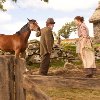
 Based on the children’s book by Michael Morpurgo, and of course on the hugely successful stage runs in both London and New York, this movie is really the story of an unbreakable bond between a sincere farm boy named Albert (newcomer Jeremy Irvine) and a majestic horse named Joey. We witness the early bonding and training sessions between the two, which allows us to swallow some of the more improbable coincidences that occur later in the story. When the war breaks out, Albert’s dad (Peter Mullan) sells the horse to the cavalry so that he can save the farm by paying the landlord (David Thewlis). Fortunately, Captain Nicholls (Tom Hiddleston) agrees to keep Joey as his personal horse and return him to Albert after the war.

 War is unpredictable, and Joey gets passed from the British to the Germans to a French farmer’s daughter, back to the Germans and back to the British. Along the way, we witness what a remarkable creature the horse is. Were he a man, he would be a most decorated officer. Instead, we witness how little value the military places on animals … even the beautiful ones. There are numerous scenes that make will make you uncomfortable with the cruelty shown, but just as many that will make you smile with joy. The already famous scene that features Joey’s unfortunate conflict with barbed wire and fence posts will have you squirming in your seat, while also scratching your head in wonderment.

 Though many of the events and sequences are a bit of a stretch to believe (the time-out in No Man’s Land), the one thing you will never doubt is the beauty of the film. It’s epic nature recalls Doctor Zhivago or Lawrence of Arabia (though not at the overall level of either of those films), and the photography reminds me of John Ford‘s best work. Off the top of my head, I would say it is the most beautifully photographed movie since Terrence Malick‘s Days of Heaven in 1978. Spielberg’s long time DP Janusz Kaminski is at his best here and will surely be recognized by the Academy for his cinematography.

 Many of the British actors are recognizable (Emily Watson, Benedict Cumberbatch, Toby Kebbell, Eddie Marsan, David Kross), but it’s key that Spielberg cast no “movie stars”, only quality actors. The stars of the film and the story are the horse and the visuals. It should also be noted that the great John Williams delivers another perfect score … one that would run away with the Oscar in many years.

No need to be frightened off because the story is based during World War I. It’s not for the youngest of kids, but this is an uplifting, sentimental and emotional movie for most everyone. It is peak Spielberg working with sentiments and subject matter with which he so excels.

SEE THIS MOVIE IF: you enjoy being swept away by the emotions and grand scale of an epic film OR you would like a primer to war films that goes a bit easy on the gore.

SKIP THIS MOVIE IF: you are expecting similar war reality to Saving Private Ryan OR you have a hard time suspending disbelief for some rather remarkable coincidences

watch the trailer:


CAPTAIN AMERICA: THE FIRST AVENGER

July 24, 2011

 Greetings again from the darkness. If it seems to you as if the past three years have provided an overload of superhero and comic-based movies, you are absolutely correct. There have been too many. There are a few I would be willing to toss out, but Captain America is not one of them. This ranks right with the first Iron Man as the closest to a real movie … one with a story to go with the action and CGI.

It begins with the present day discovery of an exposed plane wing jutting from the frozen Arctic tundra. The search team quickly finds the Captain America shield visible beneath the ice. Flash back to WWII and we are introduced to a scrawny Steve Rogers (Chris Evans with Benjamin Button FX) who wants nothing more than to fight for his country. Unfortunately, this 90-pound weakling might as well have 4-F stamped on his forehead, as the size of his heart far exceeds the size of his biceps.

His tenacity at trying to enlist is noticed by a powerful scientist named Erskine (played with sheer smirking joy by Stanley Tucci). Erskine happens to be working with Col. Phillips (a perfectly grumpy Tommy Lee Jones) on a secret plan to develop super-soldiers with the injectable cocktail Erskine has invented. As you might guess, the plan is thwarted immediately after scrawny Steve Rogers is transformed into a super soldier yanked from the cover of “Men’s Fitness”.

 Working with Col Phillips and Erskine is Peggy Carter (Hayley Atwell). Her main purpose seems to be adorning the brightest red lipstick and flashing her legs in front of the soldiers. She falls for Rogers and spends most of her scenes staring somewhat scarily into his eyes. Actually, their scenes together are pretty good and her character helps us remember that Captain America is still just a regular good guy … not a Norse God.  It was humorous to watch the early song and dance routines to sell war bonds.  Seeing the super soldier cast as a traveling side show could be seen as a commentary on the military.

 Personally, I thought the movie lagged just a bit in the fight scenes between good and evil. But that doesn’t mean I didn’t find Red Skull (Hugo Weaving) to be a terrific bad guy. Nazi’s still make for the perfect adversary. Although, I found myself laughing on occasion as Weaving’s German accent reminded me of Christoph Waltz in Inglourious Basterds. I was quite impressed with the infamous Captain America shield, though I never quite figured out how he trained it to “return” to him … I am sure this is better explained in the comics.

 What makes this movie work is the fact that Captain America remains Steve Rogers. He is always a good guy wanting to do the right things. He is deeply affected when he thinks his actions may have caused the death of his best friend Bucky. But he also manages to keep his ego in check and his patriotic duty in the forefront. Also, the film is directed by Joe Johnston. If you are unfamiliar with his work, let me recommend two of his earlier films: The Rocketeer and Hidalgo. You are probably familiar with his Jumanji and October Sky. He is a director that creates a specific look and feel to his films, and the texture helps make this one work.

Since this is entitled Captain America: The First Avenger, it is obviously another step towards The Avengers movie slated for 2012. So don’t miss Dominic Cooper as Howard Stark (father of Tony Stark/Iron Man). And don’t miss Samuel L. Jackson as Nick Fury in the odd ending to this film … and the obligatory “bonus” after closing credits.

SEE THIS MOVIE IF: you always viewed yourself as the 90 lb weakling in those old Charles Atlas comic book ads OR you just never miss a chance to see nazi’s get thier asses kicked … especially by a guy in tights.

SKIP THIS MOVIE IF: a comic book flashback to WWII seems about as appealing as having your air conditioner go out during this crazy heat wave

watch the trailer:


OUTSIDE THE LAW (Algeria)

February 26, 2011

 Greetings again from the darkness. I am certainly not qualified to offer an expert opinion as to the historical accuracy of the film, but I can say that it provides a seemingly realistic view of the horrible situation and struggles endured by the Algerians during their fight for independence from France during WWII.

The story is a sequential sequel to director Rachid Bouchareb‘s film Paths of Glory and centers around 3 brothers who are separated during the horrible massacre at Setif. Messaoud (Roschdy Zem, who was the best thing about The Girl from Monaco) goes off to fight as a soldier for France; Said (Jamel Debbouze) takes his mother and moves to Shantytown in France and becomes quite the street hustler; while Abdelkadar (Sami Bouajila) is imprisoned and absorbs all that he sees.

 Each of the brothers endures much hardship until circumstances serve to reunite them in Shantytown.  That’s when the real mission begins. Abdelkadar becomes the driving force behind the Algerian’s FLN movement. He is the local figurehead and brains, while his brother Messaoud acts as the muscle and bodyguard. Brother Said continues his pursuit of money through shady night clubs and as a boxing promoter, but he is never far from his brothers’ sides – even if he isn’t quite as politically motivated.

I found all three brothers interesting in their own right, but the film is just so downbeat as it tells this story, that I just never felt engaged. That’s not to say the mission of the Algerian people during this two decade period isn’t amazing, because it certainly is. It’s just this film doesn’t really offer much in the form of telling the story. This one is nominated by the Academy for Best Foreign Film, so obviously many thought better of it than I.

SEE THIS MOVIE IF:  you want to keep your streak intact of seeing ALL Oscar nominated movies (yes, that’s me)

SKIP THIS MOVIE IF:  a downbeat movie about the Algerian struggle during WWII is not the pick-me-up you are seeking right now.