Greetings again from the darkness. It’s the first feature film from Jared Douglas, and as with most dedicated independent filmmakers, he wears many hats in this production: writer-director-producer-editor. Mr. Douglas certainly didn’t take the easy route or shy away from difficult material. Instead, he takes us deep into the dark world of mental illness.
Rather than a peek inside an asylum or mental hospital, we are up close and personal with Lucio and his struggles. Lucio is played by Christian Gnecco Quintero, and our first inclination something isn’t quite right comes when he’s buying diapers at a convenience store. Lucio gets skittish and looks around as if someone is watching or following him (the camera enhances the feeling). He calls Vanessa (Stefanie Rons) to tell her that he’s in danger and he can’t come home to her and their young daughter. Lucio then hits the road … he’s on the run from something or someone we don’t see.
Our eyes are on Lucio nearly every moment of the 84 minute run time. It’s not pleasant to see what he’s going through. Lucio is paranoid to the point of self-destruction. When his car breaks down, a kind stranger named Chris (Dwayne Tarver) takes him back to his ranch cabin. Throughout the film, Lucio flashes the ability to converse with others, but it’s never long before the illness kicks in. Even the charity or generosity of strangers isn’t enough to put Lucio at ease, and the consequences can be severe. His biggest challenge … his biggest hurdle … is himself. Periodic calls to Vanessa provide us the insight to see what a devastating scenario this is for her as well.
“I know you’re out there!” The phantom is all too real to Lucio. His reality is not ours. Cinematographer Neeraj Jain effectively captures the frantic moments and Quintero’s performance relays the urgency of every tick. Mental illness is often overlooked or overplayed in movies, but not so here. There is no comic relief, only the relentless pressure of trying to make sense of the confusion.
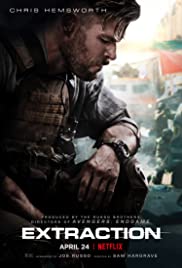
Greetings again from the darkness. The description for this movie labels lead character Tyler Rake “a fearless black market mercenary.” Now I’ve personally never shopped for a mercenary, but my assumption is that every one of them is ‘black market’, and none would likely self-identify as anything other than ‘fearless.’ My Facebook account is inundated with unwanted advertisements, and I’ve yet to see one for any mercenary, much less one that lacks courage. Now you likely find this to be worthless meanderings, but that’s where the first feature length film from director Sam Hargrave took me. Mr. Hargrave is a veteran stunt coordinator and stunt performer (he’s been the stunt double for Chris Evans’ Captain America), and he’s working from a script by Joe Russo (director and producer of the last two Avengers movies and the last two Captain America movies).
Chris Hemsworth (THOR) stars as the aforementioned Tyler Rake. It’s a role that would have just as easily worked for Jason Statham or, in past years, Bruce Willis, Sylvester Stallone, or Arnold Schwarzenegger. Rake is a live action hero, haunted by visions and dreams of better times. His fighting prowess, shooting skills, and willingness to play roulette with his own life, make him the perfect hire for imprisoned drug lords when their son is kidnapped by a rival drug lord. And that’s exactly what happens.
The film opens with Tyler in a bad spot. He’s injured and trying to shoot his way out of a mess where he’s badly outnumbered. The film then flashes back a couple of days where we witness the kidnapping of Ovi Jr (Rudrhaksh Jaiswal) by Amir Asif (Priyanshu Painyuli), the drug lord rival to Ovi Jr’s imprisoned father. We also see Tyler, after a few too many drinks, take a running leap off a 30 meter cliff into an Australian lake. Soon he’s visited by Nik (Golshifteh Farahani, Adam Driver’s wife in PATERSON). She acts as his handler for the dangerous jobs, and few are more risky than extracting Ovi Jr.
What follows are fast-paced car chases through the dusty streets of Dhaka, bone-crunching hand-to-hand combats, and more shootouts than we’ve seen in a while. Tyler’s job is to extract Ovi Jr and deliver him safely home. When things go sideways, the two end up on the run from an entire army, and take cover in a local sewer … with all the sights and smells you might imagine. Supporting roles are covered by David Harbor as Tyler’s old friend, and Randeep Hooda as Ovi Sr’s right-hand man.
As you might expect, there are double-crosses and plenty of opportunities for Tyler to show off his ‘fearless’ Samercenary skills. Ovi Jr is a bit of a nerd, but does offer up some life philosophy for his troubled protector: “You drown not by falling in the water, but by staying submerged in it.” The kill count here is extraordinarily high and literally thousands of rounds get fired. What’s most surprising, however, is that Tyler’s cell phone somehow survives his many falls, gunshots, sewage, and car collisions. It’s much more impressive than the old Timex commercials. Gifted cinematographer Newton Thomas Sigel (X-MEN movies, DRIVE, THREE KINGS, THE USUAL SUSPECTS) does an admirable job capturing the action sequences; it’s just that this is too similar to many movies we’ve seen before, though it serves as a chance for Hemsworth to be something other than Thor. For those in need of an action flick fix after all this social distancing, EXTRACTION should scratch the itch.
Greetings again from the darkness. Let’s face it. It was a brilliant marketing strategy. In the wake of mass shootings, the release date of this film was delayed when its subject matter was deemed controversial, even scandalous The film’s new marketing slogan became, “The most talked about movie of the year is one that no one’s actually seen.” Of course, it wasn’t really true, as very few were actually talking about it. But that’s what made it genius marketing … they created interest amidst controversy that has since proven unnecessary. Director Craig Zobel (Z FOR ZACHARIAH, 2015) has delivered the least controversial, non-polarizing film of the year. It basically laughs at extremes on the left and right, and reminds us how laughing at something can often take away its power. And regardless of your “side”, you’ll find some laughs here.
If you’ve seen the trailer, you know that the premise has a group of liberal elites hunting a hand-selected group of social media-active MAGA deplorables. It’s a twist on Richard Connell’s 1924 short story “The Most Dangerous Game”, although the modern day rich aren’t hunting for sport, but rather for political affiliation – gun lovers and climate change deniers. That may sound politically charged, but in fact, it plays as more comedy than comeuppance. Sure, the violence is over-the-top and often quite graphic, but this is a skewering of both red and blue.
Preventing the project from falling into B-movie muck is a standout performance from Betty Gilpin (“Glow”) as Crystal. She’s a Rambo-type who speaks (with a southern drawl) only when necessary, and seems to have learned a lot while serving in Afghanistan. Most of the time she looks like she has “a pinch between her cheek and gum” (a tip of the Stetson to Walt Garrison), and she also hums to herself and tosses down some unusual facial expressions. This is a seriously oddball performance that is the film’s highlight.
One of the best sequences of the film comes quite early as the dozen or so ‘deplorables’ slowly wake-up and find themselves gagged in a field. A container of weapons leads to an early massacre that allows the filmmaker to tease us with numerous familiar faces taking turns as the heir-apparent lead. Some of the faces that pop up include Ike Barinholtz, Wayne Duvall, Ethan Suplee, Emma Roberts, Christopher Berry, Sturgill Simpson, Kate Nowlin, Amy Madigan, Reed Birney, Glenn Howerton, Hannah Alline (flight attendant), and Usman Ally.
Of course we know this is headed to a showdown between Crystal and Athena (2-time Oscar winner Hilary Swank), the ringleader of the hunting party. A fight scene reminiscent of the KILL BILL movies (sans Samurai swords) takes place at Athena’s “manor”, and it is stunningly staged and executed. Unfortunately this scene also highlights the mostly inadequate dialogue that exists throughout the film. Some of the quips click, but many fall flat – surprising since the co-writers Nick Cuse and Damon Lindelof have previously collaborated on “Watchmen” and “The Leftovers.”
Blumhouse Productions keeps cranking out these offbeat genre films, and this one likely benefits from a misplaced scandal, and it strives for self-importance by comparing itself to George Orwell’s “Animal House” and with an obscure reference to TEARS OF THE SUN (2013). It’s not at the level of last year’s gem READY OR NOT, and it missed the opportunity to make some political points, but it’s a hoot to watch and as an added bonus, Hilary Swank teaches us the proper way to make a grilled cheese sandwich!
Greetings again from the darkness. I got hooked on “Monster” movies as a kid, and even all these years later, I still get a kick out of them. Of course, with today’s special effects, the look of these films is much different than in the early days. The big challenge for the genre now isn’t how to frighten us or create an awe-inspiring effect, but rather can it capture the charm and appeal of those ground-breaking B-movies? Universal Studio’s Dark Universe got off to a less-than-stellar start with Tom Cruise’s 2017 THE MUMMY. Now, after re-grouping, the fabled Monster studio re-boots THE INVISIBLE MAN … with roots in H.G. Wells’1897 sci-fi novel and the Claude Rains – James Whale film from 1933.
Perhaps their best decision was choosing Leigh Whannell to write and direct. I’m hesitant to mention that Mr. Whannell was a creative writing force behind both the SAW and INSIDIOUS franchises, as some may jump to conclusions on what to expect with this latest. All I can say is that you’d be incorrect to assume THE INVISIBLE MAN falls in line with those previous films. Instead, this film is a psychological thriller in the form of #MeToo vengeance. Whereas the 1933 film featured a brilliant scientist whose invention turned him sour, this contemporary version is told from the viewpoint of a woman who has been abused and controlled by her boyfriend.
When we first see Cecilia (Elisabeth Moss), she is sneaking out of her stunning cliffside home while her boyfriend Adrian (Oliver Jackson-Cohen) sleeps. Within just a few minutes, Ceclia’s escape has taken us on a tour of the home (including a high-tech laboratory), disclosed that she has drugged Adrian, introduced us to her sister Alice (Harriet Dyer), and above all, given us a glimpse at just how terrorized Cecilia feels. The sequence is complemented by a nerve-jarring score from composer Benjamin Wallfisch (BLADE RUNNER 2049).
We flash forward two weeks and find Cecilia taking refuge at a friend’s home, and she remains so paranoid, she is barely able to step outside. As the old saying goes, ‘is it paranoia if they are really after you?’ Her friend is James (Aldis Hodge, CLEMENCY), a stout no-nonsense cop and single dad raising teenage daughter Sydney (Storm Reid, A WRINKLE IN TIME). When it’s discovered that Adrian has committed suicide and, according to Adrian’s creepy attorney brother Tom (Michael Dorman), left millions to Cecilia, she allows herself to celebrate the moment. However, what fun would it be watching her spend and give away money? Instead, the tone shifts and Cecilia’s life becomes unbearable as she is convinced dead/invisible Adrian is torturing her. As you can imagine, this leads to questions about Cecilia’s mental stability, which then leads to more misery and tragedy.
Director Whannell’s brilliant approach and Ms. Moss’ superb performance combine to make this a thrill ride worth taking … it’s the kind where some folks in the audience shout warnings to the characters on screen! It’s difficult to tell which is more frightening, having everyone you know think you have lost your mind, or actually being stalked by an invisible, presumed-dead former abuser who wants you to suffer. Floating knives and physical fights are unsettling, but can’t compare to the tension created by cinematographer Stefan Duscio turning his camera to a blank wall or empty space. Our mind (and Ms. Moss’s face) fill in the gaps with Adrian’s evil presence. This is not a scientist-gone-bad, but rather a madman utilizing his most powerful tool. Having Adrian be an Optics innovator was a contemporary twist that takes us from the science fiction of the 1930’s to the technological world of modern day.
The film was originally going to star Johnny Depp, but it works so much better, and is so much more terrifying, having it told through the eyes of Ms. Moss’ Cecilia. Strangely enough, the movie I kept flashing back to was not the 1933 Claude Rains and Gloria Stuart (64 years later, she played reminiscing Rose in TITANIC) movie directed by the great James Whale, but rather the schlocky 1991 Julia Roberts film SLEEPING WITH THE ENEMY. This is the most fun kind of movie suspense, and what’s scarier than the things we can’t see? It’s nice to have Universal Studios’ monsters back on track, and we have talented filmmaker Leigh Whannell to thank for this “Surprise!”
Greetings again from the darkness. Should you ever get cast as the stepmother in a horror movie, just know things aren’t likely to go well for your character. That even holds true for the stepmom-to-be in this latest from the writer-director team of Severin Fiala and Veronika Franz who delivered GOODNIGHT MOMMY (2014). Their script comes from an idea by writer Sergio Casci, and it starts with a bang!
Richard (Richard Armitage) has planned a Christmas holiday trip to an isolated cabin in the woods so his two kids can get to know his fiancé Grace. Of course, his kids blame Grace for the break-up of their family, and the subsequent tragedy that befalls their mother. Aidan (Jaeden Martell, IT) and Mia (Lia McHugh) take advantage of Google to discover that Grace is the sole survivor of a cult’s mass suicide (similar to Marshall Applewhite’s Heaven’s Gate). As if that’s not enough, Richard gets called back to the city for work (what??) and then a massive snow storm hits the cabin just after the power and water are cut-off. Finally, Grace’s meds for sanity disappear, along with most of the clothes.
So we have a snow-covered cabin deep in the woods with two kids stranded with a quasi-stepmom that they don’t like. And yes, there’s a cute pet dog. We also have more religious images and ornamentation than anyone who is not the Pope should have in their home. On top of everything, there is a large dollhouse that often factors in to what we see on screen and to what the kids and Grace are going through. And it’s Christmas! In other words, there is no shortage of elements necessary for a quality horror film.
I much prefer creepy over slasher for horror films, and this one easily meets that standard. Rather than a slow burn, it’s a slow freeze. Unfortunately, the actions of the characters and the script just didn’t work for me. The tormenting that goes on was not believable, and I just never could get over the fact that dad left these people who didn’t even know each other, together in the middle of nowhere while he went back to work. As a rule of thumb (or red flag), when a character expresses their theory about unexplained occurrences in a horror movie, you can be fairly certain that the theory is incorrect, or at least misleading, even if it’s what you were already thinking.
On the bright side, Riley Keough (daughter of Elvis Presley’s daughter) gives a terrific performance as Grace. She is very effective in keeping us guessing as to her true colors – is she a creepy monster or is she being victimized? Also, the film has a very stylish look. The cinematographer is Thimios Bakatakis (THE LOBSTER), and the cabin and nature setting give him plenty to work with. Other bright spots include a very brief appearance from Alicia Silverstone, and the opening credits logo of the resurrected Hammer Films (a favorite of monster movie fans). I caught this at the inaugural North Texas Film Festival in 2019, and it will surely strike a chord with some horror movie lovers … even though it left me out in the cold.
Greetings again from the darkness. In the movie world, good things rarely happen on a train. In fact, whether it’s the train whistle, the train depot, or the passenger compartment, it’s a warning to viewers that this journey is troubled. So brace yourself. This may be the first feature film for Russian writer-director Diana Galimzyanova (known for video and documentary shorts), but her visual flair and nods to cinematic history are evident and welcome.
It’s billed as the first female directed Russian noir, and it’s clear Ms. Galimzyanova offers up a tip of the cap to Alfred Hitchcock (and others) in this homage to 1940’s Film Noir. Filmed in stark black and white for dramatic effect, the film features a very interesting story structure. Events move forward for the characters on the train, but their individual backstories are revealed in reverse chronological order via flashbacks and recollections. It’s both linear and reverse linear … requiring the viewer to pay attention and keep up!
So, who are these characters? We have Ruslan, the OCD private detective played by Rashid Aitouganov. The self-described “Crime Solver” has his frustrations at being unable to solve a case playing out with him compulsively wiping his hands. Next we have arrogant and judgmental concert pianist Elina played by Marina Voytuk. Elina boasts that her face is recognizable from the marketing posters for her concerts. Lastly we meet screenwriter Arina, played by Irina Gevorgyan. Arina claims she is researching for her computer game being written from the perspective of the murderer.
What murderer you ask? Well it turns out there is a serial killer nicknamed The Fruiterer, who is responsible for 6 murders over the last 6 months – all on the same train route that our 3 characters find themselves on. The nickname stems from the fresh strawberry the killer leaves by each body. If you enjoy the armchair detective work that goes along with murder mysteries, you’ll get a real kick out of this. Processing the interaction between the characters on the train, and blending in the details we pick up from the flashbacks leaves us filtering out what matters and what doesn’t. During the flashbacks we meet an unconventional therapist name Izolda (Kolya Neukolin) who seems to have a strange power over clients. Izolda is a key character, and also entertaining are the two knockout train conductors who have quite the side gig going on this route they refer to as “murder express.”
The opening of the film shows us a suitcase being packed with instruments of destruction. As with most mysteries, each clue must be taken with a grain of salt. Strangers, suitcases, secrets and strawberries all play a part in keeping us off balance. The film works thanks to the psychological uncertainty as we attempt to assess each character and what each tidbit means. When one of the characters says, “I can’t stand to talk to grieving people. They are so self-absorbed”, we understand each of these people has their flaws, but no one jumps out as the obvious killer.
The black and white photography, harsh lighting with shadows, and story structure add elements to the suspense and the surreal tone of the film. The camera angles and shots via mirrors, as well as the disconcerting score (often harpsichord) add intrigue to the bounty of clues and fake clues. It’s a fun movie to watch and a challenge to try and solve ahead of the reveal. For fans of murder mysteries and/or Film Noir, it’s a train ride worth taking.
Greetings again from the darkness. Kicking off a successful franchise that can sustain multiple sequels is the dream of most actors, writers, directors, and producers. When it clicks, a movie franchise can be a cash cow for many years. Unfortunately, it’s just not that easy to create characters that viewers will invest in, or story lines that will keep those viewers interested. Author Mark Burnell has already published four books in his Stephanie Patrick series, and director Reed Morano brings the first one to the big screen. By the time the end credits roll, we have little doubt that “franchise” was the goal.
An opening scene finds Stephanie Patrick (Blake Lively) pointing a gun at the head of a man who is unaware of her presence. A freeze frame shifts us to “8 months earlier.” Stephanie is a mess. She is supporting her heroin addiction through prostitution, all with the objective of numbing her pain. Three years earlier, her family was killed in a plane crash. It’s the kind of tragedy followed by a grief so devastating that Stephanie has basically given up on life.
Stephanie is jolted back to life when a journalist informs her that it was a bomb planted by a terrorist that brought down the plane her family was on. Now, Stephanie has a reason to exist … revenge. Clearly some suspension of disbelief is in order here. Actually everything about this story is a stretch from reality or even believability. Quick, name all of the heroin addicts who become world class assassins in 8 months. OK, that’s probably not a fair question since you likely don’t know many heroin addicts, and you hopefully don’t know many assassins. But you get the point.
The film plays like a brochure for a travel agent, as the story and Stephanie have stops in Tangier, England, Ireland, Madrid, New York, and Marseilles. Each stop is pretty brief – merely long enough for some killing. Of course most of the stops occur after former MI6 agent Ian Boyd (Jude Law) trains her on the finer points of being a contract killer. The training includes jogging uphill, a frigid lake swim, how to fight in the kitchen, how to get run off the road while driving, and the invaluable advice to shoot your victim twice (but your teacher only once). Oh yes, and she has to impersonate a presumed-dead assassin. Fortunately, Stephanie was top of her class at Oxford, so she is smart enough to make sense of all these things that make no sense to us.
And another thing … why do all these people have such perfect and complete files on their targets? Photographs by Glamour Shots, map coordinates to hideouts, and an alphabetical list of known accomplices are all quite helpful when former MI6 and former CIA agents (Sterling K Brown) are trying to get a heroin addict to do their dirty work. Brown’s CIA agent turned ‘information broker’ is the oddest of many odd characters here. He lives in a stunning ultra-modern home and has no qualms about hitting on hot assassins that he knows only by reputation. Thanks to all those marvelously complete files, the only unknown here is the mysterious U17. Well, U17 seems to be mysterious to everyone except those watching the movie.
Blake Lively is a talented actress as evidenced by her work in THE TOWN, THE SHALLOWS, and A SIMPLE FAVOR. She is simply miscast here. Despite the “training” her Stephanie received from Ian, we never once believe she is ready to kill all the bad guys. This contributes heavily to the lack of believability presented by the film. It’s a serious story that is ultimately impossible to take seriously as a viewer.
There is a difference in believable and stylish, and director Reed Morano certainly serves up style. She is known mostly for her work as a cinematographer, though she did direct the first 3 episodes of “The Handmaid’s Tale.” Ms. Morano and cinematographer Sean Bobbitt hit us with some jarring camera work, and the musical inserts are just a tad too cutesy and obvious at their given time: “I’m Sorry”, “It’s Now or Never”, and “Where Did You Sleep Last Night?” (a cover by Sleigh Bells).
Having author Mark Burnell adapt his own novel may have been a mistake, as there are far too many plot holes and ridiculous moments for this to work as any type of thriller. Here are three examples: we never know why Stephanie didn’t get on the flight with her family; it makes little sense that the journalist tracked her down; and is that supposed to be a twist or not? Given the inclusion of Bond producers (and half-siblings) Barbara Broccoli and Michael G Wilson (stepson of Cubby Broccoli), we can safely assume that the vision was to turn Mr. Burnell’s books into a franchise along the lines of James Bond and Jason Bourne – right down to the fight scenes and international settings. This film certainly sets things up for round two, and if that happens, let’s hope more attention is paid to the script … a crucial element if viewers are expected to buy in.
Greetings again from the darkness. Since November 4, 1995, the day that Yigal Amir shot and killed Israel Prime Minister Yitzhak Rabin, speculation has existed that there could have been peace in the Middle East – if only the assassination had not occurred. The film opens on the first Oslo Peace Accord in 1994. Why was there a segment of the population concerned about possible peace? They were angry at the idea of surrendering their “promised land” to Palestinians and the Chairman of the PLO, Yasser Arafat.
Writer-director Yaron Zilberman and co-writers Yair Hizmi and Ron Leshem aren’t focused on what an end to the hostilities might look like today. Instead they offer up a psychological study of Yigal Amir (played by a forceful Yehuda Nahari Halevi) and what drove him to take the fateful action that changed the course of history. The film is presented as a slow-build thriller, and it mainly takes us through Yigal’s transformation from activist to assassin … a giant and significant step.
Yigal is a Law student at Bar-Ilan, and the college campus is filled with protests and tables dispensing information on all sides. Soon enough, Yigal is seeking counsel from rabbis who seem to be on board with revenge. When someone becomes obsessed, it’s not uncommon for them to ‘hear what they want to hear.’ Yigal sees Rabin fitting into the Jewish law of “pursuer/Rodif and Informer”, and he believes himself to be guided by Talmud and rabbis. The film is not about Yigal’s glory, but rather WHY he did it.
Alternatingly charming and frightening, intelligent and foolish, Yigal organizes a rebel movement for what he sees as a coming war. To him, there is no line between religion and politics. With archival footage of Netanyahu speaking out against Rabin and the peace project, it just pushes Yigal that much closer to action. There are three women who cross paths with Yigal and have varying impacts on him. His mother convinces him he is due for greatness (again, he interprets in his own way); Nava (Daniela Kertesz) is attracted to him, but can’t come to grips with his beliefs; and Margalit (Sivan Mast), who respects Yigal and understands how to lead him deeper down his chosen path.
There is a terrific scene between Yigal and his father, where the parent is emphasizing to the son he knows he’s losing that only the hand of God should determine Rabin’s fate … not an idealistic young man. The Oslo II accord from 1995 leads Yigal to conclude that Rabin is a traitor, and that it’s God’s will for Yigal to “let him go out like a tyrant.” This is all chilling to watch, and it helps us comprehend the vicious cycle of violence that plagues the Middle East. The film was Israel’s official submission for Academy Award consideration.
Greetings again from the darkness. Let’s get this out of the way upfront. Filmmaker Guy Ritchie’s return to London crime-comedy is most assuredly a bit too far removed from today’s acceptable Politically Correct line. It features mostly male characters and far too many stereotypes to count. It’s also ridiculously funny. Mr. Ritchie doesn’t take his story or characters too seriously, but he proves yet again that he’s serious about entertainment.
The film begins with Matthew McConaughey ordering “a pint and a pickled egg”, a jolt to the senses, and a very cool opening credits sequence (think James Bond). We then find Fletcher, a sleazy private detective, making a surprise appearance at Ray’s (Charlie Hunnam) house. Fletcher is played by a deliciously smarmy Hugh Grant. He is trying to extort 20 million from Ray by offering up the details he has uncovered about Ray and his boss, marijuana kingpin Mickey Pearson (McConaughey). Conveniently, Fletcher has turned the story into a screenplay, which he has generously agreed to include for the 20 million.
It’s tricky business trying to make drug dealers likable, and Ritchie steers clear of this despite the presence of a few. In addition to Mickey, we have Matthew Berger (Jeremy Strong) who is trying to buy Mickey’s business; Lord George (Tom Wu), who controls the Chinese syndicate; and Dry Eye (Henry Golding), an ambitious underling of Lord George who is anxious to make his own way, by any means necessary. Other players here include Mickey’s wife Rosalind (Michele Dockery, “Downton Abbey”, “Godless”) who runs a “safe space” garage for exotic cars owned by women; Coach (Colin Farrell) who runs a boxing gym for troubled young adults; and Big Dave (Eddie Marsan), a tabloid editor seeking revenge for a dinner party where he felt Mickey disrespected him.
As if all of those characters don’t provide enough humorous crime fodder, we also have a Russian Oligarch, street gangs, heritage estate owners in need of cash, YouTube fight porn, and the plight of Laura Pressfield (Eliot Sumner, Sting’s daughter) in a heroin haven. Fletcher’s ongoing narrative for Ray provides the framework for the film, and each scene is filled to the rim with clever and wise-cracking dialogue – often delivered with flair by one of our colorful characters. Mr. Grant and Mr. Farrell are exceptionally fun to watch, and Ms. Dockery leaves us wishing her Rosalind was more prominently featured.
For some reason he’s never been a critical favorite, though Guy Ritchie garnered a cult following with his early frenetic crime flicks LOCK, STOCK and TWO SMOKING BARRELS (1998) and SNATCH (2000). Lately he’s been focusing on big budget films like SHERLOCK HOLMES (2009), SHERLOCK HOLMES: A GAME OF SHADOWS (2011), THE MAN FROM U.N.C.L.E. (2015) and ALADDIN (2019). He’s back to his roots here, and is joined by many actors and crew members he’s worked with before. Ritchie co-wrote the screenplay with Ivan Atkinson and Marne Davies. His cinematographer is Alan Stewart (ALADDIN) and his film editor in charge of those signature smash-cuts is frequent collaborator James Herbert.
Quick listening pays off in some deadpan one-liners that might otherwise sneak by, although most of them can’t be repeated here. The “c-word” most frequently used in the film is not ‘cash’, and is rarely a term of affection. There is even a Miramax gag. Too soon? Only you can decide. It’s rare for McConaughey to play the heavy, and he seems to relish the opportunity. But then most of the actors seem to really enjoy delivering these lines and wearing these clothes … well except for Colin Farrell’s track suits and spectacles! Certainly this one isn’t for the masses, and undoubtedly people will be offended. This is what happens when you make Guy Ritchie play nicely for a decade.
Greetings again from the darkness. Daniel Alfredson directed two of the three films in the original “Millenium” trilogy by fellow Swede, the late Stieg Larsson. He handled THE GIRL WHO PLAYED WITH FIRE and THE GIRL WHO KICKED THE HORNET’S NEST. Alfredson has now signed on to direct a trilogy of films based on Hakan Nesser’s “Intrigo” novellas. This is the first in the series, with “Dear Agnes” and “Samaria” coming soon (each with completely different casts).
Nesser’s stories have been adapted for the screen by Alfredson and Brigitta Bongenheim, and they face the challenge of all crime stories making the move to movies … how to create an equal level of suspense. Benno Furmann (JOYEUX NOEL, 2005) stars as David, a translator by profession who has written his first novel. We first see David on vacation with his wife Eva (Tuva Novotny, ANNIHILATION, 2018), who spoils his plans by telling him she is leaving him for her therapist. We next see him planning or imagining her death.
Flash forward three years and David has arranged a meeting with successful writer Alex Henderson (Sir Ben Kingsley, Oscar winner for GANDHI, 1982) in hopes of receiving advice on his debut novel. Their meeting takes place at Henderson’s isolated island retreat, which serves as his primary residence away from ‘people’, the lot of whom he readily admits he doesn’t much care for. Henderson agrees to let David read passages of his novel, and the ‘cat and mouse’ game is afoot.
David has been contracted to translate the final book of Austrian writer Germund Rein, who recently committed suicide (mysteriously) while at sea. As the twists and turns unfold, David begins to wonder if there is a connection between Rein and his own story. A simple cough heard while listening to a radio concert sends David on the road. He discovers a code within Rein’s manuscript, and the film bounces between the multiple stories and layers.
When David’s fiction crosses over with his own reality, it’s our job as viewers to keep up and distinguish between the two. It’s not always easy as the structure seems designed to confuse. On the other hand, some of the aforementioned twists and turns might as well have neon signs explaining what is about to happen, why it happens and how it is related to what has already happened. Because of this, the film lacks the tension suspense and conflict necessary for this type of story. Storytelling is the focus, but it’s that storytelling that is the film’s downfall. While it’s always fun to watch Kingsley tear into a role, and some of the scenery is drop-dead gorgeous, we do hope the next two chapters of Nesser’s books transfer better to the screen.