MARSHALL (2017)

October 12, 2017

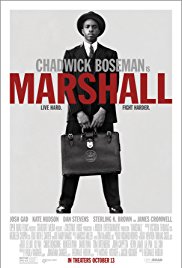
 Greetings again from the darkness. The question must be asked: is the movie worthy of the man? The man was the first attorney for the NAACP. He won 29 of the 32 cases he argued in front of the U.S. Supreme Court, including the ground-breaking 1954 Brown v. Board of Education (separate but equal public education). This man was a trailblazer for Civil Rights, and in 1967 became the first African-American Supreme Court Justice. This man was, of course, Thurgood Marshall … a man who unquestionably deserves not just a movie, but a really good and important one.

Chadwick Boseman has taken on film versions of such icons as Jackie Robinson in 42 and James Brown in GET ON UP, so he likely jumped at the chance to play the revered figure, Thurgood Marshall. Mr. Boseman has true movie star screen presence, and supplies the young Mr. Marshall with a self-assured swagger that accompanies a brilliant legal mind – a mind that refused to be ignored during a time it was desperately needed. Lest he be labeled a superhero, the film does portray Marshall smoking and drinking, while also hinting at his carousing. The common flaws of a great man.

It’s 1941 and the young (33 years old) Marshall is the lone NAACP attorney, so he spends his time ping-ponging around the country fighting for fair trials for those African-Americans accused simply because they aren’t white. He works only for “innocent” people and his efforts during this time were crucial to the Civil Rights movement gaining attention and legitimacy. Most of the film centers on a case in Connecticut (no, not the Jim Crow south) where a black man, Joseph Spell (Sterling K Brown), is accused of sexual assault of a “respectable” married white woman, Eleanor Strubing (Kate Hudson). If you are reminded of the great book and film TO KILL A MOCKINGBIRD, you must know that those literary and cinematic standards are such that few can ever hope to reach.

What follows is not one of the more dramatic or tension-filled cinematic courtroom dramas. There is simply too much levity for the film to be classified as a historical heavyweight. That said, the man and his story are fascinating, and though director Reginald Hudlin chooses a deft touch rather than a sledge hammer, it’s likely the wise choice if the goal is to entertain, while also educating the masses to Marshall’s early career. Josh Gad co-stars as Marshall’s co-counsel Sam Friedman, a specialist in legal technicalities within the insurance industry. Boseman and Gad have nice chemistry (at times it feels like a buddy movie), and as a Jew in those times, Friedman is himself stuck in limbo between staunch racism and acceptance by the white community.

James Cromwell plays Judge Foster, yet another man caught between the old world he has lived in his entire life and the fast-changing society and legal system that permits him to silence Marshall, while also forcing (somewhat) fair treatment of the accused Spell. Dan Stevens (BEAUTY AND THE BEAST) is Loren Willis, the disgusted and disgusting prosecutor. This character is so cartoonish that the only thing missing is a neon necklace that flashes “racist” as he speaks. Sophia Bush has a brief, yet important scene and Sterling K Brown (as Mr. Spell) has the film’s most heart-breaking moment as he sits on the stand and explains why he lied.

Director Reginald Hudlin seems like an odd choice for the project. He has been working mostly in TV since back-to-back-to-back bombs BOOMERANG (Eddie Murphy), THE LADIES MAN (Tim Meadow) and SERVING SARA (Matthew Perry). Mr. Hudlin has experienced more success as a Producer, having been Oscar nominated for DJANGO UNCHAINED. Here he works with the father and son screenwriters Jacob Koskoff and Michael Koskoff. The elder Michael is a well respected criminal attorney and legal historian, and certainly understands the expectations that come with offering a public look at a near-mythical figure … especially one as revered as Thurgood Marshall.

This isn’t so much a movie about the icon as it is about a young man on the path to greatness and importance (he served on the Supreme Court from 1967-1991). The soundtrack is filled with jazz which complements the light-hearted approach, and further distances from any semblance of “heavy” or “historical”. Director Hudlin adds a contemporary touch by having Trayvon Martin’s parents (Sybrina Fulton, Tracy Martin) appear in a scene near the end. On the downside, multiple upshot camera angles are designed to make his lead character look larger than life. The truth is, Thurgood Marshall required no help in looming large. Hopefully this mainstream approach pays off and many are introduced to the legacy of a man who is more than worthy of this movie … and another.

watch the trailer:


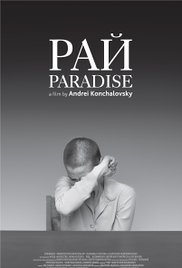
PARADISE (Rai, Russia, 2017)

October 10, 2017

 Greetings again from the darkness. Hollywood, and the movie industry as a whole, absorbs a fair amount of criticism for the perceived lack of originality and creativity in this era of remakes and sequels. However, filmmakers also deserve some credit for constantly finding fresh stories associated with The Holocaust and World War II – seemingly endless sources of material for new movies. As Russia’s official Oscar Foreign Language entry, this film from director Andrey Konchalovsky (co-written with Elena Kiseleva) offers up three distinct perspectives of the same tumultuous period.

Julia Vysotskaya plays Olga, a former Russian Countess and member of the French resistance. Ms. Vysotskaya is the wife of director Konchalovsky and has a screen presence somewhat reminiscent of Ingrid Bergman with her ability to appear alternatingly tough, loving, sensitive and stubborn. Her character Olga has been arrested for sheltering two Jewish boys. Philippe Duquesne is Jules, the lead detective assigned to Olga’s case. His questionable loyalties are accompanied by a weakness of the flesh that is all too common among those in a position of power. Christian Clauss plays Helmut, a nobleman and German SS officer who is emotionally torn between his personal desires and his duty to the cause of his country.

The story is told from the perspective of each character through a blend of flashbacks and interviews. Harsh lighting, stark surroundings, and their respective wardrobes during the interviews appear to show each being held captive as they are interrogated by an entity that remains unheard and unseen. The interviews provide some insight into the characters, but almost seem intent on keeping us off-balance as the film progresses. It’s really the flashbacks that are the most interesting and provide the fascinating details for Olga, Jules, and Helmut.

Beautifully filmed in black and white with an excellent use of lighting effects by cinematographer Alexander Simonov, the tangled web of paths intersecting during war time offers some terrific sequences: a father and son on a morning walk, an isolated and guilt-ridden officer in a fog-draped forest, the immediate scavenging after an unexpected prisoner death, the excruciatingly emotional deportation of Jews, and a remarkable sequence involving a meeting with Himmler and Helmut’s subsequent mission to audit the concentration camps.

The brief flashes of joy are usually crushed by the weight of despair and bleakness, yet by the end, we believe we know each of these characters – and what motivates them. Director Konchalovsky’s film is an unconventional, creative, and ambitious combination of The Holocaust, Germany’s quest for perfection, and the greed and daily desperation of those involved. The interviews might not be what you assume, yet cause us to wonder how might our own interview sound while reminding us that, no matter the circumstances, we can always choose to do good.


WALKING OUT (2017)

October 5, 2017

 Greetings again from the darkness. Man vs Nature movies tend to remind us of both our tenacity when things go badly, and our lack of control or overall insignificance in the big picture of life. This tends to be true in the mountains, on the water, under the ocean, in caves and in space. Twin brothers Alex Smith and Andrew J Smith have adapted and co-directed this film from a short story by David Quammen. The filmmakers were raised in Montana, and have an inherent feel for the stunning and often treacherous landscape.

Matt Bomer, in a sharp left-turn from his usual pretty-boy roles, plays Cal, a live-off-the-land mountain man with seemingly few needs outside of food, water and a desire to connect with his teenage son through a hunting trip. Josh Wiggins (who exploded on the scene in 2014’s HELLION) plays David, a suburban Texas boy who is out of his element without his cell phone. The opening panoramic view of snow-covered mountains is contrasted with David’s engrossed concentration on his hand-held video game as the plane approaches the landing zone. “How was your year?” is David’s greeting from Cal, instantly elucidating their relationship.

Cal excitedly reports to David that he has been tracking a bull moose for 11 weeks, and wants this to be David’s first big game kill. We are constantly reminded that this isn’t trophy hunting, and that this single moose will provide Cal enough meat for a year. David has no real interest in killing a moose, but longs to connect with his father … and “longs” is interpreted through the teenager’s shrugs, glances and body language. Wiggins plays David with the subtle authenticity of the teenagers most of us have known, raised, and at one time, been.

As Cal explains the history of the mountains, he also works in stories of his youth when his father (David’s grandfather) was teaching him the ethics of nature. Numerous flashbacks feature Bill Pullman and Alex Neustaedter (as young Cal). The flashbacks are a bit artsy, and sometimes intrusive, but in the end, form a parallel story structure that works.

A couple of poor decisions lead to an accident that could be straight out of the Dick Cheney’s field guide to hunting. Cal and David are both injured – Cal severely so. It’s at this point where David must grow up quickly. The skills he has learned, or at least absorbed, are now necessary if he expects to save his father’s life. What was a story of two polar opposite blood relatives trying to connect, transitions instantaneously into one of survival, maturity, persistence, and love.

Movies such as THE REVENANT and THE EDGE come to mind, but this one is short on thrills, and is instead a trudging struggle to survive – taking a quiet approach, rather than a showy one. Lily Gladstone, fresh off her terrific work in CERTAIN WOMEN, has a brief sequence near the film’s end. The beautiful landscape and terrain is captured by cinematographer Todd McMullen, while Ernst Reijseger’s score effectively complements the odd mixture of slow pacing and non-stop danger. Whether you are trying to live a reclusive life off the land, or simply one of the many parents attempting to connect with their kids, keep in mind that regardless of the beauty of the mountains, “snow is not our friend”.

watch the trailer:


BATTLE OF THE SEXES (2017)

September 29, 2017

 Greetings again from the darkness. At least two generations are too young to have experienced the 1973 media circus that was the tennis match between Billie Jean King and Bobby Riggs. However, what matters is that the impact and social changes that began in earnest that night at the Astrodome are still being felt and evolving today. It might seem incredulous that the 29 year old top-ranked women’s player emerging victorious against a 55 year old who played his last professional match 14 years prior would have an impact on anything other than TV rankings, but in fact, it caused a significant societal shift.

Real life married couple and co-directors Jonathan Dayton and Valerie Faris are well known for their collaborations on iconic music videos and TV commercials, and since joining the movie world have brought us LITTLE MISS SUNSHINE and RUBY SPARKS. Their talent for visual presentation is on display here in both the tennis scenes and the more intimate character moments. And, oh my, there are some intimate moments thanks to the script from Oscar winning screenwriter Simon Beaufoy (SLUMDOG MILLIONAIRE). There is no shying away from Ms. King’s sexual confusion/awareness/preferences.

Emma Stone (Oscar winner for LA LA LAND) stars as tennis legend Billie Jean King and manages to convey three different sides: the ultra-competitor, the champion for equal rights, and the married woman coming to grips with her sexual identity. Steve Carell captures the essence and mannerisms of Bobby Riggs, the former tennis champ, floundering in middle-age and always on the lookout for his next hustle or gambling opportunity. Surprisingly, only a minor portion of the film deals with the actual tennis match. Instead, the film dives into the personal lives of these two polar opposite personalities, each with their own challenges and issues.

Despite the fun and outrageousness that the Riggs character delivers, the film might have been better served focusing even more on Ms. King. While she needed the “villain”, it was really her dedication to the cause and strength amidst the backlash that made the difference … along with her court skills. Watching her stand tall in confrontations with the chauvinistic and powerful Jack Kramer (Bill Pullman) is something to behold. Again, those that weren’t around might not believe some of the outrageous claims by the men of the times.

Supporting work comes from Andrea Riseborough as the all-important Marilyn, who turns Billie Jean away from her husband Larry (Austin Stowell), Sarah Silverman as promoter Gladys Heldman, Natalie Morales as Rosie Casales, Alan Cumming as the colorful clothes designer, an underutilized Elisabeth Shue as Riggs’ wife, Fred Armisen as Rheo Blair – Riggs’ partner in the herbs and vitamins game, and Lewis Pullman (Bill’s real life son) as Riggs’ son, Larry. We are even treated to a Bob Stephenson sighting as the Sugar Daddy PR guy at the match.

This was the era when the Vietnam War was winding down, the Watergate scandal was raging, outside “the norm” sexual preferences were kept in the closet, prize money for men’s tennis was 8-10 times that of women, and the overall respect for women and their sports was excruciatingly misguided. Listening to Howard Cosell speak so condescendingly during the national broadcast merely confirms the inequity. Of course, these same issues are discussed and debated even today, as society evolution is often slow, even when moving in the right direction. The film might not add much to today’s cause, but it reinforces the early legacy of Billie Jean King as a difference-maker.

watch the trailer:


VICTORIA AND ABDUL (2017)

September 29, 2017

 Greetings again from the darkness. Director Stephen Frears has enjoyed a long career by focusing on the interesting stories of people, rather than the salient specifics of history or politics. He received Oscar nominations for THE QUEEN and THE GRIFTERS, and helmed other crowd-pleasers such as MRS. HENDERSON PRESENTS, PHILOMENA, HIGH FIDELITY, and FLORENCE FOSTER JENKINS. While purely entertaining movies are always welcome, it’s important to note the filmmaker’s approach when the story is entwined with historical importance.

Based on real events … mostly” is Mr. Frears’ cutesy way of kicking off the film and asking us to enjoy the unusual story of connection between a Queen and a servant, and cut him some slack on the historical depth. For most of us, the real enjoyment will be derived from watching yet another standout performance from Oscar winner (and 7 time nominee) Dame Judi Dench as the longest-reigning monarch, Queen Victoria in her elderly years. It’s a role she played twenty years ago in MRS. BROWN, and her relationship with John Brown (presented in that film) has some parallels to what we see here with Abdul Karim (Ali Fazal). Dame Judi is the rare actress who can capture both the loneliness and tiresome burden of six decades of rule and the re-invigorated woman we see learning a new language and new religion. She plays weary and spunky with equal believability.

Victoria was Queen of the United Kingdom of Great Britain and Ireland and Empress of India, and in 1861 her beloved husband Prince Albert died. This film picks up in 1887 with the pomp and circumstance of the Golden Jubilee – a celebration of her 50 years of rule. The early scenes tease us with obstructed views, and the comedic element becomes quite obvious as we see her so carelessly slurping her soup at the formal lunch. Part of the celebration includes the presentation of an honorary coin by two Indians peasants Abdul (Fazal) and Mohammed (Adeel Akhtar), the first chosen because of his height, and the second as a last minute fill-in.

Lee Hall (Oscar nominated for BILLY ELLIOT) wrote the screenplay based on the book by Shrabani Basu. The journals of Abdul Karim were only discovered in 2010, a hundred years after his death. Some of the less favorable moments of this era are mentioned, but most of the Queen’s lack of knowledge or awareness is attributed to the “boring” reports from her advisers. This leads to some awkward moments later in the film regarding the Muslim mutiny and the subsequent Fatwa.

Rather than dwell on history, the film prefers to focus on the unconventional friendship and the re-awakening of the Queen. Abdul becomes her “Munshi” – a spiritual advisor and her teacher of Urda and the Koran. As you would expect, this is all quite scandalous and frustrating for those such as Prime Minister Lord Salisbury (Michael Gambon), Lady Churchill (Olivia Williams), Victoria’s son Bertie (Eddie Izzard), and the royal staff: Sir Henry (the recently deceased Tim Pigott-Smith), her physician Dr Reid (Paul Higgins), and her quivering maid Miss Phipps (Fenella Woolgar). There is even a comical sequence with the great singer Puccini (Simon Callow) as the Queen herself belts out the Gilbert and Sullivan song “I’m Called Little Buttercup”.

Balmoral, the Isle of Wight, and Windsor Castle are all part of the breath-taking scenery, while the absurdity of the royal status is viewed through the eyes of the Indian servants. Most of the focus is on Victoria’s transformation from joyless, isolated monarch to the anything-but-insane (an Oscar worthy scene) and eager to engage elderly woman (one who has an entire era named after her) falling back in love with life as she fights off “the banquet of eternity”. Come for the laughs and the performance of Dame Judi … just not for a history lesson.

watch the trailer:


STRONGER (2017)

September 21, 2017

 Greetings again from the darkness. There is a fine line between getting chewed out by your Costco supervisor one day and having the country claim you as a hero the next. Just ask Jeff Bauman. On April 15, 2013 Jeff was near the finish line for the Boston Marathon, holding a handmade sign in support of his runner-girlfriend Erin. When she was still about a mile away, the two bombs went off, killing three people and injuring hundreds. Mr. Bauman lost his legs that day.

When Jeff regained consciousness in the hospital (after two surgeries), he was able to provide the FBI a detailed physical description of one of the bombers. His information led directly to the identification of one of the scumbag brothers responsible for this atrocity. Immediately, Jeff was hailed as a hero – both locally and nationally. The film does a nice job of telling Jeff’s story and how his life unfolded over the next few months.

Director David Gordon Green is responsible for such disparate film projects as OUR BRAND IS CRISIS, MANGLEHORN, and PINEAPPLE EXPRESS. He may seem an odd choice to adapt the film from the book by Jeff Bauman and Bret Witter (screenplay by John Pollono), but the story is so moving and heart-warming, and the three lead actors are so good that we immediately connect with each of them.

Jake Gyllenhaal plays Jeff, Tatiana Maslany (“Orphan Black”) plays Erin, and Miranda Richardson tears up the screen as Jeff’s mother, Patty. Mr. Gyllenhaal is remarkable (as usual) as the working class local boy who truly believes his lucky seat and beer determine success or failure for his beloved Bruins and Red Sox. His initial portrayal is spot on for the normal guy who seems caught in the web of eternal teenage mentality so common in the male species. As he struggles with his new life challenges, he strives to do better, but simply doesn’t understand why he is viewed as a hero … and doesn’t particularly embrace what comes with the label, at least early on. Ms. Maslany is terrific as the guilt-ridden, confused-yet-strong, on-again-off-again girlfriend to Jeff. She fights through being treated as an outsider by the family, and the daily grind of caring for a guy who needs constant help. The twice Oscar nominated Miranda Richardson is unlike we have ever seen her on screen. Despite being a Brit, Ms. Richardson captures the Boston sauciness (in more ways than one) and takes no ‘stuff’ from anyone. Her performance is stunning.

Of course, at its core, this is an inspirational story about how a normal guy became a hero after a tragic event. The recent Mark Wahlberg film PATRIOTS DAY focused on the aftermath and investigation, while here the attention is on the emotional story of one man and one family. We see the recreation of the flag-waving at the Boston Bruins game, and the ceremonial first pitch at Fenway Park. We also see the obstacles faced when rehabilitation and care-giving becomes too much to bear. Carlos Arredondo and his cowboy hat and heroics are also given much-deserved space here. His back story is heart-breaking, and a reminder that everyone has a story, and each of us can be a hero in some way. Since life isn’t a movie, the realities are that Jeff and Erin have since divorced, but that in no way reduces the impact of their touching story that inspires each of us to be stronger.

watch the trailer:


BRAD’S STATUS (2017)

September 21, 2017

 Greetings again from the darkness. Mid-life crisis has long been a popular movie topic. A list of the best would include: Fellini’s 8 ½, Blake Edwards’ 10, AMERICAN BEAUTY, CRAZY STUPID LOVE, SCENES FROM A MARRIAGE, THE BRIDGES OF MADISON COUNTY, THE SEVEN YEAR ITCH, and THELMA & LOUISE. Some of these are outright comedies, while others are turbulent dramas. With the label ‘white male privilege’ being applied so broadly these days, it’s impressive how writer/director Mike White (THE GOOD GIRL, SCHOOL OF ROCK, creator of TV’s “Enlightened”) so expertly and gracefully takes on the familiar topic.

Ben Stiller stars as Brad Sloan, a married man raising a teenage son and running a Non-Profit Organization in middle-class Sacramento. As Brad and his son Troy (Austin Abrams, PAPER TOWNS) embark on an elite northeast college visitation trip, we get the sense that Brad is only now waking up to his son’s rapid approach to adulthood and remarkable talent as a student and musical prodigy. This happens congruently to Brad’s mid-life realization that his own college buddies are richer and more famous than he. Self-loathing, insecurities and concern over the jealousy he feels towards his own son are the focus of Brad’s inner thoughts, which we hear courtesy of his narration.

Brad’s college friends who are unknowingly driving his defeatist attitude include: Jemaine Clement as Billy Wearsiter who retired in Hawaii at age 40 after selling his tech company; Mike White (the film’s director) as successful movie director Nick Pascale whose house is featured in Architecture Digest; Luke Wilson as hedge fund manager Jason Hatfield who married into money; and Michael Sheen as Craig Fisher, a best -selling author and frequently seen on TV political commentator. In comparison, and by today’s societal levels of achievement, Brad views himself as a failure – a man whose early idealism didn’t change the world, and instead prevented him from reaching the capitalistic heights of his friends.

There are a couple of elements that allow the film to work. First, Ben Stiller softens his usual snark, making him more relatable than his usual woe-is-me character. Next, the film isn’t as harsh on the white man as we’ve come to expect. There is no feeling sorry for Brad, but there is at least compassion … space for him to explore what he’s feeling and take stock in his life. The difference maker is Mr. White’s script. The underside of human nature is explored with a deft comedic touch and incisive societal observations.

Stiller’s tightly wound Brad contrasts with Troy’s easy-confidence leading to some unusual father-son scenes. When Troy questions whether his dad is having a breakdown, we understand that the existential crisis is actually fairly common. We certainly enjoy watching as Troy’s Harvard friend, and fellow musician Ananya (Shazi Raja) listens patiently before slapping Brad with the dose of reality he so desperately needs. Ananya’s beyond-her-years wisdom leads Brad to a moment of self-awakening during her concert of Dvorak’s “Humoresque”. Ms. Raja’s role is given much more weight than that of Jenna Fischer as Brad’s wife/Troy’s mother, who inexplicably only appears about every 20 minutes as a check-in during the boys’ trip.

Keeping up with the Jones is a no-win approach to life, and if a Hollywood film can help a few more people understand this, then it’s a beneficial way to spend a couple of hours. The Mark Mothersbaugh score has a sharpness to it that mirrors Brad’s tarnished idealism and search for self. We are reminded that normal insecurities can blow up if we focus too much on what others have, and not enough on what we do.

watch the trailer:


CLOSE ENCOUNTERS OF THE THIRD KIND (1977) revisited

September 17, 2017

 Greetings again from the darkness. Despite my fascination and quasi-obsession with movies, the Science Fiction genre has never really appealed to me. Sure, there have been a few dozen exceptions over the years (and it depends how you categorize certain movies), but it’s the non-classics in the genre that just never seem to connect with my love of film. So when Steven Spielberg states that he doesn’t consider his beloved CLOSE ENCOUNTER OF THE THIRD KIND (CE3K) to be a “sci-fi” film, you won’t see me get offended, or even offer a contrary argument. Of course, the difference is that Mr. Spielberg makes his claim based on his belief of life “out there”, while I simply have no desire to defend the category label.

For its 40th anniversary, the film is making the rounds in selected theatres, and the big screen is a must for this gem. Released in the same year and just a few months after George Lucas’ groundbreaking STAR WARS, Spielberg’s follow-up to JAWS confirmed his status as a revolutionary filmmaker, and cemented 1977 as one of the finest movie years of all-time (including ANNIE HALL, SATURDAY NIGHT FEVER, A BRIDGE TOO FAR, JULIA). CE3K would become the first of 7 Best Director Oscar nominations for Spielberg (inexplicably only one win to date).

Spielberg is credited as the writer, though many contributors are “uncredited”: Hal Barwood (now known for video games), Jerry Belson (Emmy winner for “The Odd Couple” and his work with Tracey Ullman), and John Hill (QUIGLEY DOWN UNDER), and Matthew Robbins (CRIMSON PEAK). Paul Schrader and Walter Hill also contributed to the script, making this the veritable vegetable soup of screenplays. The film came at a time when Columbia Pictures was struggling, so in order to remain under budget, Spielberg had to make some compromises on the final version. In a highly unusual development in the movie industry, Spielberg was able to revise, re-edit, and add new scenes to a 1980 re-release of the film – realizing his original vision.

Richard Dreyfuss stars as Roy Neary, a blue collar family man from Muncie, Indiana. With an acting career spanning more than 50 years (many recognize his baby face in THE GRADUATE as he offers to call the cops), it was AMERICAN GRAFFITI that caused his career to take off, leading to JAWS in 1975, and his stellar 1977 with both CE3K and THE GOODBYE GIRL. He later overcame a severe drug habit to star in such crowd favorites as WHAT ABOUT BOB?, MR. HOLLAND’S OPUS and “Madoff”. His wife Ronnie in CE3K is played by Teri Garr, whose acting career also covers more than 50 years, including small roles in five different Elvis movies in the 1960’s and her best known roles in YOUNG FRANKENSTEIN and TOOTSIE (for which she received a Best Supporting Actress Oscar nomination). In recent years, she has had to turn her energy and attention to health issues.

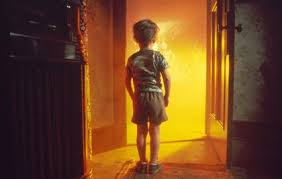
Melinda Dillon stars as Jillian, mother to young Barry (Cary Guffey) who is abducted by the aliens. Ms. Dillon received her first (of two) Oscar nomination for her work in the film, and is still seen annually breaking a leg lamp in the holiday favorite A CHRISTMAS STORY, although she retired from acting ten years ago. Young Mr. Guffey is now 45 years old and hasn’t acted since 1985. Director Stanley Kubrick considered him for the role of Danny in THE SHINING, but ultimately decided on Danny Lloyd, another youngster who decided against remaining in showbiz.

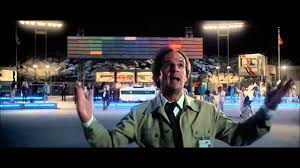
 Francois Truffaut was an Oscar nominated director known for kicking off the French New Wave of Cinema with his all-time classics THE 400 BLOWS and JULES AND JIM, and it was quite surprising to see him cast in the role of UFO expert Claude Lecombe. It’s likely that cinephile Spielberg loved the idea of working with a peer whose work he so admired. Truffaut is a significant screen presence despite his challenges with the English language (which led to “dialogue cheat sheets” throughout filming). Bob Balaban, so familiar to “Seinfeld” fans, plays the translator, while Justin Dreyfuss (Richard’s real life nephew) is the noisy and obnoxious son during the hectic family scene. Roberts Blossom is the one in the film who admits to spotting Bigfoot, and is best known as Kevin’s neighbor in HOME ALONE and the braced-up car seller in CHRISTINE. He was also a well-respected poet before passing away in 2011. Other familiar faces include Lance Henrikson (ALIENS), George DiCenzo (BACK TO THE FUTURE), Carl Weathers (ROCKY), CY YOUNG (OK, more a name than a face), Bill Thurman (Coach Popper from THE LAST PICTURE SHOW), and gas mask salesman Gene Rader, who hails from Paris, Texas.

 Desert discoveries are a key here, and offer more insight into Spielberg’s attention to history. The “lost” plane is a tribute to real life Flight 19 which disappeared in 1945, and The Cotopaxi was a real cargo ship that sunk … both becoming part of Bermuda Triangle lore. Devil’s Tower in Wyoming is also significant here, and it’s Spielberg’s nod to John Ford’s frequent use of Monument Valley in his westerns. Spielberg has admitted to watching Ford’s THE SEARCHERS dozens of times while filming CE3K. Another tribute comes in the form of a wind-up monkey with cymbals. It was previously seen in REBEL WITHOUT A CAUSE, and can also be viewed as a precursor to the infamous clown in POLTERGEIST.

Spielberg acknowledges being inspired by President Nixon and the Watergate scandal. He wondered what else the government might be hiding from us. Remarkably, he gets his point across with a total absence of modern day cynicism. As opposed to what we usually see these days, the military isn’t trying to bomb the mothership and citizens aren’t retreating in a panic to bunkers. Instead, the military is working to keep the public safe (albeit through some sneaky strategy), the scientists are approaching communication through a protocol steeped in research and data gathering, and Dreyfuss and Dillon are trying to figure out why they were “chosen”. Spielberg delivers sweetness and warmth rather than a show of power and might. It’s such a pleasant viewing experience to watch people we like and to whom we can relate.

Some points of interest related to the film include a cameo from famed UFOologist J Allen Hynek, who is seen smoking a pipe as the abductees are released from the mothership. Mr. Hynek actually created the phrases Close Encounters of the First, Second, and Third Kinds. ABC news anchor Howard K Smith is seen since CBS would not grant permission for Walter Cronkite to appear. The film’s stunning visual effects come courtesy of Douglas Trumball, who also collaborated with Stanley Kubrick on 2001: A SPACE ODYSSEY. Of course, the Visual Effects Oscar that year went to STAR WARS, and that speaks to the contrast between the films. STAR WARS is clearly a special effects movie, while CE3K is much more of a character study … a study of human emotions.

 As for other Oscar categories, the film was nominated for 9 total, with the only win going to Cinematographer Vilmos Zsigmond, though it was also awarded a Special Achievement Oscar for Sound Effects Editing. Spielberg was nominated, but Woody Allen won Best Director for ANNIE HALL, and Richard Dreyfuss actually won the Best Actor Oscar that year for THE GOODBYE GIRL. The great John Williams was of course nominated for his iconic 5 note melody (following up his immortal JAWS theme), and he instead won the Oscar that year for … repeat after me … STAR WARS. A quirky note on the music – the “voice” of the mothership was a tuba, not an instrument that typically gets much publicity.

While Stanley Kubrick opted not to show aliens in 2001: A SPACE ODYSSEY, this film not only puts the aliens front and center, it reminds us to keep an open mind to those unfamiliar to us … a lesson that is still important today. The film was named to the National Film Registry in 2007, and seeing it on the big screen allows for the full impact of awe and wonderment. It’s rated PG and can be enjoyed by most ages. Spielberg only asks that you leave the cynicism at home.

watch the trailer:


THE UNKNOWN GIRL (2017, La Fille Inconnue, France)

September 10, 2017

 Greetings again from the darkness. A nice story set-up is always welcome, and this one delivers a creative attention-grabber that draws us in pretty quickly. Brothers and long-time filmmaking collaborators Jean-Pierre Dardenne and Luc Dardenne (TWO DAYS, ONE NIGHT, THE KID WITH A BIKE) edited the film a bit after its Cannes screening, and the result is a quiet little whodunit with an interesting lead actress performance.

A doctor and her intern have a disagreement at closing time, and opt not to answer the clinic door when a young lady rings after hours. The doctor’s guilty conscience leads her to become obsessed with finding out the name of the lady when she turns up murdered the next morning. It’s passionate and amateur sleuthing at its most awkward, unconventional, and dangerous.

Dr Jenny Davin has recently accepted a post at the prestigious Kennedy Hospital, replacing a retiring doctor. The tragedy causes a change of mind on the job so that she may focus on the case and on continuing patient care through her clinic. The filmmakers initially wanted Marion Cotillard for the role (what filmmaker wouldn’t?), but Adele Haenel (LOVE AT FIRST FIGHT) brings her own approach, and though she doesn’t come across as the warmest person, it’s quite apparent that she is a dedicated doctor who cares very much for her patients. Even when she tells her intern Julien (Olivier Bonnaud) that “a good doctor must control his emotions”, she is ever-stoic with her delivery.

The story is missing the usual Dardenne brothers’ twist, and instead, at its core is an ill-advised detective story and a case of morality, guilt, and the drive to do the right thing. The house calls and open communication with doctors will confound some U.S. viewers, but the various vignettes during Dr. Davin’s gumshoe work keep us engaged. The sub-plot with Dr. Davin reigniting intern Julien’s passion for medicine also maintains the minimalist approach and restrained performances … all with a very grounded approach with mostly handheld cameras.

watch the trailer:


REBEL IN THE RYE (2017)

September 7, 2017

 Greetings again from the darkness. “Holden Caulfield is dead.” So states Jerry’s letter to his mentor. You likely know Jerry better as J.D. Salinger, and he wrote that while hospitalized with Post Traumatic Stress Syndrome after WWII. Of course, we know this proclamation is premature, as Holden Caulfield is the main character from Mr. Salinger’s famous (and only) novel, “The Catcher in the Rye” … a high school literature staple for decades.

Imagine your dream is to become a great writer, but your own father continually reminds you that “meat and cheese distribution has been good for this family.” Your restlessness often works against you, and though you are hesitant to admit it, a mentor for writing and life direction is desperately needed if you are to avoid the family business. Enter Columbia professor Whit Burnett (Kevin Spacey).

This is Danny Strong’s first feature film as a director, though you would surely recognize his face from his frequent acting appearances – often as a weasly character. He is also the creator of TV’s “Empire” and wrote the screenplays for THE HUNGER GAMES: MOCKINGJAY (Parts I and II) and LEE DANIELS’ THE BUTLER. Strong does an admirable job in showing the commitment required to hone one’s writing skills and proving “the difference in wanting to be a writer and actually being one.”

Jerome David Salinger is played well by Nicholas Hoult. His scenes with Spacey’s professor are the film’s best, and Hoult also shoulders the responsibility of Salinger’s writing frustrations, personal life challenges, military service, and finally, his decision to become the most famous and long-lasting recluse (by comparison, Howard Hughes was an amateur).

We learn that Burnett was instrumental in getting Salinger’s first short story published, which finally gave Jerry the answer needed for a writer’s most dreaded question, “Have you been published?” Quite a bit of time is devoted to his odd romantic relationship with Oona O’Neill (Eugene’s daughter and the future, long-time wife to Charlie Chaplin). Zoey Deutch (daughter of Lea Thompson) plays Oona as an enigmatic lover attracted to Salinger’s genius, but incapable of being patient for his career that might happen (and might not). She opts for the sure bet.

Salinger’s military service included Utah Beach on D-Day, and nearly as remarkably, his toting the tattered manuscript ‘Catcher’ pages throughout his tour. He returned home in 1946, and in 1951 “The Catcher in the Rye” was published. It’s been referred to as the Great American novel and a rite of passage, while also being banned and derided for its whiny Holden.

Director Strong emphasizes Salinger’s turn to Zen Buddhism and his sessions with Swami Nikhilanda, as well as his evolving distrust of stalking fans and two-faced media. Support work is provided by Sarah Paulson as Salinger’s salty agent, Lucy Boynton as his wife, Victor Garber as his father, and Hope Davis as his supportive mother. Just as in real life, we get nothing of Salinger’s later years of solitude and isolation in New Hampshire, where he died at age 91.

The book has sold more than 65 million copies, and continues to sell well today. In a shift from the recent documentary SALINGER by Shane Salerno, and the book “J.D. Salinger: A Life Raised High” by Kenneth Slawenski, this dramatization doesn’t dig too deep, but it does allow a new generation to personify the legend. Perhaps it even paints a picture of a better/nicer man than what his real life actions showed. Regardless, the older Salinger certainly seemed to embrace the cause of “write and get nothing in return”.

watch the trailer: