STAN & OLLIE (2019)

January 5, 2019

 Greetings again from the darkness. Any list of the all-time great comedic teams would surely include Laurel and Hardy at or near the top. Influenced by pioneers such as Charlie Chaplin, Buster Keaton and The Marx Brothers, Stan Laurel and Oliver Hardy (the rotund one) rose to the top of the comedy world through their films and shorts produced by Hal Roach Studios during 1926-1941. In later years, we recognize the Laurel and Hardy influence in hugely popular acts such as Abbott & Costello and The Three Stooges. Director Jon S Baird (FILTH, 2013) and writer Joe Pope (PHILOMENA, 2013) deliver a warm tribute to the comedy giants by giving us a peek on stage and off.

The film kicks off in 1937 when the duo are the height of their popularity, and a wonderful extended opening take allows us to follow them as they make their way across the studio lot and onto the set of their latest film, WAY OUT WEST. Before filming the scene, they have a little dust up with studio owner Hal Roach (Danny Huston) over the money they are being paid per their contract. Stan thinks they deserve more, while Oliver, racked with debt from a stream of broken marriages, prefers to not rock the boat.

It’s this early scene that acts as a precursor to the challenges we witness in the business partnership side of the duo. Imagine if the work of you and your business partner were on display for the world to judge. And how does friendship fit in? The film flashes forward to 1953 when the popularity of the comedic duo has faded. They find themselves on a United Kingdom tour arranged by smarmy booking agent Bernard Delfont (played well by Rufus Jones). The purpose of the tour is to convince a film producer to back their Robin Hood parody idea. The early gigs are very small music venues and the crowds are even smaller. But these are true pros, and soon Stan and Ollie hustle up their own growing audiences, and by the time their wives join them on the tour, they are filling the best venues.

As Lucille Hardy (Shirley Henderson) and Ida Laurel (Nina Arianda) make their appearance, we soon find ourselves with two comedy teams to watch. The chemistry between the ladies is so terrific, they could be the featured players in their own movie. Lucille is a strong and quiet former script girl who is quite protective of her Ollie, while the outspoken Ida is a former Russian dancer who, in her own way, is also protective of the gentlemen performers.

The suppressed resentment over the (much) earlier Roach negotiations finally boils over in a heart-wrenching scene. The grudges and feelings of betrayal are voiced – alongside Ollie’s physical ailments. As they air their grievances, it cuts to the quick. Not long after, Ollie’s heart condition finds the two mimicking their “hospital” skit in real life … it’s a show of ultimate friendship that can only be built through decades of working closely together.

John C Reilly plays Oliver Hardy (the American) and Steve Coogan is Stan Laurel (the Brit). Both are extraordinary in capturing the look and movements of the comic geniuses. Mr. Reilly and Mr. Coogan are such strong actors, that it’s difficult to decide which segments are best. Is it the reenactments of some of Laurel and Hardy’s iconic skits, or is the off-stage moments when they are dealing with the human side of these entertainment giants? Reilly benefits from excellent make-up and prosthetics (that chin!) and Coogan has the hair and determination needed for his role.

Director Baird’s film is sweet and sad and funny. Stan and Ollie deserve this warm tribute, and it’s a reminder of all the stress and hard work that performers put in so that the show looks “easy”. This is what’s meant by honing the craft … even if it’s “another fine mess” accompanied by the trademark “Dance of the Cuckoos” music. Let’s hope the film attracts some youngsters who might gain an appreciation for the good ol’ days of Classical Hollywood.

watch the trailer:


LEAVE NO TRACE (2018)

January 5, 2019

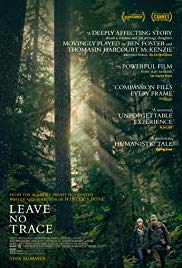
 Greetings again from the darkness. It seems like many more than 8 years have passed since filmmaker Debra Granik’s outstanding film WINTER’S BONE exploded onto the indie scene and introduced most of us to Jennifer Lawrence (although she had been acting for 5 years prior). The talented Ms. Granik has chosen to adapt another book as her feature film follow-up, and once again nature and an independent spirit play a key role. Based on the novel “My Abandonment” by Peter Rock, it’s the story of a father and daughter who live off the grid … until society catches up to them.

Ben Foster (always exceptional) plays Will, a war veteran and father to Tom, his teenage daughter played brilliantly by Thomasin McKenzie. The two live off the grid in the forests outside of Portland. An extended opening sequence with very little dialogue shows us their daily life: capturing rain water, cutting trees for firewood, hiding their camp site, and drilling on making themselves ‘disappear’ in the foliage. It’s in these scenes where cinematographer Michael McDonough shines. His camera work allows us to feel as if we are in the damp forest as the sun rays peek through the trees. It’s a beautiful sight despite our uneasiness towards the father-daughter situation.

When Park Rangers discover them, the two enter the Social Services system, but rather than treat us to yet another uncaring and incompetent bureaucracy, director Granik allows human kindness and reasonableness to play its part. Will and Tom are moved onto a farm where she will enroll in school and he will work on a Christmas tree farm. Of course, we know that Will is not cut out for this life, though we begin to see Tom show signs of true independence and her own dreams.

They make their way back into the woods and an injury – and more human kindness – has them end up in a camp with other outliers. The story really captures the conflict between a society that is obligated to educate and protect children, and the same society that has little clue how to assist veterans of war. We see folks who just want to be left alone, and others who maybe can’t fit in to society – or have no interest in trying.

Supporting work is provided by Dana Millican, the great Dale Dickey, and Isiah Stone (one of the kids from WINTER’S BONE). There is a believability here rarely seen on the big screen, and the love between father and daughter is something to behold. Ms. Granik says so much by saying very little, but what could be such a bleak story actually revels in the kindness to fellow man – the type of kindness which seems all too rare these days.

watch the trailer:


THE MULE (2018)

January 5, 2019

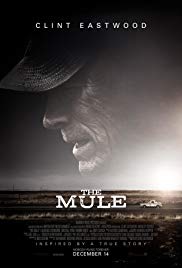
 Greetings again from the darkness. When a film is inspired by a true story detailed in a 2014 New York Times article entitled “The Sinoloa Cartel’s 90 Year Old Drug Mule” written by Sam Dolnick, we should expect a message delivered with a certain amount of tension. Unfortunately, tension is somehow lacking throughout, and the only real message delivered is the same of most every elderly person (even those who aren’t drug runners) – they regret not spending more time with family. That’s not to say the movie doesn’t have its moments (it does), but know going in that the terrific ensemble cast is given little to do in a script painted with such broad strokes that no other message or image ever emerges.

Clint Eastwood directs his second movie of the year (THE 15:17 TO PARIS being the other) and stars in his first acting role since TROUBLE WITH THE CURVE in 2012. Here he plays Earl Stone, a popular horticulturalist who admittedly devoted more time and love to his prize-winning daylilies than to his family. A flashback to 2005 shows us Earl in his element at a convention where he is treated as a celebrity, and as a man who would rather buy a round of drinks at the hotel bar than show up to his daughter’s wedding and walk her down the aisle. The family has grown weary of and accustomed to his no-shows, and Earl displays little remorse.

Pushing forward twelve years, we find Earl’s house and farm in foreclosure – and him blaming the internet (just one of many ‘good old days’ syndrome bits). When his appearance at his granddaughter Ginny’s (Taissa Farmiga) engagement party causes turmoil with his ex-wife (Dianne Wiest) and daughter (the aptly named) Lilly (Alison Eastwood), he is approached by one of the attendees who tells him he can make money ‘just driving’.

Being hard up for cash, Earl takes the job driving his truck and dropping off his unknown cargo. In one of numerous convoluted moments we are supposed to accept, Earl is shocked when he discovers the cargo he’s been toting is bags of illegal drugs. Now mind you, this is a Korean War veteran who has spent his life on the road running his own business. The naivety is a bit too much for us to swallow. Comparisons are expected to Eastwood’s turn as Walt in GRAN TORINO (2008), but here his being an off-the-cuff racist is seemingly excused by his age and generation … plus it’s meant as comic relief quite often. Earl becomes a trusted mule for the cartel led by a kingpin played by Andy Garcia, and transports record amounts of drugs valued at millions. Still, Earl is a cranky old geezer who does things his own way, whether that’s stopping for the world’s best pulled pork sandwich or helping a stranded family change a tire. He’s also a 90 year old with the libido of a 28 year old gigolo (which given Eastwood’s real life track record, may or may not be fiction).

While Earl makes his commutes through the picturesque Midwest (including White Sands National Park) singing classic country songs and ballads, the Chicago DEA is busy tracking the cartel. Two partner agents (Bradley Cooper and Michael Pena) report to the Station Chief (Laurence Fishburne) and are under pressure for drug “busts”. It’s this segment that truly causes the story structure to crumble. Cooper, Pena and Fishburne are all excellent actors and it’s a bit embarrassing to see them with such limited and basic roles. Fishburne especially seems relegated to intricate dialogue such as “get it done” and “do it”. There is also a Waffle House scene shared by Cooper and Eastwood that so unreasonably requires us to suspend all disbelief that it ends up just being an eye-roller.

One’s expectation for the film should be tempered by the knowledge that Earl’s line, “For what it’s worth, I’m sorry for everything”, is really the crux of the film. An elderly drug runner’s life regrets and attempts to make amends and re-connect with his family somehow plays like a disjointed soap opera than a real life drama. That said, even at age 88, Mr. Eastwood still has a strong screen presence, and we can’t help but find it interesting that both he and Robert Redford (THE OLD MAN AND THE GUN) had roles this year as criminals with a certain appeal.

watch the trailer:


AMERICAN HANGMAN (2019)

January 4, 2019

 Greetings again from the darkness.  Two men are kidnapped, bound and gagged, and dragged into a secure basement. Soon enough, the disoriented men (and we as viewers) realize this is to be a trial conducted via social media – and the stakes are very real. Writer-Director Wilson Coneybeare presents the kidnapper as a quiet dude with an intricately well-designed, though quite demented, set-up.

Ron (Paul Braunstein) and the ironically named Judge Straight (Donald Sutherland) are the two men held captive, while Henry David Cole (Vincent Kartheiser, “Mad Men”) is their captor. Ron is the high strung type who constantly threatens Cole despite being handcuffed and otherwise tortured. The Judge, on the other hand, remains calm and composed as he tries to reason with his captor … and even talk some sense into Ron. Despite the circumstances, we find a bit of humor in Ron’s bull-headedness and his frantic comparisons to the movie SAW, which of course the Judge has never seen. On a side note, Paul Braunstein actually appeared in JIGSAW (one of the SAW sequels).

Cole begins the live broadcast via social media and we periodically see the graphics for time (go live at 1:11pm) and counter of viewers tuned in. Also tuning in are the local cops led by a retiring police lieutenant (Oliver Dennis) and a detective (Joanne Boland), and a top notch hacker (Jess Salguiero). Cole’s basement set up includes numerous computers and cameras strategically placed around the room. His own moves are choreographed in a manner that keeps his face from being seen on social media. The Judge and Ron see him (and his awful haircut), as do we as viewers.

An ambitious news reporter is working her own contacts, but much of the suspense occurs inside the basement. It takes a while to unfold, but we soon understand Cole’s thought process and why he believes a publicly broadcast trial makes sense. Some of the issues touched upon include a justice system that is “ignorant, corrupt and blood thirsty”, as well as the power and peril of the news media and social media. As the public “votes” online for guilt or innocence, all parties end up in full-throttle CYA mode by the end of the film … and that may be the biggest statement here. It’s a decent little thriller that surprisingly generates some thought.

watch the trailer:


SHOPLIFTERS (2018, Manbiki kazoku, Japan)

January 3, 2019

 Greetings again from the darkness. We typically think of family as blood relatives, those affiliated by marriage or adoption, and those funky cousins (sometimes ‘removed’) that, according to the family tree, are supposedly related to us. Expert Japanese filmmaker Hirokazu Kore-eda (LIKE FATHER LIKE SON, 2013) presents a story that will have you questioning whether the strongest connection is blood, heart, or money.

We first witness ‘father’ Osamu Shibata (played by Lily Franky) and adolescent ‘son’ Shota (Jyo Kairi) in a well-coordinated shoplifting maneuver at the local grocery store. On the way home they stumble across a shivering child, maybe 4 or 5 years old, who has been seemingly abandoned by her parents. They take her home to warm her up and feed her, and it’s here we discover the multi-generational family living in a tiny apartment. This family also consists of ‘grandmother’ Hatsue (an excellent Kirin Kiki), ‘mother/wife’ Nobuyo (Sakura Ando), and teenage daughter Aki (rising star Mayu Matsuoka).

When the family discovers signs of abuse on the little girl Yuri (Miyu Sasaki), they decide to keep her – less an informal adoption than an admission to the club. See, this family lives in poverty, and finds comfort in working odd jobs and shoplifting. They do bad things out of necessity, in a kind of twisted ‘honor among thieves’. Each person, regardless of age is expected to contribute to the team. The eldest provides a steady income through her deceased ex-husband’s pension, and by scamming mercy money from his second family. Osamu and Nobuyo have regular part time jobs, while Aki works in a sexy chat room. Shota polishes his shoplifting skills and even tiny Yuri begins to learn by watching him. Everyone contributes in what can be described as a pyramid scheme of petty cons.

As the film progresses, we get to know each of the characters and begin to care about them … rooting for them to find success. Writer-Director Kore-eda draws us in with subtle scenes of interaction between the characters, each willing to sacrifice for the other. He raises the question on whether choosing one’s family might create a stronger bond than those blood ties. What really seems to matter is where we feel we belong, and where are accepted.

The film won the Palme d’Or at the 2018 Cannes Film Festival, and it’s likely due to the devastating and expert final act. In a dramatic shift in tone, true character is revealed – it’s a shocking revelation on some fronts, and fully expected on others. Each family member has a backstory that slowly unfolds through the first two acts, and then abruptly slaps us upside the head as the film nears conclusion. There are many social aspects to be discussed after this one, including how the child welfare system (seemingly regardless of country) sometimes works against a child’s best interest, even with the best intentions. This is one that will grab your heart and then stick with you for a while.

watch the trailer:

https://www.youtube.com/watch?v=9382rwoMiRc


COLD WAR (2018, Zimna wojna, Poland)

January 2, 2019

 Greetings again from the darkness. Who doesn’t enjoy a good love story? The wonderfully talented filmmaker Pawel Pawlikowski proves to us the massive difference between a story of ‘good love’ and a ‘good story’ of love. With two lead characters based (somewhat) on his own parents (and named after them), we witness how two people can be simultaneously meant for each other AND not meant to be together. It’s the story of a man and woman forever connected, yet painfully mismatched.

Director Pawlikowski’s extraordinary last film, IDA (2013) won the Oscar for Best Foreign Language film, and this time he starts us off with a curious montage of Polish folk musicians (including bagpipes and violins) performing their songs … each in stark and static close-ups. This strange opening only makes sense to us much later, as we realize what a key element music plays in the numerous shifts in tone – the chapters – of the story.

Former lovers Wiktor (Polish star Tomasz Kot) and Irena (Agata Kulesza, IDA) are co-directors of a Polish song and dance performance team, and as they are conducting auditions, Wiktor is immediately drawn to Zula (Joanna Kulig), one who has a pure singing voice but a questionable past to go with no previous dancing experience. Irena recognizes lust when she sees it, but Wiktor stands firm that he perceives Zula’s stage presence as something special. The film covers the period of 1949 through 1964, and in that time we watch as Wiktor and Irena are both proven right. Mr. Kot and especially Ms. Kulig deliver extraordinary performances … truly captivating.

Director Pawlikowski offers up a love story unlike anything we’ve ever seen on the big screen. Wiktor and Zula experience the most tumultuous and romantic ride through Poland (the company first performs in Warsaw), East Berlin, Paris, Yugoslavia, back to Paris, and back to Poland. There were likely some other stops along the way, but those are the ones I made note of. Sometimes they are together, other times they are separated. It’s 1952 East Berlin where they formulate a plan to defect … only Zula is a no show, and they don’t meet up again for a couple of years. In one Paris rendezvous a few years later, Zula explains to Wiktor that she married another man “for us”. Somehow this makes sense.

It’s best to know no other specifics of this relationship. Star-crossed lovers is not a phrase used much these days, and perhaps even that description falls short. What causes someone to sell their soul for another – or sacrifice so much? How can so much pain and humiliation be accompanied by so much longing and yearning? What’s fascinating is that the film’s music styles shift in tone right along with their relationship. Sometimes the music is political (with a Stalin poster) – as that is the wall between them, and then later Zula is dancing totally free to “Rock Around the Clock”.

There are no wasted words here. The black and white images of cinematographer Lukasz Zal complements each segment with the appropriate softness or harshness depending on the characters’ emotions of the moment. Certainly at the heart of this story is the role of memories … how snapshots in time can impact our feelings, at times causing us to be oblivious to rational thought. As viewers, we experience a constant feeling of impending doom – even during the good times for Wiktor and Zula. The unusual editing style of extended cuts to black signal shifts in time … the blackness held for an extra beat or two, allowing us to brace for the next chapter. Polish jazz pianist Marcin Masecki scored the film – a crucial element not just because our two main characters are musicians, but because the music guides us through the lives we see. The film recalls the crown jewel of mismatched lovers in CASABLANCA as two lovers apparently meant to be together, but real life circumstances prove too much. Yet another excellent film from Pawel Pawlikowski.

watch the trailer:


IF BEALE STREET COULD TALK (2018)

December 23, 2018

 Greetings again from the darkness. Humiliation and disgust register when we acknowledge that James Baldwin’s 1974 book is as relevant today as it was when published. Though the book hardly lends itself to a big screen presentation, writer-director Barry Jenkins (Best Adapted Screenplay Oscar winner for last year’s Best Picture winner MOONLIGHT) brings his cinematic artistry and deft touch to a story that is a touching love story wrapped in a tale of social injustice.

Filmmaker Jenkins has succeeded in delivering the rare film that is filled with both tender, warm, smile-inducing moments and moments of absolute frustration that fill us with outrage. It’s a beautiful film with a sweet story of love between two soul mates, and it’s also a story of race, class, and Harlem in the 70’s. The film begins with a Baldwin quote informing us that “Beale Street” is born from black roots – it’s not geographical, but rather cultural. He’s certainly not referring to today’s tourist destination in Memphis.

Tish (terrific newcomer Kiki Lane) and Fonny (Stephan James, played Jesse Owens in RACE) have been best friends since early childhood. They are now ages 19 and 22 respectively, and that friendship has blossomed into romantic attraction. Their fairy tale love story is shattered when a racist cop (Ed Skrein) falsely accuses Fonny of rape, and Fonny goes to prison. And if that’s not enough, we witness the scene where Tish and her family invite Fonny’s family over to announce she is carrying his baby. Fonny’s judgmental and religious zealot of a mother reacts with indignation and is beyond cruel to Tish. It’s one of the most emotionally explosive scenes of any movie all year. Regina King gives a powerhouse performance as Tish’s mom, and she goes toe-to-toe with Fonny’s mom played by Aunjunae Ellis (Yula Mae from THE HELP). Fonny’s dad (Michael Beach, AQUAMAN) and Tish’s dad (Colman Domingo, SELMA) are stunned by the situation, and wisely take their discussions to the corner bar.

That incredible scene of families clashing is offset by the tenderness and soulfulness of the scenes showing Fonny and Tish together … whether on the neighborhood streets, in their apartment, or talking with a glass barrier between them. As the timeline gets bounced around, we see Fonny and his old buddy Daniel (Byron Tyree Henry) in one exceptional scene, and we also see the bond between Fonny and his café manager friend played by Diego Luna. The depth of these scenes is difficult to relay, and the film acts as both a character study and social commentary relevant to today’s issues. There is so much precision and attention to detail in the story-telling and acting. The color palettes transition depending on the mood of the scene, as does the music – the strings used by composer Nicholas Britell are very much a part of the Tish-Fonny love story, and the brassy jazz music cover the rest.

We get to know Fonny as an artist and charming young man smitten with Tish, who is a gentle and angelic soul. We see his changes while in prison, and we see how others react to her (based on their race, gender and age) as she works the perfume counter at a department story. Baldwin’s writing is spot on as Tish (in her role as narrator) says “I hope that nobody has ever had to look at anybody they love through glass.”

Director Jenkins has delivered a special movie that is brilliantly constructed. It’s a story of love and family and the impact of racism without any of the preachiness we often get. Cinematographer James Laxton expertly captures the tone changes, and having the actors periodically look directly into the camera (at the viewer) proves quite powerful. This is romanticism vs. reality, and speaks to the power and beauty of love … and the strength to carry through even in an unjust situation brought on by a fractured society. It’s a beautiful film.

watch the trailer:


VICE (2018)

December 23, 2018

 Greetings again from the darkness. While it’s happening, we don’t always recognize life in terms of future historical merit. Time passes and perspective becomes possible. It’s at this point when we can reevaluate the actions and results of those involved. One might call this the benefit of hindsight, but philosopher George Santayana is credited with saying “Those who cannot remember the past are condemned to repeat it.” Filmmaker Adam McKay has moved on from his sophomoric comedies (STEP BROTHERS, ANCHORMAN: THE LEGEND OF RON BURGANDY) to full bore political satire, first with his “Funny or Die” videos (co-produced with Will Ferrell), then to his searing look at the financial crisis of the mortgage market with THE BIG SHORT (for which he won an Oscar for adapted screenplay), and now to the power dynamics within the Bush-Cheney administration … and how a quiet, unassuming insider became the most powerful man in America.

In one of the biggest casting head-scratchers of all-time, Christian Bale takes on the role of Dick Cheney. We are barely one scene in before all doubts are assuaged, and we are reminded yet again why Mr. Bale is one of the most talented and fascinating actors in cinematic history. With the weight gain, the hair, the growling voice (not unlike Bale’s Batman), the asymmetrical smirk – Bale becomes Cheney on screen and that allows us to focus on the manner in which filmmaker McKay unfolds the events – many of which we remember, even if we were blissfully unaware of the backstory.

Cheney is first seen in 1963 Wyoming as a drunk and somewhat rowdy youngster. The film then bounces the timeline to key events such as Cheney’s time as Donald Rumsfeld’s (Steve Carell) intern/lackey and the 1970’s (Bethesda, his being named youngest White House Chief of Staff, Ford’s loss to Carter, and the campaign for Wyoming Congressman). Cheney’s wife Lynne (played by Amy Adams) is portrayed as more ambitious than her husband (at least early on), and in one searing scene, yanks a young Cheney out of his funk and onto the upwardly mobile track. Were the timing 15 years forward, it’s not difficult to imagine Lynne as the rising political star.

The story really gets interesting once George HW Bush is elected and Cheney is brought back to D.C. as Secretary of Defense. From this point on, his near subversive quest for power is in overdrive. There are many quotes cautioning to ‘beware the quiet man’, and most fit the Cheney on display here. You’ve likely seen in the trailer where a finger-lickin’ George W Bush (Sam Rockwell) chows on barbeque as he offers the VP job to Cheney. Surprisingly, this is one of only two scenes where McKay makes Bush look like a buffoon. If you haven’t figured it out by now, it should be clear that McKay is not one to give the benefit of the doubt here … his mission is to highlight all ludicrous actions of our nation’s leaders during this time.

Supporting work is provided by a deep cast including Lilly Rabe and Allison Pill as the Cheney daughters (Liz and Mary), Justin Kirk as Scooter Libby, Bill Camp as Gerald Ford, LisaGay Hamilton as Condoleezza Rice, Tyler Perry as Colin Powell, Eddie Marsan as Paul Wolfowitz, and Don McManus as David Addington. There is also Bob Stephenson as Rush Limbaugh, cameos from Naomi Watts and Alfred Molina, and Jesse Plemons as the narrator whose true role is held at bay until near the film’s end.

September 11, 2001 brings on a very interesting segment when there is an emergency White House evacuation, and Cheney is whisked into a secure room and appears to overstep his authority … at least that’s how it appears to everyone other than Cheney. He is described as having power “like a ghost”, and it’s this scene and the follow-up discussions about Afghanistan, that McKay believes best exemplifies Cheney’s lust for power, and how ‘right and wrong’ are secondary to him.

Actual clips of Nixon, Reagan, bin Laden, Carter, and Obama are dropped into segments providing a quasi-documentary feel at times. Cheney’s heart issues, the political quandary resulting from his daughter coming out as gay, and the involvement of Americans for Tax Reform (ATR) and the Koch brothers all play a role here, as does the Unitary Executive Theory and the legal specifics that cause much debate. Also on display is some of the least complementary eyeglass fashion across 3 decades.

Even though his approach leans pretty far left, filmmaker McKay is to be applauded for a most entertaining look at how our government officials can manipulate policy and public statements, and may even stoop to focus groups in better understanding the views of the American people. Editor Hank Corwin (Oscar nominated for THE BIG SHORT) is a big part of maintaining the quick pace of the film, and the use of fishing as a metaphor somehow works.  “America” from WEST SIDE STORY is a fitting song to end the clever, funny and thought-provoking film and our look at the rare politician who amassed power while mostly avoiding the publicity that other politicians seek. Watch at your own risk – depending on your politics.

watch the trailer:


ROMA (2018)

December 23, 2018

 Greetings again from the darkness. It is possible for a filmmaker to be “too close” to the material when undertaking a story that is somewhat autobiographical. It’s also possible, in that situation, for them to catch lightning in a bottle and magic on the screen – and that’s exactly what writer/director Alfonso Cuaron has achieved with this look back at his childhood home life. In his follow-up to GRAVITY, for which he won the Best Director Oscar, Mr. Cuaron has dedicated the film to Libo, his family maid/nanny during his youth in Mexico City.

Balancing artistry and everyday humanity like few other films, it takes us inside the home of a well-off family: Antonio (Fernando Gredigaga), the father-husband-doctor; Sofia (Marina de Tavira, the only experienced actor in the main cast), the mother-wife; Teresa (Veronica Garcia), the grandmother; the four kids; and two live-in maids, Adela (Nancy Garcia Garcia) and Cleo (Yalitza Aparicio). There is no separating the human emotions from the near-poetic art form of Cuaron’s movie. It is unusually quiet, filmed mostly at midrange, and with no musical score. Yet, in the stillness and quiet, so much is happening.

The focus here is on Cleo. We hear many times how she is considered part of the family. Of course, she (and we) are reminded that’s only true to a certain extent as she is admonished for not cleaning up after the family dog or ‘wasting’ electricity in her living quarters by using the light in her tiny living quarters at night. First time actress Yalitza Aparicio brings a realism and accessibility to the role as the quiet, perpetually-in-motion maid/caregiver/nanny and she is mesmerizing to watch. Her duties include keeping the house clean, cooking meals, getting the kids up in the morning, getting the kids to/from school, and putting the kids to bed at night. What little scraps of time she has for a personal life are spent going on a date with the cousin of Adela’s boyfriend.  Fermin (Jorge Antonio Guerrero) is a martial arts fanatic and just prior to their intimacy, he demonstrates his skills to her with a shower rod and literally nothing else.

When Antonio and Sofia announce to the kids that dad will be attending a conference in Quebec “for a few weeks”, we as viewers understand what this means, even though the kids don’t. Spending time with his mistress means Sofia and Grandma Teresa must manage the house … but of course, as always, the bulk of the burden falls to Cleo. When Cleo finds out she’s pregnant, Fermin dumps her – leaving both Cleo and Sofia as abandoned by men. It’s fascinating to watch this unfold, and contrast how the two women react and cope. The dialogue is secondary to the situations in the film, but there is a great line of dialogue after the men leave: “We women are always alone.”

From a cinematic aspect, Cuaron’s film is a delight to watch – reminding at times of the classic Italian and French films of years past. Since his first film in 1995, Cuaron has frequently collaborated with (3 time Oscar winning) cinematographer Emmanuel Lubezki, but this time Cuaron wears multiple hats as writer/director/cinematographer/co-editor/producer. This is his movie – and his most personal one – from top to bottom. Working closely over the years with Lubezki has influenced Cuaron’s camera work … it’s stunning. He uses wide, initially static shots with slow pans – just the way we see in real life. And just like in real life, what he shows us is sometimes mundane and at other times various degrees of emotional. The remarkable opening credit scene could be quickly described as Cleo mopping the dog mess from the garage floor. But of course there is much more. We also see the reflection of planes flying overhead and hear only the sounds of everyday life. It sets the stage for the entire film.

This is 1970-71 Mexico City, so in addition to Cleo getting the kids to and from school, the street riots – some quite violent – play a role, as does the incessant sound of dogs barking in the background. Cleo’s trip to the delivery room is filmed with real doctors and nurses, while a later trip to the beach offers yet another gut punch … and both sequences maintain the overall feel of authenticity. Lest you think this is just another “small scale” indie, Cuaron goes big a few times – the street riot, a mass martial arts training session, and the beach trip. His film is a story of class and family, making it more than just a thing of celluloid beauty. It also brilliantly captures the essence of life’s emotions: the “bad” with two men who ignore their responsibilities, the “normal” with kids being kids, and the “good” with seeing Cleo become such a vital and beloved part of the family.

(Available on Netflix)

watch the trailer:


ON THE BASIS OF SEX (2018)

December 22, 2018

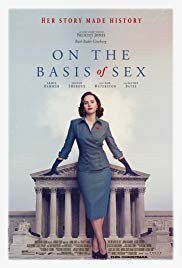
 Greetings again from the darkness. Earlier this year, the documentary RBG (co-directed by Julie Cohen and Betsy West) was a film festival and box office hit, helping turn 85 year old Supreme Court Justice Ruth Bader Ginsburg into a celebrity and cult icon, complete with best-selling “Notorious RBG” t-shirts and her own action figure. That documentary allowed us the rare opportunity to hear directly from a currently sitting Justice, and just about every viewer came away in awe – regardless of one’s political affiliations. Now, a few months later, we get the story of her younger years in a (loving) script written by Ms. Ginsburg’s nephew Daniel Steipleman.

The film opens with a lone woman in a dress engulfed by a sea of young men in conservative business suits marching up the steps on day one of Harvard Law School in 1956. Inside the oak paneled hall, the school’s dean, Erwin Griswold (Sam Waterston) discusses what it means to be a ‘Harvard man’ and how this is only the sixth year women have been admitted. As he speaks, young Ruth (Felicity Jones) glances around the room at the (only) 8 other female students. At a later reception for the females, Dean Griswold asks each to stand and explain why they are worthy of taking a man’s spot in the class. It’s our first (not last) example of the sexism obstacles of the time – much different than those of today, where women procure more higher education slots than men.

By this time, Ruth and Martin Ginsburg (Armie Hammer) are both Columbia graduates, have been married for a couple of years, and are raising their first child, Jane. When Marty is diagnosed with testicular cancer, Ruth covers his classes and hers, is mother to young Jane, and also caregiver to a recovering Marty. Of course, her husband recovers and goes on to be a highly successful tax attorney on Wall Street, and their marriage continues until his death in 2010.

But this is Ruth’s story, and her strength is on display. As uplifting as it is to see that Marty was an immensely supportive husband, it’s deflating to see how a brilliant woman – number one in her class – is so disrespected during this era that she can’t even find a job at a law firm. For one committed to doing, Ruth accepts a job teaching instead. Her time as a professor at Columbia is spent encouraging students to explore the inequities of the law when it comes to men and women. In fact, it’s 1970 when Ruth and Marty work their only case together. A Colorado man, Charles Moritz (Chris Mulkey), is denied a tax deduction for the caregiver expenses in caring for his sick mother. By law, the deduction is only allowed for female caregivers, and this gives Ruth her first taste of ‘doing’.

It’s at this point, where Kathy Bates appears as civil liberties lawyer Dorothy Kenyon, and Justin Theroux as Mel Wulf, the ACLU Legal Director. Adding spice to Ruth’s and Marty’s life is their teenage daughter Jane (a very good Cailee Spaeny) who is quite headstrong in her own beliefs. The scenes in the Appellate Court are the film’s best, as is the Moot Court sequence – though we do wish more time had been devoted to the prep work and details for the court arguments.

Director Mimi Leder is known mostly for her TV work, and she delivers the story of an amazing woman in an easily accessible manner for mass audiences. It’s an approach that will hopefully allow many young people (yes, especially women) to gain a better understanding of what this woman went through and fought for during the decades before she became the second woman to serve on the US Supreme Court.  Two takeaways here are that Ruth Ginsburg is a superhero and pioneer of social change, and also that a marriage of equal partners carries great power. Her cameo as the film’s final shot, leaves no doubt that RBG is no longer concerned about which dress will make her look like a “Harvard man”.

watch the trailer: