BOHEMIAN RHAPSODY (2018)

October 25, 2018

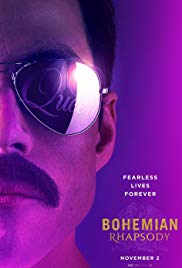
 Greetings again from the darkness. That VOICE! During my life, I’ve been fortunate enough to see many of rock’s greatest bands live in concert, including: The Who, The Rolling Stones, Bad Company, Led Zeppelin, Pink Floyd, and AC/DC. Each of these bands are amazing, but no other concert combined the energy, showmanship and musicianship as Queen (two different tours). And certainly no other lead singer donned a Harlequin leotard … only Freddie Mercury could make that look seem natural.

This is such an odd movie, and one that is somewhat difficult to discuss. It’s billed as an “inspiring story”, though one wonders how self-destructive living, an acrimonious band break-up, and dying young of AIDS could be considered inspiring. It’s not supposed to be a biopic, but the vast majority of the screen time is devoted to Freddie Mercury. And to really confound us, the film kind of drags (pun possibly intended) during the personal story times … and then explodes with greatness during the band and live performance segments.

Rami Malek plays Freddie Mercury, and he perfectly captures the swagger and strut of one of rock’s greatest theatrical showmen. Mercury was born Farrokh Bulsari in Zanzibar, and the film shows us his conservative family and time spent working as a baggage handler at Heathrow. Of course, things change quickly once he joins up with guitarist Brian May (played here by Gwylim Lee) and drummer Roger Taylor (Ben Hardy, MARY SHELLEY). When bassist John Deacon (Joseph Mazzello) is added, Queen is born.

With a story and script from two Oscar nominated writers, Peter Morgan (THE QUEEN, ironically) and Anthony McCarten (THE THEORY OF EVERYTHING), it’s surprising that much of the film is downright slow – especially the bits with frenemy Paul (Allen Leach). Perhaps this is more a factor of the issues with the director’s chair, where Bryan Singer is credited despite being fired during production. Cinematographer Newton Thomas Sigel filled in until Dexter Fletcher (next year’s Elton John biopic ROCKETMAN) was hired to complete the film. Lucy Boynton (so good in SING STREET) holds her own as Mercury’s wife and friend Mary Austin, and Mike Myers plays producer Ray Foster (with a tip of the cap to WAYNE’S WORLD). Other supporting work comes courtesy of Dickie Beau as influential DJ Kenny Everett, Aiden Gillen, Tom Hollander and Aaron McCusker.

The 20th Century Fox opening fanfare has its own Queen version, and is not to be missed as the film begins. Of course, it’s the infamous 1985 Live Aid performance that is the film’s highlight and one that will leave every audience member pumped up, smiling, and singing along. It’s a stunning sequence on a custom built Wembley Stadium stage, and it helps erase much of the tedium of the film’s non-band scenes. Erasing any doubt as to whether the film is worth the price of admission … hearing that VOICE at full volume on today’s theatrical sound systems. Killer Queen.

watch the trailer:


BEAUTIFUL BOY (2018)

October 25, 2018

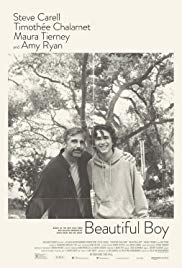
 Greetings again from the darkness. There is absolutely nothing that compares to being a parent. Sorry, pet lovers, it’s not even close. And I’m not referring to the romantic notion of having one’s DNA live on as legacy. Rather, nothing compares to the weight of never-a-break responsibility felt in keeping a helpless newborn alive and properly nourished. And later, teaching the right life lessons so that it’s not your kid who bullies others in school, or steals, or damages the property of others. Someone’s kid is going to do those things, and most of us try our darndest to prevent it from being our kid. The reality is, that even the most attentive and best-intentioned parents can sometimes fall victim to a force beyond their control. Such is the situation in writer-director Felix Van Groeningen’s film (co-written with Luke Davis) based on the two memoirs penned by father and son David and Nic Sheff.

We open on David (Steve Carell) disclosing to a physician (Timothy Hutton) that his son Nic (Timothee Chalamet) is addicted to crystal meth, and asking two questions: 1. What is it doing to him? 2. What can I do to help him? The quiet desperation and pain is plainly evident on David’s face. We know immediately that this Steve Carell movie won’t be packed with laughs.

What follows is the harsh reality of drug addiction. Rehab – Relapse – Repeat. Much of the story is dedicated to David’s struggle and devotion to helping his son Nic in any way possible. He’s a helpless father who refuses to give up on his son, despite the constant desperation and frustration. Every glimmer of hope is soon crushed by yet another lie and more drugs. The film is such a downer that it makes LEAVING LAS VEGAS look like an old Disney classic.

Bouncing between timelines is a device that works for many stories, but here it seems to take away some of the poignancy and depth of some scenes. Just as we are being absorbed into a crucial moment, the film often breaks away to an earlier or later time. This is effective in getting the point across about the never-ending struggles, but we lose momentum on particular segments.

Supporting work comes courtesy of 4 talented actresses: Amy Ryan (as Nic’s mother and David’s ex-wife), Maury Tierney (as David’s current wife), Kaitlyn Dever (Nic’s girlfriend), and LisaGay Hamilton (involved in rehab). It’s a bit odd to see the mini-reunion of Ms. Ryan and Mr. Carell from their time on “The Office”, but mostly the on screen time is pretty limited for all four women. The reason this film works is the devastating work of two fine actors – Steve Carell and Timothee Chalamet. We never doubt dad’s commitment, just as we never doubt son’s helplessness in getting clean.

The soundtrack acts as a boost to the dialogue with such songs (perhaps a bit too convenient and obvious) as John Lennon’s “Beautiful Boy”, Neil Young’s “Heart of Gold”, and Perry Como’s “Sunrise, Sunset”. It’s debatable whether it’s possible for a movie to look “too good”, but it’s a bit off-putting to admire the camera work while someone is struggling on screen with drug addiction. The downward spiral of drug addiction feeds on the misery, and while we all enjoy beautiful cinematography, this is the rare time that it’s distracting – possibly preventing viewers from going all in. The inherent lesson here is that we can’t always save people from themselves. Knowing what to do isn’t always possible, and sometimes there is simply no right answer … even with “Everything”.

watch the trailer:


WHAT THEY HAD (2018)

October 25, 2018

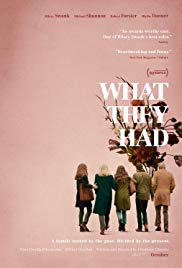
 Greetings again from the darkness. “Til death do us part.” Only far too often, long term marriages are not broken by death, but instead by memories being cruelly erased through disease. Alzheimer’s and Dementia are dreadful diseases, even in the early stages. Writer-Director Elizabeth Chomko uses her feature film debut not to analyze the specifics of these diseases, but instead to focus on the incredibly personal and emotional fallout they produce.

At first glance, Bridget (Hilary Swank) seems to have figured things out in life. She’s a California career woman married to a successful man (Josh Lucas), and their daughter Emma (Taissa Farmiga) is a college student. Slowly, the truth is unfurled – much of it after she receives a frantic call from her brother Nick (Michael Shannon) back home in Chicago. Their mother (Blythe Danner) is missing, having wandered out into a snow storm wearing her pajamas. Bridget and her daughter Emma hop on a plane and land in the middle of a huge family ordeal. See, Nick is exhausted from being the caregiver, and believes the best thing for their mother (and for him) is to move her into an extended care facility. Dad (Robert Forster) is adamant that she remain home with him, where she (and he) are most comfortable.

Of course, the turmoil doesn’t end there. Bridget is in a loveless marriage. Emma has been evicted from her dorm for drinking. Nick’s long-time girlfriend has booted him to the backroom of the bar he owns. Bert, the father, is unwilling to accept or even discuss surrendering the life he’s known for decades. Ruth, the mom, is as apt to make a move on her son as to remember her daughter’s name. Contrasting personalities abound in this house. Despite having power of attorney, Bridget is still intimidated by her bullying father, and seems to have no empathy for the burden carried by Nick. It’s all very messy – just like a real family, and filmmaker Chomko revels in it.

It’s so wonderful to see Robert Forster in such a hefty role. These days, he’s typically relegated to a tertiary character where he mostly frowns and grunts. Not this time. He is at once a bullying force within the family, and an elderly man treading on fragile ground. He belittles his grown kids by calling his bar owner son a “bartender”, and having coerced his daughter into marrying a man for security. Mr. Forster nails the role, as does Michael Shannon as his irksome son. Shannon is one of the best actors working today and he is mesmerizing with his snap backs – sometimes funny, sometimes mean, sometimes both.

There is some horrible relationship advice served up. The family philosophy is “pick somebody you can stand, and make a commitment”, as there’s no such thing as “bells and whistles”. It’s not the romantic chatter most movies provide, but it plays to the complicated bond between parents and kids (of all ages). Director Chomko brilliantly and accurately handles the gut-wrenching effects of Alzheimer’s. She embraces laughter as a coping mechanism, and reminds us to enjoy the rare moments of clarity – those times a parent can remember who you are. There are a few cringe-inducing moments of mushy melodrama, but for the most part, Ms. Chomko delivers.

watch the trailer:


SUSPIRIA (2018)

October 25, 2018

 Greetings again from the darkness. It makes perfect sense when you think about it. After three artsy prestige projects (CALL ME BY YOUR NAME, A BIGGER SPLASH, I AM LOVE), Oscar nominated Italian filmmaker Luca Guadagnino decides to let his freak flag fly. And what better way than to pay homage to his fellow countryman Dario Argento’s 1977 surreal cult classic that featured a blinding color palette, obtuse camera angles, and enough schlock-horror (in a good way) to remain a midnight movie favorite for more than 40 years? While both movies are B**S**T crazy, we can’t help but think a filmmaker of Mr. Guadagnino’s caliber should have done better.

Dakota Johnson (FIFTY SHADES OF GREY) stars as Susie, a Bambi-eyed self-trained dancer raised in Ohio by her Mennonite parents. Following her dream, she shows up for an audition at the world renowned Markos Dance Company in Berlin. The film is set in 1977 (the same year as the original was released) and Susie sufficiently impresses the company director Madame Blanc (Tilda Swinton) to be invited to join.

A title card informs us that we are about to undertake “Six Acts and an Epilogue set in divided Berlin”. It should have added the run time of two-and-a-half hours (it seemed longer). For those of us who would pay to watch Tilda Swinton in any role, this one does deliver bonus value. The enormously talented actress who has disappeared into numerous characters over the years, plays two other roles here – disguised by heavy make-up in both. The trade-off is that Ms. Johnson is the lead, so not only are we subjected to the limitations of her acting, but also camera-trickery when it comes to her dance scenes. A bushy bushy red hairdo conceals her face during the most physically demanding dance sequences … think Cousin It from “The Addams Family”.

An almost entirely female cast features some interesting choices from across generational and geographical boundaries. Angela Winkler and Ingrid Caven have long been familiar faces on the big screen, and Mia Goth and Chloe Grace Moretz are fine choices for the younger company members. As an added bonus, Jessica Harper appears in one segment towards the end. Ms. Harper played the lead role of Suzy in the original. Other fun comparisons between the two films are the original score by Goblin compared to the updated (and more serene) score by Thom Yorke of Radiohead, and the muted color palette chosen by Guadagnino and cinematographer Sayombhu Mukdeeprom for this updated version.

The reason there is an open spot in the company for Susie is that Patricia (Chloe Grace Moretz) has disappeared after unloading her ‘coven of witches’ theory on an aged psychiatrist Dr. Josef Klemperer. Dr. Klemperer initially thinks the hysterical Patricia is delusional, and would prefer to wallow in his grief over his beloved wife Anke – missing since WWII. When Susie gets her shot at the lead in what is to be the company’s final performance of its most famous dance piece Volk, we get the film’s best sequence and one of a few WTF moments. A mirrored dance studio is the site of unexplained violence, and some terrific editing shoots us back and forth between art and mayhem. It’s difficult to watch but exceedingly well done.

Unfortunately, the truly bizarre and horrific moments are much too rare. In fact, some of the segments come off as unintentionally funny, which is not a good thing for a horror flick. The primal dancing never seems sensual, the bloodbath finale is too far over the top, and the political subtext with the Baader-Meinhof terrorist group just never seems to fit. While watching this, a few films came to mind: BLACK SWAN, THE WICKER MAN, MOTHER!, and ROSEMARY’S BABY, though this one doesn’t reach the level of any of those. Sometimes a movie just doesn’t lend itself to analysis or review, and it comes down to whether this is your cup of tea.

watch the trailer:


Mid90s (2018)

October 25, 2018

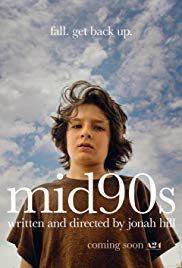
 Greetings again from the darkness. It’s a shame that many will immediately write off this as just another ‘skateboard movie’.  While it’s true that the characters spend a good deal of each day skating, talking about skating, or hanging out in a local skate shop, a more accurate description would be: life lessons presented from a street level view. Remarkably, this is Jonah Hill’s directorial debut. We all know Mr. Hill and his raunchy sense of humor from his acting in such movies as KNOCKED UP, SUPERBAD, and THE WOLF OF WALL STREET, and here he flashes an intimate knowledge of what it’s like to be an outsider … those on the fringes of mainstream society.

Stevie (Sunny Suljic from THE KILLING OF A SACRED DEER) is a junior high kid (slightly built for his age) who gets regularly pounded by his older brother (yet another excellent turn from Lucas Hedges). Their single mother (Katherine Waterston) is more concerned with her own life and mostly clueless as to what goes on with her boys, both inside the house and out.

As one who doesn’t really fit in at school, Stevie happens to notice a group of skaters trash-talking and seemingly having a good old time. He quietly starts hanging around the group, absorbing the nuances of their (mostly) good natured put-downs, and gazing in awe at their skating abilities. Stevie begins the painful and slow process of teaching himself how to skate – one fall at a time. A montage of nasty spills in the driveway make the point that bruises, blood and frustrations are just part of the process.

This group of older boys consists of the leader Ray (Na-Kel Smith, a professional skateboarder and musician), party animal and aptly nicknamed F**KS**T (Olan Prenatt), filmmaker wannabe and also aptly nicknamed Fourth Grader (Ryder McLaughlin), and Ruben (Gio Galicia), the youngest who is only a year or two older than Stevie. We quickly learn the personality type of each. Ray is working towards skating professionally and escaping the hood. F**KS**T simply loves having fun chasing girls, partying, and hanging with friends. Fourth Grader always has his camera and has enough vision to know he wants to make a movie, while young Ruben is insecure and confused about what makes a man – probably the most tragic of all.

As Stevie learns the ropes, we see he is constantly smiling – just happy to finally be a part of something. His fearlessness and ability to absorb pain (thanks to his brother) allow him to be quickly accepted and guided by the guys … some of it good, some of it a bit questionable. The language throughout is more realistic than what we’ve become accustomed to. There are plenty of slurs and profanity-laced trash-talking that wouldn’t pass today’s PC auditors, but director Hill pulls no punches.

One of the downsides is that Lucas Hedges isn’t given much to do here – though he is spot on with the type of bully we all recognize. Instead, the story is a skate movie only to the extent that the sub-culture can be a haven where outsiders come together. Although the film is set 20 years ago, it’s quite interesting to see how these outsiders are so similar regardless of the era. Everyone needs to connect with others, whether they be band members, athletes, or skaters.

Hill has created a spontaneous, quasi-documentary feel thanks to his filming techniques and by using only 3 real actors (young Suljic is outstanding). Trent Reznor and Atticus Ross deliver a terrific score, and there are a couple of beautiful shots of the boys freewheeling down the middle of a busy road with a colorful sky as backdrop. We can’t help but notice some similarities to SKATE KITCHEN, KIDS, LORDS OF DOGTOWN, and even CLERKS, and Hill’s debut is less a story, than a snapshot for those who tend to look past the fringes.

watch the trailer (CAUTION: NSFW):


WILDLIFE (2018)

October 23, 2018

 Greetings again from the darkness. Actors becoming directors is a Hollywood tradition going back many years, although it seems to be quite the trend these days. Just within the past 3 weeks, there have been feature film directorial debuts from Bradley Cooper, Jonah Hill, and now Paul Dano. You surely know Mr. Dano from his work as the uber-quiet brother from LITTLE MISS SUNSHINE, his dual role in THERE WILL BE BLOOD, and his turn as the early years’ Brian Wilson in LOVE & MERCY. He’s a talented actor who now flaunts a near-master’s grasp of filmmaking.

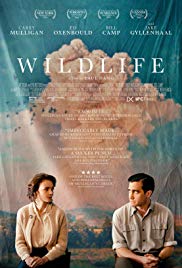
It’s Montana in 1960 when we meet the Brinsons, a typical family of dad Jerry (Jake Gyllenhaal), mom Jeanette (Carey Mulligan), and 14 year old son Joe (Ed Oxenbould). Jerry is a gregarious golf course employee, Jeanette is a former substitute teacher – now stay at home mom, and Joe is a mostly normal teenager who only attempts to play football in order to make his dad proud, and needs his mom’s help on his math homework. Jerry drinks a few beers each night and Jeanette cooks a nice family dinner. Nothing to see here.

This idyllic world is shaken to its core when Jerry gets fired from his job for not respecting the boundaries with club members (not what you’re thinking), and his manly pride won’t allow him to return to the job when the club reconsiders. Jeanette does what moms do – she takes a job as a swim teacher at the local YMCA to tide them over until Jerry can find a new job. It’s at this point when we realize son Joe has extraordinary observation skills for a teenage boy, and he has a front row seat to a disintegrating marriage. Bearing the shame and frustration of a man in this era who can’t provide for his family, Jerry abruptly leaves to go fight an out of control forest fire in the mountains.  Joe longs for normalcy – the only life he had known to this point.

Joe watches in quiet confusion as his mother evolves from doting housewife and caring mother to something and someone he doesn’t recognize. She changes how she talks, how she dresses and how she acts. Jeanette is experiencing the contradiction of knowing she needs a man, and not liking that feeling one bit. She latches on to a local car dealer named Warren Miller (Bill Camp). Miller is basically a master-predator seizing on his injured prey through the power of money and promise of stability, and this makes for some uncomfortable situations both for us as viewers and for Joe watching his mom.

This is a family drama that doubles as insight into the changing times – what defines happiness, what role to women play, how involved are kids in household. Based on a book by Richard Ford, the screenplay is co-written by director Dano and his long-time girlfriend Zoe Kazan (RUBY SPARKS, 2012). The story is one part feminist, one part coming-of-age, and one part societal shift. These are fully drawn, complex individuals that walk, talk and react like people tend to.

As Jerry, Jake Gyllenhaal is excellent in his limited scenes, and Ed Oxenbould is an intriguing young actor and captures the essence of young Joe – especially that moment when kids realize their parents are individuals, not just devices put on earth to serve kids. This is Joe’s story, but it’s Mulligan’s film. What a terrific performance she delivers, which is not surprising, given her track record. Here she makes us feel everything Jeanette feels, and though this isn’t the kind of movie to reach out and grab you, Ms. Mulligan’s performance likely will. There is an expressive score, heavy on the woodwinds, from David Lang; and the cinematography from Diego Garcia is also spot on for era – as is the authentic set design.  Mr. Dano has delivered an exceptional piece of filmmaking for what will likely be a very limited audience. Those that seek it out will be rewarded.

watch the trailer:


BIG KILL (2018)

October 18, 2018

 Greetings again from the darkness. It’s been 6 years since Scott Martin directed his last feature film, and most of his credits are as a producer. This time out, the Texas filmmaker proves his love of the western genre, and he’s so committed to the cause that he dons many Stetsons for the project: writer, director, producer, editor, and one of the lead actors. We always admire those who overcome obstacles and see their vision become a reality. Every movie doesn’t need to be a classic … it’s a Herculean task just to get a film made, and hopefully it provides some entertainment value (which this one does).

Mr. Martin plays Jake, who along with his friend Travis (Clint Hummel) travels the old west countryside finding trouble and making waves at every turn. Jake is the sharpshooter, while Travis is the ladies’ man. Neither seem to have any marketable skills, other than the knack for staying alive – which is an accomplishment given that they seem to be shot at quite frequently and run out of every place they ride into … even Mexico!

The opening shootout sets the mood for us, as it comes across as tongue-in-cheek, with just enough realism to let us know danger exists. Danny Trejo has an entrance worthy of his cult status as Mexican General Morales … a man very displeased with Jake and Travis. An annoying electronic score accompanies a chase scene that crosses the border and ends at a Cavalry outpost run by a Colonel played by the great Michael Pare (EDDIE AND THE CRUISERS), whose two scenes are over far too quickly.

Jake and Travis accompany city slicker Jim Andrews (Christoph Sanders) on a road trip via horseback to Big Kill, Arizona … a town Jim’s brother has promised him is booming. A recurring punchline of “Never heard of it” adds some levity every time Big Kill is mentioned. Instead of a lucrative silver mining town, they find a once boom town gone bust, and now the town is run by the most unethical “Preacher” (steely-eyed and square-jawed Jason Patric) that one is likely to find. The preacher is aided by his muscle: quick-draw Johnny Kane (Lou Diamond Phillips in a gaudy red suit and evil grin) and Stephanie Beran as a knife toting Felicia Stiletto – just one of the character names pulled straight out of the comic book universe.

Jim’s brother (played by KC Clyde) is located, and though Jim begins the courting process with local girl Josie Strong (a standout Elizabeth McLaughlin), the troubles and violence and literal backstabbing in town soon draws the boys into the fracas. Much of the film has the look of kids playing dress up, but as a tongue-in-cheek western, there is enough entertainment value to hold our interest for 2 hours. Fortunately music director Kays Al-Atrakchi resorts to more traditional trumpet-based western music after that opening chase. Most of the shootouts provide some humor, whether intended or not, but we can be sure the cast had a grand time making this one … that shines through loud and clear – especially in a town where the undertaker is named Digger.

watch the trailer:


FIRST MAN (2018)

October 11, 2018

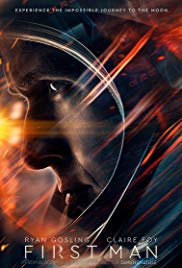
 Greetings again from the darkness. “That’s one small step for [a] man, one giant leap for mankind.” Every junior high student learns that Neil Armstrong spoke those words when he became the first person to walk on the moon’s surface in 1969. So while his words are etched into our minds and the televised visuals of the historic event are seared into our corneas, most of us know little of the man who is renowned as an American hero. Director Damien Chazelle (LA LA LAND, WHIPLASH) finds a way to personalize a man’s story without sacrificing the corresponding grandiose theatre and immense danger.

Kicking off with one of the most intense cinematic sequences ever, the film puts us inside the cockpit of a test flight with Armstrong in 1961 as he bounces off the atmosphere and rockets towards near certain death. This opening makes the statement that this is no ordinary man, and this is no ordinary movie … and we are now prepared to hold on tight! Based on James R Hansen’s book, the only biography Armstrong authorized, the script from Oscar winner Josh Singer (SPOTLIGHT) expertly balances the test pilot/astronaut portion with the character study/personality of the man. Intensity is on display throughout – whether in a capsule or during family time.

Ryan Gosling stars as Neil Armstrong, and the story tracks him from 1961 through that famous moment in 1969. What we see is a man who was first an engineer, and then a pilot. A man whose intellect and nerve allowed him to be part of the second group of pilots selected for NASA’s astronaut program in 1962. The first group was the Mercury Seven. He was also a man emotionally devastated by the death of his young daughter Karen (from a brain tumor) and the numerous deaths of friends and associates in the space program. The film clearly shows how he was impacted.

Proving true JFK’s proclamation that the driving force wasn’t that it was easy, but rather that it was quite hard (and dangerous), we glimpse some of the inner workings of NASA, and what becomes clear that the space program was high stakes gambling filled with huge risks – all for a space race against the Russians that was motivated by ego and national pride. Daily danger was part of the job, as was the claustrophobia that comes with sitting in tin can space capsules being monitored by computers far less powerful than the cell phone you are likely using to read this.  Armstrong’s claustrophobia somehow seemed less apparent during his flights than during press conferences or sitting at the kitchen table with his family – providing even more insight into the man.

Claire Foy (“The Crown”) plays Janet Armstrong, the strong-for-the-kids while suffering-in- (mostly) silence homemaker wife. Ms. Foy does a nice job of conveying the emotional turmoil that goes with being an astronaut’s wife, and having no one to share the uncertainty and worry with. Jason Clarke plays Ed White, the first American to walk in space (Gemini 4) and Armstrong’s neighbor and close friend. Olivia Hamilton plays his wife Pat, while Kyle Chandler plays Deke Slayton, and Corey Stoll offers up a not so complimentary portrayal of Buzz Aldrin. Other familiar faces in the cast include Shea Whigham as Gus Grissom, Christopher Abbott as Dave Scott, Pablo Schreiber as Jim Lovell (played by Tom Hanks in APOLLO 13), Ethan Embry, Ciaran Hinds, Patrick Fugit, Lukas Haas, Cory Michael Smith, Brian D’Arcy James, and Leon Bridges.

Meticulous attention to details of the era include kids that actually ask to go play outdoors (and aren’t overly impressed with astronaut dads). The sound design and set designs are phenomenal and complement the outstanding cinematography of Linus Sandgren (Oscar winner for LA LA LAND). The abundance of close-ups allow for an intimacy that makes the awe-inspiring space sequences even more breath-taking. Actual historic space audio is used whenever possible, and director Chazelle doesn’t shy away from showing us the “other side” of the space program: Gil Scott-Heron’s “Whitey’s on the Moon”, writer Kurt Vonnegut publically questioning the program, and many citizens wondering why so much money is being spent on rockets while there were so many other areas (including Vietnam) in need of attention.

The humor is often quite sly, including a scene where his competitive applicants shrug off Armstrong as only a “Civilian”, unaware of his remarkable service and record in the Korean War as a Navy Fighter Pilot. Gosling’s quietly intense portrayal of Armstrong could be termed constrained, but it’s quite fitting given his subject. Composer Justin Hurwitz (Oscar winner for LA LA LAND) delivers and unusual but fitting score, and we can’t help but realize this would make a terrific trilogy bookended by THE RIGHT STUFF (1983) and APOLLO 13 (1995). Chazelle presents a fitting bio of a true American hero (and yes, we can see the flag on the moon), while also giving us a look at the harrowing process of putting folks into space. It’s on us to decide if it’s worth it, but leaves no doubt that President Kennedy was right … it is hard.

***On a personal note, I attended the first year of Edward H White Middle School in San Antonio, and his widow Pat White came to the Grand Opening. I vividly remember what a classy lady she was and how proud she was of her husband.

watch the trailer:


BIKINI MOON (2018)

October 11, 2018

 Greetings again from the darkness. HEARTS OF DARKNESS: A FILMMAKER’S APOCALYPSE was released in 1991. It was an incredible documentary that explored the struggles of Frances Ford Coppola in making his classic film APOCALYPSE NOW (1979). Although it’s totally unrelated to either of those films, this latest from director Milcho Manchevski kept reminding me that we rarely get a peek at just how challenging it is to complete a film, and HEARTS OF DARKNESS is likely the cream of the behind-the-scenes crop.

Director Manchevski directed the Oscar nominated BEFORE THE RAIN (1995), and he, along with co-writer W.P. Rosenthal, deliver an indie-film societal commentary with some not so complimentary observations on certain segments of our populace.  Producer Kate (Sarah Goldberg) and director Trevor (Will Janowitz) are in a relationship and are trying desperately to make their name with a documentary that can play film festivals. While filming in a homeless shelter, they stumble upon a woman who calls herself Bikini … a homeless African-American Army veteran who is desperate to get her daughter out of the social services system. Bikini (Condola Rashad) is a striking, volatile woman with a story – the perfect subject for Trevor and Kate’s documentary.

It takes a while for us viewers to get the rhythm of the film. We are watching as a documentary crew attempts to make a film about a woman who may be delusional or bipolar, and at a minimum is a bit unstable. Bikini admits to a nervous breakdown while in Iraq, and is inconsistent remembering to take her medication. However, in her moments of clarity, we recognize her exceptional intelligence and charisma. At other times, we worry about the safety of her and those around her. We even question whether she actually has a daughter and how much of her story we can believe.

While coming to grips with the presentation and what to make of Bikini, we also have to adjust to Trevor, an obnoxious jerk who only cares about making his film – and is willing to exploit Bikini (or anyone else) to get it done. At the opposite end of the spectrum is Kate, who has a heart of gold, even at the expense of reality at times … she’s the stereotypical modern day liberal extremist who wants to save everyone and everything. It’s the only way she knows to rid herself of white guilt syndrome.

Cinematographer Joshua Z Weinstein (director of MENASHE) works wonders with the tight residential quarters as well as the numerous urban settings from the streets of New York. Ms. Rashad, whom many will recognize from “Billions”, delivers a powerhouse performance as Bikini, though it’s a bit of stretch to see someone with movie star looks pulling off the role of someone living on the streets. Cynicism is present throughout, and director Manchevski really wants us to question what is ‘truth’ … what happens when the media crosses the line and influences the story … what is the real story?

watch the trailer (NSFW):


THE OLD MAN AND THE GUN (2018)

October 4, 2018

 Greetings again from the darkness. Jim Morrison’s lyrics, “This is the end. Beautiful friend. This is the end” have been interpreted to have many meanings over the years, and they also seem just right for what is likely the final on screen performance from one of the few remaining iconic movie stars. Robert Redford claims this is probably the end of his nearly 60 year acting career. If that’s true, he couldn’t have selected a better project for his victory lap. The film itself is a nice mixture of mass appeal and the independent projects that Mr. Redford has long supported. As for the character he plays, it too fits him like a glove.

Filmmaker David Lowery (fresh off last year’s indie favorite A GHOST STORY) has adapted the story from a 2003 “New Yorker” article by David Grann, and it’s based on a true story – one that’s a bit difficult to believe … well, at least until Mr. Redford brings Forrest Tucker to life. Mr. Tucker escaped from San Quentin at age 70, and it was just one of his 16 prison escapes during a lifetime of robbing banks and getting caught. The story is that Tucker simply enjoyed the work, and went about it in the most gentlemanly possible way – often described by bank employees as polite and nice. It’s the perfect character for Redford’s trademark twinkle and grin acting style.

Most of this portion of the story takes place in 1981, and the film captures not just the era, but also the essence – something much deeper than clothes and cars. Starring alongside Mr. Redford is Sissy Spacek as Jewel, and their chemistry allows the quiet moments between their characters to work as effectively as their (sometimes) playful verbal exchanges. Tucker’s “crew” is manned by Danny Glover as Teddy, and the great Tom Waits as Walter. Waits is always fascinating to see on screen, and here he gets one especially good scene to shine. They are referred to as “The Over the Hill Gang” (in contrast to “The Hole in the Wall Gang” from Redford’s classic BUTCH CASSIDY AND THE SUNDANCE KID.

Casey Affleck (reunited with director Lowery for the third time) plays Austin Texas detective John Hunt, who spent a great deal of time chasing Tucker, and actually put the puzzle pieces together. Tika Sumpter appears as Hunt’s wife, Gene Jones is memorable as a Bank Officer, and for you Austin music lovers, Lefty Frizzell’s granddaughter makes a brief appearances. Other far too brief appearances include Isiah Whitlock, Jr, Keith Carradine (weirdly brief), Robert Longstreet, John David Washington, and Elisabeth Moss. The parade of familiar faces can be a bit distracting, but it’s understandable why so many wanted to work with Lowery and Redford.

Joe Anderson’s cinematography is terrific, and the film is oddly devoid of violence. If not mistaken, I believe we only see Tucker’s gun once … and that’s in a glove compartment. There is a certain easiness and warm fuzzy to the film, somewhat conflicting with what we would expect following an armed bank robber!

Of course, the reason we buy into the gentlemanly outlaw is the performance of Robert Redford. Charming and easy-going comes pretty easily to a man that is charming and easy-going. Director Lowery even treats us to a quick clip from young Redford’s film THE CHASE, and does so within a delightful montage of Tucker’s prison escapes. Few actors get such a perfect farewell tribute, and though it’s not quite Ted Williams hitting a home run in his final at-bat, at least Redford gets to tip his cap to the fans. Since he’s moving his career off screen, let’s bid a fond and appreciative farewell to the man that once proclaimed, “I’m better when I move”.

watch  the trailer: