NINOTCHKA revisited (1939)

April 14, 2020

 Greetings again from the darkness. It’s been too far long since my last “revisited” piece. These are meant to be a combination of movie review and historical perspective on a particular classic movie that I’ve watched yet again. My choice this time is NINOTCHKA, nominated for 4 Oscars (including Best Picture nominees) in what is widely considered one of cinema’s greatest years, 1939.

The roster of director, writers, producers, cinematographer, composer, set director, set decorator, editor, costume designer and actors reads like a “Who’s Who” of Hollywood. The director-producer was Ernst Lubitsch, whose career included 3 Best Director Oscars for HEAVEN CAN WAIT 1943, THE LOVE PARADE 1929, and THE PATRIOT 1928. He also directed THE SHOP AROUND THE CORNER (1940) which was later adapted into YOU’VE GOT MAIL (1998 with Tom Hanks and Meg Ryan). Lubitsch made a successful transition from silent films to talkies, and also directed 3 other films (a total of 6) that were Oscar nominated for Best Picture, including NINOTCHKA. He died of a heart attack at age 55 in 1947.

There are four credited writers for the film, each of which received an Oscar nomination. The original story was written by Hungarian writer Melchior Lengyel, and was adapted by Billy Wilder, Charles Brackett, and Walter Reisch. Mr. Wilder was nominated for 21 Oscars in his career, winning 6. Of course, he went on to become one of Hollywood’s most successful directors with classics like DOUBLE INDEMNITY (1944), THE LOST WEEKEND (1945), SUNSET BLVD (1950), WITNESS FOR THE PROSECUTION (1957), SOME LIKE IT HOT (1959), and THE APARTMENT (1960). Co-writer Mr. Brackett scored 9 career Oscar nomination, including wins for THE LOST WEEKEND (1945), SUNSET BLVD (1950), and TITANIC (1953), the first two of which he shared with Mr. Wilder. Wilder and Brackett had quite a professional relationship, as they wrote 14 movies together, and on an odd personal note, Brackett’s second wife was the younger sister of his first wife (who had died). Mr. Reisch, a 4-time Oscar nominee, shared the TITANIC Oscar with Mr. Brackett, and also wrote the still-popular GASLIGHT (1944, directed by George Cukor).

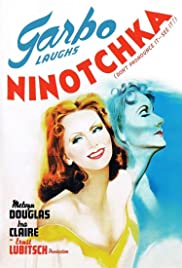
Greta Garbo plays Nina Ivanovna Yakushova, better known as the titular Ninotchka. Ms. Garbo was born in Sweden, and became more than a movie star … she was an icon. She was a 4-time Best Actress nominee, including one for NINOTCHKA. This was her first U.S. comedy, which was such a big deal, that MGM used the tagline, “Garbo laughs!” (a riff on “Garbo Talks!”). This was her penultimate film, as after TWO-FACED WOMAN (another comedy with co-star Melvyn Douglas), she walked away from acting in 1941 at age 36 (imagine if Meryl Streep had retired after OUT OF AFRICA). Ms. Garbo lived in seclusion in New York City, cultivating the infamous “Garbo Mystique”. She never married, though John Gilbert standing all dressed up at the alter certainly thought she was going to! For other standout Garbo performances, see ANNA KARENINA (1935), CAMILE (1936) and QUEEN CHRISTINA (1933).

Melvyn Douglas plays Count Leon d’Algout, a debonair charmer who incites a (passive-aggressive) rivalry between Ninotchka and Grand Duchess Swana. Douglas’ character is one we more frequently expect from William Powell or Cary Grant (both were offered the role), but it would be a mistake to think Lubitsch “settled” on Douglas. He’s considered one of the finest actors ever, and one of the few to have won a Tony, an Emmy, and an Oscar (he won two). Douglas has played the on screen dad to both Paul Newman (HUD, 1963) and Robert Redford (THE CANDIDATE, 1972), as well as Gene Hackman’s dad (I NEVER SANG FOR MY FATHER, 1970) and Peter Sellers’ quasi-mentor in BEING THERE (1979). Mr. Douglas is the grandfather of well-known actress Illeana Douglas (TO DIE FOR, 1995; STIR OF ECHOES, 1999), although, to this day, he is best remembered as the actor who made Greta Garbo laugh!

While Ms. Garbo and Mr. Douglas dominate the screen time, the cast features some other interesting and talented players. Ina Claire plays the exiled Grand Duchess Swana. Ms. Claire was a young Vaudeville performer and part of Ziegfeld Follies before building a reputation as a sophisticated comedy stage actress. She was briefly married to John Gilbert after he was jilted by Garbo, and she only appeared in 7 “talkie” movies before retiring from acting in 1943. Bela Legosi appears as Commissar Razinin, and of course he is best remembered as Count Dracula from Tod Browning’s 1931 DRACULA for Universal. Legosi was a charter member of the Screen Actors Guild (SAG), and died flat broke after his affiliation with schlock-director Ed Wood. He appeared alongside fellow Monster Universe icon Boris Karloff in numerous films (including THE BLACK CAT, 1934; THE RAVEN, 1935), and was buried wearing one of his Dracula capes (not the one from the film). The 3 bumbling Russian envoys who so quickly adapt to western ways are played by actors who fled their homeland and emigrated to the U.S. due to war. Sig Ruman was a German who appeared in several Marx Brothers films, Felix Bressert was a German who had a medical practice as a “side gig”, and Alexander Granach was Hungarian, and also appeared in FW Murnau’s 1922 NOSFERATU. Lastly, Edwin Maxwell, who plays jeweler Mercier, appeared in 13 Best Picture nominees (4 winners) in a 15 year span.

Although the story is not a complicated one, it’s important to note the era. The world had not yet stabilized after WWI and was on the verge of WWII. Joseph Stalin was the leader of the Communist Party in the Soviet Union, and one of the most feared men on the planet. That may not sound like the foundation for a comedy, and it’s important to note that the film is comedy, satire, and political commentary rolled into one. Three Russian envoys are sent to Paris to sell the jewels seized from Grand Duchess Swana during the Russian Revolution. They book the Royal Suite at a posh hotel (partly) because it has a large in-room safe for the jewels. As they are meeting with local jeweler Mercier to finalize the sale, Count Leon barges in to scuttle the sale and trick the envoys into returning the jewels to their rightful owner, the Grand Duchess. Soon, Ninotchka, a no-nonsense Russian, is dispatched to expedite the sale and send the first 3 envoys back home. Ninotchka and Count Leon meet by happenstance, and he’s immediately smitten with her, while she initially views him as little more than a curiosity.

The Eiffel Tower segment is pure brilliance in writing and acting. The dowdy Russian (Ninotchka) is interested in the global landmark for its technical achievement, while Count Leon shifts his charm into overdrive. Her line telling him to “suppress” his flirting is really our first glimpse of Garbo comedic timing … though it’s certainly not the last. The segment serves as a contrast in personalities – the face of communism versus the face of capitalism. Of course, it’s the “Garbo laughs!” moment in the café that most remember. Count Leon bumbles through joke after joke to no reaction, and once she cracks, she really lets loose. It’s a thing of beauty to watch.

As previously mentioned, it’s not just Lubitsch and Garbo and Douglas that make this a classic. The full production crew have a place in cinematic lore. Cinematographer William H Daniels won an Oscar for THE NAKED CITY (1948), and lensed 21 Garbo films. Editor Gene Ruggiero won an Oscar for AROUND THE WORLD IN 80 DAYS (1956), and composer Werner Haymann was a 4-time Oscar nominee. Set-Art Director Cedric Gibbons was a one-time Edison Studios staffer, and won 11 Oscars over 26 years, eclipsing the 8 Oscars won by Set Director Edwin Willis. Adding to the intrigue is Costume Designer Adrian (married to actress Janet Gaynor) who is still revered as one of the best all time with over 250 movies in 30 years, though he’s even more famous for his designs outside of cinema.

1939 is arguably the greatest of all movie years since it also gave us: GONE WITH THE WIND, THE WIZARD OF OZ, STAGECOACH, MR SMITH GOES TO WASHINGTON, GOODBYE MR CHIPS, GUNGA DIN, THE HOUND OF THE BASKERVILLES (the first of the series starring Basil Rathbone), OF MICE AND MEN, WUTHERING HEIGHTS, and LOVE AFFAIR. Though it didn’t win any Oscars (4 nominations), film schools still study NINOTCHKA’s sardonic dialogue, and the way the ‘decadent’ western ways seduce the Russians. It’s clear why film history books refer to the “Lubitsch touch” – a comical and witty approach to serious topics. Beyond that, the MGM marketing department certainly knew how to capitalize on a guffawing Garbo. As with the best classic films, there is much to study, much to learn, and above all, much to enjoy.

watch the trailer:


THE SHARKS (Los Tiburones, Uruguay, 2020)

April 13, 2020

 Greetings again from the darkness. Uruguayan writer-director Lucia Garibaldi has seemingly designed her first feature film specifically for film critics at festivals (it was well received at Sundance). I can’t recall a coming-of-age film with a less-accessible lead character, nor one that displayed that awkward phase between child and adult in a harsher manner. Watch that emotional step – it’s a doozy!

First time actress Romina Betancur plays 14 year old Rosina. The opening finds her running from her angry father right into the sea. It’s at this point she spots the dorsal fin of a shark. Of course no one believes her because sharks are not known to swim around this fishing village in Uruguay. We also learn that Rosina has recently caused an eye injury to her sister Mariana (Antonela Aquistapache), and Rosina claims it was an “accident.” It becomes apparent that her actions are not always the result of wise planning.

Rosina begins working on one her father’s labor crews as the town prepares for the summer visitors. Also on the crew is Joselo (Federico Morosini), an older boy in whom Rosina shows an interest. After their unconventional “date”, Joselo bores of the youngster, while she is rendered both curious and confused. Rather than a sexual awakening, Rosina seems to experience internal prods of which she is unsure how to handle. This transition phase is shown through the perspective of an awkward 14 year old girl who seems to handle everything with a constant stone-face … the envy of any poker player.

Once Joselo’s interest level shifts to others, Rosina fights back in what apparently is her dark nature. Some could call her a psychopath, as her instincts prove ill-advised at best, and possibly even flat out dangerous. Her quiet predator similarities to the shark are obvious, even as the question of ‘shark or no shark’ cloaks the community. Life in this area is not easy. Water is scarce, and these folks have no time to wrestle with Rosina’s twisted ways. Her mother is opening a new salon, and even a pregnant dog has a role in Rosina’s revenge plan.

Uruguay’s rocky coastline and wooded forests make for a picturesque background, and Ms. Garibaldi and cinematographer German Nocella take full advantage. The many tight shots of Rosina are meant to emphasize her isolation and separation, but at times it felt like this shot was used a bit too frequently. The electronic music was often distracting, and the slow pace certainly could have worked if the character development of Rosina had allowed us to better grasp her emotions and thoughts. Instead, the film is either restrained or dull, depending on your taste … although the flashes of humor certainly help. Director Garibaldi may relate to Rosina, but we never do. We are left thinking this could have been an extraordinary short film.

watch the trailer:


NEVER RARELY SOMETIMES ALWAYS (2020)

April 2, 2020

 Greetings again from the darkness. Movies that put youngsters in peril can go one of two directions: the story can feel contrived to the point of manipulation, or it can be real and heartfelt with commentary on society. Filmmaker Eliza Hittman proved her mettle with BEACH RATS (2017), and she proves yet again, that her instincts translate to the screen in stories and characters that hit a nerve.

It’s stunning to discover that this is the first screen credit for Sidney Flanigan who plays 17 year old Autumn. We first see her onstage at her school talent show singing a soulful rendition of “He’s Got the Power”, a 1963 song by The Exciters. Her performance stands in contrast to the mostly generic acts from her classmates, though it’s our first hint at how she is perceived. Autumn is one of those teens who seems to be naturally burdened with more than she can carry. A bloated belly leads her to take a pregnancy test at the local clinic, where she is informed that “a positive is always a positive” – a brilliant line than doesn’t hold true for all interpretations.

The clinic worker shows Autumn an anti-abortion video, which leads her to Google do-it-yourself abortion, and finally to the realization that because of Pennsylvania’s requirement for parental consent, she’ll have to travel to New York City for the procedure. Fortunately for Autumn, she has a trusted and resourceful friend/cousin/co-worker in Skylar (Talia Ryder, who will appear in Spielberg’s upcoming WEST SIDE STORY remake). The girls skim from their cash registers at the grocery store they both work at, and then hop on the bus towards the city.

Their time in the city is an adventure unto itself. By this time we’ve seen some of the everyday obstacles faced by teenage girls, including thoughtless teenage boys, a loathsome stepfather (Ryan Eggold), and a sleazy store manager. All of this is in addition to the challenges brought on by being a sexually active minor. On the trip, they meet Jasper (Theodore Pellerin, “On Becoming a God in Central Florida”), a fellow bus traveler who strikes up a conversation. Is he a good guy or not? Can he be trusted or not? Again, these are situations that the teens must navigate through instincts not yet fully developed.

A questionnaire administered at the Planned Parenthood clinic provides the film’s title, as well as one of its most powerful scenes. Ms. Flanigan is exceptional as this simple form requires her to face her situation and her life as she answers questions regarding her sexual and personal history. Ms. Ryder is also tremendous in making Skylar such a strong young woman and friend. This film and these actresses show more than they tell. The minimal dialogue contrasts to the many movies who portray gabby teens. Writer-director Hittman seems to make movies more appreciated by critics than mainstream audiences, but it seems her time is coming. She makes her political belief quite clear, but does so by focusing on the real world that teenage girls face. It’s a dramatic work of art with extraordinary camera work by Helene Louvart (the excellent INVISIBLE LIFE, 2019).

watch the trailer:


CLOVER (2020)

April 2, 2020

 Greetings again from the darkness. These days, B-movies don’t get the respect they deserve. In the age of massive, hundred million dollar (and more) budget blockbusters, the low-budget movies produced purely for entertainment purposes get brushed off as being undeserving of screen time. The truth is, the best ones are easy to watch … and can be a fun way to while away the hours if, say, one is forced to stay in their home for an extended period of time. Writer-director-actor Jon Abrahams’ movie fills this role just fine.

Mr. Abrahams (MEET THE PARENTS) and Mark Webber (GREEN ROOM) star as the Callahan brothers, Mickey and Jackie, respectively. These are the type of Irish brothers who only stop bickering long enough to wrestle each other to the ground. While most of their spats may be typical brother stuff, this latest involves Jackie’s inept card playing, and the subsequent loss of the money they needed to pay back a mob loan shark. Missing this payment means Tony (Chazz Palminteri) assumes ownership of the Irish bar their late father opened, and it could mean even worse news for the brothers.

I would pay triple ticket price just to watch Chazz Palminteri chew scenery like he does here as Tony. When he makes the boys an offer they can’t refuse, they end up in the basement of a house with Tony’s son Joey (Michael Godere) telling them to shoot the man tied to a chair (another of Tony’s loan customers). Ba-da-bing, ba-da-boom, and the next thing we know Mickey and Jackie are on the run with 13 year old Clover (Nicole Elizabeth Berger), dodging Tony’s men, in addition to the 2 female assassins (Erika Christensen, TRAFFIC) and Julia Jones (WIND RIVER) they aren’t even aware of!

As a quasi-framing device, we find Ron Perlman holed up in a fabulous mansion that we view with the film’s opening aerial shot. Mr. Perlman is afforded his own chance to ‘let loose’ and emote like he’s participating in an acting seminar … while play-calling the wolf video running simultaneously. Other characters that cross paths with the brothers and Clover include Jackie’s ex-girlfriend Angie (Jessica Szhor), a befuddling rescue ‘scientist’ played by Jake Weber, and a bar owner played by Tichina Arnold, who like Perlman and Palminteri, was clearly directed that it’s not possible to go “too big” in a scene.

Humor, most of it pretty dark, is around every corner. A bowling pin has a use outside the lane, the lady assassins drive a car with a fitting sign, we are treated to a good old fashioned death scene, and there’s a shootout accompanied by melodic jazz. As a cherry on top, the bar patron that the brothers leave in charge is Larry, played by the director’s dad, Martin Abrahams. There is a definite 1970’s vibe to the story and film, and we can’t help but be a little disappointed when the conclusion does in fact, “end the chaos.”

watch the trailer:


RESISTANCE (2020)

March 26, 2020

 Greetings again from the darkness. Learning of the courageous people who found their own way to battle the Nazis during World War II never gets old. Sometimes brain power and courage are more important than gun power. Such is the case in this latest from writer-director Jonathan Jakubowicz, who brings a fascinating story from within the French Resistance to the big screen. This is a group that rescued 10,000 orphaned kids, and this is a story of one special man from within that group.

Jesse Eisenberg (and an iffy French accent) plays Marcel, the son of a multi-generational Jewish butcher in Strasbourg France. Out of familial duty, Marcel works at the butcher shop with his father, but his passion is in performing arts. One evening his dad (Karl Markovics) ‘catches’ him performing a silent Charlie Chaplin act on stage at a local cabaret. A parental lecture follows. Marcel’s penchant for entertaining does come in handy when he helps his brother Alain (Felix Moati) and cousin Georges (Geza Rohrig, SON OF SAUL) rescue 123 orphans.

The opening sequence in the film finds young Elsbeth (Bella Ramsey, Lorna Luft in JUDY) witnessing her Jewish parents being murdered in the street outside their Munich home by Nazis in 1938. We next see her in the group of 123 orphans noted above. As a kind of framing device, we flash forward to 1945 in Nuremberg, as General George S Patton (Ed Harris) is addressing the troops and telling the story of a remarkable man. That man is Marcel, and the film then takes us through his journey and we “see” the story that General Patton is “telling.”

When Marcel and his brother agree to join the French Jewish Resistance (also known as Organization Juive de Combat, OJC), they face more danger, and maintain their focus on rescuing orphans. Helping in the cause is Emma (Clemence Poesy, IN BRUGES), and a mutual respect and attraction forms between she and Marcel. The brutality of the war is shown through the actions of Klaus Barbie (Matthias Schweighofer). As the head of the Gestapo in France (and known as The Butcher of Lyon), Barbie works out of the Hotel Terminus, and his sadistic tendencies find their way into the Resistance.

Once the war escalates to a certain point, the Resistance must decide whether it’s best to continue hiding the kids, or risk the perilous journey across the Alps in hopes of freedom. In reality, it’s not much of a decision, as staying put likely means torture, if not death. There are some touching moments between Marcel and the kids, and some acts of pure bravery from all involved.

At times, the film teeters into LIFE IS BEAUTIFUL territory, but never for long. The moments of pure terror are well presented, yet never overly graphic. We feel the stress of the Resistance as they struggle to get the kids to safety, and feel their pain in tragic losses. As the film ends, General Patton finishes his story by introducing his story’s Marcel. The spotlight then lands on Marcel Marceau in full make-up and costume. Marceau, of course, went on to become famous and beloved around the world as the most famous mime. Filmmaker Jakubowicz has delivered yet another fascinating story of heroism and courage … another story that deserves to be remembered.

watch the trailer:


LOST GIRLS (2020)

March 25, 2020

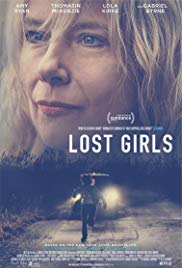
 Greetings again from the darkness. The Long Island serial killer is a famous unsolved case, yet very few filmmakers would take on a true murder mystery that has no ending (The Boston Strangler and Zodiac excepted). Liz Garbus long ago established herself as an expert documentarian, and has earned Oscar nominations (WHAT HAPPENED, MISS SIMONE? 2015; THE FARM: ANGOLA, USA 1998). My guess is she was initially attracted to this story as a documentary, but transitioned to her first narrative feature out of necessity. Working from the book by Robert Kolker and a screenplay from Michael Werwie (EXTREMELY WICKED, SHOCKINGLY EVIL AND VILE, 2019), Ms. Garbus and her talented cast offer up a different viewpoint of the crimes … the viewpoint of a mother who refuses to give up her daughter a second time.

Amy Ryan (Oscar nominated for GONE BABY GONE, 2007) gives a fierce and compelling performance as Mari Gilbert. Mari is a struggling single mom holding down two jobs – one as a construction worker, and one in a local diner. She is raising two daughters: Sherri (rising star Thomasin McKenzie, JOJO RABBIT, 2019) and Sarra (Oona Laurence, THE BEGUILED, 2017). Mari takes a phone call from her eldest daughter Shannan, expressing delight that the girl will visit for dinner, and with little hesitation, asks her daughter for some money to fill the gap left by reduced work hours.

Shannan never shows up, and a mysterious phone call the next morning sends Mari and her daughters into investigative mode. Daughter Sherri uncovers the secrets her mom has been keeping from her, while at the same time watching her mom tear into the cops for their apparent lack of interest in finding Shannan. Dean Winters (“Mayhem” from the insurance commercials) plays Detective Bostick, who barely hides his contempt for Mari and her missing ‘prostitute’ daughter. Police Commissioner Dormer (Gabriel Byrne) deals directly with Mari, and bears the brunt of her aggressive fight to keep her daughter’s case from fading.

Mari is wrestling with her own emotions regarding Shannan, and it’s really daughter Sherri (Ms. McKenzie) who becomes the most interesting character in the saga. Other key players are Kevin Corrigan as conspiracy theorist Joe Salise, Reed Birney as creepy Dr. Peter Hackett, and Lola Kirke (daughter of Bad Company drummer Simon Kirke, and GONE GIRL) as Kim, the sister of one of the missing sex workers. With Mari pushing the cops, four bodies are discovered near a wealthy gated community called Oak Beach. There is a tremendous sequence involving 911 calls, and it plays right into the debate of whether this was incompetent police work or a cover-up. The lack of interest regarding missing girls seems to make it clear that the cops were hardly motivated to find the sex workers, and when Mari reminds them that these are daughters and sisters, it’s a powerful moment.

Director Garbus includes some actual news clips, and at the film’s conclusion we see a 2016 press conference with the real Mari Gilbert. Shannan disappeared in 2010, and 10-16 bodies have since been attributed to the Long Island serial killer – though the cases have never been solved. As a police procedural, the film has far too many gaps and skims over details and evidence. However, as a personal drama and commentary on police attitudes, it succeeds.

The film is now available on Netflix.

watch the trailer:


BLOW THE MAN DOWN (2020)

March 20, 2020

 Greetings again from the darkness. Who better to sing the title song than Gloucester, Massachusetts singer David Coffin … while wearing the attire of the local fishermen of fictional Easter Cove, Maine? Mr. Coffin’s rich vocals (and face) pop up periodically throughout the film and provide an unusual bit of story structure to the feature film debut of co-writers and co-directors Bridget Savage Cole and Danielle Krudy. It’s a nifty little indie film that’s fun to watch, despite some gaps in the storytelling that keep it from ‘what could have been.’

Sophie Lowe and Morgan Saylor star as the Connolly sisters, Priscilla and Mary Beth. Their mother Mary Margaret Connolly has just died, and it appears they may lose their family home as well as the family business – a local fish market. Priscilla is the reserved, level-headed one, while Mary Beth (who put off college for a year) is impulsive and reactionary. A poor decision made while drinking with bad boy Gorski (Ebon Moss-Bachrach) leads to a violent confrontation involving a harpoon, a brick and cole slaw. Well, technically the cole slaw comes in during the clean-up being orchestrated by Priscilla.

There are some Coen Brothers and neo-noir elements at play here, which, along with the intriguing small town characters keeps us connected to the story and wondering how things will end up. An interesting twist has Easter Cove with a Matriarchal town structure, one of which the recently deceased Mary Margaret Connolly was instrumental. Three elderly ladies played with glee by June Squibb, Marceline Hugot, and Annette O’Toole take it upon themselves to continue the behind-the-scenes power brokering, while at the same time ‘cleaning up’ the town a bit. After the murder of a local prostitute, the triumvirate of senior women confront Enid Nora Devlin (yet another scene-stealing turn from Margot Martindale), who runs Ocean View B&B, the town’s brothel. Enid listens to their request to shutter the doors … or at least transition into a traditional bed and breakfast.

A found bag of money plays a role, as does Priscilla’s carving knife, and Alexis (Gayle Rankin), a friend of the murdered girl. Will Brittain plays Officer Justin Brennan, a young policeman who fancies Priscilla and is committed to solving the crime(s). All of these interactions are quite something to watch, as most every character has their own secrets and motivations. As mentioned, the story structure may remind some of Coen Brothers projects, however as fun as it is to watch, it’s lacking the sharp and witty dialogue of the Coens. Also, while many of us enjoy movies that don’t fill in every detail, there are gaps crucial to understanding the actions of these characters … gaps that probably should have been colored in a bit more.

Harpswell, Maine poses as Easter Cove, and there is something about this small fishing community on the northeast coast that creates a unique and appealing setting for a movie. Additionally, the dialect and personalities make for entertaining cinema. It’s a nice first feature for Ms. Cole and Ms. Krudy and we look forward to more of their work.

*available on AMAZON PRIME

watch the trailer:


SAINT FRANCES (2020)

March 17, 2020

 Greetings again from the darkness. The old saying goes, “Fake it till you make it.” Well when it comes to life and adulting, no one ever really makes it. Everyone has their doubts and troubles and challenges. And by everyone, this means every single person, regardless of whether you think they have it all figured out. This is the first feature film for director Alex Thompson and the first feature length screenplay from Kelly O’Sullivan, who is also the lead actress here. The script is so smart and intimate that we tend to believe she included at least some of her own experiences. Either way, this is superb independent filmmaking … the type usually reserved for festival runs.

Ms. O’Sullivan plays Bridget, a 34 year old “server” who seems cloaked in a type of sadness or melancholy that elicits first disinterest, and then attraction from the two guys we see her meet at a party. Once a promising writer, Bridget’s life has started to slip away. As often happens when things aren’t going well, life gets more complicated for Bridget. Her casual relationship (“This is NOT a relationship!”) with uber-nice guy Jace (Max Lipchitz) leads to an unwanted pregnancy, followed by an abortion. Jace is very supportive during the process, and seems to be a wonderful guy. Rather than giving him a split personality with an evil side, the film allows Jace to be Jace, while Bridget treats him as a convenience (can you say turned tables?).

Bridget soon takes on her first ever nanny job, even though it’s pretty clear she is clueless when it comes to caring for kids. Her “job” is rambunctious and whip-smart 6 year old Frances (Ramona Edith Williams), daughter of mixed race lesbian couple Marin (Charin Alvarez) and Annie (Lily Mojekwu). Marin recently gave birth and is suffering from postpartum depression, while Annie is a stressed-out attorney. In other words, they are all a mess. What stands out here, and throughout the movie, is that these characters all seem like real people … folks we could know. That’s why we immediately click with the story and the characters, especially Bridget and Frances.

There are times the film gives off the vibe of a feminist handbook, as it touches on modern world dating and sex, depression, sexual orientation, contemporary societal standards, the conflicting role of religion, and the challenges faced both professionally and personally in a world that is slow to accept the new normal. Despite that, the film never loses focus on what makes it work … the budding relationship between Bridget and Frances, and the forces at work around them (including Joan Jett and a fulsome music teacher/poet played by Jim True-Frost).

One of the more impactful moments occurs when Bridget’s mother (Mary Beth Fisher) is recollecting an emotion she experienced when Bridget was a baby. It’s a terrifying and honest moment that most movies wouldn’t touch. Kelly O’Sullivan wrote a terrific script, but it’s her performance that sticks with you. She reminded me of Brie Larson in SHORT TERM 12 in that the character seems so real … so authentic. There is also a lesson here in that our lives can be impacted by anyone we meet – even a precocious 6 year old.

watch the trailer:


THE HUNT (2020)

March 12, 2020

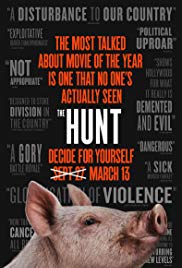
 Greetings again from the darkness. Let’s face it. It was a brilliant marketing strategy. In the wake of mass shootings, the release date of this film was delayed when its subject matter was deemed controversial, even scandalous The film’s new marketing slogan became, “The most talked about movie of the year is one that no one’s actually seen.” Of course, it wasn’t really true, as very few were actually talking about it. But that’s what made it genius marketing … they created interest amidst controversy that has since proven unnecessary. Director Craig Zobel (Z FOR ZACHARIAH, 2015) has delivered the least controversial, non-polarizing film of the year. It basically laughs at extremes on the left and right, and reminds us how laughing at something can often take away its power. And regardless of your “side”, you’ll find some laughs here.

If you’ve seen the trailer, you know that the premise has a group of liberal elites hunting a hand-selected group of social media-active MAGA deplorables. It’s a twist on Richard Connell’s 1924 short story “The Most Dangerous Game”, although the modern day rich aren’t hunting for sport, but rather for political affiliation – gun lovers and climate change deniers. That may sound politically charged, but in fact, it plays as more comedy than comeuppance. Sure, the violence is over-the-top and often quite graphic, but this is a skewering of both red and blue.

Preventing the project from falling into B-movie muck is a standout performance from Betty Gilpin (“Glow”) as Crystal. She’s a Rambo-type who speaks (with a southern drawl) only when necessary, and seems to have learned a lot while serving in Afghanistan. Most of the time she looks like she has “a pinch between her cheek and gum” (a tip of the Stetson to Walt Garrison), and she also hums to herself and tosses down some unusual facial expressions. This is a seriously oddball performance that is the film’s highlight.

One of the best sequences of the film comes quite early as the dozen or so ‘deplorables’ slowly wake-up and find themselves gagged in a field. A container of weapons leads to an early massacre that allows the filmmaker to tease us with numerous familiar faces taking turns as the heir-apparent lead. Some of the faces that pop up include Ike Barinholtz, Wayne Duvall, Ethan Suplee, Emma Roberts, Christopher Berry, Sturgill Simpson, Kate Nowlin, Amy Madigan, Reed Birney, Glenn Howerton, Hannah Alline (flight attendant), and Usman Ally.

Of course we know this is headed to a showdown between Crystal and Athena (2-time Oscar winner Hilary Swank), the ringleader of the hunting party. A fight scene reminiscent of the KILL BILL movies (sans Samurai swords) takes place at Athena’s “manor”, and it is stunningly staged and executed. Unfortunately this scene also highlights the mostly inadequate dialogue that exists throughout the film. Some of the quips click, but many fall flat – surprising since the co-writers Nick Cuse and Damon Lindelof have previously collaborated on “Watchmen” and “The Leftovers.”

Blumhouse Productions keeps cranking out these offbeat genre films, and this one likely benefits from a misplaced scandal, and it strives for self-importance by comparing itself to George Orwell’s “Animal House” and with an obscure reference to TEARS OF THE SUN (2013). It’s not at the level of last year’s gem READY OR NOT, and it missed the opportunity to make some political points, but it’s a hoot to watch and as an added bonus, Hilary Swank teaches us the proper way to make a grilled cheese sandwich!

watch the trailer:


WENDY (2020)

March 12, 2020

 Greetings again from the darkness. When you think of Peter Pan, you likely envision either the 1953 animated Disney film classic or the writings of J.M. Barre, who first introduced the character in his 1902 adult novel, “The Little White Bird.” Whatever your impressions and memories of Peter Pan, they likely differ from those of filmmaker Benh Zeitlin, who was Oscar nominated for his stunning 2012 film, BEASTS OF THE SOUTHERN WILD.

The story begins at a small town greasy spoon diner nestled along railroad tracks. Birthday boy Thomas (Krzysztof Meyn) is devouring a plate of bacon and taking ribbing from the locals who are teasing him with tales of his future working at the diner. He storms out yelping “I ain’t gonna be no mop and broom man”. Toddler Wendy watches as Thomas jumps on the passing train and disappears with the wind. A few years later, Wendy (newcomer Devin France) and her older twin brothers James and Douglas (Gage and Gavin Naquin) are awakened by a passing train and spot a giggling Peter (Yashua Mack) running along the top of the cars. The siblings climb out the window and leap to join Peter. Soon, they are on an adventure to an island (we assume is Neverland) which seems to be populated with kids who run and jump and play all day. Among them is Thomas, who hasn’t aged a day since his birthday bacon.

Any re-imagining of a classic comes with risks. Messing with people’s childhood memories inevitably leads to push-back. Benh Zeitlin gives the impression that he’s a passion-project only type of filmmaker. This interpretation means something to him, and it’s obvious in the detail and creativity. The similarities in visual style to his previous “Beasts” film are obvious, and render quite a different look and feel than we are accustomed to with fantasy movies. But then, this is not a Peter Pan for kids. It’s really a philosophical analysis of life. Everything is an adventure for kids, and then somewhere along the way, we lose ourselves and start the ‘adulting’ portion of life – leaving our childhood dreams behind.

Buzzo represents the once young boy who lost faith. He’s now an old guy dreaming of recapturing his youth. Mr. Zeitlin’s film, which he co-wrote with his sister Eliza Zeitlin, includes magical elements, fantasies, realism, life lessons, hardships, and the importance of personal connections. The score from Dan Romer is exceptional, as are the performances from youngsters Devin France and Yashua Mack. It was filmed on the volcanic island of Montserrat, and thanks to the mythical “Mother” who lives underwater, it becomes a fable about keeping the faith and never growing old. J.M. Barre’s famous first line was “All children, except one, grow up.” Are you that one child, or have you lost faith?

watch the trailer: