WILD MOUNTAIN THYME (2020)

December 10, 2020

 Greetings again from the darkness. While I have Irish ancestors, the uproar of the Irish press over the accents in the film is a bit puzzling to me. Any frequent movie watcher can tell you that cinema history is filled with actors giving difficult accents their best shot – and the results have ranged from ‘spot’ on to ‘not even close’, and everything in between. As a Texan, I can vouch for the sometimes cringe-inducing ‘not close’ efforts, but I’ve never judged a film by such trivial matters. Why do I start with this? Only to get it out of the way in order to have a more meaningful discussion of the latest film from writer-director John Patrick Shanley (DOUBT, 2008, and an Oscar winner for the MOONSTRUCK screenplay, 1987). It’s based on his 2014 Broadway play, “Outside Mullingar”.

After the breathtaking shots of the Irish countryside over the opening credits, we learn of two neighboring farms belong to the Muldoons and the Reillys. Rosemary Muldoon (Emily Blunt) and Anthony Reilly (Jamie Dornan) have known each other their entire lives, and it’s been assumed by locals that they would someday marry each other. Their elderly parents are dying off, yet what prevents the relationship from deepening beyond “Good morning to ya’” is Anthony’s bizarrely awkward social skills compounded by his constant bickering with his father (Christopher Walken), and his belief in a family curse. The two men still mourn the passing of Anthony’s mother, and Rosemary has her own sadness to deal with … while growing a bit antsy waiting for Anthony to come around.

Anthony’s father is concerned that the family name is in danger of ending, due to his reticence to marry. Because of this, dad decides to give the family farm to another relative. The fun kicks off when Adam (Jon Hamm) arrives. Adam is the stereotypical “Yank” – arrogant and showy, with only a romantic notion of what being an Irish farmer means. If that’s not bad enough news for Anthony, Adam also sets his sights on Rosemary and convinces her to visit him. He can’t imagine how the excitement of New York City contrasted with daily life in Ireland won’t win her over.

We don’t actually see any real farming in the movie, and Anthony’s sullen act gets a bit tiresome, but the message is conveyed well by Ms. Blunt and Mr. Dornan. Filmmaker Shanley has delivered more of a romantic drama than romantic comedy, but there are humorous moments included, not the least of which being Anthony’s practice proposal to a donkey. Ms. Blunt proves again what a fine actor she is, and her sequence inside her home in the final act is terrific. As for the accents, Mr. Dornan’s holds up the best, while Mr. Walken’s downright comical, but the story and characters are what we remember when this one ends … unless, of course, you are part of the Irish media.

In theaters and On Demand November 11, 2020

watch the trailer


MANK (2020)

December 3, 2020

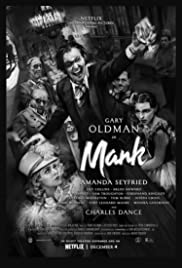
 Greetings again from the darkness. “Just a writer.” The line made me laugh. How many times have writers not received the recognition they deserved, or were underestimated, only to have their words create a lasting impact? Hollywood often likes to portray writers as socially-awkward, loner types who rarely contribute much during conversations. Not this time. The subject is Oscar winning screenwriter Herman J Mankiewicz, who was as quick with a dinner table zinger as he was writing the script to CITIZEN KANE (1941) while bedridden.

More than 20 years in the works, this is director David Fincher’s first film since GONE GIRL (2014), and it’s based on a screenplay written by his late father, Jack Fincher. Dad receives sole writing credit here, though David and producer Eric Roth (Oscar winner for FORREST GUMP, 1994) admit to some polishing. It’s a film seemingly designed for us film nerds, but likely entertaining and interesting enough for expanded appeal. CITIZEN KANE is often regarded as the “best” movie of all-time, though the origin of the film is much debated. We do know that struggling RKO Pictures gave 24 year old wunderkind Orson Welles free reign over his first film, and the result was something quite special. Director Fincher’s film offers up three distinct aspects here: a look at Mankiewicz’s writing process for ‘Kane’, some background on Mankiewicz’s career, and a somewhat fictionalized dissection of 1930s Hollywood politics.

Oscar winner Gary Oldman (DARKEST HOUR, 2017) stars as Herman J “Mank” Mankiewicz, an international correspondent-turned NYC cultural critic-turned playwright-turned screenwriter. Herman was the older brother of Joseph L Mankiewicz, a four time Oscar winning writer-director (ALL ABOUT EVE, 1950), and grandfather to Ben Mankiewicz, a well-known host of Turner Classic Movies. Herman was also renowned as a boozer and gambler, and in 1940 (where this movie begins), he was a bedridden mess recovering from a car accident. Herman was part of the sphere of the infamous Algonquin Round Table, and in most of this film, he talks like he’s still at one of those gatherings.

Mank is taken to a desolate ranch house in Victorville, California, along with his assistant Rita Alexander (Lily Collins), his nurse (Monika Gossman) and his handler John Houseman (Sam Troughton). Orson Welles (Tom Burke) has given Mank 60 days to finish the script, and his only guidance seems to be “write what you know”, and don’t drink. The result was a controversial, yet brilliant script that Welles and his crew (Oscar winning Cinematographer Gregg Toland, Editor Robert Wise, a 4-time Oscar winner) turned into a classic film that still holds up 80 years later.

We immediately start seeing flashbacks, as noted by old style on-screen typing. Ten years prior, Mank was the Head Writer at Paramount, where his staff included Ben Hecht, George S Kaufman, and Charles Lederer … writers whose work would later include NOTORIOUS (1946), multiple Marx Brothers movies, and GENTLEMEN PREFER BLONDES (1953), respectively. Lederer was also the nephew of starlet Marion Davies (played here by Amanda Seyfried), who was the long time mistress of media mogul William Randolph Hearst (Charles Dance). Are you starting to see how this wicked web all fits together? Of course, Hearst was the model for Charles Foster Kane in Welles’ classic movie, while Ms. Davies was supposedly the inspiration for Kane’s wife, Susan. Other key players in these flashbacks are Producer David O Selznick (Toby Moore), Irving Thalberg (Ferdinand Kingsley, son of Oscar winner Ben), MGM founder Louis B Mayer (Arliss Howard), Mank’s brother Joseph (Tom Pelphrey), and Mank’s wife “Poor” Sarah (Tuppence Middleton).

Director Fincher’s masterful film features a couple of standout sequences. The first involves the initial meeting between Mank and Hearst, while Marion Davies is filming a scene on the grounds of San Simeon (Xanadu in CITIZEN KANE). Rapid fire dialogue, multiple characters, and terrific editing with Mank keeping pace as Hearst overlooks the filming. Much later there is a scene following Mank and Marion as they stroll through the manicured gardens with the nearby exotic animals on display. The scene is fascinating to watch, while also reinforcing the kindred spirits of Mank and Marion – both talented, yet not quite allowed in the “club”. Beyond those two sequences, we also get a quite funny segment where Mank and his Paramount writers are improvising a pitch to Selznick and director Josef von Sternberg, plus a telegram sent by Mank to Lederer that states, “Millions to be made here and your only competition is idiots” (a sentiment some believe still holds true today).

Quite a bit of the film is focused on Hollywood politics of the 1930s, both in the studios and nationally. In particular, the 1934 Governor’s race focuses on the campaign of writer and socialist Upton Sinclair (played by Bill Nye, the Science Guy), and the concerted efforts by Hearst and studio capitalists to prevent Sinclair from being elected. The symmetry and contrasts of modern day Hollywood and politics cannot be overlooked. Also made abundantly clear is the disconnect between studio heads, directors, and writers – quite the mishmash of disrespect.

The brilliance of Fincher’s movie is that it can be relished from multiple perspectives. Is Mank attempting to salvage a near-dead career or is he settling a grudge against Hearst? Did Welles intend to hold firm to Mank’s contract and prevent him from receiving a screenwriting credit? And then there is the filmmaking side. Superb performances from Oldman and Seyfried highlight the terrific cast. It’s filmed in black and white by cinematographer Erik Messerschmidt (“Mindhunter”), but not the razor-sharp images we are accustomed to these days, rather soft and hazy in keeping with the look of the times. The production design from Donald Graham Burt takes a couple of viewings to fully appreciate, and the music from Trent Reznor and Atticus Ross is spot on, as usual. Even the opening credits provide nostalgia, as does the 1942 Academy Awards ceremony, which neither Mank nor Welles attended. Netflix delivers another winner, and one likely to receive awards consideration.

watch the trailer


THE PROM (2020)

December 3, 2020

 Greetings again from the darkness. The success of his TV series “Glee” and “American Horror Story” has delivered Ryan Murphy the creative freedom to explore other projects. This time out he directs the cinema version of a Tony-nominated musical, and blends star power with newcomers in an extravaganza meant to fill the gap left by the darkened stages of Broadway during the pandemic. Created by Jack Viertel, with a book and screenplay from Bob Martin and Chad Beguelin, it’s a story of homophobia and narcissism, and the battle to defeat both.

Meryl Streep stars as Dee Dee Allen, and along with James Corden as Barry Glickman, their opening night exuberance for “Eleanor! The Eleanor Roosevelt Musical” fades quickly when the reviews hit. Licking their wounds at Sardi’s, the two are told by the producer that nobody likes narcissists. Joined by chorus girl Angie Dickinson (played by Nicole Kidman) and Julliard-educated actor/bartender Trent Oliver (Andrew Rannells), they decide what’s needed to revamp their careers is a ‘cause celebre’. Thanks to Twitter trends, they locate the plight of Emma Nolan (newcomer Jo Ellen Pellman), whose Indiana High School PTA has just voted to cancel prom rather than allow Emma to bring another girl as a date.

As you would imagine, becoming an activist for the wrong reasons (publicity) can make things messy. These flamboyant city slickers aren’t exactly welcomed with open arms by Midwestern folks. Plenty of touching moments occur between Barry and Emma, Barry and Dee Dee, Angie and Emma, Dee Dee and school Principal Mr. Hawkins (Keegan-Michael Key), and mostly, Emma and her closeted girlfriend Alyssa (Ariana DeBose, who will also star in Steven Spielberg’s upcoming remake of WEST SIDE STORY). PTA leader and leading homophobe Mrs. Greene (a fiery Kerry Washington) does a nice job as a bigot and caring parent.

So while a story exists and messages are conveyed, this is, more than anything, a glitzy musical covered in primary colors as only Ryan Murphy can. Each of our main players gets a featured song, with Ms. Streep’s campy “Not About Me” a highlight, along with Ms. Kidman’s Fosse-esque “Zazz”. Mr. Corden probably gets more than his fair share of screen time, while Ms. Pellman and Ms. DeBose shine brightly in their numbers, and both possess lovely voices. Young Ms. Pellman is especially impressive holding her own on screen with Oscar winners Streep and Kidman.

There likely aren’t many gay teen rom-com musicals set in middle-America, especially ones with a Tina Louise reference, but leave it to Ryan Murphy to make it work. There is some quality humor, though it’s likely the song and dance segments are what will draw the audience. Choreographer Casey Nicholaw takes full advantage of the athletic youngsters and fills the screens with backflips and leaps – complimenting the dance moves of the stars. It’s a shame inclusivity must still be addressed, but at least it can be battled in a fun and colorful way.

Opening in theaters December 4, 2020 and on Netflix December 11, 2020

watch the trailer


ELYSE (2020)

December 3, 2020

 Greetings again from the darkness. We aren’t sure what to make of Elyse Bridges as we are first getting to know her. She seems a bit unstable and unpredictable, and even her husband Steven and her mother are at a loss with how to get along with her. The Bridges live in a beautiful modern mansion, and their live-in help is excellent at helping take care of their son, something Elyse seems to have minimal interest in.

Of course this is a movie, and things aren’t always what they seem. Writer-director Stella Hopkins and co-writer Audrey Arkins keep us guessing for quite a while before revealing the twist. Ms. Hopkins is the wife of Sir Anthony Hopkins, and it’s her directorial debut. Many filmmakers would appreciate having the advantage of a built-in Oscar winner to give their film a shot of prestige, and he does just that, elevating the film with his all-too-brief turn as a psychologist.

Surprisingly, this movie doesn’t belong to Mr. Hopkins, as his role is relatively minor. Instead, it’s Lisa Pepper in the titular role that has us initially grasping at straws, trying to make sense of her behavior. Ms. Pepper only rarely acts in films, as this is her fourth film spread over 13 years. Elyse’s attorney husband Steven is played by Aaron Tucker, whose movie credits come even less frequently than Ms. Pepper’s. This film is a bit of a reunion for Mr. and Mrs. Hopkins, as well as Ms. Pepper and Mr. Tucker, as they all previously appeared together in the 2007 film SLIPSTREAM (written and directed by Sir Anthony).

The pieces finally come together in the third act, and by that time, it’s quite apparent that director Hopkins was attempting to create a stylish psychological drama that keeps the audience guessing. There are a couple of references to “The Wizard of Oz”, including Dorothy’s quote, “If we walk long enough, we will surely come to some place.” Not much more can be said without spoiling the story and what caused the changes within Elyse. Memories are a field of study with many unanswered questions, and the unfortunate path of Elyse is spurred by a single event … something that could happen to any of us. Anthony Hopkins is credited with writing music for the film, and it would have been nice to have him in a few more scenes.

watch the trailer


PRINCESS OF THE ROW (2020)

November 26, 2020

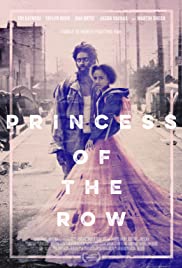
 Greetings again from the darkness. Writer-director Van Maximilian Carlson and co-writer A. Shawn Austin touch on a wide variety of controversial topics in this one: PTSD, Veterans’ Affairs, homelessness, foster care, social workers, and mental illness. At the heart of their story is the touching and strong bond between a father and daughter, even when life’s obstacles become too much to overcome.

Tayler Buck delivers a career-changing performance as Alicia Willis (ANNABELLE: CREATION, 2017), the adolescent daughter of Sgt Beaumont “Bo” Willis (Edi Gathegi, “The Blacklist”), an Iraqi War veteran whose PTSD is linked to a brain injury sustained while deployed. Bo is mostly non-verbal and often disconnected, and living a tough life with the homeless on Skid Row. Alicia is devoted to her father, and worships him as the man who told her bedtime stories when she was young. Those memories not only inspire her to take care of him now, but also to write her own award winning short stories, and to view her life as a sort of Fairy Tale (rather than a tragedy).

We learn that Alicia has already been in three foster homes, including one with her mean-spirited aunt (Tabitha Brown), who likely took her in only for the money. Social Worker Magdalene (Ana Ortiz, “Ugly Betty”) shows true compassion for Alicia, and understands the love she has for her father. Of course Magdalene is also pragmatic and does her best to find a stable environment for Alicia. That’s where writer John Austin (Martin Sheen) comes in. He and his wife agree to take in Alicia, despite this putting her a 10 hour drive from Bo. But distance can’t hold her back.

Following Alicia around is exhausting, yet fascinating. Director Carlson and cinematographer Maz Makhani do a terrific job of capturing her various adventures – each with the purpose of being with her father. Alicia understands, and we see evidence, of Bo’s unpredictability and propensity for violent outbursts. Oh, but in those few fleeting moments when the father she remembers reappears, it’s emotional and heart-warming. Alicia has a wonderful line that will surely touch viewers. She says, “I love it when you come back to me.” And so do we … the world seems right, even if it’s only a blink.

This performance should elevate Tayler Buck amongst young actors, and we will likely be seeing her quite often over the next few years. And as strong as she is here, we shouldn’t overlook the work of Edi Gathegi and Ana Ortiz, or even Martin Sheen (now 80 years old), who always seems a natural for movies with a message. Jessica Childress sings a beautiful song, “Walk with Me”, that is the exact fit for this film that puts love and hope amidst misery and hopelessness.

watch the trailer


UNCLE FRANK (2020)

November 24, 2020

 Greetings again from the darkness. Alan Ball has been behind such high profile projects as Best Picture Oscar winner AMERICAN BEAUTY (1999), “Six Feet Under”, and “True Blood”. This time, he is writer-director-producer for a film that he partially based on his own father. Repressed homosexuality, alcoholism, death, and family dysfunction all play a role in a film that starts out beautifully insightful and then morphs into something totally different.

Paul Bettany stars as the titular Uncle Frank Bledsoe. When we first see Frank, he is the calm amidst the chaotic family gathering in their tiny hometown of Creekside, South Carolina. His 14 year old niece Beth (Sophia Lillis, IT) serves as our narrator, and she quickly discloses her admiration for her favorite uncle. He’s a college professor at NYU, and the only adult “who looked me in the eye”. He even wore after shave! The two are oddities in this family since they both love to read, have deep conversations, and can’t escape Creekside soon enough.

Beth is too sheltered to realize that Frank has kept his homosexuality a secret from the family. She’s shocked at how cross the family patriarch Daddy Mac (Stephen Root) acts to his son Frank, which contrasts to his affinity for his other son, and Beth’s father, Mike (Steve Zahn). A terrific ensemble cast fills out the family: Margot Martindale as Mammaw Bledsoe (Frank’s mother), Judy Greer as Kitty (Mike’s wife), Lois Smith as Aunt Butch (Frank’s stuck-in-the-past Aunt), and Jane McNeil as Neva (Frank’s sister).

We flash forward 4 years and Beth is now a freshman at NYU where her favorite uncle is a professor. Of course it doesn’t take long before Frank’s secret is revealed, and Beth meets his longtime partner Wally (Peter Macdisi, who is director Alan Ball’s real life partner) and their pet iguana named Barbara Stanwyck. When the call comes through that Daddy Mac has died, the film shifts to the road trip portion of the show, and the excellent tone set in the first half is shattered.

With a shift to Frank’s perspective, we experience his flashbacks to childhood and what caused the rift with his father. The memories of his first encounter with another boy turn horrific, and explain much about why Frank and his closed-minded father don’t have a relationship, and why Frank has a nasty history with booze. The road trip itself is enlivened thanks to the enthusiastic presence of Wally, a man with a good heart who tries to always be there for Frank. This is a coming of age trip for Beth, but her role goes pretty quiet until the ending.

The story has elements of small southern town contrasted to New York City, and the pent up frustrations that accompany a life of closeted homosexuality and lack of honesty with one’s family. The bond of family outsiders could have been a full movie unto itself, but filmmaker Ball chose to explore numerous emotional points, rather than one. The unforgivable nature of Frank’s dad provides an emotional wallop that embraces the melodrama of the film’s second half. It’s sure to draw out tears from more than a few viewers, and a film that connects like that, surely has something to say.

Premieres on Amazon Prime on November 25, 2020

watch the trailer


STARDUST (2020)

November 24, 2020

 Greetings again from the darkness. Traditionally, an “unauthorized biopic” will contain some of the less-desirable, and often more entertaining aspects of its subject; however, writer-director Gabriel Range (with co-writer Christopher Bell) admit up front that this is mostly “fictional”. Since David Bowie’s son, filmmaker Duncan Jones, announced that the family was not participating in the project, we somehow miss out on both the personal “dirt” and the actual music of the icon. What remains is an odd couple road trip representing Bowie’s first American tour in 1971.

Johnny Flynn stars as a young (early 20’s) David Bowie. Flynn is a musician-actor recently seen as Mr. Knightley in this year’s excellent EMMA. He’s very talented, but certainly bears little physical resemblance to the androgynous waif of early-1970’s Bowie. We first see Flynn’s Bowie through his dream during an airplane flight. The riff on 2001: A SPACE ODYSSEY is our first clue that the film will track Bowie’s transformation from David Jones to David Bowie to Ziggy Stardust. It plays as a search for his identity … though he mostly just seems to desire being hailed as a star, rather than a musical genius.

Jena Malone appears as Bowie’s first wife, Angie. She’s presented as quite controlling and eager to bask in the success she expects from her husband. We also see her teasing their open marriage, and pregnant with Duncan. When Bowie lands in America, he’s put through the ringer with U.S. Customs and Immigrations – his flowing dress doesn’t help. Bowie is disappointed that Mercury Records has sent Ron Oberman (an excellent Marc Maron) as his station-wagon driving publicist – not exactly the red carpet he envisioned.

Bowie and Oberman on the road is the highlight of the movie. Bowie is relegated to playing the worst imaginable gigs … like a Eureka vacuum salesman conference, while Oberman preaches practicality. Beyond that, Bowie seems self-defeating at every opportunity and we never quite understand his motivation. Miming during an interview with a rock publication can’t seem wise to anyone, no matter how offbeat they perceive themselves. On top of the disastrous American trip, Bowie is dealing with the “family curse”, as his mother describes it. Bowie’s brother Tony (Derek Moran) is shown battling a mental illness, likely schizophrenia. Of course, given his gene pool, David is concerned for his own well-being.

Recent biopics of Elton John (ROCKETMAN, 2019) and Freddie Mercury (BOHEMIAN RHAPSODY, 2018) are perfect examples of what this film is not. This is more of an exploration of identity before Bowie became an iconic theatrical rocker. The influences of Iggy Pop and Marc Bolan (played by James Cade) are hinted at, but mostly the birth of Ziggy Stardust just seems to happen. Commencing countdown to a biopic of a musician before he’s famous, and being handicapped by not having access to his original music, is quite a challenge, and considering those things, even if it’s watchable, it’s likely to be crucified by Bowie devotees.

watch the trailer


HILLBILLY ELEGY (2020)

November 23, 2020

 Greetings again from the darkness. “We don’t use that word.” That is law school student JD’s reaction when someone refers to those like his family as hillbillies. He’s understandably defensive, despite his daily navigations between two distinct worlds. Oscar winning director Ron Howard (A BEAUTIFUL MIND, 2001) presents the true story of JD Vance, a young man who earns his way out of his Appalachian background to gain admittance to Yale Law School, only to get dragged back into the life he worked so hard to escape. Vanessa Taylor (Oscar nominated for THE SHAPE OF WATER, 2017) adapted the screenplay from Vance’s own memoir.

The first thing noticed about this film is that it stars Amy Adams (6) and Glenn Close (7), who between them, have 13 Oscar nominations for acting. That’s a pretty distinguished pedigree for a cast. Ms. Adams has been seen recently in the TV mini-series “Sharp Objects” and as Lynn Cheney in Adam McKay’s VICE (2018). Ms. Close was most recently nominated for her performance in THE WIFE (2018). Other notables in the cast include Haley Bennett (excellent in SWALLOW earlier this year), Freida Pinto (SLUMDOG MILLIONAIRE), and Gabriel Basso (THE KINGS OF SUMMER, 2013).

As the film begins in 1997, we find a young JD (Owen Asztalos) in a tough spot, and we quickly get a feel for the chaos commonplace around his family in Jackson, Kentucky … and also the bond that comes with being a family in the hills. The obligatory family photo ends the segment. We then skip ahead 14 years as the family has 3 houses on the same street in Middletown, after some of them find a way out of Jackson. In this blue collar town hit hard by a financial downturn, they admit to missing only “hope”. The story is told from the perspective of an older JD (Basso), who struggles with the emotional turmoil that his mother Bev (Adams) constantly creates. Remarkably, it’s Mamaw (Close) who provides the strength and stability in the family, and yet, she always seems one small step from exploding at the universe. There is an odd grounded nature and tough-mindedness to Mamaw that Ms. Close radiates on screen. It’s an interesting performance, that some may call over-the-top … a phrase also likely to be used for Ms. Adams as she displays the desperation of an addict, and the broken spirit of one whose shot at life disappeared early on.

For such a stereotypical “simple” family, the complexities of the story and characters are sometimes difficult to appreciate. JD’s sister Lindsay (Bennett) does her best to raise her own family while also managing her mother and grandmother, so that JD can pursue law school. She understands he has possibilities, whereas she has few. And JD’s law school girlfriend Usha (Pinto) truly has no concept of his childhood and family. Class differences are on full display not just with Usha, but also at the dinner where JD (a former Marine) is maneuvering to secure a summer internship that keeps him teetering in the balance of moving forward or falling back.

It’s at this point where JD receives a call from Lindsay informing that mother Bev has overdosed on heroin. It’s yet another example of his own mother inadvertently subverting his efforts to make a new life for himself. Addiction, relapse, financial struggles, family abuse, and untold secrets are the pieces that make up JD’s family pie. When his “old” life collides with his “new” life, will it drag him back down? He periodically faces decisions that are legal and/or morality based, and given his circumstances, it’s never as straightforward as it should be.

Without the power of Glenn Close and Amy Adams, director Howard likely would have had the film slide into the maudlin mode so common with Hallmark or Lifetime Channel movies, and while it’s not the Oscar bait Howard aims for, Netflix has yet another watchable film in their stable. Mr. Howard’s decision to bounce back and forth between 1997 and 2011 does provide the history we need to understand JD’s dilemma, but the see-saw approach is at times distracting. Home movies provided by JD Vance are shown over the closing credits, and it’s here where we realize just how closely Ms. Close physically resembles the real Mamaw. We walk away easily seeing how the circle of this life becomes perpetual, and just how challenging it can be to break free.

Premieres on Netflix November 24, 2020

watch the trailer


SOUND OF METAL (2020)

November 19, 2020

 Greetings again from the darkness. Many of us have attended concerts and experienced a ringing in our ears for a while afterwards. Have you ever thought about the musicians who are playing that music night after night? It’s a risk requiring precautions … and even then, disaster can occur. The first narrative feature from writer-director Darius Marder uses the hearing loss of a heavy metal drummer to explore what happens when the life we know is suddenly snatched away.

Riz Ahmed (TV mini-series “The Night Of”) stars as Ruben, the aforementioned drummer. The film opens with Ruben drumming on stage as his lead singer/girlfriend Lou (underrated Olivia Cooke, THOROUGHBREDS, “Bates Motel”) screams out the lyrics punk-style for their band, Blackgammon. We witness Ruben’s euphoria in the moment, with his “Please Kill Me” tattoo visible across his chest. Afterwards, we see the couple in their RV living a happy life of veggie juice, yoga, and slow dancing between gigs. The first crack in the armor is Lou’s scratching her arm from anxiety, and the next is devastating for Ruben and the couple.

Ahmed is terrific in the most important moments, and he’s assisted by top notch sound design from Nicolas Becker (GRAVITY, 2013). This allows us to feel and experience the moment Ruben realizes he has a problem, and how he begins to process this. Director Marder utilizes subtitles/closed captioning throughout, both for the deaf community and to make Ruben’s situation visceral for viewers. When the doctor explains hearing loss, frustration and defiance kick in for Ruben. He becomes focused on the $40-80,000 cochlear implant option, and views it as a way to maintain his normal life.

Lou becomes worried for Ruben’s well-being, and we learn he’s a recovering heroin addict. He reluctantly agrees to a remote deaf community/rehab facility run by Joe (Paul Raci). It’s here that Ruben learns sign language and begins to adjust to his new reality. Joe is a very patient and sage advisor, and preaches that being deaf is not a handicap – it’s not viewed as something to fix. Implants are considered an affront to the deaf culture, and the film neither shies away from this conflict, nor magnifies it.

The clash between Joe’s patience and guidance, and Ruben’s desire to get his normal life back comprise much of the film. The final scene between the two is gut-wrenching thanks to extraordinary acting from Ahmed and especially Raci. Supporting work in the film is provided by Lauren Ridloff (a hearing-impaired actor) and Mathieu Amalric as Lou’s dad. The final act is quite something to watch. The director says the film is about the finality of life changes, and letting go of what we can’t fix. Joe urges Ruben to appreciate the stillness, and we also see a love story that served its purpose and run its course. Will the distortion lead Ruben to find peace in the stillness? Depending on your stance in regards to the debate within the deaf community, the ending either works for you or it doesn’t. Either way, it’s well done and well-acted.

Amazon Studios will release this in theaters November 20, 2020 and on Prime Video December 4, 2020

watch the trailer


THE LAST VERMEER (2020)

November 19, 2020

 Greetings again from the darkness. Knowing the film is based on Jonathan Lopez’s 2008 book, “The Man Who Made Vermeers” removes some of the mystique from the story; however Dan Friedkin’s (stunt pilot on DUNKIRK) directorial debut is an enticing look at a blending of art history and world history. The screenplay was co-written by John Orloff, Mark Fergus, and Hawk Ostby.

It’s May 29, 1945, three weeks after the fall of Hitler’s Reich, and the Dutch military is on a mission to reclaim valuable art and collectibles confiscated by the Nazis during the war. Some of these were hidden in Austrian salt mines by order of Hermann Goring, actions also depicted in the 2014 film, THE MONUMENTS MEN. After serving in the war, Captain Joseph Piller (Claes Bang, “Dracula” 2020) is tasked with tracking down those who stole the art, and those who sold the art to Germans. It’s a task meant to preserve his country’s culture. One particular piece, “Christ with the Adulteress” held special significance, as it was billed as ‘the last Vermeer’, a long lost painting by Dutch master Johannes Vermeer (“The Girl with the Pearl Earring”), for which Goring had paid a record price.

Investigation on this painting led Piller and his assistant Minna (Vicky Krieps, PHANTOM THREAD 2017) to Han Van Meegeren (played with panache by Guy Pearce and his stylish eyebrows). Piller is also helped by his friend Esper Vesser (Roland Moller, ATOMIC BLONDE 2017) who supplies a bit of muscle and brawn. Van Meegeren has a fancy manner of speech, and Piller determines he’s the key to the case, and to unlocking what occurred and how. At the same time, the Ministry of Justice (August Diehl, INGLORIOUS BASTERDS 2009) is after Van Meegeren for conspiracy, and the parties end up in court.

Piller and Van Meegeren existed in real life, and though some dramatic license is taken, much of what we see actually happened. Art experts and politics collided. And it’s not surprising that egos ruled the day (not unlike today). The twist may or may not be a shocker to those who know the story, but it’s still fascinating that folks would risk their lives in such a manner during the darkest of times. It seems opportunists exist regardless of the era. Mr. Bang and Mr. Pearce are both excellent here, and it’s quite fun to watch their verbal wranglings. Director Friedkin adds an Epilogue that will surely bring a smile to most viewers.

Opening in theaters November 20, 2020

watch the trailer