THE 24 HOUR WAR (2016, doc)

December 8, 2016

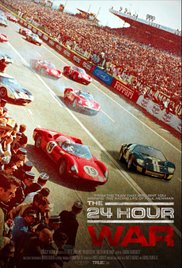
24-hour-war Greetings again from the darkness. This is a war documentary, but it’s not about Vietnam or Afghanistan. Instead, it’s the story of the war of pride and ego between Henry Ford and Enzo Ferrari. Their war took place in garages, in factories and finally on the streets of Le Mans. This clash of race car giants took place in the early 1960’s at a time when drivers were truly risking their life every time they got behind the wheel.

Many of us have heard and read about Henry Ford’s failed attempt to buy Ferrari’s company, but this film from directors Nate Adams and Adam Carrolla goes much deeper. They even help us connect the dots between the personal rivalry and the development of the legendary Ford GT40.

One of the interesting aspects is the contrast and comparison between the two companies. Ford, and its seemingly endless resources, going up against the small Ferrari group that was barely making ends meet … and sometimes not even able to do that. But the real treasure here is the stream of interviews with those who were there. We hear from racing legends such as Bob Bondurant, Mario Andretti, Peter Brock and Dan Gurney. There is historical video footage of Carroll Shelby in the early days of the Cobra and Ford GT40, and additional perspective is provided by Henry Ford III and race historian Brian Laban.

Documenting the golden age of racing is an admirable undertaking, and the filmmakers have done a very nice job. There are some incredible clips of the early 24 Hours of Le Mans races, and special note is provided for the historical 1966 race when Ford finished 1-2-3. While that didn’t sit well with Enzo, it’s fascinating to realize just what an important role that racing played in the development of the passenger cars that we drive even today.


WHEN WAR COMES HOME (2016, doc)

December 3, 2016

when-war-comes-home Greetings again from the darkness. The tragedy of soldiers killed in action is a topic often discussed, and for good reason. Another product of war is less frequently discussed, and involves up to 20% of soldiers returning home from tours in Iraq and Afghanistan. Post-traumatic Stress (PTS) and Traumatic Brain Injury (TBI) have a deep and often long-lasting effect on soldiers, their family and friends, and even the military officers who are responsible for the troops.

Filmmaker Michael King focuses on three soldiers and their efforts to readjust to life at home after war. Wes Carlile is a former US Army Chaplain’s assistant, Emmanuel Bernadin was a Naval Technician in Afghanistan and Iraq, and Spencer Milo was a Sergeant in the US Army. The heart-wrenching story of these three men and the challenges faced by them and their families are a key to what drives Four Star General Peter Chiarelli to seek better treatment for soldiers returning home.

Of course there are those who still claim PTSD doesn’t exist (these are usually folks who haven’t experienced war first hand), but the visits to Walter Reed Army Hospital, and the plethora of interviews conducted for the film, leave little doubt that better and more effective treatment is necessary if these returning heroes are to find a way to fit back in to post-battle life.

Some innovative therapies are discussed, and the important part is that General Chiarelli and others are making certain that the studies continue. The physical and psychological challenges are our responsibility as a society, being as it’s our society that sent them charging off to fight.

The film does an excellent job of providing real life proof of the devastating (and sometimes dangerous) impact to spouses and kids. Seeing mounds of prescription drugs does little to build confidence that we are closing in on the “right” treatment. Every soldier has issues to deal with when they return home … some are able to work through it, while others need help. Mr. King and General Chiarelli are doing their part to see that the best help is available.


14 MINUTES FROM EARTH (2016, doc)

November 23, 2016

14-minutes Greetings again from the darkness. The audience for this documentary is probably every after-school Science club, although most anyone with a sense of wonder will find it interesting enough. Four directors (Jerry Kobler, Adam “Tex” Davis, Trey Nelson, Erich Sturm) combine to present visual proof of a middle-aged Google executive reaching for the stars … or more accurately, pursuing his dream of free-falling from the stratosphere.

The film begins with an introductory and basic overview of the stratosphere being one of five layers to Earth’s atmosphere – and the most difficult to access and study. Tribute is paid to Felix Baumgartner, the Austrian skydiver, who in 2012 set the exit altitude record for his jump from the stratosphere. It’s at this point we are introduced to Alan Eustace, the Google executive who wishes to go higher/fall farther than Baumgartner

For the next couple of years, Eustace and his team of brainiacs discuss, draw, develop, calculate, re-calculate and test their many theories and concepts on how to bring the project to life. To paraphrase Matt Damon’s character in The Martian, they science and technology the sh## of out of this.

Developing a space suit, a specialized parachute, a balloon the size of a football stadium, and the necessary equipment to take Eustace up and get him back is actually a pretty fascinating project to follow … especially the errors and mistakes. The human element is never far away, and just to make sure we know that, Eustace’s wife makes a couple of appearances.

When you or I catch a flight from Chicago O’Hare to LAX, our plane’s altitude probably reaches about 35,000 feet. Imagine going up another 100,000 feet (almost 25 miles above Earth’s surface) and then being dropped with an experimental parachute … now you understand the Eustace dream.

As interesting as the details are, it’s unfortunate there isn’t more of a scientific discovery aspect to the project and the story. It’s mostly just some rich Google dude pursuing a hobby that you and I would never consider. As viewers, we are rewarded with some spectacular and rare photographic evidence of the mission, and a part of our atmosphere that we wouldn’t ordinarily see. One of the quotes about Eustace is his commitment to the Google way … “We believe in the impossible”. So it’s refreshing to know that in this day and age, there are still pioneers and risk-takers, and the technology exists to record it all.


PENCILS DOWN! THE 100 DAYS OF THE WRITERS GUILD STRIKE (2016, doc)

November 6, 2016

pencils-down Greetings again from the darkness. This documentary from director Brian S. Kalata (a successful Location Manager) details the 100 day strike of the Writers Guild of America, and more interestingly, provides a peek behind the curtain of the business side of the entertainment industry. It’s an industry that continually cries financial wolf, while green-lighting the construction of new theatres and producing ever-bigger budget projects. Though this documentary won’t clear up any of the voodoo economics (to borrow a phrase), it does shed some light on who the power players are and who are the ones typically drawing the short straw.

On November 9, 2007, 4000 picketers joined the rally outside the Fox Studios as the WGA strike began. Numerous interviews with industry insiders provide us a basic education on what makes the entertainment world unique when it comes to labor disputes. Here, the leading studios … competitors, mind you … bond together to go up against each of the separate unions (DGA, SAG, WGA, Teamsters, etc) at contract time. Historically, this has resulted in contracts that heavily favor and maintain the largest piece of the pie for the power studios – now run by major media conglomerates, rather than the hands-on studio heads of early Hollywood (Mayer, Warner, et al).

What made this particular strike more interesting was the strong support the WGA received from its members – both past and present, the acting community (SAG), and the viewing public, thanks to an online media blitz telling the story. At the heart of the negotiations was this (at the time) new and rapidly expanding digital media. The studios claimed they didn’t have a business model yet for streaming, iTunes, Netflix, etc, so this was all to be categorized as “home video”, which short-changed the writers from previous contracts.

Those being interviewed include Alan Rosenberg, Harlan Ellison, Howard Rodman and Patric Verrone … all key players in the strike and the vision for the WGA. Each is very forthright in the past shortcomings of contract negotiations, as well as how they felt this strike offered the first real opportunity for fairness.

Labor issues are commonplace in most industries, but the fascination here is derived from the creative artists going up against powerful corporate forces. Even with a show of solidarity between the various entertainment unions, the cause is severely impacted when the DGA cuts their own deal. The film acts as a primer on both entertainment economics and labor relations … two topics we rarely have much access to, though we only get the labor (writers) side of the story.

The film trudges through the different stages of the 100 days, and makes it clear that the WGA felt back-stabbed by the DGA at a time when the industry was in danger of having its most important event canceled … Oscar night. In the end, the writers got their “toe in the door” for digital media, but Julia-Louis Dreyfus said it best … “Without the writers, we are speechless.”


FINDING BABEL (2016, doc)

October 27, 2016

finding-babel Greetings again from the darkness. Tracing one’s roots, or family tree, has become much easier in the internet age, and the process has made for a few interesting documentaries. Andrei Malaev-Babel is an acting teacher at Florida State University, but more importantly, he’s the grandson of famed Jewish-Soviet writer Isaac Babel. Director David Novack tracks the grandson’s journey in re-tracing the steps of the elder Babel’s writings and subsequent arrest/imprisonment/execution.

Isaac Babel is one of the best known post-Russian Revolution writers thanks to his “Odessa Tales” and “Red Cavalry”. He was often critical of the post-revolution society and leadership, and it was his play “Maria” that was the final straw that resulted in his arrest, torture and, finally, execution in 1940. His grandson wants to know the full story … especially what became of the volumes of unpublished work that was seized and “lost” during Stalin’s Great Purge.

Liev Schreiber narrates and reads excerpts of Babel’s work throughout the film. It’s these passages that Andrei and Novack use to make the subtle comparison of then and now … much of today’s Russia is not so different from the oppressive Soviet Union of the 20’s and 30’s. Andrei meets with those who have researched his grandfather, as well as those who have been influenced by his work. There are exceptional clips of a 2003 discussion with Andrei’s grandmother Antonina Pirozhkova who provided much insight before her passing at age 101. This is a woman who was brilliant and tough in her own right.

The journey takes us through Ukraine, Paris and Odessa (where a statue is being constructed in his honor). Andrei looks through the criminal file, though once again, the file with writings is conspicuously missing. He also visits the mass grave where his grandfather is supposedly buried, and we learn that Isaac’s charge of treason was later reversed … unfortunately many years after his execution. Andrei’s journey through Isaac’s 1920 diary blends well with the various stops, but we can’t help but think that as viewers, we are witnessing personal and emotional times that we should not necessarily be seeing … absolutely fascinating, but so very private.


BEFORE THE FLOOD (2016, doc)

October 23, 2016

before-the-flood Greetings again from the darkness. Ten years ago Al Gore became a climate-change icon thanks to the Oscar-winning documentary An Convenient Truth (from director Davis Guggenheim). With this updated warning, the climate change crown is passed to Leonardo DiCaprio, and rather than just speak to the topic, he takes us on a worldwide journey to show us the effects.

The film is bookended by DiCaprio’s speech to the UN general assembly after he was named UN Messenger of Peace on Climate Change. It’s a reminder that the mega movie star has long been an environmental activist … and yes, before you scoff, he does acknowledge that his carbon footprint is probably larger than ours (an obvious understatement – unless you also travel by yacht and private jets, and own multiple mansions).

DiCaprio’s personal story about Bosch’s “The Garden of Earthly Delights” hanging above his crib (seriously, how many parents think this is acceptable artwork for a toddler?) acts as a visual to his message that we are on the path of virtual destruction to the earth that we now know.

The power of celebrity in on full display as DiCaprio scores interviews with such luminaries as UN Secretary General Ban Ki-moon, President Obama, Elon Musk, John Kerry, and even Pope Francis. There is also a clip of his long-ago interview with then President Clinton (Bill, not Hillary). However, it’s not the talking heads that have the most impact here. Rather, it’s the first-hand look at the Canadian Arctic, the disappearing glaciers of Greenland, the sunny day street flooding in Miami, the destruction of Indonesian Rain Forest to capitalize on the palm oil market, and the eroding coral reefs. The film plays like a Tim Burton Travel Channel series … each stop more nightmarish than the previous.

His passion is obvious, though his knowledge less so. DiCaprio understands the power his celebrity brings, and he joins with director Fisher Stevens (known mostly for his acting, but also an Oscar winning director for The Cove, 2009) in this attempt to bring the urgent message to the masses. As they state, we are beyond simply changing lightbulbs, and the key is a shift from fossil fuels to renewable energy … a shift that China (not the U.S.) has taken seriously.

With generic solutions like “consume less” and “vote better”, the film mostly avoids controversy … though it does acknowledge the slick and well-funded ‘campaign of denial’ by those who profit mightily from a fossil-fuel dependent world. We see an impressive map/video screen tracking ocean currents, temperatures, etc. and there is a chart comparing electricity usage by U.S. citizens vs other countries (we are energy hogs, in case you weren’t sure). The ending message hasn’t changed much in the past 10 years … “It is all up to us”.

watch the trailer:


DOOMED! THE UNTOLD STORY OF ROGER CORMAN’S THE FANTASTIC FOUR

October 15, 2016

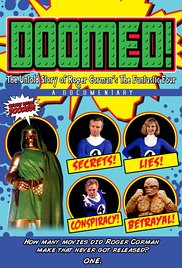
doomed Greetings again from the darkness. Most people over age 30 remember the release of Tim Burton’s Batman Returns, the sequel to his 1989 hit. The film’s budget was $80 million, which seems remarkably low compared to the $250 million (or more) budget of today’s superhero and comic book film adaptations. Putting all of that in perspective, and providing the best ever look at low budget filmmaking, comes this documentary from director Marty Langford. It’s a look back at the ONE million dollar production of Marvel’s iconic The Fantastic Four (the same year as Batman Returns), and how backroom negotiations provided a stake to the heart of those involved.

We are shown a quote from Stan Lee: “The movie was never supposed to be shown to anyone.” It’s a quote that we understand by the end of Langford’s story, but still makes little sense. In 1992, producer Bernd Eichinger realized his rights to these famous Marvel characters were expiring at year end. He contacted the master of “B” movies, Roger Corman, who gave his production team one weekend to come up with a workable plan. What followed was the “movie magic” that we rarely glimpse. Even with that low budget, the script was written, the movie was cast and shooting began (with no rehearsal) … the ultimate rushed production.

The documentary connects the dots between Eichinger, Corman, Troma Entertainment, Marvel Studios, Neue Constantine Films, and Avi Arad; however, the real heart and soul comes courtesy of the interviews with the actors and production crew who were so involved. Looking back with nostalgia, pride and frustration, these folks clearly represent the “get it done” attitude that is so crucial in low budget filmmaking. Their disappointment in never having the film released is evident a quarter century later in their words and their faces.

In what could be described as a conspiracy … though more appropriately as yet another clash in the age old art vs. business battle … the cast and crew were manipulated into believing the film would be released. Many made publicity appearances at festivals, and a trailer was cut and shown in many theatres. Unfortunately (for all but a few), the production was merely a ploy to drive up the demand and cost for the rights … as Avi Arad envisioned a slick, high-budget version of the franchise (there have been two failed versions in the years since).

Some of those interviewed include director Oley Sassone, editor Glenn Garland, Joseph Culp (Doctor Doom, son of Robert Culp), Jay Underwood (Johnny Storm), Alex Hyde-White (Reed Richards), Rebecca Staab (Sue Storm), Michael Bailey Smith (Ben Grimm), and Carl Ciarfalo (The Thing). We mostly get the viewpoint of those who were so close to the film, though there is a brief clip of Roger Corman claiming he was under the impression that it was a legitimate film project … this despite his healthy cash out.

Since a copy of the film was “rescued” by the director and editor, it has become something of an urban legend among the comic book fan base … a cult film that never had its day on the big screen. The best comparison might be a bootleg version of a deep cut of a Springsteen song in the 1970’s. Everything gets released today, but in those days, studios had a way to control what was seen (and what wasn’t). This is a well made documentary on an unusual topic – and a reminder that the artists just want their work seen, while the business side just wants the money.


STARVING THE BEAST (2016, doc)

September 29, 2016

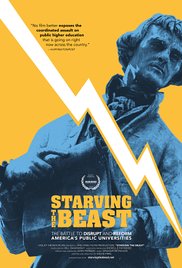
starving-the-beast Greetings again from the darkness. Our founding forefathers have been the focal point of many conversations during this political campaign season, and now Thomas Jefferson and John Adams (along with Abraham Lincoln) are keys to one side of the debate explored by director Steve Mims’ latest documentary. The movie kicks off with James Carville’s commencement speech at LSU as he reminds the graduating students of the vision each of the three iconic Presidents had for public higher education … visions that are now under attack.

The debate in question boils down to a contrast of philosophies: should public higher education continue to be treated as a societal investment in its citizens, or should students be considered consumers of a commodity (education) with public universities being self-sustained profit centers? It’s the ultimate clash between politicians struggling with state budget shortages and those in the world of academia, which has remained mostly unchanged for almost 150 years.

Five highly-respected state research universities form the basis of this research: University of Texas at Austin, University of Wisconsin – Madison, University of North Carolina- Chapel Hill, University of Virginia (founded by Thomas Jefferson), and Louisiana State University (LSU). We learn about the Morrill Act of 1862, a 500% tuition increase in the thirty years 1980-2010, and Wisconsin Governor Scott Walker’s attack on a fundamental core of the education system … tenure for professors. Other topics include CATO Institute, Texas Public Policy Foundation, and “the disruptor” Jeff Sandefer (founder of Acton School of Business) and his “Seven Breakthrough Solutions”.

This is a documentary designed to prompt awareness and discussion. Both sides of the debate receive a fair shake, though the filmmaker’s stance is pretty obvious. An example of “disruptive innovation” is shown with US Steel and its refusal to adapt to market demands for cheaper, lower quality steel. The point being … market change occurred, but the change made things worse, not better. Pan Am airlines is also a case study in how a company can refuse to adapt to market changes … they held tight to “old ways” until Pan Am no longer existed. Such examples are why there is no easy solution to the question being posed. Arguments can certainly be made that our education system has fallen behind that of other countries, but do we really want a populace where the humanities become a relic of the past since they don’t readily fit into the equation for a valuable and productive profession?

Disruption for the sake of reformation can be a good thing if the exchange of ideas and beliefs is done in a logical and precise manner. Of course, in our world, logic is often overridden by emotion … money and profit vs. a societal investment in each generation. Is it “immoral” to rob the next generation of this opportunity, and is that even what’s happening? Numerous interviews (with some smart folks) and clips are offered to drive home just how complex the topic can be … and the strong mindset for each side.

Producer Bill Banowsky was on hand for a post screening Q&A. He was the founder of Magnolia Pictures, and his father was a University President – so the topic is important and personal to him. Well made social issue documentaries such as this are crucial sources to those of us attempting to cut through the tabloid-style journalism that has overtaken mass media. Conflicting ideologies can make for some terrific discussions, and in this case, it’s a subject vital to our societal approach to future generations.

watch the trailer:


SILICON COWBOYS (2016, doc)

September 20, 2016

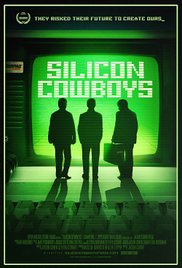
silicon-cowboys Greetings again from the darkness. After countless projects spotlighting Steve Jobs and Apple, it’s about time the tech-nerdy Texas entrepreneurs behind Compaq get their moment on the silver screen. Filmmaker Jason Cohen turns his camera on Rod Canion, Bill Murto, and Jim Harris … none who have the persona or magnetism of Mr. Jobs … and tells the story of how they took on Goliath IBM at a time when most wouldn’t dare.

Taking us back to 1981, the 3 friends (and Texas Instruments co-workers) quit their jobs to start a new company – only they have no real plan on what that company should be or even what industry it should be in. There is a re-enactment of a conceptual drawing of a mobile computer on a diner’s paper placemat … a drawing that helped them secure a big investment from Ben Rosen at a time when Venture Capitalism was non-existent for technology companies (yep, 35 years ago).

Those early days of a slow developing Silicon Valley featured more hobbyists and non-commercial efforts than anything going on these days. Mobile computing was not really even a product category when Compaq stuck a handle on their case … the visuals of businessmen toting them through airports is comical. This was truly the beginnings of the home computer era, and even the tech start-up. The film serves as a historical perspective of the times, while also documenting how Compaq fits into the evolution of the personal computer.

It’s pretty easy to draw comparisons to the great and powerful IBM ignoring the “little guys” to the 1970’s when GM and Ford overlooked Honda and Toyota. It’s always easy to chuckle at the arrogance of big corporations, and when Compaq computers were more compatible with IBM software than IBM computers were, it’s a real head-scratcher. The dawn of “clones” were more than a thorn in the side of Big Blue (IBM), and eventually it got worse for them. Head-to-head advertising campaigns of IBM’s Charlie Chaplin vs. Compaq’s John Cleese further emphasized the contrast between those out of touch with those who clearly understood the market.

Normally a movie that spends much of its time interviewing such down to earth guys as Canion, Murto and Harris, would feel like it’s dragging, but the historical significance is such that contemporary comparisons to Dell, Google, Apple and Facebook keep it briskly on track. Though the electronic background music seems out of place, many viewers will enjoy watching a true story where the nerds win!


THE FIRST FILM (2016, doc)

September 19, 2016

first-film Greetings again from the darkness. How do we handle challenges to historical achievements that have been accepted as facts for more than a millennium? Film classes have long taught that Thomas Edison and the Lumiere brothers were the pioneers of moving pictures. Director David Nicholas Wilkinson has worked for 33 years to prove that Louis LePrince actually beat them to the punch with his own camera and “movies” produced in 1888 Leeds. When LePrince mysteriously disappeared in 1890 he became the industry’s first tragedy/mystery, leaving him with no place in history … something Wilkinson is trying to correct.

You may have heard other arguments for Eadweard Muybridge, William Friese-Greene and Wordsworth Donisthorpe, but it comes down to limiting the definition to a single lens camera capturing live action on film for playback. Director Wilkinson includes the 3 surviving snippets of scenes recorded by LePrince: a small gathering of friends/family walking around, LePrince’s son Adolphe playing an instrument, and a Leeds street shot of moving carriages.

To prove his theory and secure LePrince’s place in history, Mr. Wilkinson meets with film historians, researchers, academic experts, museum curators, and even a patent lawyer. The patents are key because LePrince had secured his U.S. and England patents, but the laws worked against him and his supporters once he disappeared. Details are presented in all aspects … some concrete, scientific and impressive; others more speculative and circumstantial (as you would expect 125 years later). Wilkinson is willing to do what’s necessary to make a clear point as evidenced by his searching a graveyard for a specific headstone (to establish a timeline of the “walking” footage).

Two of the more interesting sequences occur when Wilkinson visits the actual room in the oldest house in Manhattan where LePrince’s moving picture was to be shown; and his trip to Memphis, Tennessee to meet with LePrince’s great great granddaughter to share evidence, artifacts and stories. The three main theories surrounding LePrince’s disappearance are profiled. Was he murdered (possibly a hit by Edison)? Did he commit suicide? Was it all a plot to steal his patents? With no body, no witnesses and no evidence of a crime, the LePrince disappearance is the first unsolved mystery of the movie business.

It seems Wilkinson presents enough hard evidence to justify adding LePrince into the discussions around the birth of movie making. The unsolved mystery adds an element of intrigue, and makes for a more interesting movie. Mostly Wilkinson is to be admired for his 33 year obsession, for finishing his project, and for bringing attention to one of history’s forgotten players. Beyond that, the tongue-in-cheek manner in which he chooses to end his film allows us to appreciate his efforts and keep it in perspective.