EVERYBODY FLIES (2021, doc)

January 14, 2021

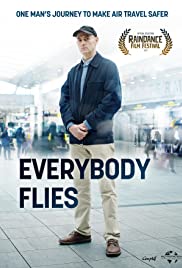
 Greetings again from the darkness. Do you know where cabin air comes from on the commercial planes you fly for vacation or business? Most of us don’t. We simply take the airlines’ word that the air is filtered and safe. Or at least we did before the pandemic motivated us to question air quality everywhere. Former British Airways Captain Tristan Loraine has spent most of two decades researching and compiling information on the cabin air he and so many flight crews … and passengers … breathe on a regular basis.

Loraine is not diving into whether COVID is being spread between folks on a flight, but rather his focus is on TCP (Tricresyl Phosphate), a chemical present in the oil used in jet engines. Without proper filtration (HEPA filters are not sufficient) and maintenance, TCP can leak into cabin air and cause varying degrees of health issues. Catastrophic events are rare and typically identified early, but the real concern is the long-term impact of being exposed to slow leakage causing contaminated air.

The comparison to “Big Tobacco” is made here, and it seems to fit as airlines and manufacturers all say there is nothing to worry about. This stance seems to fly in the face of documented cases of varying illnesses reported by crew members over the years … plus the numerous times where passengers and crews were overtaken by odor and toxic fumes that put them in immediate danger. When the toxicologist points out that a defense of “no evidence” showing danger is meaningless when no tests are run or data collected, the real concern kicks in.

Tristan Loraine and co-director Beth Moran (a former USAF Thunderbirds pilot) present testimony, research, and documentation to justify focused attention on the risk of bleeding air from the engines. They contrast this method with that of Boeing’s 787 which utilizes compressors. What’s shocking is that this has been a known, and overlooked issue since the 1950’s, and the hope is that the film can spur some true action for the safety of those why fly. No narrator is utilized in the film, but the information is systematically presented … it’s not meant to be entertaining, but rather informative. And that it is.

VOD January 15, 2021

WATCH THE TRAILER


SOME KIND OF HEAVEN (2021, doc)

January 13, 2021

 Greetings again from the darkness. The Villages of Florida is a massive master-planned retirement community. It’s similar in development to Del Webb’s Sun City, but roughly 5 times the size. We learn that there are 20,000 single folks among the residents of The Villages, and it’s described as “Disneyland for retirees”. Director Lance Oppenheim (his first feature length documentary) peaks behind the façade of paradise.

You come here to live. You don’t come here to die.” One of the residents makes that statement, and there is much to back it up. Golf courses, tennis courts, swimming pools, recreation centers, social activities, concerts, churches, shopping, and it seems there’s always a party to be found. However, rather than explore the seniors who are embracing this pre-fab lifestyle, director Oppenheim focuses on four individuals whose situations wouldn’t be considered success stories.

Anne and Reggie are about to celebrate 47 years of marriage. But is there reason to celebrate? While Anne fine-tunes her pickleball skills, Reggie self-treats his declining mental acuity with drugs and solitary spirituality. Dennis is the party boy. He’s an 81 year old ‘teenager’ living in his van down by The Villages as he searches for a companion with money – one who will open her villa and treat him like the king he views himself as. Barbara is homesick for Boston. She moved to The Villages with her husband, and he died not long after their arrival. Out of money, she’s working full time in the community office – carrying a sullen look that implies depression and loneliness.

Anne looks to a counselor for help, while Reggie fights drug charges by representing himself in a court of law to a judge who doesn’t appreciate rudeness. Dennis is a self-described “handyman” who can’t work venetian blinds, and is smarmy in his pickup methods. Barbara watches video of her wedding on her iPad while eating lunch with her dog, and only shows signs of life when the Parrot Head Margarita man is kind enough to converse with her. While we are getting to know these four, Oppenheim shows off the fabulous community with a golf cart bridge over the freeway, its manicured lawns, swaying palm trees, and engaged citizenry.

The Villages were originally developed by Harold Schwartz, and he makes a brief appearance here thanks to an old video clip. With more than 100,000 residents, is it the sterile environment that masks sadness as presented by Oppenheim, or does it provide an environment for folks to live out their final years by staying active, learning new activities, and socializing? By choosing these four as his focus, there is little doubt the filmmaker is making a statement about his stance, but a better approach would have included insight from “the other side” of the argument. Otherwise, why are there so many “Frogs” – those there till the croak?

Available January 15, 2021 on Video on Demand

WATCH THE TRAILER


NIGHT STALKER: THE HUNT FOR A SERIAL KILLER (2021, docuseries)

January 13, 2021

 Greetings again from the darkness. Crime dramas are one of the most popular television series types these days, and Netflix is proving to be exceptional at producing crime docuseries – a short run series (2-8 episodes) based on real life crimes. This latest is the most haunting yet, as it focuses on a 1985 crime spree in California by one of the most notorious serial killers in history.

Tiller Russell (Producer BERNIE, 2011) directs all four episodes, which provides the continuity needed in this type of project. Each of the episodes are titled: Devil in the City of Angels, Anyone Could Be Next, Lock. Your. Doors., and Manhunt. Additionally, director Russell uses the date and number of days for story structure … beginning with March 17, 1985 as “Day 1” (although the police later learned this sick individual had already been at work for months). This was 1985 and Los Angeles was at its most glamorous, while also experiencing a heat wave.

The first three episodes play like a whodunit and detailed police procedural. We meet the two lead detectives: Gil Carrillo, who was the youngest detective in the Los Angeles County Sheriff’s office, and his partner, Frank Salerno, the legendary detective who was worshipped for tracking down the Hillside Strangler (actually two cousins) in 1977. Both Carrillo and Salerno sit for interviews and recall much of what went in to the case – the detective work, the many mistakes, and the luck (both good and bad). In addition, there are interviews with surviving victims, family members, and journalists to go with the significant archival footage and photographs. Rather than a high-level overview of history, this is an in-depth dive into a tough-to-solve case that had the citizens of an entire state on edge.

As Carrillo and Salerno go back over the case and tell their stories, they are re-living the frustrations of the time. There were so many loose puzzle pieces and, initially, they weren’t sure the pieces were connected. In stark contrast to most serial killer cases, there was no pattern – no consistency in the race, age, or location of the victims. In addition, the crime scenes were only similar in that no fingerprints were discovered. Even the choice of weapons varied. In other words, it was a detective’s worst nightmare.

It’s fascinating to watch as the detectives discuss how footprints were the connective piece that made them realize they were dealing with one very sick individual. The crimes committed – murder, sexual abuse, burglary, etc – were increasingly brutal, and we see many of the crime scene photographs. Even more gut-wrenching are the recollections of surviving victims and family members. It’s mind-boggling how some of these folks survived such vicious attacks.

We also hear from some of the journalists who followed the story at the time, including one who broke the cardinal rule and became part of the story. It’s the humanity of this story that sticks with us, as there is certainly no attempt to glorify this psychopath or his reign of terror. Maps are utilized to help us visualize the haphazard nature of the attacks, and we hear about the multitude of jurisdictions in the area that were not initially sharing details on crimes. It wasn’t until July 20 – Day 125 that the detectives made a specific crime public, which caused the media to create monikers, including “the Walk-in Murderer”, before settling on “Night Stalker”. With no apparent motive or pattern, shock waves of fear flooded the local communities. Episode three recaps the crimes and victims, including one near Detective Carrillo’s home and another in San Francisco. This drives a particularly galling segment featuring San Francisco’s mayor at the time, Diane Feinstein (now a U.S. Senator). Feinstein made a huge gaffe that infuriated the detectives. She released much of their evidence during a TV press conference, possibly jeopardizing the case.

It’s not until the fourth and final episode that we understand how things came together and police were able to close in on the suspect. A tip from Skid Row and a rare break with fingerprints led to the release of a mug shot. With help from the community, the suspect was ultimately captured, and things got even weirder for the trial (3 ½ years later). Richard Ramirez was charged with dozens of crimes with victims ranging from age 6 to 82. In the courtroom, he flashed his palm with a pentagram and yelled, “Hail, Satan”, even while attracting his own following of groupies. Detective Salerno recalls thinking that the Hillside Strangler was a “once in a lifetime case”, and then as things started to come together on the Night Stalker, he thought, “Here we go again.”

The series features haunting, lasting images and a horror that most of us can’t even imagine. Richard Ramirez is the face and embodiment of pure evil, the likes of which we can’t fathom. He created fear and destroyed lives in unspeakable ways before being apprehended and sentenced to death row. Writer Philip Carlo later interviewed Ramirez, and some of those recordings are heard throughout the series. Dedicated Law Enforcement officers like Carrillo and Salerno are remarkable people committed to ensuring most of us can sleep well at night, and that the evil work of psychopaths is stopped as quickly as possible. Even though I vividly remember the time of the Night Stalker, this series will stick with me for a while. It’s not for the faint of heart, but it’s exceptionally well done.

Premiering January 13, 2021 on Netflix

WATCH THE TRAILER


DICK JOHNSON IS DEAD (2020, doc)

January 6, 2021

 Greetings again from the darkness. Hal Ashby’s 1971 cult classic HAROLD AND MAUDE takes a comical look at death, and in the process shows us the importance of living, and the jolt delivered by dying. Documentarian Kirsten Johnson (CAMERAPERSON, 2016) makes this a more personal project by involving her dad in a series of staged deaths for her film. Initially the purpose was to help him begin to deal with an end that could be coming soon, but it evolved into something altogether different.

Dick Johnson is an elderly psychiatrist. He’s a charming and lively man, boasting a nice sense of humor and a twinkle in his eye. His daughter Kristen is “a camera person”, and suggests to him that they make a film about him dying. He’s on board. Kristen then stages various “deaths” for her father. These scenes include getting crushed by a falling air-conditioner, getting hit by a car, taking a horrific fall down stairs, and a construction site mishap. The more we get to know Dick, the more we like him. We learn it’s been 30 years since he had a heart attack, and 7 years since his wife died. She suffered from Alzheimer’s for years before she passed. We learn he’s a Seventh Day Adventist, and loves chocolate fudge cake. My how he loves chocolate cake.

Initially gung-ho for his daughter’s idea, and fully supportive of the situations she puts him in for her art, Dick begins to show signs of forgetfulness and confusion. At times we have our doubts that he fully comprehends what’s happening – not just in the film, but in everyday life. The comical elements shift to wistfulness, as we are present when Dick has to shut down his practice, sell his car, and ultimately box up his belongings and move out of his beloved home. Kristen moves him to her one bedroom New York City apartment, which is right next door to that of the two fathers of her children.

In addition to the staged deaths, we also meet a stuntman who gets involved, and we are on set for the filming of Dick’s “Heaven” which includes chocolate and popcorn, and his “Last Supper” featuring, among others, Bruce Lee, Frida Kahlo, Farrah Fawcett, and Frederick Douglass. There is also a family trip to a beach in Lisbon, and a reunion with Dick’s college girlfriend in California. The strangest bit is the staged funeral, replete with Dick in a coffin, and friends offering tributes. We also celebrate Dick’s 86th birthday, and see many family pictures and home videos.

Leonardo da Vinci is quoted: “As a well spent day brings happy sleep, so life well used brings happy death.”

Watching Dick’s spirit fade along with his memory is anything but happy. His daughter Kristen tries to remain sensitive to his changing state, but the feeling we are left with is anything but happiness towards death. Her film is likely structured much differently than she originally intended, but has so much value for discussion with loved ones and a reminder of just how precious life is for those who appreciate it.

Now showing on Netflix

WATCH THE TRAILER


THE ART OF POLITICAL MURDER (2020, doc)

December 16, 2020

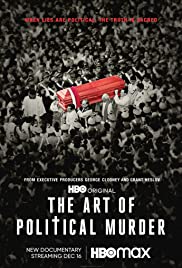
 Greetings again from the darkness. Very few documentaries can also be labeled political crime thrillers, but that description fits Paul Taylor’s film based on Francisco Goldman’s 2014 book. It’s a blend of history, religion, corruption, and investigative work as it all relates to a brutal murder. Even in these times when trust is broken on so many fronts, we as viewers are left wondering how something like this could happen.

The Guatemalan Civil War spanned 1960 through 1996, and had the right wing military facing off against leftist rebels supported by the indigenous Mayans. More than 200,000 civilians were killed, and the people’s faith in their government was destroyed. But this isn’t the story of the war. Bishop Juan Gerardi publicly condemned the government and military for war crimes and atrocities in his deeply researched 1996 REMHI (Recovery of Historical Memory Project) report. Two days later, 78 year old Bishop Gerardi was murdered. Savagely murdered. Bludgeoned in the head and face with a concrete slab, outside his parish home.

The bulk of the film is dedicated to what happened after the April 26, 1998 murder: a botched crime scene, numerous theories, citizen protests, and a high profile trial. It’s really the stories behind the story. The Bishop was an outspoken activist for the Mayan people and he was beloved by many. However, the exploration of the police investigation left many wondering what kind of government would issue a state-sponsored hit on a religious leader of the people.

We hear from the key witness and see clips of the prosecutors. There are interviews with a journalist and activists, and we learn of some of the theories of who killed the Bishop and why. These theories included: organized crime, drug traffickers, church thieves, and it was even proposed that it was a crime of passion. Not only does the film chronicle the police investigation, but we are also privy to the more fascinating investigation into the investigation. It’s an exploration of the crime and its aftermath – including governmental and military corruption, and more attempted violence. The clips from the courtroom scenes are stunning, and although those at the highest level may never answer for what happened, the dedication of Bishop Gerardi is still remembered.

This HBO Documentary is premiering December 16, 2020

watch the trailer


THE LAST SERMON (2020, doc)

December 15, 2020

 Greetings again from the darkness. In 2003, Jack Baxter and Joshua Faudem were in the process of making a documentary on Mike’s Place, a blues club in Tel Aviv located next door to the American Embassy. The purpose of the project was to show that there was more to Israel than violence and terrorism. On April 30, while they were filming, two British-born Hamas suicide bombers changed the course of the documentary and the lives of the filmmakers.

Joshua Faudem finished that documentary, BLUES BY THE BEACH, while his filmmaking partner Jack Baxter recovered from the severe injuries he incurred during the blast at the club. The two reunite in what seems to be Mr. Baxter’s personal mission to prove, in his own words that, “murder is not the essence of Islam”. He wants to understand or make sense of radicalism, and to meet with the families of the Tel Aviv bombers. While his experience makes this a logical pursuit, we know the likelihood of success is nil.

The film opens with a quote from Cervantes’ Don Quixote: “Where there’s music, there can be no evil.” Baxter, now using a cane for stability, takes this to heart and ties in music to most of the refugee camps he visits. It should also be noted that Baxter still has a piece of what he calls “organic shrapnel” embedded in his arm. Yes, it’s a bone fragment of one of the bombers. Baxter’s mission for the film takes him to many different areas of Europe, including Jerusalem, Serbia, Hungary, Berlin, Prague, Paris, and London. His meeting with the Mayor in Hungary is especially interesting, as we are informed that his country welcomes refugees, but the fence/wall he built is to show that Islamists are not welcome.

The film takes its title from the Prophet Muhammed’s Last Sermon, and it’s referenced a few times throughout as a contrast to Islamic extremists. The film succeeds as a personal journey for Baxter, but not so much as research on terrorism or discovering how so many have corrupted Islam into a call for violence. Most of the interviews and discussions with refugees, imams, and others are left at face value, so no groundbreaking occurs here, other than traveling to various areas and as a cleansing for Mr. Baxter.

Gravitas Ventures is releasing the film in virtual cinemas and VOD platforms December 15, 2020

watch the trailer


THE BEE GEES: HOW CAN YOU MEND A BROKEN HEART (2020, doc)

December 12, 2020

 Greetings again from the darkness. “Whether you’re a brother or whether you’re a mother, you’re stayin’ alive” … that instantly recognizable lyric is a bit ironic when it comes to the fascinating story of the Brothers Gibb – a story of love, ego, success, and tragedy. Director Frank Marshall delivers a heartfelt and quite detailed chronicle of the familial music group that experienced the highest highs and lowest lows. The foot-tapping “Stayin’ Alive” plays over the opening, but we soon cut to a 1979 concert in Oakland where the Bee Gees are performing the film’s title track. If somehow you are unfamiliar with their music, this beautiful performance will clue you in quickly.

Flash forward to 2019, and we hear from 73 year old Barry Gibb as he dolefully states, “my immediate family is gone”. Going back to their childhood, we see 5 year old twins Robin and Maurice joining with older (by 3 years) brother Barry to perform live shows. Contrary to popular belief, the boys were born on the Isle of Man, and only later did the family relocate to Australia. Robin’s tear-jerking voice perfectly blended with Barry’s power (and later falsetto), while Maurice was a natural harmonizer. Barry promised his younger siblings they were “going to be famous”. It’s a prediction that certainly came true.

Along the way, we hear recollections from musical luminaries such as Eric Clapton, Chris Martin, Nick Jonas, Justin Timberlake, and Noel Gallagher. Jonas and Gallagher both speak to performing with one’s brothers, and it’s Gallagher who nails it with, “Brothers singing is an instrument nobody can buy.” In comparison, Timberlake’s few comments seem to be included because of who he is rather than what he has to say. It’s noted that early work from the Bee Gees sounded very much like the Beatles, and it was music executive Robert Stigwood who truly recognized their talent and the possibilities of their stunning harmonies. Stigwood would guide them through their career peaks and valleys.

Much is made of how the brothers functioned as “one” while writing and singing, but as often happens, success brought out the egos, and in 1969 Robin quit the group due to his creative clashes with Barry … both wanted to sing lead. It’s interesting to note that Maurice married singer/actress Lulu, who most will remember as the singer on the smash hit “To Sir with Love” (she also appeared in the movie). Not surprisingly, the brothers’ first song after reconciling was “How Can You Mend a Broken Heart?”, which provided some symmetry to their own situation.

The film closely tracks their career, including resorting to performing in small clubs, and their shift in musical styles with 1975’s “Jive Talkin’”, followed by “Nights on Broadway”. The Bee Gees went through a few producers in their career, which likely explains their numerous shifts in style. Arif Mardin was followed by “hippie” Albhy Galuten, who helped create the ‘Miami sound’ and then turn them (like it or not) into disco icons when Robert Stigwood included them in his film and music vision of a little magazine article entitled “Tribal Rights of the new Saturday Night”. The movie, of course, was SATURDAY NIGHT FEVER, and the soundtrack exploded on the scene. Of particular interest here is Galuten’s explanation of how they built/wrote the song “Stayin’ Alive”. It was also around this time when the youngest Gibb brother, Andy, zoomed up the charts with three consecutive number one singles.

Of course all good things must come to end … even if by the end they aren’t so great (“Disco Duck”). Chicago DJ Steve Dahl organized “Disco Demolition Night” at Comiskey Park and the anti-disco movement was well underway. This is discussed from a historical and societal perspective with some particularly fascinating insight into what actually happened that night. Casualties of the movement and the collapse of disco, the brothers once again reinvented themselves – this time as songwriters for such performers as Barbra Streisand, Dionne Warwick, Diana Ross, Celine Dion, Kenny Rogers and Dolly Parton.

It may seem that the Brothers Gibb had more lives than a cat, but alas, tragedy struck numerous times. First to go was Andy at age 30, followed by Maurice in 2003, and Robin (cancer) in 2012. It’s a wonderful documentary for fans of the Bee Gees, as well as those just wanting to know more. I am especially grateful to director Marshall for including my favorite, “Massachusetts”. Mr. Marshall has had quite a career himself. He had a minor acting role in the classic THE LAST PICTURE SHOW (1971), has been a Producer on numerous Spielberg movies including RAIDERS OF THE LOST ARK (1981), directed ARACHNOPHOBIA (1990), and has been married to Hollywood power producer Kathleen Kennedy since 1987. Elected to the Rock and Roll Hall of Fame in 1997, the Bee Gees music can be described as: “Ah, ha, ha, ha, stayin’ alive …”

HBO Documentary premieres December 12, 2020

watch the trailer


GUITAR MAN (2020, doc)

December 7, 2020

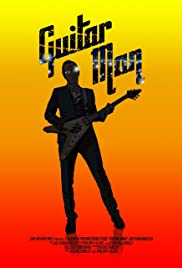
 Greetings again from the darkness. It’s a trivia question likely to stump most of your friends: Who has more number one Blues albums than anyone else? The answer is guitarist extraordinaire Joe Bonamassa, and co-directors Phillippe Klose and Kevin Shirley serve up a documentary to remove some of the mystery for those familiar with Smokin’ Joe, and an unveiling for those who aren’t. If you are asking yourself, “Joe who?” you should know that he opened for BB King … as a 12 year old prodigy!

I’ve got to go become the other guy.” Joe B confesses that’s his approach to prepare for a gig. He’s been described as bi-polar (not a clinical diagnosis) as he alternates between Joe in blue jeans and a ball cap, and Joe Bonamassa on stage in a suit and shades. And what a transformation it is. Joe is such a laid back guy that his Los Angeles home is nicknamed “Nerdville”, yet when his stage presence and music is explosive and beloved by his audiences.

A treasure trove of concert clips is provided, including a few from Joe’s early years. We learn of his struggles within the music industry, including his time with the band, Bloodline, which featured the offspring of legends Miles Davis, Robbie Krieger, Berry Oakley, and Sammy Hagar. Joe’s agent and partner Ray Weisman provides a great deal of background on the difficulty associated with helping Joe find his niche, and the risks and rewards of their founding their own record label in order to “own” Joe’s music. It’s fascinating to hear how a guy so talented faced so many challenges in discovering the right path.

Speaking of clips, we see Joe perform at such hallowed venues as Radio City Music Hall, Carnegie Hall, The Greek Theater, and Royal Albert Hall … with Eric Clapton. A personal favorite is the clip of Joe performing as the great Paul Rogers (Free, Bad Company) sings lead. A concert at the stunning Red Rocks Amphitheater in Colorado shows up a couple times, and we see Joe and his producer Kevin Shirley (also co-director on this film) make a trip to the “Crossroads”, where the legend of Robert Johnson was born. Other influences for Joe include Albert King, Freddie King, BB King, and Muddy Waters.

Joe Bonamassa natural talent likely stems from his family of musicians. His great-grandfather and grandfather played trumpets, while his own father was a guitarist. His progression through producers and collaborators includes Miami Steve Van Zandt, Phil Ramone, Tom Dowd, and, Kevin Shirley. Of course neither genetics nor affiliation explains Joe’s extraordinary work ethic and obsession with challenging himself.  We see his joy in music as he’s interviewed in front of a wall of Fender amps … the same amps he once dreamed of owning.

Arriving December 8, 2020 on VOD from Paramount Home Entertainment

watch the trailer


LENNOX LEWIS: THE UNTOLD STORY (2020, doc)

December 7, 2020

 Greetings again from the darkness. After winning a fight, Mike Tyson spouted, “Lennox Lewis, I’m coming for you.” That fight didn’t occur for a few years, yet that match is central to the Lewis story in this biography from co-directors Seth Koch and Rick Lazes. When the Lewis vs Tyson fight finally did happen in 2002, it certainly wasn’t the peak form Tyson that had taken the boxing world by storm years earlier. The generational ties between Tyson and Lewis are stressed here, well, because outside of a tremendous boxing career, Lennox Lewis is not terribly interesting as the subject of a documentary, other than as an anomaly in the boxing world.

Dr. Dre narrates the story, and we must respect Lennox for overcoming a childhood where he was abandoned, at least for a few years. Boxing gave him the structure and purpose to avoid the life on the streets that would typically occur in this situation. Much is made of his tangled roots. Lewis’ parents were from Jamaica, though he was born in England, and raised in Canada. We trace his boxing background from juniors to the amateur ranks, including two Olympics (1984 and 1988), and finally on to his professional career. We are told that “The Heavyweight Champion of the World” is the most coveted title in sports, though minimal attention is given to boxing’s numerous scandals and less than stellar reputation. Being mostly a tribute to Lewis, we do see a man who reached the pinnacle of an industry of which he was mostly an outsider.

Quite reserved as an adult, and lacking the bluster commonplace in the sport, Lewis is the polar opposite of the constantly posturing and bellowing of Don King, the longtime face of boxing promotions. We see King via numerous archival footage clips, and it is interesting to note how since Lewis opted not to sign with King, the megaphone-mouthed promoter always seemed to work extra hard against him. It’s actually Lewis’ selection of Brit Frank Maloney that provides the most fascinating aspect of the story, but that’s a twist best left unspoiled.

Lewis’ boxing career is chronicled, including his Olympic Gold Medal, being ‘robbed’ in the first fight against Evander Holyfield, and losing and regaining his title within the same year. Unifying the titles/belts in 1999 was an impressive accomplishment, but also goes straight to the unorthodox structure of a sport, and that first Holyfield fight left us wondering just how deep corruption ran. But that’s not the movie Koch and Lazes have made. Instead it’s about how Lewis retired as champ in order to spend more time with his lovely wife Violet and his family … just one more thing that sets him apart from the stereotypical boxer.

The documentary begins on Amazon, Apple TV/iTunes, and numerous VOD platforms on December 8, 2020.

watch the trailer


DEAR SANTA (2020, doc)

December 3, 2020

 Greetings again from the darkness. In an era when being nasty to those who don’t share your opinion is de rigueur, it’s such a pleasant relief to watch a story centered on generous folks who want nothing more than to bring joy to others … especially those in need. Director Dana Nachman is fast becoming a master of ‘feel good’ documentaries, and this one fits nicely with her recent projects, PICK OF THE LITTER (2018) and BATKID BEGINS: THE WISH HEARD AROUND THE WORLD (2015).

Bringing a smile to our face quickly is the opening where kids excitedly talk about Santa Claus and the letters they write to him. There is nothing more pure than a young child’s hope and belief that someone is devoted to delivering happiness, and yes, presents! A quick history lesson explains that kids have been writing letters to Santa for more than 150 years, and in 1912, the United States Postal Service began Operation Santa – a way to process the letters being sent to Santa Claus each year. It wasn’t until the 1940’s that the program was opened up to the public, and only recently has gone online. These days, it’s a remarkably coordinated effort involving individuals, companies, organizations, and non-profits.

We visit big cities and small ones as director Nachman shows us the impact these “North Pole elves” have on their communities. A ‘Countdown to Christmas’ is used to keep track of the deadline facing each and every person. We see how the USPS has digitized the letters and categorizes according to location, age, and type of request. There is even discussion about the surprising variances in gift requests based on geographic locations. It might also interest you that many adults write letters to Santa each year, although it probably wouldn’t surprise you to know that many of these are folks facing tough times, and their requests tend to be necessities like mattresses for the kids or a functioning appliance.

Most of the letters to Santa are heartfelt, and many are requests for others rather than gifts for themselves. Families displaced by fire or divorce will surely strike an emotional chord, as will the reactions of the “elves” reading the letters. Delivering the many donated gifts requires a highly coordinated effort – especially when live animals are involved. Yes, sometimes pets are requested, and again, the joy on the faces of those receiving gifts may only be equaled by the smiles by the givers.

The true spirit of giving at Christmas is on display throughout, and we have director Nachman to thank for bringing this to light. There are so many generous and caring people involved with the program, and their goal is to make sure others experience joy at this time of year. If you are interested in getting involved or learning more, the website is https://www.uspsoperationsanta.com/

watch the trailer