BUTCH CASSIDY AND THE SUNDANCE KID (1969) revisited

February 5, 2013

butch Westerns tend to be one of most divisive film genres.  “I hate westerns” is proudly proclaimed by otherwise intelligent and open-minded movie goers.  Ask these anti-western types for specifics on what it is they don’t like and their answers often include:  boring/slow pace, hard to relate to characters, simplistic dialogue, too few women characters and too much machismo.  Western lovers wouldn’t attempt to argue any of those points.  Instead, we prefer to believe that some of those are the BEST features of westerns!

What’s fascinating is, despite the haters, westerns have achieved immense popularity through the years.  Some have provided us the strong, quiet hero: High Noon, Tombstone, The Magnificent Seven.  Many have shown us the joy of revenge: True Grit, Django Unchained, The Searchers.  Some provided us with wonderful villains: The Wild Bunch, Once Upon a Time in the West (nice guy Henry Fonda as a badass).  Still others offered up the conflicted gunslinger: Unforgiven; The Good, The Bad and The Ugly.  Westerns can even be tearjerkers: Shane; comedies: Blazing Saddles, City Slickers; and animated: Rango.

butch5 The one western which seems to be the exception … it’s even beloved by western haters … is Butch Cassidy and the Sundance Kid.  It’s a mainstream film with three movie stars, a strong director, a renowned writer, one of the best ever cinematographers, a love story, a #1 charting pop song, enough action (but not too much), and a level of comedy that is witty and quotable.  Released 44 years ago in 1969, it was recently part of Cinemark’s Classic Film series.

Paul Newman (Butch) and Robert Redford (Sundance Kid) charmed audiences even as they made their way through the west robbing banks and trains.  It’s interesting to note that Steve McQueen was originally cast as the Sundance Kid.  Unfortunately, there was a disagreement over top billing and McQueen dropped out.  Newman and McQueen wouldn’t work together until 1974 in Towering Inferno.  On the bright side, Newman and Redford were terrific together and would team up again in 1973 for The Sting (Oscar winner for Best Picture).  It’s no coincidence that George Roy Hill directed the Newman/Redford duo in both films. He was known as an “actor’s director” and recognized the mass appeal of these two.
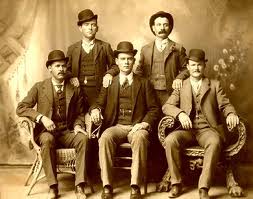
butch6 “Much of what follows is true” is our introduction to the film, along with a polychromatic montage of film clips and photographs of Butch and Sundance with The Hole in Wall Gang (renamed from The Wild Bunch, to avoid confusion with Sam Peckinpah’s recent release).  Butch (Robert LeRoy Parker) and Sundance (Harry Longabaugh) were real life outlaws in the early 20th century.  The Wild Bunch is pictured at left.  The real Butch is seated on the right, and the real Sundance is seated on the left.  Of course, many of the facts from the wild west have been displaced by colorful legend and lore.  It’s apparently true that their holdups rarely involved violence and they were in fact pursued by a posse, which in the film is portrayed as the Dream Team of posse’s assembled by Mr. E.H. Harrison of the Union Pacific Railroad.

One of the first real scenes in the movie has Sundance playing poker and being accused of cheating.  And we all know what that means in a saloon card game – it’s time for a gunfight.  The young stud making the accusations is none other than Sam Elliott, making his big screen debut.  Elliott went on to star in many movies and TV shows, and of course used his manly voice for “Beef. It’s what’s for dinner”.  In 1984, Elliott married Katharine Ross (they are still married today).  Ms. Ross became the dream woman of the 1960’s for many after appearing as Elaine in The Graduate and Etta Place in Butch Cassidy and the Sundance Kid.
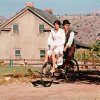
butch2 There are many individual scenes or moments that have become classics over the years: the bicycle scene while BJ Thomas sings “Raindrops Keep Fallin’ on My Head”; watching the great Strother Martin call Butch and Sundance morons as he spits chewing tobacco while riding a mule; the looks on their faces as Butch, Sundance and Etta arrive in the garden spot of Bolivia.  It also remains one of the most quoted movies with eternal lines such as:  “Who are those guys?” I’m better if I move”  “I’m not crazy.  I’m colorful” “Think you used enough dynamite there Butch”  “Are you crazy?  The fall will probably kill you” and my personal favorite “You just keep thinking Butch.  That’s what you’re good at”.

Although it’s certainly a star vehicle for Newman and Redford, and to a lesser extent, Katharine Ross, the supporting cast is diverse and exceptional.  In addition to Strother Martin and Sam Elliott, Butch has an infamous knife fight with Ted Cassidy (as Harvey Logan).  Cassidy is the 6’9” actor who also played Lurch on TV’s “The Addams Family”.  He is not 7’2” Richard Kiel who played Jaws in two James Bond films, though many people get them confused.  75 year old Percy Helton plays Sweetface.  Mr. Helton had over 200 career screen credits dating back to 1915. Henry Jones plays the opportunistic bicycle salesman, George Furth plays the young and loyal Woodcock, and the still active today (at age 86) Cloris Leachman plays the working girl who is so giddy to see Butch again.

butch3 The movie received 7 Oscar nominations and won 4: Cinematography (Conrad Hall), Original Score (Burt Bacharach), Original Song (“Raindrops Keep Fallin’ on My Head”), and Original Screenplay (William Goldman). It was also nominated for Best Picture, but that award went to the controversial Midnight Cowboy and its director John Schlesinger.  It should also be noted that there was a 1956 movie titled The Three Outlaws that featured Neville Brand as Butch, and Alan Hale, Jr as Sundance.  Mr. Hale is best known as the Skipper on “Gilligan’s Island”. In 1979 a pre-quel was released, Butch and Sundance: The Early Days. It featured Tom Berenger as Butch and William Katt as Sundance.  Mr. Katt is best known as the unfortunate prom date in Carrie.  Most recently, in 2011 Sam Shepard starred in Blackthorn, a film about an aging Butch Cassidy quietly hiding out in Bolivia.

So whether you “like” westerns or not, if you have never taken in the exploits of Butch Cassidy and the Sundance Kid, I would encourage you to do so.  If, after that, you still don’t like westerns, all I can say is “Boy, I got vision and the rest of the world wears bifocals.”

here is one of the short original trailers:

http://www.youtube.com/watch?v=X41Ylp02NRs


THE SHINING (1980) revisited

January 29, 2013

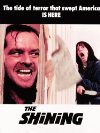
shining Greetings again from the darkness. One of the keys to my love of cinema is what I term the “three D’s” – Dispute, Discussion and Debate.  Legendary director Stanley Kubrick directed only eleven feature films, each a perfect fit for the “three D’s”.  Now combine Kubrick with renowned author Stephen King, and the result is 33 years (and counting) of ongoing dispute, discussion and debate.  The Shining is considered one of the best horror films of all-time and limitless in its ability to entertain … even after the closing credits.

Kubrick and his co-writer, novelist Diane Johnson, took the already twisted source material and delivered a film focused more on the downward spiral towards madness than King’s supernatural story.  Sure Kubrick gives us ghosts (Lloyd the bartender, Grady the butler, the two girls and the women of Room 237), but the bulk of time is spent watching the three members of the Torrance family each breakdown in their own special manner.

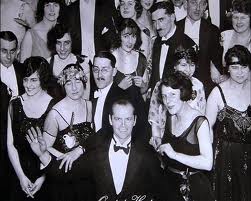
shining7 The ambiguities of the story are intensified on the closing shot of the 1921 photograph featuring the likeness of Jack Torrance (Jack Nicholson). The various interpretations over the years have only added to the cult status and overall perplexity associated with this masterpiece.  The historic Texas Theatre in Dallas presented a 35 mm print this past weekend and it was a thrill to once again watch the movie on the big screen with a full house.

There are so many elements that elevate this one above most horror films. The claustrophobic feel that comes with an isolated hotel snowed off from society is complimented by a cast of actors who fully commit to what must have appeared ludicrous on the script pages.  Jack Nicholson was at the peak of the acting profession (just a few years after Chinatown and One Flew Over the Cuckoo’s Nest) and really creeps us out with his aggressive descent into insanity.  Shelley Duvall survived an actor’s nightmare during filming as Kubrick was relentless in his efforts to make sure she shining5was constantly hysterical and on the verge of tears.  Yet, she never fails in convincing us that she is frantically grasping for sanity as she works to save herself and her son.  Despite having no previous acting experience, six year old Danny Lloyd won the role of Danny, who is blessed/cursed with “the shining” – a psychic ability to see the past and the future.

Over the years, conclusions have been reached that Kubrick was making a statement on topics ranging from the slaughter of Native Americans, the Holocaust, the supernatural, alcoholism, and the hollow institution known as family. Regardless of your interpretation, it’s impressive that a horror film can generate such divisive thoughts. Even more impressive is how the movie sucks you in with a methodical pace and  deliberate build-up to a wild ending … an ending missing a key hospital scene that was cut by Kubrick AFTER the film was initially released.

Known as The Overlook Hotel in the movie, it’s really a conglomeration of many different hotels. The exterior shots are of Timberlake Lodge in Oregon.  Much of the interior, including the Colorado room where Jack writes, is patterned after Ahwahanee Lodge in Yosemite, though the red bathroom is courtesy of the Arizona Biltmore (and Frank Lloyd Wright).  The giant set was built shining3in England and included the shrubbery maze that is front and center come climax time.  Stephen King was inspired to write the story after staying at The Stanley Hotel in Estes Park, Colorado. In 1997, he personally oversaw a TV mini-series that stayed true to his original story … and was filmed at The Stanley.

Scatman Crothers is best known as a musician and composer, but immediately became well respected for his role as Dick Hallorann, the hotel’s chef.  The scene where he discusses the meaning of “the shining” with Danny became infamous for the 148 takes demanded by Kubrick. His penchant for multiple takes nearly broke the actors and the crew, but most since then have acknowledged the grueling approach provided the edge needed for the dramatic effects seen in the movie.

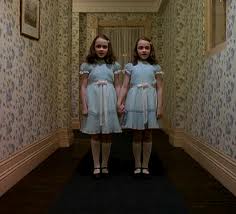
Some other interesting aspects of the movie include the numerous “classic lines” such as Nicholson’s ad-libbed “Here’s Johnny!” and “Little Pig, Little Pig”; the controversial line from Grady (Philip Stone) stating Torrance has “always been the caretaker”; Torrance’s exchange with Lloyd the bartender (Joe Turkel) when he calls alcohol the “white man’s burden”.  It’s also interesting shining2to note that the visual of the two girls was influenced by Diane Arbus’ famous photograph.  Ask yourself; prior to seeing this movie, would you have recognized REDRUM?  Since this was in the days before computers, a secretary spent months typing up (yes on a typewriter) the hundreds of pages that read “All work and no play make Jack a dull boy”.  In the Gold Room party scene, that’s 17 year old Vivian Kubrick (daughter of Stanley) smoking a cigarette while sitting on the sofa. And a special note to my fellow baseball lovers, Shelley Duvall whacks Nicholson with a Carl Yastrzemski model Louisville slugger.  Of course, Stephen King is a lifelong Red Sox fan, so this was a nice touch.

It’s understandable if you consider the movie more disturbing than horrifying. Kubrick would take that as a compliment.  As for the complexities and contradictions, nothing is more frightening than the unexplained and the unreasonable. Without an obvious roadmap to a tidy conclusion, Kubrick keeps us guessing and leaves us uncomfortable by what we have seen. Maybe most remarkable is the incredible way this movie impacts you EVERY TIME you watch.  This is quite an accomplishment for the horror genre, since most depend on visual tricks, cheap scares and over the top gore.  If you are waiting for more, Stephen King is scheduled to release “Dr. Sleep”, which is the story of an adult Danny (no word on whether Tony is with him) who now works with those who share “the shining”.  Just don’t expect Danny Lloyd to reprise his childhood role.  He hasn’t acted in over 30 years and is enjoying his career as a science teacher.

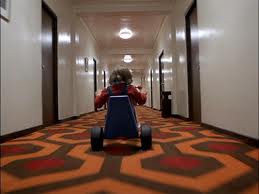
check out Danny’s big wheel scene:

http://www.youtube.com/watch?v=bCeBeS_OGso


PULP FICTION (1994) revisited

December 9, 2012

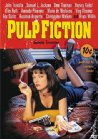
pulp5 Greetings again from the darkness. Typically, I don’t get too serious about a film’s place in history until at least 20 years pass since release. Cinemark presented Pulp Fiction in its Classic Film Series, so the timing seems right … despite it being only 18 years (1994) since Quentin Tarantino’s film won the Palm d’Or (best film) at Cannes Film Festival.  While challenging today to understand the buzz created as it made the festival rounds, there is no question it solidified Mr. Tarantino as the next generation’s auteur … though some would argue that occurred with Reservoir Dogs two years prior.

The lasting impact of some classic films stems from the emotional connection of their loyal viewers.  Casablanca and The Sound of Music are two examples. Others, like Citizen Kane and 2001: A Space Odyssey made their mark through technical achievements.  Adapting a classic novel was the key for To Kill a Mockingbird and The pulp2Godfather.  Still others reached the classic level via spectacle and by becoming an event unto themselves … Jaws and Star Wars.  Pulp Fiction is one of the few films that has so clearly defined a generational change in filmmaking style by influencing and motivating writers and directors.

When asked, I never really answer the “What’s your all-time favorite film?” question. I can name my favorite car, my favorite boss, and even my favorite dessert.  I can’t name my favorite kid or my favorite film … for much different reasons.  Without a doubt, there are numerous films that belong to the “list” of my all-time favorites, but not one is clearly THE best or most favorite on every single day.  There are a few that fall into the elite category AND also into ‘must stop’ category – should they happen to pop up on a movie channel.  Pulp Fiction is one of the chosen few for me.  I realize this opens me up for less-than-flattering judgment, but sometimes we don’t choose the movie … the movie chooses us.

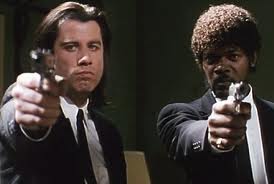
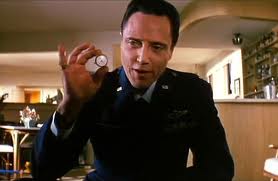
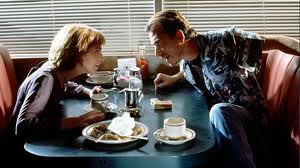
pulp3 Unfortunately, this movie proved to be the end of the highly creative partnership between Tarantino and Roger Avary.  Former video store co-workers, these two had a nice run with True Romance, Reservoir Dogs and Pulp Fiction (for which they won the Best Original Screenplay Oscar), but ego conflict messed up The Beatles and had no less effect on these two writers.  Still, the stars aligned and provided us a non-linear collision of multiple story lines and dialogue unlike we had previously heard on screen. Additionally, it proved to be the career defibrillator for John Travolta, and allowed Samuel L Jackson to deliver one of the most powerful non-biblical bible verses ever.  For most us, it was the first time we had ever seen the plunging of an adrenaline filled syringe through a comatose woman’s breastplate. Quentin Tarantino made no effort to hide his fascination with Uma Thurman’s bare feet … a fetish we would again experience in Kill Bill. We were reminded of the cool effect provided by the “trunk shot” and baffled by the MacGuffin (the glowing briefcase). Vincent Vega (Travolta) taught us that due to the metric system, we would need to order a Royale with Cheese while visiting France, and Christopher Walken explained the, um, depths some would go to pass along a gold watch to a soldier’s son.  The debate of what constitutes a miracle was no less than interesting than watching The Wolf (Harvey Keitel) take charge of a messy situation.  It’s kind of funny to watch Steve Buscemi as Buddy Holly the Waiter since as pulp4Mr. Pink in Reservoir Dogs, he refused to tip for food service.  While Tim Roth and Amanda Plummer discovered the brilliance of holding up restaurant patrons, we were also shown the possible downside to such a plan.  However, the key lesson we all learned, and all hope to avoid ever needing, was that if you are dumb enough (Bruce Willis) to double-cross a gangster (Ving Rhames), you sure as heck better rescue that same gangster from Deliverance-style pawn shop owners.

Tarantino showed us how multiple viewings are rewarded by keeping track of the numerous pop culture homage’s and by realizing just how perfect were his choices of single songs (no film score) for particular scenes.  Listening to Dick Dale strum “Misirlou” over the opening credits still gets me going!  In fact, the only two things I picked out that show a bit of aging are Vincent’s disbelief in a $5.00 milkshake and when Jules calls one of Big Brain Brad’s team “Flock of Seagulls”.  So if you are taken aback by Pulp Fiction as one my all-time classics, my only response is … “Say ‘what?’ again”.

here is a video of Dick Dale playing “Misirlou” in 1963:

http://www.youtube.com/watch?v=ZIU0RMV_II8


CASABLANCA – 70th Anniversary

November 26, 2012

 Leonard Maltin calls it a “perfect” movie. It appears on most all-time “Best of” lists and it had its world premiere 70 years ago today on November 26, 1942 in New York City.  Casablanca went on to win 3 Oscars for Best Picture, Best Director, and Best Screenplay. The cast defined “stellar”: Humphrey Bogart, Ingrid Bergman, Paul Henreid, Sydney Greenstreet, Claude Rains and Peter Lorre. Dooley Wilson, who plays Sam the piano player, was in real life a drummer and couldn’t actually play piano (but that is him singing).   Director Michael Curtiz finished with more than 170 directing credits, and had some other acclaimed films (White Christmas, Mildred Pierce, Yankee Doodle Dandy), but this was clearly his career pinnacle.  There is so much more to say about the film, but I’ll save it for another time.  Just remember … “a kiss is just a kiss” …  “oh yes, the world will always welcome lovers, as time goes by“.


DR. STRANGELOVE (1964)

November 2, 2012

 DR. STRANGELOVE OR: HOW I LEARNED TO STOP WORRYING AND LOVE THE BOMB

Greetings again from the darkness. Difficult to decide if it’s more shocking that this film is almost 50 years old, or that it ever got released in the first place. No other black comedy satire on such a sensitive political issue has ever had its theatrical release right smack dab in the middle of the ongoing issue. The cold war between Russia and the US was in high gear and the Cuban Missile crisis had just occurred. In fact, President Kennedy’s assassination caused the film’s opening to be delayed.

 Stanley Kubrick only directed eleven feature length films, and ten of them can be considered classics (A Clockwork Orange, 2001: A Space Odyssey, The Shining, to name a few). Dr. Strangelove is regarded as one of the greatest comedies of all-time, though it’s difficult to imagine anyone under 30 really “getting” much of the humor – unless they happen to be a history buff. The movie could come across as one big “inside joke” to those unfamiliar with the times.

 Loosely based on Peter George‘s “Red Alert” novel, Kubrick decided to take the source material and turn it into satire. He brought in Terry Southern (“The Magic Christian”) to help with the script, and then he turned the incomparable Peter Sellers loose in 3 roles (originally 4, but he broke his leg and gave up the Commander King Kong role). Stories abound with Sellers causing multiple takes and significant editing due to his ad-libbing cracking up other cast members (and even Kubrick).

 The structure of the film involved three separate, yet intertwined sequences. We see Burpelson Air Force Base Commander General Jack D Ripper (Sterling Hayden) issuing the order to Group Captain Mandrake (Sellers) to lock down the base. It turns out, Ripper has gone a bit loony and somehow issued the strike first command against Russia. Mandrake spends much of this segment trying to calmly obtain the Recall Codes from Ripper. We also meet the crew of one of the multiple B-52 bombers in route to Russia. Led by Commander “King” Kong (Slim Pickins), they are on the way to deliver two nuclear bombs. One of his crew is played by James Earl Jones in his screen debut. Lastly we go inside the War Room where President Merkin Muffley (Sellers) is meeting with his Joint Chiefs of Staff and advisors. A key player here is General Buck Turgidson (George C Scott) in full kill and be killed mode.

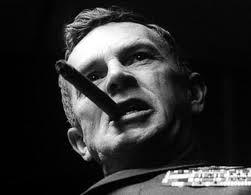
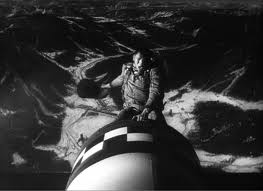
 There are so many interesting bits to discuss, but let’s limit to just a few. Watch the camera angles that Kubrick uses to film Hayden. He is made to look both powerful and nuts. Hayden (so great in Kubrick’s The Killing) has the voice and tough guy stance to make us believe he could start a war due to a Russian plot to pollute the “precious body fluids” of Americans. Sellers plays two roles in the War Room, but his straight man performance as the President allows George C Scott to really shine in one of his few comedic turns as an actor. Scott’s performance is somehow over the top AND right on the button (so to speak). When watching Slim Pickins in the iconic final image, keep in mind that he was a real life rodeo cowboy prior to breaking into acting.

 Obviously the character names are outlandish (Keenan Wynn plays Col. Bat Guano), but it should be noted that the character of the President was based on real life politician and Presidential candidate Adlai Stevenson. The General Turgidson character is based on real life General Curtis LeMay who was infamous for his kill ’em first attitude. Also, General Ripper was based on General Thomas S Power, who was LeMay’s protégé and ultimate replacement as Joint Chief of the Air Force. It should also be noted that Tracy Reed is the only female character who appears … and yes, that is her in the Playboy magazine that Commander Kong is perusing.

There are so many classic lines and sight gags in the film that it’s challenging to keep up on the first viewing. Also, it’s been a few years since a pay phone and coke machine played such vital roles. When Kubrick killed the original pie fight ending, he added more frightening images and the poignant closing song – “We’ll Meet Again” by Vera Lynn. Director Sidney Lumet did a film version of this same basic story told in a straight-forward and thrilling manner. His Fail-Safe was released less than a year after Dr. Strangelove.

**NOTE: While it’s now common to refer to the film as “Dr. Strangelove”, the actual title is Dr. Strangelove or: How I Learned to Stop Worrying and Love the Bomb.  It is the longest title of any film nominated for a Best Picture Oscar.  The film received four total nominations, but it turned into the year of My Fair Lady (Best Picture), George Cukor (Director), and Rex Harrison (Actor).

watch the unusual trailer:

http://www.youtube.com/watch?v=1gXY3kuDvSU


FRANKENSTEIN (1931) BRIDE OF FRANKENSTEIN (1935)

October 26, 2012

 Greetings again from the darkness. It’s pretty easy to underestimate the importance of a couple of monster movies from 80 years ago.  Since TCM and Cinemark teamed up for this double-feature, it seemed worth revisiting and discussing.  Most people are aware of Mary Shelley’s 1818 novel (published when she was 21) and have probably seen some of the many screen versions throughout the years. It is interesting to note that while the brilliant (and often misunderstood) novel was the source, it was really these two films that jolted the monster film genre to life … and careers for many actors, directors, make-up artists and set designers.

When Carl Laemmle, Jr assumed control (from his father, the legendary producer and studio founder) of struggling Universal Studios in 1928, he was very aware that something special and different was needed to save the business. A string of Universal horror movies soon followed: Dracula (1931), Frankenstein (1931), The Mummy (1932), The Old Dark House (1932), The Invisible Man (1932) and Bride of Frankenstein (1935).  Two driving forces of this period were director James Whale and actor Boris Karloff. While Dracula with Bela Lugosi hit theatres first, it was Karloff as “The Monster” who really captured the interest of the movie-going public.

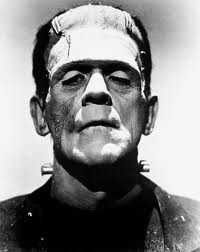
Frankenstein was Karloff’s 81st film and he was only cast because Lugosi turned down the non-speaking role.  Wearing over 60 pounds of make-up, prosthesis and padding … including 26 pounds of shoes to make him over 7 feet tall …Karloff still managed to bring personality to the creature created by Dr. Henry Frankenstein (Colin Clive).  Yes, HENRY.  Though named Victor in the novel, the name was “softened” for the film.  In the film, Dr. Frankenstein is on a mission to create life from body parts and organs of the dead. His stated goal of a man-made race at his beck and call was a clear indication that his God complex was out of control.  His fiancé is played by Mae Clarke.  Ms. Clarke went on to Hollywood infamy when she took a grapefruit in the face from James Cagney in Public Enemy.

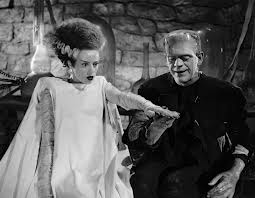
 The enormous success of Frankenstein begged for the first real sequel.  Bride of Frankenstein was released in 1935 with Karloff and Clive reprising their roles. Elsa Lanchester was cast as Mary Shelley (the writer of the Frankenstein novel), and we even get a scene with characters representing her husband (the poet Percy Shelley) and Lord Byron.  Of course, Ms. Lanchester became famous for her Bride’s iconic hairstyle, as well as her hissing and screaming.  Taking Mae Clarke’s place as Elizabeth was Valerie Hobson. Ms. Hobson later became famous as the stand-by-her-man wife of disgraced British Secretary of War John Profumo. Profumo lied to the House of Commons about his relationship with Christine Keeler, the mistress of a Soviet Spy. The “Profumo Affair” forced his resignation in 1963 and was the source of the 1989 British film Scandal.  Bride of Frankenstein is also renowned for the mad scientist Dr. Pretorius played by Ernest Thesiger. Much was made at the time of his “probable” homosexuality and, combined with the multiple crucifix imagery, the film was banned in some markets. It should also be noted that the film utilized a full score … just the second film after King Kong to do so. Previously, film music was thought to be distracting to viewers.

 When discussing these early monster movies, revolutionary make-up artist Jack Pierce must be noted. He created the bolts/electrodes and flat head look for the monster, and even came up with the now-famous green make-up that looked ash gray in Black & White films. Mr. Pierce is easily the most famous of the early movie make-up artists and made his mark during the Universal horror period of the 1930’s-40’s.  Director James Whale turned to monster movies after tiring of war films. His impact was felt as he turned the Frankenstein monster into a sympathetic character, and later added much humor to Bride of Frankenstein.  Unfortunately, once he tired of monster movies, his career and life took a dark turn, and he took his own life in 1967.

Numerous remakes, spin-offs and spoofs have been released over the years and, tip of the cap to Abbott and Costello, the most famous is probably Mel Brooks’ Young Frankenstein. It is a brilliant tribute and spoof, while also standing on its own as one of the best all-time comedies. With such creative works based on her writings, Ms. Shelley would surely be impressed to know that nearly 200 years after her novel; this can still be said about her monster …. “It’s Alive! It’s Alive!”

watch the trailer to Bride of Frankenstein:

http://www.youtube.com/watch?v=r9t6NHlPJHA&feature=related


SOME LIKE IT HOT (1959) revisited

October 12, 2012

 Greetings again from the darkness. Billy Wilder‘s classic was the latest in the comedy series sponsored by Dallas Film Society and Dallas Morning News. It is almost always ranked as one of the top comedy films of all-time, and often the best ever. While that’s a bit higher than I would rank it, there is little doubt that it has earned its enduring place in cinematic history. To fully understand the impact of the film, it helps to remind yourself of the times … it was filmed more than 50 years ago. What we might call tame today, was incredibly risqué and daring for the times.

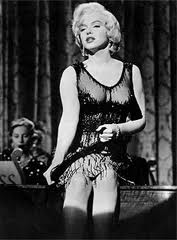
What really stands out while watching the film is just what an incredible screen presence Marilyn Monroe possessed. It is quite challenging to take your eyes off her during any of her scenes. I am at a loss to come up with any other actor or actress who even comes close to this level of camera-cornering. Greta Garbo and Marlon Brando were great, but Marilyn is transcendent while on screen. Of course, the reports of her personal issues are legendary. Supposedly on this film, she was constantly 2-3 hours late, couldn’t remember her lines and had to be coddled by all involved. Still, the final product is stunning and director Billy Wilder understood that no other actress could be substituted. Sadly, Marilyn only made two more films and was dead 3 years after this film was released.

 As wonderful as Marilyn is, this is really the story of Joe and Jerry, or Josephine and Daphne, or even Junior. Those five characters are all played with crackling comedy timing by Tony Curtis and Jack Lemmon. Lemmon, as Daphne, is especially terrific as he tango’s the night away with Osgood Fielding III (played by Joe E Brown). Curtis is at his best when courting Marilyn’s Sugar Kane while sporting his Cary Grant impersonation and driving the boat backwards.

There are so many classic comedy moments in this film, and though it is based on a 1935 French farce titled Fanfare d’Amour, Wilder and his co-writer and frequent collaborator I.A.L. Diamond made it their own by adding the gangster story line. Seeing notorious movie bad guy George Raft tied to the 1929 Chicago St Valentine’s Day Massacre adds a dimension that many writers/directors would be unable to handle. Instead, Wilder injects his frenetic dialogue and mixes in some wild double-entendre’s, a touch of Marx Brothers, and the sensuous singing of Marilyn to deliver a world class comedy and must see for any movie lover.

 The Florida scenes were filmed across the country at the historical Hotel del Coronado in San Diego, which remains a very popular resort location even today. Marilyn sings “I Wanna Be Loved By You” and “I’m Through With Love” in such a way that her character’s naivety adds a dimension that breaks the heart of Joe (Curtis) and mesmerizes the viewer. Billy Wilder is certainly one of the Hollywood giants and delivered such classics as Sunset Blvd, The Apartment, Irma laDouce, and Witness for the Prosecution. His excellence spans numerous film genres, and we admire his patience and proficiency in juggling the issues required to pull off Some Like it Hot … and, though it’s true that “Nobody’s perfect“, he does avoid the fuzzy end of the lollipop.

**Note: the film received 6 Oscar nominations, and won for Best Costume Design

**Note: Wilder decided to film in Black & White because the make-up on Curtis and Lemmon was distracting in color

watch the trailer:

http://www.youtube.com/watch?v=rI_lUHOCcbc


HIGH NOON (1952) revisited

September 26, 2012

 Greetings again from the darkness. Thanks to the Cinemark Classic Series, seeing this one on the big screen became a summer highlight. Often rated as one of the all-time best, and easily one of the best from the western genre, the film was written (by Carl Foreman) as an allegory to Hollywood blacklisting brought on by Sen. McCarthy’s red-baiting crusade. The cowardly townspeople represent those who wouldn’t stand up against the wild and often false accusations.

The film won four Oscars, including Gary Cooper as Marshal Will Kane. The character is often compared to Atticus Finch from To Kill a Mockingbird. Both are shining examples of men doing the right thing in very difficult circumstances. It’s been noted that Gary Cooper’s constant look of pain during the film might not have been excellent acting after all. He reportedly was suffering from a bleeding ulcer and severe back during filming (though he was apparently strong enough to carry on an affair with his beautiful co-star).

Originally filmed in “real” time with the numerous clock shots to prove it, the film was re-edited prior to release, nullifying the effect. The Tex Ritter (John’s father) version of “High Noon (Do Not Forsake Me)” is heard throughout, and will stick in your head for some time after viewing. This was the first major motion picture for both Grace Kelly and Lee Van Cleef. Ms. Kelly plays Kane’s new bride, who doesn’t understand his need to stay and face Frank Miller. Mr. Van Cleef flashed his beady eyes here and went on to have a long career as a top notch movie villain.

 The film was directed by Fred Zinnemann who also directed From Here to Eternity, Oklahoma!, and A Man for All Seasons. Zinnemann lost the Oscar to John Ford, and film lost to The Greatest Story Ever Told. It’s considered one of the greatest Oscar upsets in history. Floyd Crosby was the cinematographer … he is the father of singer David Crosby (Crosby, Stills, Nash and Young).

Other supporting work is courtesy of Thomas Mitchell (Uncle Billy from It’s a Wonderful Life), Katy Jurado (excellent as Helen Ramirez), Lon Chaney, Jr, Harry Morgan (later Col Potter in “MASH“), and Sheb Wooley (later known for singing “The Purple People Eater”), and of course, Lloyd Bridges as Harvey, Kane’s ambitious, and not so loyal, deputy (and father to Beau and Jeff).

Cooper is at his most dominant in this role and it’s difficult to believe that just about every other Hollywood leading man of the time was offered the role prior to him. Cooper’s Will Kane is the epitome of the strong, silent type … and a real stand-up guy.

** watch the opening credits … featuring the opening shot of Lee Van Cleef and Tex Ritter singing the Oscar winning song:

http://www.youtube.com/watch?v=QKLvKZ6nIiA&feature=related


THE BIRDS (1963) revisited

September 20, 2012

 Greetings again from the darkness. Sure, I have seen this film many times over the years, but just couldn’t miss the chance to see it on the big screen courtesy of Fathom Events and Cinemark. Many critics consider this to be Alfred Hitchcock‘s last great film, while a few dismiss it as a lark (get it?). Hitchcock is known for his sterling career of suspense films, though this one is really categorized as horror.

The writing pedigree is beyond reproach as it’s based on a story by Daphne du Maurier with a screenplay from Evan Hunter. Dame du Maurier is considered one of the best writers of the twentieth century, and you might recognize Mr. Hunter’s pen name – Ed McBain. He was quite famous for his detective stories (including the foundation for TV’s “Hill Street Blues”).

 There are really two parts to the film. The set-up involves some playful grown-up flirting between lawyer Mitch Brenner (Rod Taylor) and socialite Melanie Daniels (Tippi Hedren). The scene in the pet store is a treat to watch thanks to the banter between two attractive, intelligent, confident people. The tie-in with the love birds for Mitch’s sister (Veronica Cartwright) is simple, yet brilliant. The extreme playfulness takes Hedren to Bodega Bay, California via her sleek Astin Martin.

Hitchcock includes his common elements of feminine mystique as Mitch Brenner’s world revolves around his omnipresent mother (Jessica Tandy), his younger sister (Cartwright), his ex-lover (Suzanne Pleschette) and now a new love interest in Hedren. There are some terrific scenes between Tandy (26 years prior to Driving Miss Daisy) and Hedren, but my favorites are those with Hedren and Pleschette. Pleschette was an underrated actress and is best known for her role in TV’s “The Bob Newhart Show”. Watching her face as Hedren talks on the phone to Taylor is classic frustration from an ex-lover.

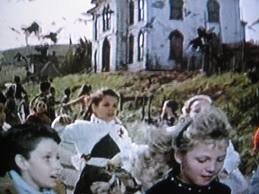
The second half of the film involves the terror of the bird attacks. Of course, the infamous scene of the kids running down the street being pecked by birds will make your skin crawl, and the scene where Hedren gets attacked in the bedroom is horrific and sends her into a breakdown. I really enjoy the scenes with the townspeople in the café. Some wonderful interchanges as they each tell bird stories. My favorite bird sequence in the film involves the empty playground equipment slowly taken over by birds as Hedren sits on the bench. Great stuff.

 Another interesting aspect of the film is the cast. Ms. Hedren (mother of Melanie Griffith) is still acting today (in her 80’s), though I have never considered her anywhere near the level of actress of other Hitchcock blondes: Grace Kelly, Ingrid Bergman, Kim Novak, Janet Leigh, Doris Day, etc. Rod Taylor is also in his 80’s now and was last seen on screen as Winston Churchill in Tarantino’s Inglourious Basterds. Jessica Tandy had a long career and is best known for Driving Miss Daisy, and Veronica Cartwright went on to star in such films as Alien and The Right Stuff). The supporting cast is filled with familiar faces including a very young Morgan Brittany (“Dallas”), Malcolm Atterbury (as the Deputy), Ruth McDevitt (as the pet store owner) and one of my favorite actor names, Doodles Weaver (Sigourney’s uncle).

As you watch the film, you will notice that there is no traditional score. Instead, we are treated to an assortment of bird effects which cue us in to the level of danger. Hitchcock was always a master of guiding the viewer right along the path he wanted. This film has some unusual pacing and a few wide shots that are quite rare for his films. To me, it proves that he was always experimenting, yet with an innate ability to know how the audience would react. A true craftsmen.

** NOTE: Hitchcock’s cameo occurs as Hedren walks into the pet store … he is seen walking out with his two dogs

here is a clip of the playground scene – that’s the school kids you hear singing.  Don’t watch this if you haven’t seen the movie:

http://www.youtube.com/watch?v=ydLJtKlVVZw&feature=related


DUCK SOUP (1933) revisited

August 10, 2012

 Greetings again from the darkness. This Marx Brothers classic was selected to kickoff the Comedy Series presented by The Dallas Morning News and Dallas Film Society.  To demonstrate to my buddy Robert just how far he has come in life, I invited him to join me.  He seemed pleased that we didn’t have to manually push the car to jump start it and that no Auto-Bomb exploded on ignition (two of his memories associated with previous Marx Bros events).  It’s been 20-25 years since I last watched this one, so catching it on the big screen was a real treat. I laughed at almost every scene, as this is the Marx Brothers best combination of quips, puns, political satire and physical sight gags. They are in prime form and for the first and only time, are directed by a real director … Leo McCarey (also known for An Affair to Remember, and Going My Way). The script is from Bert Kalmar and Harry Ruby, with additional dialogue by the great Arthur Sheekman.

 Groucho, Harpo, Chico and Zeppo star together for the last time, as Zeppo decided to join brother Gummo on the business side. Groucho plays Rufus T Firefly who is (somehow) named as the new leader of Freedonia, the bankrupt country backed by millionaire widow Mrs Teasdale (played by Margaret Dumont). A childish spat between Firefly and the ambassador of Sylvania lead the two countries to war. Of course, in between, there is a huge musical production sequence and too many funny gags to keep track of.

The film is recognized as the first political satire film and was released just 3 years after the death of silent films. Much of the film is spent as commentary on the absurdity of war and ego involved in most political conflicts. A couple of the iconic sight gags include the famous “mirror” scene with Groucho and Harpo, and the hilarious “hat scene” with Chico, Harpo and silent film star Edgar Kennedy (as a lemonade vendor). There is also one of the most bizarre early special effects (a tattoo on Harpo’s chest) and a Dallas, Texas joke that generated applause from the hometown audience. The film even pokes fun at the Hays Code (morality censorship) with a shot of a pair of men’s shoes, a pair of women’s shoes, and a set of horseshoes, and then a quick cut to twin beds and an odd sleeping arrangement.

The film came out at a time when much cynicism existed toward the Great War and the Depression was still a fact of life in the U.S.  Because of that, the film may be easier for us to watch now than it was at the time of its release. Even the Freedonia anthem, which is played several times throughout, is a spoof on the Star Spangled banner with it’s only line being “Hail Hail Freedonia, land of the brave and free“.  So that it was clear they were not choosing sides in their political shots, Groucho is seen in at least five different uniforms during the battle scenes … each a bit more outlandish than the last.

 Support work is also provided by Louis Calhern, but it’s Margaret Dumont who never ceases to amaze. A consistent presence in Marx Brother films, she is the epitome of the “comedy straight man”. How she ever played her role seriously given the Marx Brothers hijinks is beyond belief. She even gets to flash her classically trained singing voice, though it provides a flying fruit ending.

The Marx Brothers made 13 movies and this was their fifth, and probably best. The five brothers (including Gummo) only appeared together on screen one time … on a TV talk show in 1957. Their vaudeville and stage act continued to be the basis for their films, and was undoubtedly a factor in their incredible comedic timing. While it is understandable that the Marx Brothers humor may not be to every person’s taste, it is impossible to ignore their impact on film comedy (Lucy, Daffy Duck/Bugs Bunny, The Monkees). Hail Hail Freedonia!!

the classic mirror scene: