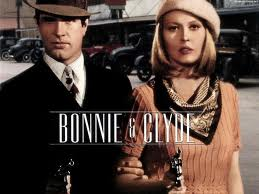
BONNIE AND CLYDE (1967) revisited

October 25, 2013

bonnie1 Dramatizations focusing on real life people, be they famous or infamous, require a certain mindset from the viewer.  First, understand that it’s not a documentary.  What you see may be different than what you have read.  Second, expect the filmmakers to take some dramatic license in order to add interest and color to the story.  All of this is in play for the wonderful and classic Bonnie and Clyde from 1967.

To put this time period into perspective, know that the movie was released 46 years ago, and depicts a period during the Great Depression that was approximately 32 years prior to filming.  That’s correct. The film’s release date was closer in time to the Great Depression than today is to the film’s release date. It’s also important to note that Bonnie Parker and Clyde Barrow were 23 and 24, respectively, at the time of their violent deaths at the 1934 Gibsland Ambush.  Their ages and the times certainly played a role in their reckless ways and poor judgment.

bonnie 3 Sadly, there is a generation of movie-goers who have little knowledge of Warren Beatty’s place in Hollywood history … or worse, their only recollection is of his clunky political rapping in 1998’s Bulworth.  By 1967, Beatty was already a heartthrob and up-and-coming actor, but it’s his role and contract as producer of Bonnie and Clyde that set him up as a Hollywood power player (not to mention, financially set for life).  His 40% of gross pay plan has made him tens of millions over the years.  In addition to his producer duties, Beatty is at his physical peak here … a glamorous actor going all out in a career-defining role. Pictured left, is the real Bonnie and Clyde.

Faye Dunaway plays Bonnie as first, a bored youngster who comes to life due to the danger and sexual attraction she senses with Clyde.  She then transitions into a spirited woman very comfortable with the spotlight of notoriety and fully understanding how to pull the strings of her man.  Dunaway’s career is best marked by her work as Bonnie, and her roles in Chinatown and Network … though many know her best as the mother with an aversion to wire hangers.

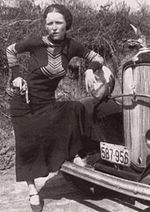
There are three writers associated with the film: David Newman (he also wrote the Christopher Reeve Superman scripts), Robert Benton (Oscar winner for Kramer v Kramer and Places in the Heart) and Robert Towne (known best for his Oscar winning Chinatown script).  Mr. Benton was inspired by the fact that his father had attended the Texas funerals of both Bonnie and Clyde. The basic outline is based on the true stories – Joplin, Missouri; Ruston, Louisiana; Texas Ranger Frank Hamer; the numerous stolen cars; the role of Clyde’s brother and his wife; the visit to Bonnie’s mother; and even Bonnie’s poem “The Trail’s End” (aka The Story of Bonnie and Clyde).  But as expected, many liberties are taken.  Unlike in the movie, bonnie 2Frank Hamer never crossed paths with Bonnie and Clyde prior to the final ambush.  Blanche (played by Estelle Parsons) was very upset at her portrayal after seeing the movie … she claims to have not been such a lunatic.  The CW Moss character is actually an amalgam of drivers affiliated with the gang.  Also, there is no mention of the horrible accident that left Bonnie’s legs badly burned … to the point where Clyde had to carry her everywhere those last few months. Pictured left is the famous photo of Bonnie with cigar and gun.
Director Arthur Penn was an Oscar winner and also gave us such fine films as The Miracle Worker (1962), Alice’s Restaurant (1969), and Little Big Man (1970). He and Beatty had many arguments while on set, but the finished project is packed with energy, emotion and action. Beatty and Dunaway give us an engaging couple with a dark destiny.  Excellent support work is provided by Gene Hackman (as Clyde’s brother Buck), Michael J Pollard (as CW Post), Denver Pyle (as Frank Hamer), Dub Taylor (as CW’s dad), Evans Evans (the real life wife of director John Frankenheimer), Gene Wilder (in his film debut), Mabel Cavitt (as Bonnie’s mom, she was literally yanked from the group of Red Oak, Texas onlookers during filming), and Patrick Cranshaw (you might know him as Blue in Old School). It should also be noted that the violence displayed was groundbreaking at the time. The use of squibs … packets of stage blood used to enhance the gunfights … were used generously throughout.  Previously, gunshot wounds rarely had blood shown onscreen.

The film received 8 Oscar nominations with wins for Estelle Parsons (Best Supp Actress) and Burnett Guffey (Cinematographer). The Best Picture winner that year was In the Heat of the Night, and nominations also went to The Graduate and Guess Who’s Coming to Dinner.  This was one of the first 100 movies inducted into The National Film Registry, and it brought Lester Flatt and Earl Scruggs into the mainstream with their “Foggy Mountain Breakdown”.  Initially released as a “B” movie playing drive-ins, things changed dramatically once critic Pauline Kael’s raving review was published in The New Yorker.

this is not the most artistic trailer, but it will give you a taste of the film’s style:

http://www.youtube.com/watch?v=3ACCpXaA-MU


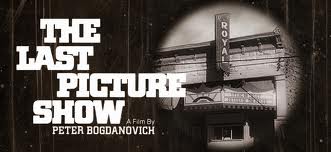
THE LAST PICTURE SHOW (1971) revisited

September 27, 2013

last pic1 Greetings again from the darkness.  Tuesday night was a real treat for this movie lover.  Thanks to the Dallas Film Society, Frost Bank and Alamo Drafthouse, the first in a Texas-themed film series was presented … The Last Picture Show.   As I have stated many times, seeing the classics in a theatre goes far beyond reminiscing. It is experiencing the best of cinematic art in the forum its creators meant for it to be seen.

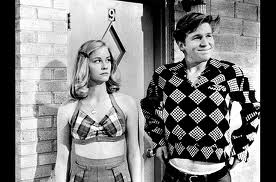
Forty-two years ago, director and co-writer Peter Bogdanovich and writer Larry McMurtry (screenplay and novel) assembled a cast that blended veteran stage, screen and TV actors such as Ben Johnson, Cloris Leachman, Ellen Burstyn and Eileen Brennan, with an energetic and fresh-faced group of relative unknowns such as Jeff Bridges, Timothy Bottoms, Randy Quaid and Cybill Shepherd.  It was the first screen appearance for Quaid and Shepherd (who had been a successful last jeff cybillteenage model), as well as Sam Bottoms (Timothy’s brother) who plays Billy, the smiling, sweeping mute boy who so adores Sonny and Duane.  Of course, Bridges had been acting off and on through his childhood thanks to his dad Lloyd, but this was his breakout role.

It’s not unusual for this film to be pre-judged as some simplistic, outmoded black and white movie with no relevance to today’s world.  In fact, a better argument can be made that this is one of the finest commentaries ever made on human nature, friendship, growing up, mentoring and personal dreams.  You might wonder how a story that takes place in some tiny, desolate, wind-blown rural Texas town in 1951 (the start of the Korean War) has anything to do with society today.  The small town setting actually strips away all distractions of today’s stories and focuses on what makes people tick … why they do the things they do.  We see the strong, the weak, the disabled, the rich, the poor, the innocence of youth, the melancholy middle-aged and the impact our decisions and actions have on others.  It’s easy to ask “why do they stay” or “what makes life worth living” in Anarene.  Those same questions are asked by many people every day in any town or city you can name, regardless of size or location. This is also one of those rare movies that causes your outlook and perception to change depending on your age.  When I first watched, I was seeing through the eyes of Sonny (Timothy Bottoms), while now I relate much more to Sam the Lion (Ben Johnson).  Not many movies have that kind of generational power.

last ben The film was nominated for 8 Academy Awards: Picture, Director, Cinematographer, Screenplay, Supporting Actress (Ellen Burstyn), Supporting Actor (Jeff Bridges), with wins for Supporting Actress (Cloris Leachman) and Supporting Actor (Ben Johnson).   The French Connection was the big winner that year, and other nominees included A Clockwork Orange and Fiddler on the Roof.  What a year!  Ms. Leachman and Mr. Johnson (pictured left) are both heart-breakingly terrific in the movie. Johnson’s scene at the fish tank is mesmerizing and he perfectly captures the wistful wonderings of so many middle-aged men who feel like life has passed them by.  I’ve often interpreted Sonny and Duane as the two sides of Sam the Lion (what he once was and what he is now). Johnson passed away in 1996, but used his wonderful slow drawl and strong presence in such films as The Wild Bunch, Dillinger and many John Ford westerns. Ms. Leachman (still working today in “Raising Hope” after striking it big in “Mary Tyler Moore” and Young Frankenstein) generates such empathy from the viewer as she re-discovers a reason to live.  She is also the key to what I consider one of the most powerful closing scenes in cinematic history.  As for the others, Jeff Bridges and Ellen Burstyn are both in their 5th decade of Hollywood stardom and have each won Oscars.  Eileen Brennan has a very memorable moment in this film where she shoots one of those filled-with-disgust glares at Jacy (Shepherd). It’s one of those looks that only exists between one woman and another. Ms. Brennan (who passed away earlier this year) was Oscar nominated for her supporting role in Private Benjamin (1980).

last bog Equally fascinating are the stories of the creative forces behind the film.  Peter Bogdanovich (pictured left) was a film historian and film critic when he broke into Hollywood as a bit actor and filmmaker.  He later had some directorial success with such films as Paper Moon (1973) and Mask (1985), but he never again reached this level as a director (though very few do).  In fact, much of his career has been spent as a supporting actor (including a psychiatrist in “The Sopranos”).  Bogdanovich can be heard as the DJ on the radio during this film … a New Yorker giving his best impression of a Texan.  Married to his artistic collaborator and (later) producer Polly Platt while filming this movie, he soon began a very public affair with young Cybill Shepherd. They made quite the high profile couple for a short while.  You might remember the story of 1980 Playboy centerfold Dorothy Stratten, who was murdered by her ex-boyfriend Paul Snider, and was the subject of Bob Fosse’s film Star 80.  At the time of her death, Stratten was dating Bogdanovich.  A few years later, Bogdanovich married Dorothy’s younger sister Louise.  Even in Hollywood, this was greeted with raised eyebrows.  Bogdanovich worshipped the films of Truffaut, Ford and his friend Orson Welles … the influence of each is visible in The Last Picture Show. Unfortunately, Bogdanovich was never able to re-capture the magic of this 1971 gem.  Some blame his divorce from Polly Platt, while last mcmothers claim it was writer Larry McMurtry’s input that helped make the film something special. In addition to this novel and screenplay, McMurtry (pictured left) is also known for his Pulitzer Prize winning novel “Lonesome Dove” (later an award winning TV mini-series),  his novel “Terms of Endearment” (adapted into an Oscar winning movie), and his screenplay for Oscar winning Brokeback Mountain.  Despite all the success, it’s The Last Picture Show that hits closest to home … it’s a semi-autobiographical rendering of his life in Archer City, Texas (renamed Anarene in the film).  Even today, McMurtry is a book seller and frequent resident in Archer City.  In 2011, he married the widow of author Ken Kesey (“One Flew Over the Cuckoo’s Nest”).  Lastly, cinematographer Robert Surtees captured the desolate landscape of Anarene through his horizontal pans of a landscape that never seems to change.  Mr. Surtees was a 16 time Oscar nominee for such films as Oklahoma!, The Graduate, A Star is Born and one of his three wins came for the classic Ben-Hur.  His son Bruce followed in his shoes and was Oscar nominated for his work on Lenny (1975)

last tim cloris There are a few other things I like to point out in regards to the film.  The high school teacher reciting Keats’ “Truth and Beauty” to a class who couldn’t care less is John Hillerman (a native Texan), who went on to stardom in “Magnum P.I.” in the 1980’s.  Randy Quaid received an Oscar nomination just two years later for his work in the great The Last Detail. Of course, he later went on to star as Cousin Eddie in the ‘Vacation’ movies. Clu Gulager plays town lothario Abilene. He is the son of vaudeville star John Gulager, who worked with George M Cohan. Clu has had a long career in TV and movies and even appeared in last year’s Piranha 3DD … at age 84!  The music in the film corresponds closely to the story and much of it is the work of the great Hank Williams, Sr. Check out the two versions of “Cold, Cold Heart” as they are performed by both Williams and Tony Bennett.  Now THAT’s how you use music in a flm!  Cybill Shepherd became a star thanks to her work here, then in Taxi Driver, and in the hit TV show “Moonlighting” (with Bruce Willis), her own show “Cybill”, and the Showtime series “The L Word”.  She continues her work in both TV and movies.  As previously mentioned, she began a very public affair with director Peter Bogdanovich while filming this movie. What many don’t know is that she was actually seeing Elvis Presley at the time, and chose Bogdanovich over the King of Rock and Roll.

In 1990, director Bogdanovich revisited Anarene and caught up with the characters 30 years later in the sequel Texasville.  While it’s based on Larry McMurtry’s novel of the same name, Mr. McMurtry was not involved in the production and Bogdanovich wrote the screenplay himself.  Many of the original cast reprised their roles, but the film was not well received either critically or at the box office.   On the bright side, The Last Picture Show was selected to become part of The National Film Registry in 1998.  Maybe the film deserved a happy ending after all.

**NOTE: I have elected not to post the original movie trailer as it is my opinion that if you have not seen the movie, it’s best to view it with fresh eyes … in other words, the trailer shows too much of a few critical scenes.


Update: Parkland trailer

August 21, 2013

The trailer for Parkland (2013) has finally been released.  As expected, the story focuses on the events immediately after the Kennedy assasination, with an emphasis on the hospital where he was treated. You will also note Paul Giamatti as Abraham Zapruder.

Here is my initial report from January of this year:

https://moviereviewsfromthedark.wordpress.com/2013/01/16/filming-parkland-in-austin-tx/

Watch the trailer:

http://www.youtube.com/watch?v=SgPjt_BRLvY


ELMORE LEONARD remembered

August 20, 2013

elmore Early this morning, word of the passing of Elmore Leonard started making its way through news outlets and Twitter.  He was 87 and died of complications from a recent stroke that had initially been reported as “not too serious”.   Mr. Leonard was one of the great American writers, and though his writing spanned more than sixty years, he may never have been more popular than today, thanks to the TV series “Justified“.

Mr. Leonard served in the Navy during WWII, and worked in advertising after graduating from the University of Detroit.  His family moved to Detroit when he was very young and he lived there the rest of his life, mostly in the township of Bloomfield Hills.  He described the city as inspirational and it often played a key role in his stories.  Mr. Leonard began writing Western stories and recalled selling the story for “3:10 to Yuma” for $90.00

With 45 published novels and countless short stories and articles, Leonard was incredibly prodigious as a writer and dedicated to writing every day.  His routine included long-hand on a yellow pad, followed by typewritten pages (never a computer).  When he made the move from Westerns to Crime stories, his “The Big Bounce” was rejected 84 times, a reminder of the incredibly complicated industry.

Hollywood loved Leonard’s style, colorful characters, black humor, and intricate plotting. Some of the best adaptations of his work include:

elmore1 “Justified“.  The TV series from creator Graham Yost revolves around Deputy U.S. Marshal Raylan Givens, one of the more interesting and entertaining characters as portrayed by Timothy Olyphant. The series specializes in bad guys who are often as clever as the good guys … as evidenced by the terrific Walton Goggins as Boyd Crowder.


Jackie Brown (1997).  Quentin Tarantino’s only directorial effort involving material he did not write. Leonard’s novel “Rum Punch” provides the foundation for this twisty thriller and the antics of Pam Grier and Samuel L Jackson.

3:10 to Yuma (1957, 2007). Not very many writers are involved with film adaptations of their work across a 50 year span. Director Delmer Daves directed Glenn Ford and Van Heflin in the original, and director James Mangold followed up 50 years later with Russell Crowe and Christian Bale. Both are tense thrillers with moral statements.

Hombre (1967).  Paul Newman stars in this fine western directed by Martin Ritt. Human nature is on full display from this Leonard novel.

Get Shorty (1995).  John Travolta stars as an out of his element (or is he?) mobster when he heads to Hollywood to collect a debt. The supporting cast is exceptional and director Barry Sonnefeld perfectly captures the finest Leonard comedic dialogue.

Out of Sight (1998).  George Clooney and Jennifer Lopez, in their sizzling onscreen best, star in a movie that oozes style from director Steven Soderbergh.

Premiering this year at the Toronto Film Festival will be the latest screen adaptation of a Leonard work, Life of Crime.  It stars Jennifer Aniston and is based on Leonard’s novel “The Switch”.   Not surprisingly, there are numerous other works in progress (mostly TV) that take advantage of Leonard’s talent.

Elmore Leonard’s efficiency with words is renowned and he often said that he “tries to leave out the parts that people skip”.  Clearly a man who understood not just writing, but what makes reading enjoyable.  My favorite of his quotes: “If it sounds like writing, I rewrite it”.  That’s a lesson we hope carries through to future generations of writers.

elmore4


MOVIES LOVE MOVIES … SO DO I

July 18, 2013

Greetings again from the darkness.  As I stated in my Mid-Year recap, 2013 has thus far been a frustrating year for new movies.  Still, that doesn’t change a thing.  I love movies … well, maybe not Sharknado (sorry SyFy).  You know who else loves movies?  Filmmakers. Making movies, watching movies and going to the movies have long been favorite topics of writers and directors.  Some are even known for their movie “tributes”: Martin Scorcese, Woody Allen and Quentin Tarantino, just to name a few.

Below is a 6 minute video that is an uplifting montage of “Movies in Movies”. If you enjoy movies, this will bring a smile to your face and remind you of that indescribable “movie magic”.  The finale is especially touching as it includes a song from what is probably the ultimate movie about movies, Singin’ in the Rain (1952).

Enjoy … and let me know if you can think of any others not included in the montage:

http://www.youtube.com/watch?v=GwGonPg8_I8


FIRST HALF RECAP – 2013

July 9, 2013

Most years, July 1 rolls around and I get kind of excited to put together my first half movie recap. This year … not so much. Simply put, it has not been a good six months for new movies.  Surprisingly, the box office is right in line with 2012, and actually, this summer season is running a bit ahead of last year.  Despite my disappointment in the quantity of quality films, there are a few that provided a nice movie-going experience — just not enough of them!

One thing that provided a cinematic boost was attending the Little Rock Film Festival (LRFF) with my long-time friend Lawrence. Three days of cramming in as many indie films and documentaries as possible, while gaining insight directly from the filmmakers, made for a great time … and contributed a few of my favorites so far this year.

Rather than dwell on the disappointments, let’s go through some of the bright spots. As is customary, these will not be presented in any particular order.  That chore is reserved for my end of year recap, which gets posted each January.

DOCUMENTARIES

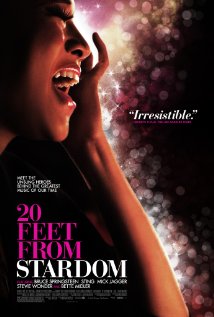
20 feet 20 Feet from Stardom – Just now building an audience as it gains theatre distribution throughout the country, it’s alternately heart-breaking and heart-warming as we meet the real people behind the artists known as back-up singers. The interviews are mesmerizing and though the music is uplifting, there are life lessons to be learned from Darlene Love, Lisa Fischer and Merry Clayton.

Gideon’s Army – another LRFF gem, and it introduced me to the hardworking folks that make up the Public Defenders force. While this one will make you grateful for your chosen profession, it will also make you appreciative of the efforts given by these mostly anonymous attorneys.  You can catch this one on HBO.

Muscle Shoals – saw this one at LRFF, and was shocked to learn so much about the influence of producer Rick Hall and his FAME studios in Alabama on the beloved music from the 50’s – 70’s. I have now been enlightened.

Stories We Tell – directed by Sarah Polley, this one plays like watching someone else’s home movies … and that’s just about what it is. Ms. Polley provides a personal example of the power of family secrets. She interviews her brothers and sisters, and spends much time with her fascinating father.

CLASSIC FILMS

If you are a regular reader of my blog, I probably sound like a broken record in regards to this topic. Should you be fortunate enough to live in a market where the theatres periodically show “classic” films, I encourage you to take advantage. Two of my favorites so far this year are Jurassic Park 3D and Lawrence of Arabia. These two movies are not only amazing stories with interesting characters, but they are spectacular on the big screen. It doesn’t matter if you have seen them before … don’t miss the classics in a theatre!

POPCORN

MOS2 Shorthand for tentpoles, blockbusters, and big budget extravaganzas, these “big” movie productions did what they are designed to do … provide entertaining escapism with a “WOW” factor:

Iron Man 3 – if you are a fan of the series, you will appreciate the wise-cracking Tony Stark (Robert Downey Jr) returning to the role that is all about fun,  wild action and effects.

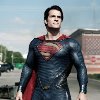
Man of Steel – rather than focus on Clark Kent, director Zack Snyder teamed with Christopher Nolan to deliver a most interesting backstory for Superman (Henry Cavill) that will surely lead to more movies. Casting Russell Crowe and Kevin Costner as Superdads was genius.

The Great Gatsby – very divisive film that turned off many, while thoroughly entertaining many others. Director Baz Luhrman visualizes F Scott Fitzgerald as hip-hop and glitzy.

OTHERS

mud1 42 – A slick version of Jackie Robinson breaking the color barrier in Major League Baseball. Harrison Ford turns an interesting Branch Rickey, and this is one the whole family can see.

 Much Ado About Nothing – director Joss Whedon films his close knit group of friends performing a modernized version of Shakespeare’s romantic comedy.

Mud – gritty little film that moves at its own pace and sucks the viewer right into this world of small town deception.  Matthew McConaughey and young Tye Sheridan turn in outstanding performances.

The Iceman Michael Shannon simmers on screen as notorious Mob hitman Richard Kuklinski, who killed more than 100 people over 35+ years … all while maintaining the façade of a happily married family man.

Being the eternal movie optimist, I fully expect some great (and I use that term judiciously) movies during the second half. The proposed line-up includes more entries into the superhero genre, the next “Hunger Games” and “Hobbit”, a couple of interesting Sci-Fi projects, a remake of the horror classic Carrie, a documentary on JD Salinger, the much anticipated August: Osage County, more from the Coen Brothers, Martin Scorcese, Andrew Payne, Spike Lee, David O Russell and Lee Daniels … and yes, the sequel to Anchorman.

Let me know your favorites so far this year, and I’ll see you at the movies!


GOLDEN VOICES OF THE SILVER SCREEN

July 2, 2013

voices - mic

 Why the void?

So often, the conversation turns to movies. Well, at least around my house it does.  A casual comment from Jen (my son’s fiancé) spurred a flurry of discussion and name-calling.  No, we weren’t verbally assaulting each other; rather we were reacting to her casually wondering aloud where all the actors with great voices have gone.  Perhaps you have noticed the void … more likely you haven’t.  The previous abundance of golden voices on the silver screen has devolved into a mass of nondescript, sometimes unrecognizable voices that rarely dominate a scene or command an audience.

My initial response to this conundrum was to note that today’s movie stars spend little or no time on stage in front of a live audience … the ultimate training ground for impactful voices. Sure, a few big time actors will take on a limited run for a play, but nothing like the years of consistent stage work from many of the stars of yesteryear.

voices - gregory peck Deeper analysis, a little research, and conversations with some people whose opinions I value, has led me to a more sociological-related conclusion. Our “ideal man” has changed.  Corresponding to that change was a distinct transition in the type and style of voices sought for acting roles. For decades (and even longer), the ideal man was often described as “the strong silent type”. Being heroic meant not just fighting for our country in the string of wars (WWI, WWII, Korea, Vietnam, et al) but also carrying the burden of family bread-winner and protector, even during the Great Depression.  A real man’s actions spoke volumes, while his words were spoken rarely.  When he did have something to say, his words cut straight to the point and were delivered with a strong, deep voice that commanded, even demanded attention. The example would be Gregory Peck as Atticus Finch in To Kill a Mockingbird.  This was the image of man which every boy strived for and most women expected.

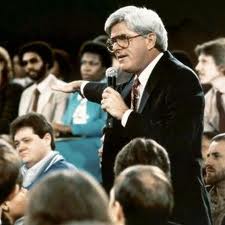
Then, along came the late 1960’s … hippies and rebellion … and a new movement. Authority figures were no longer above reproach.  Every societal norm came under scrutiny, and with this came a different style of role model.  The ideology of the strong silent type was being challenged by the intellectually vociferous types … the skeptical, quick-witted ones voices- phil donahuewho poetically debated for a more equal and open society.  When 1970 rolled around, “The Phil Donahue Show” was unleashed nationally. In 1971, “All in the Family” introduced us to Archie Bunker (Carroll O’Connor) as the grumpy “old school” man struggling to hold onto his traditional world that was being overrun by idealists (Meathead). And then in 1972, “M*A*S*H” hit TV.  Alan Alda’s Hawkeye Pierce showed us what the new ideal man was … unafraid to question authority, driven to expose system inequities, void of any desire for heroics, and above all, not just unafraid, but actually anxious to share his emotions.   Archie Bunker became the butt of jokes.  Alan Alda’s charm and often whiny voice was winning over women and taking macho men off the hook.  Phil Donahue was invoking his harried, high-pitched plea to guilt his guests into conveying the emotions necessary to publically open the long-closed lines of communication between men and women.  The world had changed and there was a new definition of “man” … and he was expected to talk a lot!

Movies are a reflection of the times, so Hollywood’s leading men have been evolving and transitioning ever since Alda and voices - cary grantDonahue raised the pitch of their voices to rip down the old façade of what makes a man. Where once we had High Noon with Gary Cooper standing tall and delivering his sparse dialogue with a deep authoritative voice, we soon had Sleepless in Seattle and the ultimate sensitive single dad (Tom Hanks) speaking gently and kindly to his young matchmaker son atop the Empire State Building (yes, it’s a remake … compare Cary Grant’s 1957 voice in An Affair to Remember to that of Hanks in the 1993 version).  The changing ideal of manliness corresponded to the dramatic shift in the screen voices of men.  Rather than leading men in the mold of Charlton Heston and Richard Burton, we were seeing and hearing the likes of Dustin Hoffman, Al Pacino (pre-bellowing years), Robert Redford and even Woody Allen. This is probably the most opportune time to point out that this comparative analysis is, by nature, a sexist undertaking. This is not meant as a slight on actresses, it’s simply a focused look at the dramatic and distinctive changes in the voice of male movie actors over the past few decades.

Of course, judging the “great” voices is a combination of opinion and general perception. An attempt was made to not simply be fooled by an elegant British accent, a charming Aussie mate, or a distinguished Frenchman.  Vocal resonance, timbre, tone and screen impact were the keys. Debate is encouraged in regards to those included, as well as those omitted. What is clear is that the imbalance between the “Over 50” and “Under 50” would be comical, if not so startling … and believe it when I say that another twenty names could easily be added to the older group, while the younger group failed to produce any others that were even borderline.

GOLDEN VOCAL CORDS – this is the group of actors who have a voice that resonates and becomes part of their character and persona.  The list is broken into age groups and includes some of the all-time greats (some no longer with us), as well as some still working today:

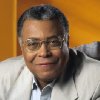
Golden Voices, age 50 plus:   Yul Brenner, Richard Burton,  Sean Connery,  Kirk and Michael Douglas, Michael Clarke voices - james earl jonesDuncan,  Sam Elliott, Morgan Freeman, James Garner, John Gielgud, Cary Grant, Fred Gwynne, Richard Harris, Dennis Haysbert, Charlton Heston, Anthony Hopkins, John Houseman, Rock Hudson, James Earl Jones, Boris Karloff, Ben Kingsley, Kris Kristofferson,  Frank Langella, Christopher Lee, Dean Martin, Lee Marvin, James Mason, Malcolm McDowell, Ian McKellen, Liam Neeson, Leslie Nielsen, Leonard Nimoy, Gregory Peck,  Sidney Poitier, Christopher Plummer, Vincent Price, Jason Robards, George C Scott, Robert Stack, Patrick Stewart, Donald Sutherland, Max von Sydow, Denzel Washington, Orson Welles, Paul Winfield

Golden Voices, under age 50: Benedict Cumberbatch, Armie Hammer, Hugh Jackman, Dwayne “The Rock” Johnson

voices - hugh jackmanIf you believe I am discriminating against the younger group, here is a list of some of the top actors in the under-50 age group.  I look forward to hearing which of these you believe belong in the GOLDEN VOCAL CORDS group:

Other Actors under age 50: Ben Affleck, Casey Affleck, Christian Bale, Javier Bardem, Jay Baruchel,  Michael Cera, Bradley Cooper, Daniel Craig, Russell Crowe, Matt Damon, Leonardo DiCaprio, Robert Downey Jr, Jesse Eisenberg, Michael Fassbender, James Franco, Andrew Garfield, Joseph Gordon-Levitt, Ryan Gosling, Jonah Hill,  Phillip Seymour Hoffman, Josh Hutcherson, Shia LaBeouf, Tobey Maguire, James McAvoy, Clive Owen, Robert Pattinson, Joaquin Phoenix, Chris Pine, Brad Pitt, Keanu Reeves, Jeremy Renner, Chris Rock, Ryan Reynolds, Mark Ruffalo, Liev Schreiber, Michael Shannon, Channing Tatum, Mark Wahlberg

What I noticed about this last group, is that rather than possessing a booming stage-ready voice, many fall into the “Mumbling” category made famous by the likes of Marlon Brando, James Dean, Johnny Depp, Clint Eastwood, and Sean Penn.  The italicized names in the group above are those that I believe easily fall into “Mumbling”.

At this point, you may be thinking exactly what I was … there are still some very recognizable movie voices that have not been mentioned. This worthy of attention group has been labeled “DISTINCTIVE”.

DISTINCTIVE VOICES:  Ed Asner, Antonio Banderas, Humphrey Bogart, Powers Boothe, Ernest Borgnine, Walter Brennan, voices - hugo weavingJeff Bridges, Steve Buscemi, James Cagney, James Coburn, Peter Falk, Clark Gable, Samuel L Jackson, Peter Lorre, Matthew McConaughey, Groucho Marx, Walter Matthau, Robert Mitchum, Jack Nicholson, Edward G Robinson, Al Pacino, Arnold Schwarzenegger, William Shatner, Jimmy Stewart, George (“Oh my”) Takei, Christopher Walken, John Wayne, Hugo Weaving.

Taking a look at the “Other Actors under age 50” group, it seems that Chris Rock and Jesse Eisenberg are really the only ones who belong in the “Distinctive” group, unless you include Keanu Reeves’ trademark “Whoa” or Mark Wahlberg’s highly recognizable Southie use of the “f-word”.

What all of this means is still a bit cloudy, but it’s clear that neither a great nor distinctive speaking voice is critical to earning a nice living as an actor these days. Heck, we haven’t even categorized Tom Hanks, Robert DeNiro, Tom Cruise, Daniel Day Lewis or Dustin Hoffman … five of the most successful actors of the last 40 years.  What’s also clear is that a transformation has occurred in the acting world. The age imbalance for “Golden” and “Distinctive” voices is proof … what’s not quite so clear is exactly WHY.

Using your best Don LaFontaine (the late, great voice actor known for movie trailers) voice, let me hear you say … “In a world where … the golden voices of the silver screen seem to have disappeared” …which actors under age 50 would you include on the list?   (You’ll have to use the comments section for me to really “hear” you)

Here is a little inspiration to get you in the Golden Voice mood.  It’s a mash-up of Don LaFontaine’s trailer work:

http://www.youtube.com/watch?v=PjWKE-IJ4R8


JAMES GANDOLFINI remembered

June 20, 2013

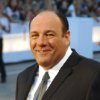
gandolfini Last evening brought the startling news that James Gandolfini had passed from a sudden heart attack.  It happened while on vacation in Rome with his teenage son, who found him.  The legacy of  Gandolfini is safe thanks to his role as Tony Soprano in HBO’s ground-breaking series “The Sopranos“, but we movie fans know him for so much more. He was a fabulous movie actor both in lead roles (Welcome to the Riley’s) and supporting ones (The Coen Brothers’ The Man Who Knew Too Much, In The Loop, and Killing Me Softly).  He was beloved and respected by those within the industry, and he once laughed off the idea that he might be like Tony Soprano.  His response … a proclaimation that he is more like “a 260 pound Woody Allen“.

The controversial final episode of “The Sopranos” was filmed at a New Jersey Ice Cream parlor called Holsteins.  Fans gathered last night, and in a touching tribute, the booth where Tony and his family sat in that final scene was marked with a “reserved” sign.

Here is a 2 minute video showing some of Mr. Gandolfini’s work:

http://www.youtube.com/watch?v=vEyhCZK2jJM&feature=youtu.be


LITTLE ROCK FILM FESTIVAL 2013

May 21, 2013

LRFF In a manner quite typical of our history, my college buddy Lawrence and I avoided an actual plan for attending the Little Rock Film Festival (LRFF) until just a couple of weeks prior to its start date.  He made the drive from Norman, Oklahoma where he pursues his lifelong profession of higher-education for future teachers.  My Southwest Airlines flight arrived from Dallas in time for us to jump right in to the festival schedule midway through Day 2.  Neither of us are the Opening Night “gala” types, but we are sorry to have missed the festival opening film Short Term 12 on Wednesday evening.  Our 3 days were spent juggling start times and venues throughout downtown Little Rock, so as to maximize our movie watching.

The key components of a Film Festival are: the selection of films (obviously), the venues, the crowds, transportation, special guests (writers, directors, actors, etc), the festival volunteers, the local flavor, and any perks (the always awkward abbreviation for perquisites) for attendees.  Here is my breakdown of each of these categories:

  1. SELECTION OF FILMS LRFF categories include: Narratives (traditional features with scripts and actors), Spotlight (usually with a special guest or discussion), Documentaries, Made in Arkansas, and World Shorts. There were also special categories such as Youth Films for young aspiring filmmakers, and Film Talks (seminars).  With much of the audience being local types, the emphasis on “Made in Arkansas” films made sense.  Providing screening for these productions brings attention to the state’s film industry and talent base.  Since neither Lawrence nor I have ties to Arkansas (insert punchline here), we focused our time on Narratives and Documentaries. We never once used our “safety net” of World Shorts.  This speaks highly of the quality and variety offered during all time slots.
  2. VENUES.  While the program lists 15 different event locations, which includes special discussions, parties and other non-movie screening spots, our movie viewings took place in 5 different venues of widely varying quality and comfort.  One of these was a modern lecture hall in the beautiful new (and highly green) Heritage Center, while another was simply unoccupied retail space with a black curtain marking the screening area. You can imagine the corresponding picture and sound quality.  A community stage theater had a wonderful look, but offered leg room seemingly designed for the Munchkins from the Land of Oz.  Its balcony offered little improvement. The soon to be completed Arcade Theater will serve as the main venue and central hub for LRFF 2014. This will allow for more continuity and a true gathering spot for festival attendees.
  3. THE CROWDS. In a pleasant contrast to many festivals, the crowds were minimal and easily spread out among the various venues. Made in Arkansas films were shown to audiences comprised of friends and family, while the Narratives and Documentaries had mostly sparse crowds made up of the few out-of-towners (like us). Since the festival overlaps with the world famous Cannes Film Festival, there is a noticeable absence of big-name filmmakers, highly-anticipated movies, and snooty Frenchmen. Cinephiles find much joy in “discovering” quality work in an entertaining or informative movie that offered little more than an upfront 2-3 sentence synopsis. LRFF is that type of opportunity, while Cannes offers a chance to stand in line for hours hoping for admission and to see Johnny Depp or Cameron Diaz posing for paparazzi. To each his own.
  4. TRANSPORTATION. The venues were spread out all over downtown Little Rock.  If you have never been there, the Arkansas River divides the city, and we spent time on both sides. A car was a basic necessity to navigate the schedule and various venues. Maybe next year’s opening of The Arcade will minimize the need to drive so often. Luckily, cheap parking was readily available.
  5. SPECIAL GUESTS. A high percentage of the films had writers, directors, producers and/or actors in attendance. Post-screening Q&A’s can be very enlightening, but the staggered screening schedule usually had us rushing off to catch “the next one”, rather than learning more about the last one.  When we did have time, we certainly enjoyed the filmmakers’ insight into their work. This was especially true for Pussy Riot – A Punk Prayer director Maxim Pozdorovkin, and Marc Menchaca, writer/director/actor for This is Where We Live.  I would have liked to have spent some time with Dawn Porter, who directed TWO of the better documentaries we saw: Gideon’s Army and Spies of Mississippi.  Film Producer and famous Bill Clinton friend Harry Thomason was there filling in for his wife, Linda Bloodworth-Thomason, who directed the award-winning Bridegroom (which we did not see).
  6. FESTIVAL VOLUNTEERS. There was certainly no shortage of volunteers working the festival. The presence of these people allows for a smooth-running operation and prevents mis-communication in regards to delays, etc. Larger crowds might have impacted the effectiveness, but there were no issues during our visit.
  7. LOCAL FLAVOR.  This category delivered the biggest surprises. Downtown Little Rock is clean and offers city parks and many pleasant views of the Arkansas River.  There are numerous locally owned mom-and-pop diners, cafes, pubs, etc. The service people were extremely friendly and the food was all tasty and reasonably priced. Friday evening’s LRFF party was held on the Junction Bridge … a walking bridge that crosses the river. That was an unusual experience and a creative party place.
  8. PERKS FOR FESTIVAL ATTENDEES. This is one area where the LRFF could take lessons from others. The price of a pass bought you a program and … umm … well … oh yeah … a pass.  No gift bag. No swag. No special offers or details on sponsors. One of the venues offered a community cheese and grapes tray that was quickly picked over.  Our Silver passes did allow us the privilege of paying a $10 entry fee for the bridge party, along with the opportunity to purchase beer or wine … our wine pour was approximately 2 oz.  The reason to attend a festival is to take in the movies, but some sort of appreciation shown to sponsors and attendees is not without merit and precedence.

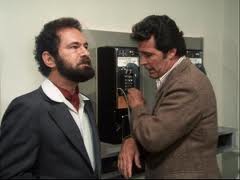
LRFF2 On a personal note, I enjoyed meeting Stuart Margolin at one of the screenings.  Over the years, Mr. Margolin has been a favorite character actor. He is probably best known for his time as Angel, James Garner’s frustrating co-hort in “The Rockford Files”.

There were of course a few movies that really made an impression.  The most entertaining documentary for me was titled Muscle Shoals. Despite my love of music from the 1960’s, I was oblivious to the real impact that FAME Studios owner and record producer Rick Hall had on the era.  This was incredible fun and filled a gap in my music knowledge.  Gideon’s Army provided insight into the absurdly difficult work environment of public defenders.  Spies of Mississippi showed us rare photos and video footage, and took an unusual angle on the Civil Rights movement … espionage from the Mississippi government.  Our Nixon showed us archival footage from the Watergate period and provided specifics on Nixon, Dean, Haldeman, Ehrlichman and Chapin.  Pussy Riot – A Punk Prayer took us inside the Russian judicial system, while The LRFF4Kill Team detailed the Military judicial system as it relates to Army infantry soldiers who went too far in killing Afghan civilians. We Always Lie to Strangers gave us a peek behind the curtain of the secondary performers in Branson, Missouri while breaking down the façade of the Branson bible-belt image.

The documentary that really kicked me in the gut was called 12 O’Clock Boys, and showed us the stunning images of illegal dirt bike riders wreaking havoc in west Baltimore. These inner-city riders create dangerous situations on the roads while knowing that the police have an anti-chase policy (for public safety).   All of that is difficult enough to watch, but the truly stunning moments come courtesy of young Pug and his mother. I have no words to describe these people … especially the mother. To give you some insight, she showed up for the screening and promptly sat front row and recorded the movie on her smart phone. I did not have the nerve (or stomach) to stick around for that Q&A.

The staggered start times and multiple venues and small crowds allowed us to skip out early if a particular movie was not capturing our interest in the first half hour. We only did this a few times, but in each case, it led to a more fulfilling cinema experience. While LRFF5the abundance of quality documentaries would have made the festival worthwhile, there were also three Narratives that caught our eyes. The Discoverers is a dysfunctional family dramedy featuring one of Griffin Dunne’s best ever performances, as well as strong supporting work from Madeleine Martin (“Californication”), Carla Buono (“Mad Men”), Dreama Walker (“Don’t Trust the B in Apartment 23”), Ann Dowd, John C McGinley and Stuart Margolin.  It has some funny, cryptic dialogue as well as a message about the bonds of family.  Written and directed by Texas born Menchaca, This is Where We Live introduces us to a rural family that just can’t seem to catch a break … other than heart-break. It has strong performances from CK McFarland, Tobias Segal, Ron Hayden, Frances Shaw and the great Barry Corbin.  Finally, we saw an interesting little film called The Girl, which features Abbie Cornish and Will Patton. This is a tough story of a struggling single mom, only we get the rare script that doesn’t make her overly likeable for the audience.

Should you ever have an interest in taking part in a film festival, I would not hesitate to recommend Little Rock Film Festival.  You better love documentaries and independents, and be able to maximize your time over a few days. Of course, if your budget and personality and love of all things French allows … there’s always Cannes!


RAY HARRYHAUSEN remembered

May 7, 2013

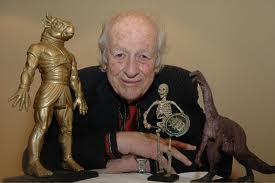
harryhausen Ray Harryhausen has passed away at age 92.  When someone from the movie-making world dies, we often talk about how their work influenced others or had an impact on the industry. It’s difficult to name any single person who influenced more filmmakers and movie lovers than Ray Harryhausen.  As for impact on the industry, we continue to enjoy not just his work, but the work of those he inspired … Steven Spielberg, George Lucas, Tim Burton, Stanley Kubrick (and MANY more!) … in genres such as Sci-Fi, Adventure, Fantasy, Horror and Monsters.

If you don’t recognize his name, it’s because he was a humble man who enjoyed his craft, but avoided the spotlight. His life-changing event occurred when he watched King Kong (1933). The visual effects ignited a passion and a lifelong pursuit of improving visual effects in movies. He tutored under pioneer George Pal and worked with Willis O’Brien on Mighty Joe Young (1949).  He then began his own work, including his most famous films The 7th Voyage of Sinbad (1958), Jason and the Argonauts (1968), One Million Years, B.C. (1966) and his final film Clash of the Titans (1981).

His most famous effects include the sword-fighting skeletons, the cyclops, the cobra woman, Medusa and the magnificent flying horse of “Titans”.  And this doesn’t even include Raquel Welch in One Million Years, B.C.  Yes, I know Mr. Harryhausen did not create Ms. Welch, but she exemplifies just how difficult it was for actors to get attention in a scene with his creatures!

While I am certainly not unique in this, Mr. Harryhausen’s creatures dazzled me as a youngster who was just starting to get a feel for the power of cinema. His innovative special effects led to a well-deserved Honarary Oscar in 1992.  If your boss is ever unhappy with your production level at work, just remind him that the great Ray Harryhausen often had work days where he finished but one-half second of filmed effects.  That’s what I call dedication to the cause!

**NOTE: Harryhausen made a few cameos/limited appearances in films, and is the voice of the Polar Bear Cub in Elf (2003)

The best video I could find for a tribute is below.  It presents the Harryhausen creatures in order … with the great Tito Puente providing the background music.  There is also a terrific documentary called Ray Harryhausen: Special Effects Titan (2011) that I highly recommend.

http://www.youtube.com/watch?v=U9kmjW73-v4