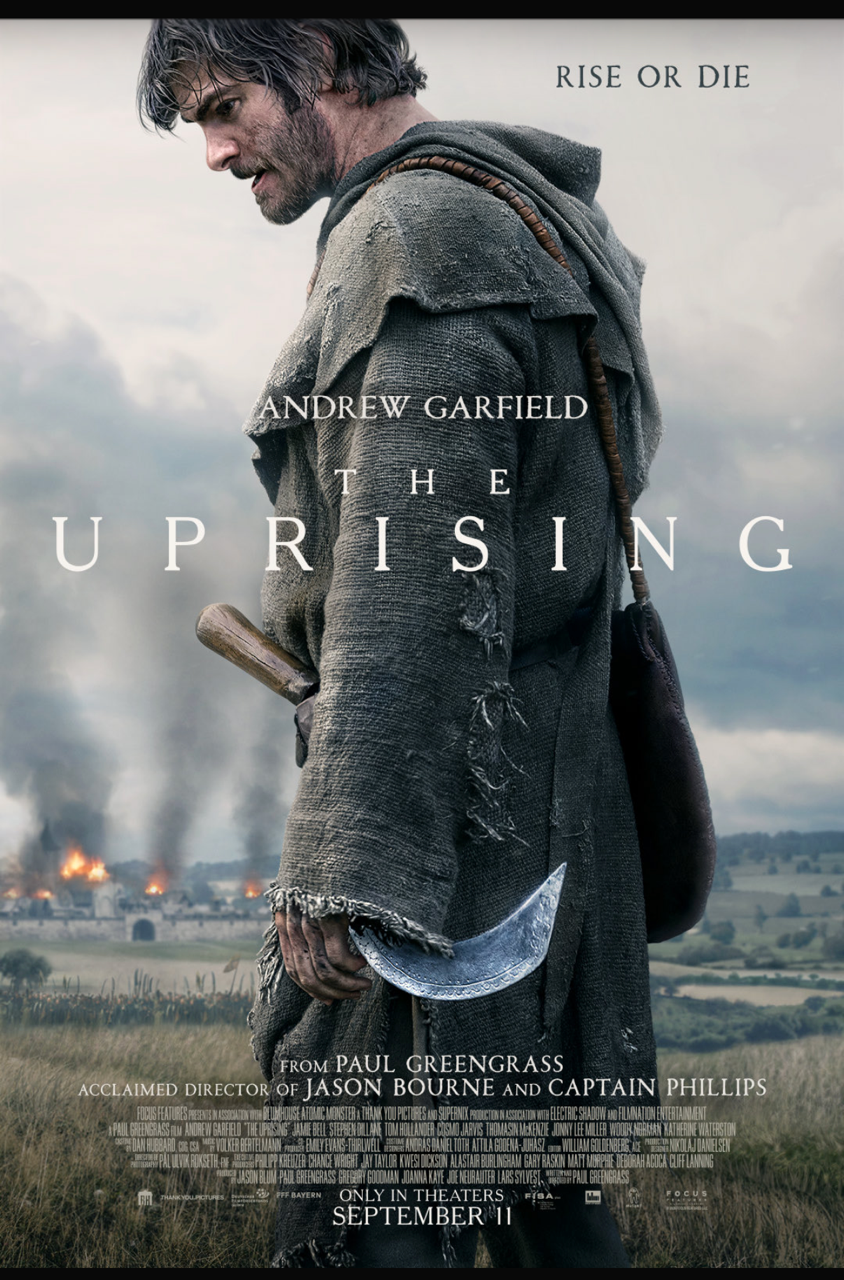
 Greetings again from the darkness. It can be challenging to relate to an historical drama set in the 14th century, yet the Peasants’ Revolt of 1381 in medieval England sometimes hits quite close to home. Writer-director Paul Greengrass directed three of the Jason Bourne movies, so we can expect the action sequences to be frenetic and thrilling … often relying too heavily on handheld cameras.
Andrew Garfield is ‘Ploughman’, a self-imposed moniker since “I am what I do”. We watch as he works his plot of land around the three graves near his cabin. He’s grieving and lonely, having paid a steep price from the bubonic plague known as “Black Death”. While he’s toiling away, the council for teenage King Richard II (Woody Norman, C’MON C’MON, 2021) is plotting behind closed doors whether to save the kingdom by taxing the rich or by taxing the poor. The rich would expect a seat at the proverbial table, so it all falls to the poor, of course. Ploughman doesn’t take kindly to the announcement and violently lashes out in anger … an action that John Ball (Jamie Bell) and Wat Tyler (Cosmo Jarvis) use as step one in the uprising of the frustrated masses.
The king’s council of corruption and manipulation is made up of elders: Archbishop Sudbury (Stephen Dillane), Chief Justice Belknap (Stanley Townsend), Treasurer Hales (Tom Hollander), and Mayor of London William Walworth (Jonny Lee Miller). While this group protects their own cone of power, the young king cowers in dark corners, escaping nightmares and uncertainty. Even his mum (Katherine Waterston) struggles to get him to govern.
Those in the rebellion are joined by Alyce (Thomasin McKenzie), a character clearly designed to represent the strong and determined women of the era. Injustice is readily accepted in no particular era, so an upswell of anger towards an oligarch by the oppressed is not surprising … although Ploughman’s elite fighting skills certainly are. The progression of the story and the battle scenes deliver significant intensity, and we can’t help but wince as those involved prove the adage, ‘power corrupts’.
If you know any of this history, you know the timid King makes a shocking turn, and one can only assume filmmaker Greengrass had no qualms about any modern-day symmetry shown in this saga from almost 650 years ago. The performances are quite good, and the Bavarian shooting locales perfectly capture the time period. Cinematographer Pal Ulvik Rokseth (ARMAND, 2024) embraces the feel of this setting, despite the trademark Greengrass overuse of handhelds. History can provide lessons of inspiration or lessons of caution, sometimes within the same story.
Opens nationwide in theaters on September 11, 2026


Fascinating reviews as always. “The Uprising” is a film that I wasn’t sure about seeing due to the largely negative reviews but your analysis has given me a reason to check it out. I do admire Paul Greengrass as a director and have always appreciated his unique style. I also find historical dramas about the lives of revolutionaries to be very fascinating. The concept of “The Uprising” reminded me of the film “Robin Hood”. Released in 2010, Ridley Scott’s movie honoured Robin Hood and his legacy as a mythical hero. “The Uprising” appears to fall into the same category of historical dramas about political rebellion. So, for these reasons, I will definitely be sure to check it out in theatres. It does seem like the type of film I would appreciate.
Here are my thoughts on “Robin Hood”: