BOY ERASED (2018)

November 8, 2018

 Greetings again from the darkness. It has taken two movies this year, THE MISEDUCATION OF CAMERON POST and this one from writer-director-producer-actor Joel Edgerton, and I finally understand that the practice of conversion therapy (treatment designed to change a person’s orientation to heterosexual from something else) is real … and it’s widespread … and it’s cruel … and it’s absurd. I’ll readily admit that my little life bubble has previously protected me from knowing much about the world of conversion.

Lucas Hedges has quickly developed into a dependable dramatic actor with his moving performances in such films as MANCHESTER BY THE SEA, LADY BIRD, and MID90S. Here he stars as Jared Eamons, a college aged young man struggling with the inner turmoil that accompanies being a gay man raised by a Pastor-dad in the heart of the Bible belt. Since the film is based on the memoir of Garrard Conley, we can assume much of what we see and hear has been seen and heard by Mr. Conley in his life.

Jared’s parents are played by Nicole Kidman and Russell Crowe, and while the parental actions of their characters may confound us, both deliver strong performances. One especially impactful scene allows Ms. Kidman to show what sets her apart … it occurs in her scene at a table with Hedges when momma finally takes control. Director Edgerton appears as Victor Sykes, the director and “therapist” at Love In Action, the refuge program where Jared’s parents send him.

Over the opening credits we get childhood clips showing Jared was a “normal” little boy being raised in a loving household. Flash forward to his awkward date with a girlfriend who asks him “what’s wrong?”. Later, after being sexually assaulted by a college buddy, Jared comes out to his parents. His time in Sykes’ program is filled with unimaginable steps. A Genogram is to be completed, listing all of the personal problems and “dangerous” traits of relatives on the family tree – the point is to isolate the source of sin. One boy is beaten with bibles by his family in an effort to drive out the demons of homosexuality (nope, that’s not a joke). There is also a macho counselor (played by Flea of Red Hot Chili Peppers) who gives inspiring manly talks and teaches how to look, act, and stand like a real man. It’s all so pathetic and tragic.

Rather than focus on Jared and the others in the program, much of the time is spent with his parents and why/how they could make the decision to enter him into conversion therapy. Jared’s dad tells him he won’t be loved by God … a message also delivered by Sykes. When Jared’s mom (Kidman) states “our family is so normal”, we aren’t sure whether she believes it, or wishes it so – although she leaves no doubt how she pictures a normal family. Of course, it’s really Jared’s dad (Crowe) who takes the news as a personal affront to his manhood and religious beliefs … beliefs somehow more important than his own son.

Support work is provided by Joe Alwyn, Cherry Jones (as a doctor, and the only reasonable adult), Frank Hoyt Taylor, Britton Sear, and Jess LeTourette. Filmmaker Xavier Dolan (MOMMY, 2014) also has a role as Jon, one of those in the program. The music is provided by Danny Bensi and Saunder Jurrianns, and for the most part, director Edgerton stays consistent with his focus on characters – though his frequent use of slo-motion loses impact with each successive use. The film avoids any cheap sentimentality or emotional gut-punches, instead focusing on the daily dealings. Perhaps it’s meant to appeal to parents in this situation – those parents who are confused and misguided. We see this film more than we feel it, although I often found myself looking at these parents and asking, ‘what’s wrong with these people?’ When the film ends by telling us 36 states allow for conversion therapy, we quickly realize Jared’s parents may be more ‘normal’ than we thought (incredible as it seems).

watch the trailer:


THE RECKONING: HOLLYWOOD’S WORST KEPT SECRET (2018, doc)

November 8, 2018

 Greetings again from the darkness. The #MeToo and #TimesUp movements are in full force, and if you somehow missed “what happened”, director Barry Avrich’s film will fill you in and get you caught up. As an expose’, it’s a bit late to the party, but as a look at how we got here, it’s pretty much right on the nose. The film opens with a proverbial cold slap to the face of viewers. We hear the Howard Stern interview where movie mogul Harvey Weinstein denies any type of sexual malfeasance exists in Hollywood. Weinstein, of course, is the poster boy for sexual misconduct in the movie industry. He’s a man who has kept the “casting couch” alive for three decades; although as we’ve learned, it certainly wasn’t Weinstein acting alone (unfortunately).

Much of the film is focused on Weinstein, and justifiably so. He is described as talented AND a monster – also as cunning, witty, brilliant, and devastating. This man was such a megalomaniac that he structured his business around two things: making money on independent films and using his position of power and influence to put women in compromising and unsafe situations. He went so far as to utilize “honey pots” – female assistants who could gain the trust of the actresses and help lure them to his web of sleaze. One of these former assistants, Zelda Perkins, is interviewed and sheds light on the process.

Many others are interviewed for the film. Writers, reporters, agents, lawyers, a psychologist, and actresses all tell their stories and insight. Weinstein is not the only name that’s named. The film also touches on: Donald Trump, Bill Clinton, Bill Cosby, Bill O’Reilly, Woody Allen, Louis CK, Aziz Ansari, Olympic Doctor Nassar … and even Pepe Le Pew (from Looney Tunes). A segment is dedicated to the audacity and despicable actions of director James Toback (known as the dream killer), and Tippi Hedren and Joan Collins talk about “that’s the way it’s always been”. We learn Mack Sennett is credited as being the founding father of the casting couch (in the early 1900’s), though numerous studio heads, producers and directors have since preyed on the ambitions of wannabe starlets.

In an awkward segment, acting legend Meryl Streep admits “I’m taking some hits” after having been targeted by street artist Sabo with #SheKnew posters. If nothing else, this underscores just how difficult it has been for women to speak up … at least until now. Dozens and dozens of women have come forward with their stories, leaving us hopeful that this blight on the industry might be over for good. Leonard Cohen’s biting song “Everybody Knows” is put to good use here.

When one of his victims recalls the story where he gifted her a copy of Fitzgeralds’ “The Last Tycoon”, and Weinstein bluntly stated, “that’s me”, we begin to understand that this monster was not just about control … he was out of control. He lost his barometer on right and wrong, and it became about what he was entitled to in his position at the top of the movie making world. Thanks to some courageous women, he no longer has that power position, and with forums like this film from director Avrich, it’s likely no other predator in this industry will ever again be able to abuse the power to the extent we’ve seen from Harvey Weinstein.

watch the trailer:


THE DIVIDE (2018)

November 8, 2018

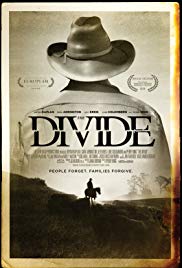
 Greetings again from the darkness. Those of us who were watching movies in the 1970’s recall Perry King as one of the fresh-faced, hunky twenty-somethings in THE LORDS OF FLATBUSH (1974) … along with Sylvester Stallone and Henry Winkler. Now, more than 40 years later, not only does Mr. King star as crusty old rancher Sam Kincaid, but he also directs his first feature film. The script is written by Jana F Brown, in what is also her first screenplay. Due to its setting, the film could be labeled as a western, but it’s really a personal drama emphasizing the importance of family reconciliation.

Sam Kincaid (King) is an elderly rancher who lives on land that looks a great deal like the Lucas McCain ranch from the TV classic “The Rifleman”. We first see Sam as he shares his philosophy of mending fences with his hired help. If you are curious, it has to do with knowing “why the holes are there”. Luke (Bryan Kaplan) is the young ranch hand who must not only deal with the severe drought-plagued northern California climate of 1976, but also the past-their-prime tools and equipment. Presenting even more of a challenge is Sam himself.

Sam is suffering from Alzheimer’s disease and his house is decorated with personal notes reminding him how the light switch works, or to perform some other menial task. A particularly pointed note on the phone states, “your daughter doesn’t want to talk to you”. Luke figures out the father and daughter had some kind of falling out, but he soon realizes Sam’s disease is progressing pretty quickly. He tracks down daughter Sarah (Sara Arrington) and pleads with her to come visit her father.

As much as I enjoyed the banter between Sam and Luke, the film picks up a bit when Sarah and her son (Sam’s unknown grandson) arrive. Family issues, secrets and skeletons in the closet make communication between these folks more than a tad uncomfortable at times. However, slowly we see the “fence” mending … and Sam’s early philosophy becomes crystal clear. Campfire-style music plays throughout much of the film, and Sam’s repeated questions allow Luke, Sarah, and grandson CJ to comprehend what’s happening and what needs to be done. Sam’s recurring nightmare can only be stopped with a reconciliation that’s painful for all involved. Perry King proves his effectiveness as an aged rancher, and also as a first time filmmaker. He and Ms. Brown deliver a nice message … and the black and white photography serves the faces and setting quite well.

watch the trailer:


SEARCHING FOR INGMAR BERGMAN (2018, doc)

November 2, 2018

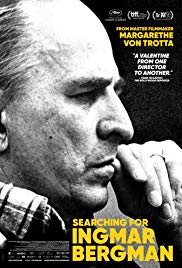
 Greetings again from the darkness. Despite his being one of the most productive and influential filmmakers of all-time, it’s understandable if you are concerned that a biopic of Ingmar Bergman might be a bit dry or difficult to connect with … you know, kind of like his movies. The happy truth is that Margarethe von Trotta, Felix Moeller, and Bettina Bohler have collaborated on this very interesting dig inside the mind and process of this remarkable Swedish artist.

Mr. Bergman’s best known films include: THE SEVENTH SEAL (1957), WILD STRAWBERRIES (1957), PERSONA (1966), CRIES AND WHISPERS (1972), SCENES FROM A MARRIAGE (1973), FANNY AND ALEXANDER (1982). It’s likely you have either seen all of these or none, but either way, as long as you have some interest in the history of cinema, you’ll be hooked on the multiple interviews and clips provided here.

Among those interviewed are actress Liv Ullman (she turns 80 this year), who appeared in 10 (she says 11) Bergman films. She cheerfully recalls the first time she met the director and how it led to their first collaboration, PERSONA. We also hear insight and personal stories from director and fellow Swede Ruben Ostlund (director of the terrific FORCE MAJEURE), Swedish documentarian Stig Bjorkman, and two of Bergman’s sons, Daniel and Ingmar Jr. On the personal side, we learn the legendary filmmaker was son to the Parson of a local church, married 5 different women and fathered 9 children via 6 women (his 5 wives plus Liv Ullmann), and that he wasn’t close to any of his children. He was described as viewing childhood through his own, rather than that of his kids. On his 60th birthday, there was an unusual gathering of all 9 children, many who had never previously met.

Maybe some of this is explained by Bergman’s own definition of art as “therapy for the artist”. This makes sense as so many discuss his insecurities and his own concerns with never being good enough. This despite a career of 50 plus films (many of which are studied in film classes) and nearly three times that many stage productions. Being wrongfully accused of tax evasion in 1976 affected his health and career, as well as his love of homeland Sweden. He moved to Germany before living out most of his life on the island of Faro – where he also filmed many movies.

The interviews presented here by Ms. Von Trotta (herself an accomplished filmmaker and actress) are each informative, though additional interviews from Max von Sydow, Bibi Andersson (each appeared in 13 Bergman movies), and Woody Allen (the American filmmaker most closely associated with Bergman) would not just have added flavor, but were also kind of expected. The end result is that we view Bergman as the ultimate brooder, and one who had much respect and admiration for actors. Though he passed away in 2007 (the same day as director Antonioni), we are now even more convinced that Ingmar Bergman was a master of both the written word and on screen imagery.

watch the trailer:


THE NUTCRACKER AND THE FOUR REALMS (2018)

November 1, 2018

 Greetings again from the darkness. Missing: Tchaikovsky and Ballet. OK, not missing entirely, and it seems all we do is beg for creativity and new approaches in movies, so let’s give this one fair treatment. It’s not the traditional “Nutcracker” holiday fare you’ve come to expect on stage, on TV, in the mall, at schools, and just about everywhere. Instead, it’s a version wrung from both the 1816 original short story “The Nutcracker and the Mouse King” by E.T.A. Hoffman and the 1892 ballet by Marius Petipa with music from Tchaikovsky, yet also something quite different. Still, different doesn’t always mean better … sometimes it just means different.

We are treated to a beautiful extended opening shot as an owl swoops through old London. This acts as preparation for the abundance of stunning visuals headed our way throughout. Budding star Mackenzie Foy (INTERSTELLAR, 2014) plays Clara Stahlbaum, a young girl distraught that it’s her first Christmas without her beloved mother Marie, who recently passed away. Clara’s quietly grieving father (Matthew Macfadyen) delivers the presents Marie left for each of the three kids. Mechanically inclined Clara’s gift is an ornate egg that requires a specialty key to unlock the hidden message Clara believes her mother has left.

A lavish Christmas party at her Godfather’s (Oscar winner Morgan Freeman) mansion leads Clara to a parallel universe where her mother Marie was Queen of the four realms. This is a fantastical land that reminds (maybe a bit too much) of Tim Burton’s ALICE IN WONDERLAND and the classic THE WIZARD OF OZ. Clara buddies up with a live Nutcracker soldier Phillip (newcomer Jayden Fowora-Knight), who quickly becomes her trusted bodyguard. Land of Snowflakes, Land of Flowers, Land of Sweets, and the blighted Fourth Realm run by a cast-out Mother Ginger (Oscar winner Helen Mirren) make up this world. Keira Knightley stars as the Sugar Plum Fairy, and her devilishly fun performance is responsible for most of the energy, humor and entertainment outside of the visual effects. The two time Oscar nominee seems to relish the voice, the costumes and the chance to play a quirky character.

Disney touches like the animal sidekicks are noted: Phillip’s loyal steed, and the pesky little mouse that flashes more personality than anyone in the film outside of Sugar Plum. Most of the comedic secondary characters (including Richard E Grant and Eugenio Derbez) fall flat with very little do in a screenplay from Ashleigh Powell that gives the impression of multiple hands in the pie. Adding to the disjointed feel and lack of cohesion in the story flow is the fact that two very different directors worked on the project. Lasse Hallstrom (CHOCOLAT) handled principal photography and then Joe Johnston (CAPTAIN AMERICA: THE FIRST AVENGER) spent a month on re-shoots with attention to visual effects. The contrasts between these two directors is quite clear in the finished project despite the cinematographer of Oscar winner Linus Sandgren (LA LA LAND).

The mishmash of styles and tone prevents us from ever really connecting with characters or being drawn in by the story, but beyond that, there are some really terrific visuals and special effects. I especially liked the look of the enhanced tin soldiers and the work of two time Oscar winning costume designer Jenny Beavan. Of course, this is a familiar story and many viewers bring certain expectations into the theatre with them. The iconic Tchaikovsky music is played early and throughout the film, though mostly in teases and in blends with new music from James Newton Howard. We do get a glimpse of Maestro Gustavo Dudamel conducting the orchestra, and for those expecting ballet, the fabulous Misty Copeland performs a couple of times, though it’s likely not enough for those hoping for more of a ballet production. The end result is an impressive visual experience that will likely still disappoint those looking for another holiday watching tradition.

watch the trailer:


CAN YOU EVER FORGIVE ME? (2018)

November 1, 2018

 Greetings again from the darkness. Despite her regular role in all 7 seasons of “Gilmore Girls” and her co-lead role in the 6 season run of “Mike and Molly”, it was her raunchy turn in 2011’s BRIDESMAIDS that turned Melissa McCarthy into a star. Since then, she has been the lead in a string of comedies written specifically for her: IDENTITY THIEF, THE HEAT, TAMMY, SPY, THE BOSS, and GHOSTBUSTERS: ANSWER THE CALL. Mixed in was an overlooked little film called ST. VINCENT, a Bill Murray vehicle in which Ms. McCarthy first flashed some dramatic chops. With this latest, she shows that she’s no one-trick pony, but the character is a bit too narrow, and the material a bit too bland to convince us whether she is up to becoming an Oscar-caliber dramatic lead.

That’s not to say her performance isn’t noteworthy, because it is. She plays Lee Israel, a real life writer who had success as a celebrity biographer in the 1970’s and 1980’s, and then turned to a life of crime as a forger of collectible letters. This (mostly) true story of Ms. Israel features Ms. McCarthy in a poorly cut wig, very little make-up and the frumpiest of frumpy clothes. She’s also an aggressively bitter person who, in the film’s opening scene, get fired from her job in 1991 for drinking scotch at her desk and telling a co-worker to “F-off”. Classy, she’s not. Her actions and this firing are our indoctrination into her caustic personality.

Director Marielle Heller is no stranger to examining the life of someone who is not so happy, as she is best known as the writer/director of THE DIARY OF A TEENAGE GIRL (2015). Her latest is adapted from Lee Israel’s memoir by screenwriters Nicole Holofcener (ENOUGH SAID, 2013) and Jeff Whitty. After her firing, Ms. Israel hits desperate times. Her publisher (an always terrific Jane Curtain) tells her that a Fanny Brice biography has no market, and that no one wants to work with Israel anymore … she has burned every bridge. Fanny Brice and Tom Clancy both take some shots here as Israel tries to defend herself by dragging down others … a personality trait not uncommon among those who are so miserable in life.

As we watch this alcoholic, slovenly, abrasive person muddle through days – only showing any affection for her pet cat – there is quite a clever scene that could seem like filler were it not for what happens soon afterwards. Ms. Israel is at home watching THE LITTLE FOXES on TV and we see her perfectly mimicking Bette Davis. This ability to imitate others leads her into a career path of forging and selling personal letters “from” the likes of Noel Coward and Dorothy Parker. It also finds her crossing paths with miscreant Jack Hock (a flamboyant and energetic Richard E Grant). The two misfits form an odd friendship and partnership that begins to cash flow.

A sequence between independent bookstore owner Anna (a talented and under-utilized Dolly Wells) and Lee Israel teases us with the idea of a love interest, but Ms. McCarthy is unable to convince us that Lee’s vulnerability is genuine, and the potential relationship soon fizzles thanks to Lee’s crankiness and criminal path. While watching, I couldn’t help but feel that I was being manipulated into feeling sympathy towards Lee Israel, simply because she is a lonely female criminal. Typically male criminals in movies are social outcasts to be despised and/or feared, so this trickery is a bit unsettling. Personally, I find it difficult to muster sympathy towards any criminal, no matter their gender or how pathetic their life and personality might be.

The best film to date about a forger, CATCH ME IF YOU CAN, worked because of the cat and mouse between good and bad, and the criminal at the center was overflowing with personality. Here, we are stuck with a curmudgeon who uses multiple typewriters to create fake letters … all in the confines of a dirty apartment she shares with her cat. Were it not for Ms. McCarthy’s expertise at delivering caustic one-liners or Mr. Grant’s impeccable comic timing, this drama would fall flat. If we ever doubted the manipulation, be prepared for two kitty cat scenes designed to elicit “aww” from the audience.

Director Heller does a nice job of presenting an early 1990’s feel for New York, including the gay bar Julius’, which is evidently still in existence today. There is also an interesting point made about how collectors want to believe, so the authentication process is crucial to the industry – though we can’t help but wonder about potential fraud. On the downside, there is really nothing dryer than watching a writer write … even someone as miserable as Lee Israel, and even on collectible typewriters. Additionally, the score and soundtrack were much too loud for the film, and proved quite distracting in certain scenes. A Paul Simon song near the end seems like a plea for Oscar consideration, but by then, we are just relieved that the bad guy got caught. But that kitty … aww.

watch the trailer:


DAUGHTERS OF THE SEXUAL REVOLUTION: THE UNTOLD STORY OF THE DALLAS COWBOYS CHEERLEADERS (2018)

November 1, 2018

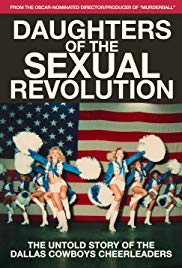
 Greetings again from the darkness. The story kicks off (at least according to legend), at a 1967 Dallas Cowboys home game, with adult entertainer Bubbles Cash walking down the aisle holding her cotton candy and catching the eye of many at the game … including team president Tex Schramm. This was a mere 4 years after the assassination of President Kennedy made Dallas the most hated city in America. Ever the opportunistic salesman and promoter, Schramm took note and decided a shift from high school and college cheerleaders might prove beneficial.

Director Dana Adam Shapiro was nominated for an Oscar for his 2005 documentary MURDERBALL, and here he provides a multi-faceted film: a biopic of Suzanne Mitchell, a forum for former cheerleaders to tell their story, and a socio-political look at a bygone era – one with some connective tissue to the modern day world.

Suzanne Mitchell was Tex Schramm’s secretary, and the director of the Dallas Cowboys Cheerleaders (DCC) from 1976-1989. She has been described as a den mother and dictator, one who ran a tight (almost militaristic) ship and also cared very much for the ladies in her organization. Although she has passed away, we get many clips of her interviews over the years. By the end, we believe we know just who this woman was and what she stood for. She was committed to making sure the DCC were proper ambassadors for the Dallas Cowboys organization, while also making sure they were on the right path as people.

This was the ultimate blend of sex appeal and feminism. Every former cheerleader interviewed here makes it clear they were proud of their time with DCC, and that the team and Ms. Mitchell had been a positive influence on their lives. What makes this so fascinating is we are also provided recollections of the pushback the team received from religious groups (it is the bible belt after all) and feminists … claiming exploitation and degradation. It’s not so different than today where so many try to thrust their opinions and beliefs on others – jumping to conclusions about what harm is being done either to the individual or society as a whole.

In addition to the interviews with Ms. Mitchell and the cheerleaders, two knowledgeable writers provide more insight: Mary Candace Evans, author of “A Decade of Dreams: Dallas Cowboys Cheerleaders, and Joe Nick Patoski, author of “The Dallas Cowboys: The Outrageous History of the Biggest, Loudest, Most Hated, Best Loved Football Team in America”. These two share much of the research for their books, and also provide perspective on the era, and just what an impact DCC had on the team, the league and TV entertainment in general. Also interviewed is long time local sportscaster and former Dallas Cowboys announcer Dale Hansen. He provides the local flavor, as well as a personal story about crossing Ms. Mitchell, known as “The Iron Butterfly”.

We learn that CBS made the conscious decision to feature the cheerleaders during the Super Bowl X telecast, and the infamous on screen “wink” is credited with creating the explosion of interest in DCC. What followed were TV appearances (including “The Love Boat”), charity events, other promotional events, USO tours, and many hospital visits to the bedsides of sick children. All of this occurred under the burden of numerous rules created and enforced by Ms. Mitchell. She and Tex Schramm were committed to ensuring this was an inclusive and diverse organization for women of all backgrounds and race. At the same time, the rules regarding weight and body shape were tough and challenging, and the pay was minimal.

TV shows, magazine covers, posters, and calendars all contributed to the mystique and popularity of the cheerleaders – the perfect mixture of innocence and sex appeal. Perfect that is, until the organization was exploited by the porn industry (DEBBIE DOES DALLAS) and Playboy magazine. Lawsuits became prevalent.

Ms. Mitchell’s ability to hold steadfast to her beliefs and standards for what the DCC represent is quite impressive and easy to respect … a respect that grows even stronger when we learn she walked out only 4 months after Jerry Jones bought the team. A new culture arrived and it was one she, and a number of cheerleaders, refused to be a part of. You may think you know the story … you may think you know the cheerleader “types” … but director Shapiro’s film is likely to teach you a few things. But whatever you do, don’t chew gum!

watch the trailer:


THE OTHER SIDE OF THE WIND (2018)

November 1, 2018

 Greetings again from the darkness. Film nerds unite! Most of us who (proudly) wear that label have known that filmmaker Orson Welles left a few unfinished projects when he died in 1985. The most famous – or infamous – of these was THE OTHER SIDE OF THE WIND. It was to be the comeback film for Mr. Welles, who had slipped from the artistic throne with his run of TV projects, shorts, and unsuccessful features during the 1960’s. Known as a perfectionist, and as someone more dedicated to the filmmaking part more than the “finishing” part, Welles filmed scenes for the movie from 1970-1976, and then picked it back up in the early 1980’s to begin the editing process … a process he never finished.

Best known for his all-time classics CITIZEN KANE (1941) and TOUCH OF EVIL (1958), Welles left mountains of copious production notes, and almost 100 hours of footage in multiple formats, and in both color and black and white stock, on this project that, even today, might best be described as experimental. Over the past 30 years there have been numerous attempts to raise the money required to finish the film, but all fell short until this one spearheaded by Peter Bogdanovich and Beatrice Welles (Orson’s daughter).

In what we can only interpret as semi-autobiographical, what we see on screen is the making of a documentary on a legendary director’s comeback film (his poke at artsy filmmakers). Clips of the unfinished film are shown throughout, while an industry party plays out, and numerous documentary filmmakers capture the scene from various angles with their always-present cameras. Got that?  Don’t worry, it takes at least a few minutes as a viewer to get the rhythm and layers of what’s unfolding before our eyes.

John Huston (himself an industry legend with 2 Oscars and 15 nominations) plays director Jake Hannaford, who is walking the fine line between Hollywood power and has-been. It’s his 70th birthday party, and Hannaford is compared to Hemingway (a description that better fit Huston than Welles), silently endures insinuations of his closeted homosexuality, desperately seeks funding to finish his film, and skulks around his own party winding through the hangers-on and those waiting for the final curtain.

Hannaford’s artsy film within a film, at least the clips we see, feature an inordinate amount of nudity from the leading lady (played by Welles 4th wife and the film’s co-writer Oja Kodar), and some ultra-coolness from the lead actor John Dale (played by Robert Random). Part of Hannaford’s desperation (both professional and persona) stems from a James Dean-type Dale walking off the set mid-picture.

Guests at the party include Peter Bogdanovich as director Brooks Otterlake, a young director once mentored by Hannaford. It’s an example of the student becoming the teacher. Susan Strasberg (daughter of famed acting coach Lee Strasberg) plays film critic Juliet Riche, a thinly-veiled portrait of Welles nemesis Pauline Kael. Other familiar faces in the cast include: Lilli Palmer, Mercedes McCambridge (Oscar winner), Edmond O’Brien (Oscar winner), Cameron Mitchell, Paul Stewart (from CITIZEN KANE), Tonio Selwart, Geoffrey Land, Norman Foster, Dennis Hopper (2 Oscar noms), Claude Chabrol, Stafford Repp (Sgt O’Hara from “Batman” series), plus Cameron Crowe (Oscar winner), William Katt, Frank Marshall (5 Oscar noms), Rich Little, Leslie Moonves (recently fired in disgrace CBS President), and Paul Mazursky (5 Oscar noms). It’s fascinating to see so many we recognize from more than 40 years ago. Of course, it’s Huston, with his face that’s made for black and white film, who is the dominating figure (his scenes were filmed prior to his work on CHINATOWN).

It’s easily viewed as a satire on the film industry, and it’s quite a fun, messy-by-design, now retro look at a fragile industry – and the even more fragile people who make movies. Welles’ love/hate relationship with the industry takes on an art form. He shows what’s good and what’s deplorable. Is it an experimental movie commenting on the post-studio world of independent filmmaking, or is it an iconic filmmaker, glory days behind him, in the midst of self-reflection. Perhaps it’s both. In addition to Welles’ early editing efforts, Oscar winning editor Bob Murawski (THE HURT LOCKER) was brought in to finish up what can now be described as a master class in film editing. It’s a wild ride for us film nerds. Are you ready to join us?

watch the trailer: