THE FAVOURITE (2018)

November 29, 2018

 Greetings again from the darkness. Our biggest fear was that Greek director Yorgos Lanthimos would one day soften the twisted edge he blessed us with in THE KILLING OF A SACRED DEER (2017), THE LOBSTER (2015), and DOGTOOTH (2009). That day may yet arrive, but not today and not with his latest. It’s his first time to direct a screenplay he didn’t write, which likely explains this being his most accessible film – though labeling it “mainstream” would be a huge stretch. So brace yourself for an unusual and odd costume period piece unlike anything you’ve seen before.

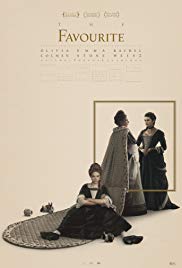
Co-writers Deborah Davis (her first screenplay) and Tony McNamara (TV background) deliver biting dialogue and treacherous situations, and benefit from three staggeringly terrific lead actress performances. Olivia Colman stars as Queen Anne, Rachel Weisz as Lady Sarah Churchill, and Emma Stone is Abigail. The three combine for one of the strangest and most convoluted love triangles and power struggles in history.

It’s very early 18th century and Britain is at war with France. Queen Anne is frail and in ill health due to severe gout and who knows how many other ailments. Her erratic behavior and quick temper convey childlike behavior from an adult body with a crown. Lady Sarah (Winston’s great-great grandmother, if I’ve calculated correctly) has strategically become the Queen’s trusted political advisor and often governs in her stead, while also sharing moments of intimacy. Sarah pulls no punches and certainly doesn’t subscribe to the ‘kill ‘em with kindness’ approach, and instead frequently insults the Queen to her face. When Sarah’s cousin Abigail appears after her family’s fall from grace (her father lost her in a card game), Sarah takes pity on her due to Sarah’s fondness of Abigail’s father during her childhood.

Abigail’s naivety and kindness soon win over the Queen’s affections. Is her sweetness an act? Is it due to ambition or desperation … is there even a difference here? We soon learn Abigail treats conniving as a profession – she views it as her only path back to respectability, and she’s willing to take on many acts lacking in respectability to charm her way into the inner sanctum. We are plopped into the wicked fun, delicious cat-fighting, strategic backstabbing and crafty political and personal maneuverings … right up until the story turns to vicious bleak darkness in the final act.

It’s fascinating to watch three women hold the power during this era, as the noblemen are relegated to constantly playing catch-up (kind of like the real world) and struggling to figure out the rules of the game. Power struggles abound, as do director Lanthimos stylistic touches. Noblemen played by Nicholas Hoult and Joe Alwyn are frequently dressed in frilly costumes, giant wigs and heavy make-up – quite the contrast to what we typically see in these period pieces. Other Lanthimos touches include royal duck races, pet bunnies representing deceased children, and fisheye lenses used from every conceivable angle.

Ms. Colman and Ms. Weisz were both in THE LOBSTER, and both have a knack for the Lanthimos style, and Ms. Stone surprisingly is also a natural with the twisted, vicious material. Each of the actresses have an extended close-up allowing them to show-off their immense and subtle talent … Ms. Colman’s is especially impactful. Extreme profanity (numerous c-words and f-words) is at times startling and effective, and the music is unique and diverse – as we would expect. As an added bonus, it requires little imagination to connect the dots to our contemporary political state, although that approach would likely stifle one’s enjoyment of the film. Mr. Lanthimos has quickly reached the ‘must-see’ list of directors, with a guarantee that we are going to see something unusual and interesting. It’s one of the year’s best, even if it’s not for everyone.

watch the trailer:


MARIA BY CALLAS (2018, doc)

November 29, 2018

 Greetings again from the darkness. These days, it’s inconceivable for anyone under 40 years old to think there was a time when the general public knew very little of the private life of celebrities – even those of whom they were dedicated fans. Today, it’s not uncommon for celebrities to pre-package their life, delivering behind-the-scenes details that far too many people care about. Madonna, Justin Bieber, Taylor Swift and Jennifer Lopez are just a few that have simultaneously tried to appease and manipulate fans into a feeling that they really know the person behind the superstar facade – and perhaps fulfill a fantasy of some common ground. Even more prevalent are the biopics, either in the form of a documentary (WHITNEY: CAN I BE ME) or dramatization (RAY).

Filmmaker Tom Volf realizes that the great Opera singer Maria Callas was known for two things: being a world class soprano/actress and for being difficult to work with … the ultimate diva, one might say. Working with narrator and noted mezzo-soprano Joyce DiDonato, the film expertly reinforces those two traits, and even adds a new label: narcissist. It does so by using (as the title suggests) Maria Callas’ own words taken from interviews, letters to friends, and personal diary entries.

The Greek-American Opera singer/actress was born in Brooklyn to Greek immigrants, and, as a teenager, moved to Athens with her mother and sister after her parents’ marriage fell apart. Director Volf uses a BBC TV interview with David Frost to provide a framing structure to the film, but there are also clips of other interviews shown, and of course, Ms. DiDonato’s readings of the personal Callas writings. We learn Maria was originally controlled by her mother, and then by agents and her husband. Maria attempts to explain how the “difficult” label undeservedly stuck to her for decades due almost entirely to her vocal issues/illness at one sold out performance at the New York Metropolitan. Her own words later contradict, or at least cast much doubt on the accuracy of this simplification.

Archival footage of her life … her mostly glamorous life … is shown throughout, including bits with Aristotle Onassis, filmmaker Vittorio De Sica, actor Omar Sharif, filmmaker Pier Pablo Pasolini, Grace Kelly, and renowned soprano Elvira de Hidalgo, who became Maria’s voice coach. Maria’s fairy tale life is on display: chauffeurs, standing ovations, worshipping fans, and her incredible wardrobe that made her a fashion icon of the times. Her words convey the unhappiness and loneliness she felt, even during the “good times”.

It’s the stage performances that made her famous and took her to the top, so Mr. Volk includes several full-length numbers from Verdi, Bellini, Bizet and others … her glorious talent on full display and surely to inspire awe from any first timers. So while her singing provides a welcome respite from her words, it’s those words … her own words … that seem to solidify her reputation as a diva. Though she claims to have been controlled by others, she managed to take extended breaks throughout her career, and every opera fan and director understands that vocal issues arise periodically, so it’s quite doubtful anyone would hold an extended grudge over such an occurrence.

A substantial portion of the film deals with Maria’s long-term affair with Aristotle Onassis, and how shocked she was, and betrayed she felt, when he married Jackie Kennedy without so much as a word of warning. And when his marriage to Jackie crumbled, he came scurrying back to Maria, who openly welcomed him … a sure sign of just how lonely she had been for most of her life, despite the glamour and adulation. We can debate whether the legacy of Callas might have been better off had her personal thoughts remained buried, but there is little doubt that we are sometimes better off simply enjoying the work or art of a rare talent, rather than getting to know them as a person.

watch the trailer:


CREED II (2018)

November 20, 2018

 Greetings again from the darkness. The theatre was packed and I don’t recall having heard a louder outburst of cheering for any movie moment. Was it predictable? Yes. Did it deliver what the fans wanted? Absolutely. Is it (as my son asked) “Was it just ROCKY IV in 4K?” Yes, that’s pretty much exactly what it is. So despite CREED (2015) director Ryan Coogler opting to make BLACK PANTHER instead of this sequel to his own movie, I’ve seen proof that it’s clearly a crowd-pleaser … which is what the “Rocky” franchise has always done best.

Michael B Jordan returns as Adonis Johnson/Creed and Sylvester Stallone is back as Rocky Balboa. And although that would likely be enough, we also have Tessa Thompson as Adonis’ girlfriend Bianca and Phylicia Rashad as Adonis’ mom, both also from CREED. We see an early training/boxing sequence in Russia featuring (professional boxer and chiseled human mountain) Florian Munteanu as Viktor Drago being trained by his father Ivan Drago (Dolph Lundgren). If you are a fan of the franchise at all, you know exactly where this is headed – and so does opportunistic boxing promoter Buddy Marcelle (Russell Hornsby).

Think of it as ‘Revenge vs Redemption’. Adonis fighting the son of the man who killed his father Apollo is the obvious revenge side, and Viktor fighting to redeem his disgraced father Ivan, who lost to Rocky 30 some years ago. This one lacks the real world Cold War element of ROCKY IV (1985), and while it’s missing the political heft of that film, it still packs quite a punch as a revenge flick … even if there was no other possible route this sequel could take. If anything, the filmmakers should be commended for not force-feeding any cheesy political statements on today’s environment.

What are you fighting for?” This must be both a necessary boxing question to answer and a tough one, as it seems to get asked over and over during the film. The combination of writers: story by Cheo Hodari and Sacha Penn, characters by Ryan Coogler, and screenplay by Sylvester Stallone and Juel Taylor, place quite a bit of focus outside the ring. Relationship quandaries are at every turn: young married couples, father-son (double whammy), mother-son (another double whammy), and first time parents.

Director Steve Caple Jr seems more comfortable outside the ring himself, as the boxing match camera work does not hit the level of the first, although audience members’ emotions run even higher. Perhaps to overcompensate for the more basic camera work, some of the sound effects for rib punches may have been pulled right out of battle scenes in war movies – they sound like explosions, and are exaggerated so that we viewers might “feel” the ribs cracking.

Wisely the relationship between Adonis and Bianca is a key element this time. Mr. Jordan and Ms. Thompson have tremendous chemistry, and the filmmakers deserve credit for hitting the hearing-impaired issue head-on. It’s a topic that’s rarely seen in movies, and appears to be very well handled. There are some other ties to the “Rocky” franchise with Wood Harris playing “Little Duke”, son of Duke, played numerous times by Tony Burton throughout the Rocky films, and there are a couple of other (very) familiar faces that pop up from both IV and ROCKY BALBOA (2006). On the music front, Ludwig Goransson is a rising star composer thanks to FRUITVALE STATION, CREED, BLACK PANTHER, VENOM, and now CREED II. He toys with the familiar Rocky numbers, but some will argue not enough.

This sequel is more grand scale than the first (which was identity driven), yet more restrained than IV. Sure we have the mandatory zany training montage (zany may be too mild), and the final bout is held in Moscow (even though it makes no sense that the champion would agree to this), but it’s definitely more low-key when comparing Bianca’s musical intro to James Brown’s “Living in America”.

For fans, it’s great to see Rocky Balboa and Ivan Drago back in the ring together – even if only for a moment; however, maybe not as thrilling (dramatically speaking) as when the two first reunite Godfather-style in a table at Adrian’s Café. It’s a surreal moment that both Lundgren and Stallone play perfectly – one with pent-up emotional turmoil and the other quite content with what life has delivered. Of course, Sly can play Rocky in his sleep … and no that wasn’t meant to encourage one-liners followed by rim shots. He’s comfortable with the shuffles and mumbles of an elderly Rocky and it’s a pleasure to watch an old friend. The only real question remaining … is the “Creed” franchise gonna fly now?

watch the trailer:


THE FRONT RUNNER (2018)

November 16, 2018

 Greetings again from the darkness. Jason Reitman has proven himself to be an outstanding filmmaker who delivers entertaining stories with insightful commentary often accompanied by biting humor. His excellent films include: THANK YOU FOR SMOKING, JUNO, UP IN THE AIR, and one of this year’s most underappreciated films, TULLY. His latest is based on the book “All the Truth is Out” by Matt Bai (who also co-wrote the screenplay with Reitman and “House of Cards” Producer Jay Carson), and it tells the story of Colorado Senator Gary Hart and his derailed 1988 campaign for President.

The film begins in 1984 when an idealistic Hart loses the Democrat party nomination to Walter Mondale, who of course, went on to lose the national election to Ronald Reagan. It then picks up as the 1988 campaign is underway and Hart is the party frontrunner, and some say the candidate most likely to win the Presidency. Hugh Jackson plays Hart and is unfortunately burdened with an ill-fitting and distracting wig meant to emulate the lush locks sported by the youthful looking Senator. Vera Famiga plays his wife Lee, and Kaitlyn Dever plays their daughter Andrea. Casting two such fine actresses matters because of what happened during the campaign.

Senator Hart was the favored candidate of the young and the idealistic forces, though the details of his platform were never communicated clearly. Mostly, he was presented as the energetic candidate of hope versus the stodgy Republican Party that had delivered Ronald Reagan for 8 years and was now looking to George Herbert Walker Bush. Everything changed for Hart when rumors of marital infidelity, and possibly even an open marriage, began to circulate. When the media asked him, he was defiant … at times snapping in anger that his personal life was no one’s business.

We are taken inside the campaign via many familiar faces, including campaign manager Bill Dixon played by JK Simmons, and a terrific turn by Molly Ephraim as staffer Irene Kelly. We are invited on board the aptly named party yacht “Monkey Business” when Hart first meets Donna Rice (Sara Paxton), setting off what could considered be the birth of political gossip-columns. The Herald and Washington Post are key players here, as are editor Ben Bradlee (Alfred Molina) and iconic journalist Bob Woodward. Apparently this is supposed to show us how politics and the media coverage of politics changed with Gary Hart.

Where the movie lets us down is in not providing any explanation to why Hart was the front runner, whether the U.S. or even the democratic party missed out on a great (or even competent) President, and how in the world Hart was so clueless as to why citizens might have an interest in his personal life activities that included sleeping with a woman (or women) that weren’t his wife. By the way, the reason for the last one is character … and we’ve since learned it’s not as important as what we might have once thought. These are all key issues as to why this is even a story, and whether or not it’s interesting enough to re-tell.

Instead of details, we are bombarded with overlapping dialogue and frenetic editing designed to generate some buzz and energy. The reality is that Gary Hart was really not that interesting, and in fact, by denying the importance of character, he thumbed his nose at his supporters. This blip on American history is simply not enough to justify a 2 hour a movie, and Mr. Jackman never seems able to capture the essence of Hart (whatever that essence might have been). There is obvious relevance to how today’s press treats personal stories, but a bland candidate makes for a bland movie.

watch the trailer:


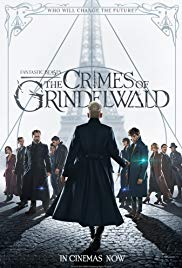
FANTASTIC BEASTS: THE CRIMES OF GRINDEWALD (2018)

November 15, 2018

 Greetings again from the darkness. It’s been seven years since the final Harry Potter movie, and this is the second entry in the planned series of 5 prequels entitled FANTASTIC BEASTS, based on a (fictional) Hogwarts’ textbook written by Magizoologist Newt Scamander (played by Eddie Redmayne). Of course the characters and stories are from the pen of J.K. Rowling, and who better to bring us the war pitting pure-blood wizards against Muggles?

FANTASTIC BEASTS AND WHERE TO FIND THEM was released in 2016, and it was mostly an introduction to these characters and to some of the cutest and oddest creatures we’d ever encountered on screen. This second entry is much darker and more sinister, and tries to develop quite a few characters … perhaps too many. On top of the roster of players, romantic complications abound, and a search for one’s roots/identity is yet another sub-plot. And then there’s that whole Nazi element – leaving us all a bit bewildered at trying to keep up (although, it is fun trying).

David Yates directed the last four Harry Potter movies, and now the first two Fantastic Beasts films. He kicks this one off with a spectacular action sequence featuring a black carriage being drawn by a team of majestic flying dragons during a driving rain storm … all part of a daring 1927 prison escape by the titular Grindewald (Johnny Depp with a bleach punk do). It’s a breathtaking sequence, and the best of many visual wonders throughout – including my favorite, a very cool statue effect and a fabulous kelp seahorse.

Most of the key players return from the first film, though, as previously mentioned, their stories are more elaborate. Eddie Redmayne returns as Newt, our main guide through this universe. Katherine Waterston is back as auror and fringy love interest Tina, Alison Sudol returns as Tina’s mind-reading sister Queenie, and Dan Fogler resumes his comic relief duties as Jacob. Jude Law is Albus Dumbledore (yes, the first name is needed), and he is prevented from fighting Gindewald (Depp) due to some youthful “bonding” that occurred years prior. Zoe Kravitz is Leta Lestrange, Carmen Ejogo is Seraphina Picquery, and Ezra Miller is the lost soul Credence Barebone. Newly introduced characters include Claudia Kim as shapeshifter Nagini, Callum Turner as Newt’s brother Theseus, and Brontis Jodorowsky (son of renowned cult director Alejandro Jadorowsky, EL TOPO) as non-ghost Flamel. If that’s not enough characters to track, you should know the story skips from New York to London to Paris and back around again.

Expect some happy gasps from the audience as Hogwarts is revisited, but the darkness and similarities to Nazi beginnings may surprise those expecting two hours of cutesy creatures springing from Newt’s coat … although, those exist as well. We do learn that ‘salamander eyes’ are not to be used while flirting, and it will be quite interesting to see how these stories close in to the Harry Potter world over the next 3 prequel-sequels (scheduled through 2024). It should be a fun ride – though not as fun as riding that seahorse.

watch the trailer:


GREEN BOOK (2018)

November 15, 2018

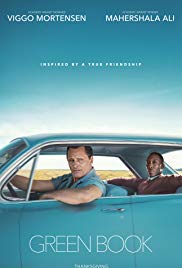
 Greetings again from the darkness. “The Negro Motorist Green Book” was a travel guide highlighting safe places for African Americans to stay, eat and visit from the 1930’s through the mid 1960’s. Yes, it was a real publication and yes, there was a real need for it during the Jim Crow era. The book makes for a nice movie title, but this sterling dramedy from director Peter Farrelly focuses more on the budding friendship of two men from vastly different worlds separated by a few city blocks.

Mr. Farrelly is one-half of the infamous Farrelly Brothers who have directed such raunchy comedy hits as THERE’S SOMETHING ABOUT MARY (1998) and DUMB AND DUMBER (1994). This is quite the change of pace for him, as it is for co-stars Mahershala Ali (Oscar winner last year for MOONLIGHT) and heavy drama stalwart Viggo Mortensen. We see a crisp blend of the era’s harsh racism and the inherent comedy of a buddy road trip featuring a working class NYC Italian-American and an upper crust, well-educated, world class African-American pianist.

The film kicks off in 1962 at the Copacabana, a mob-controlled club where Frank Anthony “Tony Lip” Vallelonga (a beefed up Mortensen) gives us an up-close look at his bouncer skills. He’s quite good at his job. When the club closes for renovation, he takes a job as a chauffeur/bodyguard for Dr. Don Shirley (Ali), who is beginning an 8 week tour as the featured player in a jazz trio through the Midwest and Deep South. Tony Lip is a walking Italian cliché, while Dr Shirley is a regal black man … in fact, he might view himself as royalty – living alone in a swank apartment above Carnegie Hall. This is a good time to note that Tony Lip’s son Nick Vallelonga co-wrote the script, is a producer on the film, and even makes an appearance as a State Trooper.

Inspired by the true story of this trip and the lifelong friendship that ensued, we get to know both men as they get to know each other. Tony Lip is a streetwise man who is comfortable with his lot in life, while Dr. Shirley plays his role in society while quietly stewing internally. He flashes his toothy grin to disarm the adoring white audiences, but then sucks down his Cutty Sark in the evening, as he is good enough to perform for them, but not good enough to dine with them (or even use their restroom). There are times the racism gets violent and that’s where Tony Lip comes in.

Don helps Tony write romantic and intimate letters to his wife Dolores (played by Linda Cardellini), while Tony teaches Don about KFC and Little Richard … proclaiming “I’m blacker than you!” in one of the film’s funniest moments. It’s an awkward buddy film that in real life developed into a decades-long friendship – one that only ended when both died in 2013. It could be described as a twisted DRIVING MISS DAISY with a dose of THE HELP. It’s certainly a crowd-pleaser, even delivering a mushy ending not dissimilar to that of PLANES TRAINS AND AUTOMOBILES. Of course we don’t mind, because after spending a couple of hours with these two, we are fine with a feel-good ending. The film is showcase for two terrific actors, and for those that don’t know, the real Tony Lip appeared in a few projects such as “The Sopranos” and DONNIE BRASCO.  Expect to see these two actors get some love at Oscar time, and this is one of the few that can be recommended to just about every movie lover.

watch the trailer:


UNDER THE WIRE (2018, doc)

November 15, 2018

 Greetings again from the darkness. With release dates so close together, this documentary from director Christopher Martin makes a superb companion piece to director Matthew Heineman’s film, A PRIVATE WAR – the Marie Colvin biopic with an excellent performance by Rosamund Pike. Heineman’s film really helps us understand what drove Ms. Colvin to become the most courageous and well-known war correspondent of her time, while Martin’s doc provides an incredibly up-close look at the dangerous environment that inspired her reports.

In February 2012, Ms. Colvin and photographer Paul Conroy were smuggled into Syria (journalists were prohibited at the time) and found their way to Baba Amr, an area of Homs, Syria. What they discovered was horrific. What the Assad regime was doing to its own people, its own children, was not what Marie and Paul had known as war. Instead they described it as slaughter. They were determined that “the world must see”, and for the next few days, they discovered “The Widows Basement” where women and children were trapped. They watched a relentless Dr. Mohamed desperately try to stitch the injured back together in a makeshift clinic with minimal supplies.

The film is based on the book of the same title by Paul Conroy. On the day the bombing killed Marie and French photographer Remi Ochlik, and many other civilians, it was Paul and French correspondent Edith Bouvier who survived, despite serious injuries. Mr. Conroy acts as our commentator as much of the footage he shots plays on screen. He admits to carrying the weight and responsibility of telling not just Marie’s story, but also the truth about what they witnessed … it’s a brutal war that continues today.

Some reenactments are blended with Conroy’s footage, and we fully understand the terror they felt in entering the drain pipe that acted as the artery to Baba Amr. The infamous clip of the dying baby shown on Anderson Cooper’s CNN interview with Ms. Colvin is no less devastating now. Paul admits that some described Marie as “scarier than the war we are covering”, but no one doubted her courage and drive to tell the stories of those who were being forgotten. As the Sunday Times war correspondent recognizable by her eye patch, Marie’s work with Paul is the best defense possible for our need for truthful and full journalistic coverage … it should be our protection against forces motivated to mislead or misdirect. Paul’s commentary of his extraction from Syria reinforces what courage is required not just to rush to the story, but also to find a way to tell it.

watch the trailer:


WIDOWS (2018)

November 15, 2018

 Greetings again from the darkness. Woman power. Black power. Racist old white men. Corrupt politicians. Abusive husbands. Cheating white husbands. Racist cops. Men are bad. Women are strong and good. If a filmmaker were to blend all of these stereotypes into a single movie, then as movie goers we should expect an ultra-talented filmmaker like Steve McQueen to go beyond conventional genre. Unfortunately, a nice twist on the heist movie formula from Lynda La Plante’s novel turns into predictability that whips us with societal clichés posing as societal insight.

I seem to be one of the few not raving about this movie. Hey it has the director behind  Best Picture Oscar winner 12 YEARS A SLAVE (Mr. McQueen),  a screenplay he co-wrote with Gillian Flynn (GONE GIRL) from the aforementioned novel by Lynda La Plante, and a deep and talented cast of popular actors. It ticks every box and it’s likely to be a crowd-pleaser, despite my disappointment. Every spot where I expected intrigue, the film instead delivered yet another eye-roll and easy-to-spot twist with a cultural lesson. Each of the actors does tremendous work, it just happens to be with material they could perform in their sleep.

It’s the kind of film where audience members talk to the screen – and it plays like that’s the desired reaction. This is the 4th generation of the source material, including 3 previous TV mini-series (1983, 1985, 2002). It makes sense that this material would be better suited to multiple episodes, rather than hurried through 2 hours. There are too many characters who get short-changed, and so little time to let the personalities breathe and grow. But this is about delivering as many messages as possible.

A strong premise is based in Chicago, and finds a team of four burglars on a job gone wrong. This leaves a mobster/politician looking to the four widows (hence the title) for reparations. Since the women have no money, their only hope is to tackle the next job their men had planned. Viola Davis, Michelle Rodriguez, Elizabeth Debicki, and Carrie Coon play the widows, though only the first three are given much to do, as the talented Ms. Coon is short-changed. In fact, Ms. Davis is such a strong screen presence that she dominates every scene she is in – she’s a true powerhouse. Even Liam Neeson can’t hang with her. Colin Farrell appears as a smarmy politician and Robert Duvall is his f-word spouting former Alderman dad. Cynthia Erivo has a nice supporting turn in support of the women, and Bryan Tyree Henry, Daniel Kaluuya, Jacki Weaver, Garret Dillahunt, Kevin J O’Connor, Lukas Haas, and Jon Bernthal fill out the deep cast … see what I mean about too many characters and too little time?

There is no single thing to point at as the cause for letdown. The story just needed to be smarter and stop trying so hard to comment on current societal ills. As an example, a quick-trigger cop shooting an innocent young African-American male seems thrown in for the sole purpose of ensuring white guilt and an emotional outburst from the audience. It’s difficult to even term this film as manipulating since we see the turns coming far in advance. Two far superior message films released earlier this year are Spike Lee’s BLACKKKLANSMAN and Boots Riley’s SORRY TO BOTHER YOU. For those who need only emotion and little intellect in their movies, this not-so-thrilling heist might work. For the rest of you, it’s good eye-roll practice.

watch the trailer:


OUTLAW KING (2018)

November 10, 2018

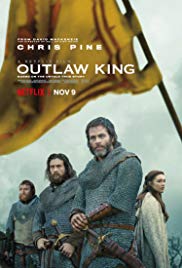
 Greetings again from the darkness. Much was made of the ‘artistic license’ director Mel Gibson took in creating his own version of historical events and actions of William Wallace for his Oscar-winning BRAVEHEART (1995). Director David Mackenzie (in his follow up to the excellent HELL OR HIGH WATER, 2016) pays a bit more attention to historical details as he picks up the story at the end of Wallace’s rebellion – and the beginning of the uprising led by Robert the Bruce.

Chris Pine plays Robert the Bruce, a man forced to pledge loyalty to Kind Edward I and England prior to leading the rebellion. It’s the year 1304 and director Mackenzie’s opening sequence is a several minute long tracking shot that is simply superb. It features our introduction to Robert the Bruce (Pine), King Edward I (Stephen Dillane) and Prince Edward (Billy Howle, ON CHESIL BEACH), as well as an early swordfight and an eye-popping fireball shot from an enormous catapult into the protective wall of a distant castle.

Not long after, we learn William Wallace has been killed, the King has provided Robert the Bruce a wife in Elizabeth de Burgh (Florence Pugh, LADY MACBETH) and Robert  takes the life of fellow Scotsman John Comyn … an act that costs him dearly in the early going. However, it does lead to his being named King of Scots by the Church, and he slowly begins to build his forces. Of course, Scotland’s forces are always dwarfed in numbers by that of the English Empire, but never in spirit.

Pine plays Robert the Bruce as the strong, (mostly) silent leader, while Howle and Aaron Taylor-Johnson cross into camp in their respective portrayals of Prince Edward (yet another wide-eyed son intent on making his father proud) and James Douglas (a manic, crazy-eyed Scotsman bent on revenge). Ms. Pugh brings courage and a headstrong nature to Elizabeth (in far too limited a role), while Mr. Dillane shows us a worn down King Edward I who gets the film’s best line … “I am so sick of Scotland!”

The two words of the title are actually separated by a slash in the opening credits; a device meant to emphasize the dual sides to the man and his actions. In addition to that opening long shot, there is a visually stunning sequence of a nighttime raid on a camp site. Unfortunately after that, we get mostly mud and blood, including the pivotal Battle of Loudon Hill which features the ultimate in home field advantage. There are some terrific costumes and set pieces, but mostly it’s elaborate and detailed moviemaking (with a few downright silly moments) that never fully clicks. Perhaps that’s a factor of having 5 different writers involved. With many familiar faces from “Game of Thrones”, it will be interesting to see how this plays on laptops and TVs via Netflix. Another Robert the Bruce film is scheduled for theatrical release in 2019, and the inevitable comparison will be made at that time.

watch the trailer:


A PRIVATE WAR (2018)

November 10, 2018

 Greetings again from the darkness. Marie Colvin was a (seemingly) fearless war correspondent obsessed with giving a voice to those forgotten during war. Were she alive today, she could not have hand-picked a better filmmaker than Matthew Heineman to tell her story. Director Heineman was Oscar nominated for CARTEL LAND (2014) and, combined with his CITY OF GHOSTS (2017), gives him two of the best ever documentaries that show what the front lines are like in both international wars and the equally dangerous wars being fought over drug territories. Heineman has carried his own camera directly into the center of those storms, while Ms. Colvin took her pen and pad. Simpatico.

Based on Marie Brenner’s Vanity Fair article “Marie Colvin’s Private War” (screenplay by Arash Amel), the film benefits from the extraordinary and courageous work of Ms. Colvin, and also a terrific performance from Rosamund Pike (words I’ve not previously written). Ms. Pike captures the extremes of Ms. Colvin’s life – the atrocities of war and the self-prescribed treatment of her PTSD through vodka, and does so in a manner that always seems believable. She lets us in to a world most of us can’t imagine.

As a war correspondent for Britain’s Sunday Times (since 1986), Ms. Colvin told the stories we’d rather not know. In her words, “I saw it, so you don’t have to.” The film begins with a stunning overhead view of 2012 war-ravaged Homs Syria (destruction courtesy of Assad’s soldiers) – a place that starts the film and later ends the story. We then flash back to 2001 London so we can witness Marie in society and struggling with a personal relationship. She then chooses, against her editor’s (Tom Hollander) guidance to cover Sri Lanka. It’s a decision that cost her an eye, while also providing her recognition as the eye-patch wearing female war reporter.

In 2003, a tip takes her to a previously undiscovered mass grave site in Fallujah. This is her first work alongside photographer Paul Conroy (played by Jamie Dornan). Having “seen more war than most soldiers”, Ms. Colvin’s severe alcoholism can’t kill the nightmares, visions, and PTSD. After time in a clinic, she returns to work. We see her in 2009 Afghanistan and then pulling no punches when interviewing Libya’s Muammar Gaddafi in 2011. During these assignments, we learn much about Ms. Colvin’s personality and approach. She is rarely without a cigarette, admits to wearing Le Perla lingerie (and why), carries Martha Gellhorn’s “The Face of War” as her field manual, and wins two British Foreign Journalist of the Year awards – though seeing her at the banquets is quite surreal.

Hollander’s subtle performance as news editor Sean Ryan is also quite impressive. He fears for her safety (and even questions her sanity) but is in constant conflict with the need to sell newspapers – something Ms. Colvin’s stories certainly did. Stanley Tucci has a role as Tony Shaw, her love interest, but despite her words, we never believe he and his sailboat are ever more than a distraction from her obsession with the front lines. The final sequence in 2012 Homs Syria is stunning, as is her final interview with Anderson Cooper on CNN.

Ms. Pike has altered her voice to mimic the deeper tone of Marie Colvin – her efforts confirmed in the final interview played at the film’s end. It’s quite a career boost for Ms. Pike, who has previously been known for playing ice queens in films like GONE GIRL. She captures the traumatized Marie, but also the obsession of someone whose DNA constantly drove her back to the stories that needed to be told.

Director Heineman’s unique perspective combined with the cinematography of 3 time Oscar winner Robert Richardson (a favorite of Scorcese, Tarantino, and Oliver Stone) delivers a realism of war that we rarely see on screen. Mr. Richardson also shot SALVADOR (1986) and PLATOON (1986) and his work here surpasses both. The film gives us a glimpse at the psychological effects of such reporting, and a feel for the constant stress of being surrounded by tragedy and danger. This is fitting tribute to a courageous and very skilled woman, although I do wish the men weren’t constantly helping her out of trucks and jeeps.

watch the trailer: