COCO (2017)

December 26, 2017

 Greetings again from the darkness. Despite my two-decades long worshipping at the animated alter of Pixar, the trailer for this one just never struck a chord with me. Thank goodness there was a late night showing aboard my recent Disney cruise, or I might still not have caught this gem that ranks among Pixar’s best … and this is the studio that has gifted us the TOY STORY franchise, THE INCREDIBLES, UP, and INSIDE OUT – instant classics, each and every one.

Lee Unkrich and Adrian Molina team up as co-writers and co-directors for the 19th feature film from Pixar Studios. It’s the second Pixar film this year (CARS 3), but the first original (non-sequel) since 2015 (THE GOOD DINOSAUR, INSIDE OUT). This latest not only offers the most advanced visuals to date, it also features a complex story that touches on numerous topics: Mexican culture, family legacy, religious traditions, loyalty, following one’s own path, respect for the elderly, and remembrance of those deceased. If all of that sounds a bit too heavy-handed and deep for kids, keep in mind that Pixar charmed us with UP, the story of a man whose wife dies – yet, they kept us laughing with one word …”squirrel!”

The story focuses on young Miguel and his desire to sing and play guitar despite his long-standing family ban on music. Miguel is convinced he is related to the most famous Mexican performer in history, Ernesto de la Cruz, and he concocts a plan that corresponds to Dia de Muertos to convince his family that he must be allowed to play music. The film is respectful to this tradition as the living pay tribute to those who have passed. The deceased are invited back for this one night with beautiful flowers guiding them from the Land of the Dead to that of the living.

Miguel’s adventure is quite a wild ride as he navigates the path between the living and the dead. Somehow the film is even a visual step up from the colorful beauty of UP and INSIDE OUT, with the city and the unique flying creature being exceptionally stunning. The Pixar charm and personality are evident throughout – even in Dante, the ever-present dog. Many Mexican celebrities and historical figures (including Frida Kahlo) are noted, but at its core, this is the story of a boy pursuing his dream, no matter the obstacles.

Pixar fans will be relieved to know that the Pizza Planet truck makes an appearance, as does A113, and numerous other Easter eggs. John Ratzenberger keeps his Pixar streak alive, and though Anthony Gonzalez (Miguel), Gael Garcia Bernal (Hector) and Benjamin Bratt (Ernesto de la Cruz) all do fine work, this one is not so much about the voice acting as it is about the tremendous story and art work. Remarkably, Pixar has done it again … an animated masterpiece that is among its finest yet. Parents should note that the film is rated PG, rather than G. There are talking skeletons and a couple of scenes that could frighten young kids.

watch the trailer:


SECRETS OF SPANISH FLORIDA (PBS doc, 2017)

December 26, 2017


Greetings again from the darkness. Most of us have been spoon-fed the same basic history of the first settlements in the United States. Sure, you’ve heard mention of the Vikings, but it’s more probable your textbooks referred to the Plymouth Rock landing and the British settlement of Jamestown as “the beginning”. This latest entry in the PBS series “Secrets of the Dead” explores the relatively recent information that has been compiled in regards to the role of Spain, France, Britain, and the Native Americans in the state of Florida some five decades prior to the Pilgrim landings.

St. Augustine, Florida has long been recognized as the oldest city in the United States, and it’s only recently that more of the details of its place in history have been discovered. It occupies a central role in the story told here by Historians, Archaeologists, and Archivists as they guide us through a timeline of events that should definitely be taught to U.S. students. It seems clear we have inherited the British version of American history, which ignores the importance of Spain and the melting pot of nationalities that first settled.

The documentary kicks off in September 1565 and carries us through the American Revolution, the War of 1812 and into the mid-19th century. We are informed of such key figures as Pedro Menendez de Aviles, Jean Ribault, Sir Francis Drake, and the most fascinating story of Francisco Menendez. The realities of British slavery vs Spanish slavery is detailed, specifically the first settlement of free Africans which occurred 125 years prior to the Emancipation Proclamation.

One of those interviewed refers to this as American History “Revised”, and it should more likely be referred to as American History “Corrected”. With so much attention and action occurring in Florida, we should all be educated on how the various battles and settlements played a role in establishing the foundation of this country. In this two hour window, PBS provides an enormous amount of new information … presented in a manner that makes sense for most anyone old enough to understand the importance.


THE POST (2017)

December 25, 2017

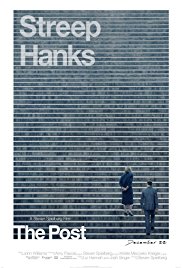
 Greetings again from the darkness. It’s the first time a movie marquee has read “Spielberg-Streep-Hanks”, so expectations are sky high – and rightly so. The result is level of cinematic preciseness we don’t often see. As an added bonus, it also features both historical and contemporary relevance – the type of relevance that forces us to consider where we stand and what type of society we prefer. So for the price of a ticket, we get Hollywood star power, a history lesson, and current societal commentary … now that’s a holiday bargain!

Meryl Streep stars as Katharine (Kay) Graham, the first female publisher of a major U.S. newspaper, and she delivers her most nuanced performance in years … that of a conflicted woman coming to grips with her immense power at a time when many men believed she lacked the capacity for making such far-reaching and weighty decisions. Tom Hanks slides into the loafers of Ben Bradlee, the hard-charging editor of Ms. Graham’s newspaper, The Washington Post. The role fits Hanks like a glove, and he even brandishes Bradlee’s trademark growling speech pattern. Bradlee is laser-focused on what he believes is the right thing to do, and steadfast in his commitment to the cause.

Of course, the dilemma faced by these two involved the Pentagon Papers scandal of 1971. The film kicks off with a quick timeline of the political maneuverings that led to, and escalated, the Vietnam War. When Daniel Ellsberg (Matthew Rhys) leaked documents from the Defense Department’s study on decision-making during the Vietnam War, and the New York Times published some of the pages, the ramifications were numerous and the fallout was ugly. The complicated web of deceit and bad decisions spanned 5 Presidential administrations (Truman, Eisenhower, Kennedy, Johnson, and Nixon). It became obvious that those in power continued a war they knew we couldn’t win. The cover-up was widespread and the string of lies were delivered by many. The government lost the people’s faith, and then tried to crush the free press that had exposed its dirty secrets.

It’s only been a couple of years since SPOTLIGHT won the Oscar for Best Picture, and now that film’s Oscar winning writer Josh Singer teams with Liz Hannah on a script that is elevated by an extraordinary cast and crew. We get the real feel of the organized chaos of a newsroom, and it’s a thing of beauty. The clacking of typewriters, exuberant phone conversations, and a cloud of cigarette smoke all blend to create the fabric of an institution designed and intended to deliver the truth. As with all things, it’s never quite so simple. We learn of the historical collusion between press and politics, as reporters and editors commingled with politicians, only to draw the line when deemed necessary. Both sides have flaws, yet as citizens, we simply can’t tolerate the government manipulating and even quashing the free press – a free press designed to protect the governed, not those that govern (per the Supreme Court decision).

Steven Spielberg has delivered a master class of ethics vs legalities vs political power, touching on not just the responsibilities of all parties, but most crucially on the conflicting objectives of a free press (making money) and the government system (getting elected) it is charged with holding accountable. Cinematographer Janusz Kaminski (two time Oscar winner, SAVING PRIVATE RYAN, SCHINDLER’S LIST) captures the authenticity of the newsroom, the intimacy of private discussions, and the fascinating look back at typesetting machines and a newspaper delivery system that silently forces us to recognize the power of today’s internet.

As you would expect, the supporting cast is remarkable and deep. Bradley Whitford, Bruce Greenwood (as Robert McNamara), Alison Brie (Kay’s daughter), Carrie Coon (reporter/editor Meg Greenfield), Sarah Paulson (as Bradlee’s wife), Jesse Plemons (attorney Roger Clark), and Michael Stuhlbarg (as NY Times publisher Abe Rosenthal) all bring realism to their roles. Two particular standouts are Tracy Letts (Ms. Coon’s real life husband) as Kay Graham’s trusted advisor Fritz Beebe, and Bob Odenkirk as The Post reporter Ben Bagdikian who meets with Ellsberg.

Gender inequality of the era is front and center for many scenes – sometimes even a bit too showy or distracting. The prime example is the scene where Ms. Graham is leaving the Supreme Court through a sea of silently admiring women – an unbelievably disproportionate crowd make-up. The gender point is made clearly through the position of Kay Graham and her actions, and no further proverbial slaps upside the head were required for the audience to “get it”. A rare Hindenburg joke is tossed in, and Bradlee is referred to as a pirate … two attempts to lighten the mood on a story that deserves serious attention. Composer John Williams’ score is never over the top, and perfectly complements the various conversations throughout. The film is quite clearly meant to impress how history repeats itself = those in power believing they are above all, while the free press tries to expose the abuses. It also makes the point that we as citizens must remain vigilant in our pursuit of the truth, as all sides have an agenda … sometimes it’s as complicated as covering up bad decisions, while other times it’s as simple as driving up the stock price. With its cliffhanger ending, Spielberg’s film could be viewed as a prequel to the fantastic 1976 film ALL THE PRESIDENT’S MEN, and that’s pretty lofty company.

watch the trailer:


ALL THE MONEY IN THE WORLD (2017)

December 23, 2017

 Greetings again from the darkness. The grandson of J Paul Getty, the wealthiest man in the world, was kidnapped while in Rome in 1973. That fascinating story holds more than enough drama for an engaging movie, and certainly did not need the notoriety or artistic challenges brought on by the Kevin Spacey scandal. With filming completed and a release date mere weeks away, director Ridley Scott made the decision to erase all evidence of Mr. Spacey’s J Paul Getty, and replace him with Oscar winner Christopher Plummer. The “do-over” is nearly seamless and it’s not a stretch to believe the second version turned out better than the first.

The precisely descriptive titled 1995 John Pearson book “Painfully Rich: The Outrageous Fortunes and Misfortunes of the Heirs of J Paul Getty” is adapted by screenwriter David Scarpa, and it’s the storytelling instincts of Mr. Ridley, and remarkable acting of Mr. Plummer and Michelle Williams that keep us engaged for the 132 minute run time.

16 year old John Paul Getty III is played by rising star Charlie Plummer (“Boardwalk Empire”, no relation to Christopher), and though this is the story of his kidnapping and violent torture, the movie mostly focuses on the contrasting personalities of his devoted mother Gail Harris (Michelle Williams) and his miserly grandfather J Paul Getty (Christopher Plummer), the wealthiest man in the world. She is a woman totally committed to her children while spurning the strings attached to family money. He, on the other hand, has devoted his life to money and winning, ignoring anything that might be construed as loyalty or compassion to family. With Mr. Plummer having just starred as Ebenezer Scrooge in THE MAN WHO INVENTED CHRISTMAS, this is just about the easiest transition an actor could hope for, given so little prep time for a new role.

The billionaire Getty refuses to pay the ransom, instead dispatching his security specialist Fletcher Chase (Mark Wahlberg) to negotiate the boy’s release. As a former CIA operative, Chase misreads both the situation with the abductors and the strength and determination of Gail. We get periodic looks at the captors and the environment where the grandson is being held. Romain Duris (THE BEAT THAT MY HEAR SKIPPED) is excellent as Cinquanta, the captor who spends the most time with the boy. The “ear” scene is explicit enough to elicit groans and shrieks from the audience, so be advised.

We are not like you” is what the younger Getty tells us as narrator, and he’s right. The ultra-rich live in a different world than you and I (assuming you aren’t one of “them”), and that’s never more clear than when the elder Getty explains his preference for things over people. While we never empathize with the rich miser, director Scott at least helps us understand what made him tick. To him, life was a negotiation and it’s all about winning – though his definition of winning could be debated.

The two octogenarians, Mr. Scott (80) and Mr. Plummer (88) work wonders with the outstanding Ms. Williams to make this a relatable story and captivating movie. The elder Getty died in 1976, two months to the day after Howard Hughes, while the grandson Getty had a massive drug overdose in 1981, and died in poor health in 2011, leaving behind his son, actor Balthazar Getty.

watch the trailer:


MOLLY’S GAME (2017)

December 23, 2017

 Greetings again from the darkness. Aaron Sorkin’s dialogue is like a rap battle with proper grammar and no down-beat. He must have been abused by pregnant pauses and moments of silence as a kid, as his screen banter gives new meaning to ‘the fast and the furious’. This latest is his directorial debut, but his loquacious diatribes have previously tested our attention spans in such films as STEVE JOBS, MONEYBALL, and of course, THE SOCIAL NETWORK (for which he won an Oscar).

Molly Bloom’s memoir is the adapted source material, and though her story might be a bit challenging to show, there is certainly much to tell … which is right in Mr. Sorkin’s wheelhouse. The verbal sparring amongst characters rarely pauses, and when it does, we have Molly immediately jumping in as narrator and guide.  The ultra-talented Jessica Chastain (ZERO DARK THIRTY) takes on the Molly role, and narrates her back story at break-neck speed (there is a pun in there). We learn her psychologist father (Kevin Costner) pushed her hard as a kid and she became off-the-charts intelligent while also being a world-class downhill skier.

A freak accident ended her athletic career, and after deciding to delay law school, Molly found herself working for a real estate agent in Los Angeles. Soon he got her involved with hosting the high-stakes underground poker games he ran for local celebrities, and being a quick study, she was soon running and managing her own games. When Molly was forced to take her game to New York, the players transformed from movie stars and professional athletes to business magnates, hedge-fund managers and, unbeknownst to her, the Russian mob.

Don’t mistake this for a poker movie. Cards and chips are everywhere, but this is Molly’s story, and Sorkin wisely simplifies the poker details and focuses more on Molly’s brilliant strategy to build her business. Of course, there wouldn’t be much to this were it just rich people playing poker. Less than a decade in, Molly is arrested in an overblown FBI sting featuring 17 armed agents at her pre-dawn door. The charges ranged from money-laundering to hedge-fund fraud to dealings with the Russian mob.

The criminal charges lead Molly into the offices of defense attorney Charlie Jaffey (Idris Elba), who is reticent to take what appears to be an unwinnable case. The Sorkin back-and-forth kicks into full gear as Molly and Jaffey expertly verbally spar until she convinces him that she is adamant in not wanting anyone else to get hurt – even if it might save her proverbial rear-end.

Although Sorkin doesn’t name names, it takes very little research effort to determine some of the featured players in Molly’s games. Hints are provided such as “green screen”, New York Yankee player, and Oscar winner. Michael Cera is identified only as Player X, but it’s quite obvious he is playing the noted green screen actor, and he does a nice job in a small, but vital role. The rest of the cast offers up colorful work: Jeremy Strong as Molly’s first boss, a very funny Chris O’Dowd, Brian d’Arcy as “Bad Brad”, Justin Kirk as a rock star, Angela Gots as the wise table dealer, and the always great Bill Camp as Harlan, whose story highlights the true risk in this supposed game of skill. Graham Greene has a nice moment as the judge hearing Molly’s case, and it’s likely the first time he and Kevin Costner have appeared in the same film since DANCES WITH WOLVES.

At times the film and story bear a slight resemblance to THE WOLF OF WALL STREET, but mostly it’s one woman’s journey through entrepreneurship and a web of legalities. Arthur Miller’s “The Crucible” is used as a comparable for protecting one’s own name, as well as a life lesson for Jaffey’s young daughter. Writer Sorkin predictably surpasses first time director Sorkin, and never is that more obvious than a cringe-inducing father/daughter scene on a park bench near the end of the film. It’s designed to wrap up Molly’s inspiration and influence, but plays like a cheap Hollywood ploy to mop up loose ends. Molly deserved better, and fortunately most of the movie delivers.

watch the trailer:


CALL ME BY YOUR NAME (2017)

December 21, 2017

 Greetings again from the darkness. Although confusing the two is understandable, there is a difference between a story of romance and a story of love. That’s not to say that the two can’t overlap; in fact, they often do. In movies, romance is the dish most often served because it’s usually more interesting. Watching the flirtatious dance and often awkward exploratory stage of what was once called the rituals of courting offers a writer, actor and director infinitely more possibilities than what we associate with the years of deep connection labeled as love. Andre Aciman’s novel is adapted by James Ivory (of Merchant-Ivory fame, and 3 times Oscar nominated for Best Director) and the script leans heavily on romance … lustful romance, to be specific.

Director Luca Guadagnino (A BIGGER SPLASH, I AM LOVE) is an expert at making movies that engage our senses. His movies delicately tease us – they slowly absorb us into the emotions and feelings of the characters. Very few filmmakers have the skill to subtly seduce the viewer, and draw us into the story so that we are no longer merely observing. It’s nuanced story-telling at the highest level.

Elio’s (Timothee Chalamet) family spends the summer at their estate in northern Italy. You’ve likely never met a more cultured family. His father (Michael Stuhlbarg) is a renowned professor, his mother (Amira Casar) a recognized translator, and Elio himself is a musical prodigy who whiles away the days by transcribing classical music and reading every book he can get his hands on. Oh, he also flirts with the local girls because he is, after all, a 17 year old boy. His intelligence and corresponding wit is of a much older person, standing in stark contrast to his innocence and childlike maturity level with all other pieces of life’s puzzle.

Elio’s world is rocked when his father’s newest research assistant, Oliver (Armie Hammer), shows up. An “Americano” who offsets his extreme politeness with an unrefined “Later” when departing any encounter, Oliver explodes on the scene like a Greek God. He and Elio have an initial passive-aggressiveness towards each other as they test the boundaries for weakness, and more importantly, interest. Things move very slowly as the passion and curiosity brews during their bike rides, walks through the apricot orchards (forbidden fruit), swimming in every watering hole, and competitive banters on intellectual topics. There is a sensuality to most every scene, though those same scenes are filled with unspoken tension.

The sunlit beauty as each summer day passes initially masks the emotions, and the stunning setting, people, colors, and music is accentuated by the camera work of cinematographer Sayombhu Mukdeeprom. Nature is on display in its full glory; not just through trees, sunlight, and water, but in that elusive and unexplained connection between two people so strongly drawn to one another.

Director Guadagnino’s film easily slides into the romantic sub-genre of such films as BLUE IS THE WARMEST COLOR, BROKEBACK MOUNTAIN, and CAROL, and the artistic approach provides a gentleness that even the peach scene can’t undo. Michael Stuhlbarg (who seems to be everywhere these days) has an extraordinary father/son scene near the end which reminds us that each one of us has a story on how life may or may not have turned out as planned. The gut-wrenching pain with sharing that story usually means it remains untold; however, the invaluable lesson is not lost on Elio. First love and first heartbreak bring both emotional ecstasy and emotional devastation, and whether you believe the film’s statement “We have less to give each new person”, you’ll likely agree that the use of Psychedelic Furs “Love My Way” is spot on.

watch the trailer:


I, TONYA (2017)

December 21, 2017

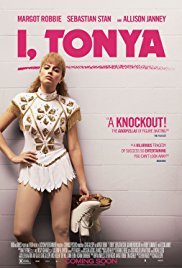
 Greetings again from the darkness. Your recollection of Tonya Harding is likely not that she was the 1991 U.S. Champion figure skater and a two-time Olympian. And rather than honoring her as the first female skater to land a triple axel in competition, you likely remember “the incident” in 1994 where she whacked her on-ice rival Nancy Kerrigan on the knee with a club. Only Ms. Harding wasn’t the one who attacked Ms. Kerrigan … and that’s only the beginning to what director Craig Gillespie (LARS AND THE REAL GIRL) and writer Steven Rogers (P.S. I LOVE YOU, and a bunch of other mushy stuff) detail in this madcap look at a reality infinitely stranger than most fiction.

Margot Robbie (THE WOLF OF WALL STREET) stars as Tonya Harding, and it’s a career-defining performance … funny, tragic, physical and emotionally charged. This isn’t the expected bleak biopic, but rather it’s a brilliant blend of parody, docudrama, and dark comedy focused on some real life folks that will surely make you grateful for your life. Harding’s abusive, profane and icy mother LaVona is played with aplomb by Allison Janney, who manages to bring some humor to the role of a woman whose approach went far beyond the realm of tough love and straight into cruelty. Sebastian Stan plays Tonya’s husband Jeff Gillooly and Paul Walter Hauser is Shawn Eckhardt, his friend and co-conspirator. In regards to these last two gents, we spend most of the film trying to decide if they are goofy, ignorant or downright dangerous (or all of the above).

Director Gillespie expertly weaves together the domestic scenes, ice skating scenes, and “current” interviews with the main characters. The domestic scenes include Tonya and Jeff, Tonya and her mother, Eckhardt with Tonya and Jeff, and Eckhardt with his own parents. The ice skating scenes emphasize how hard Tonya worked and her relationship with Coach Diane Rawlinson (Julianne Nicholson), while the interviews (recreated from actual interviews) provide contradictory details from the memories of Tonya, Jeff, Eckhardt and LaVona. The film tries not to make fun of them, but they kind of do it to themselves.

Bobby Cannavale appears as a “Hard Copy” reporter who provides some story structure by walking us through the timeline as reported by the media at the time. McKenna Grace plays a young Tonya, while Caitlin Carver is Nancy Kerrigan. Tonya has long been labeled as the most “notorious” figure skater, and a failed boxing career was the closest she came to capitalizing on her notoriety after the scandal. Her life and the incident have been the basis for songs, books, news specials, documentaries, TV parodies, and even a Brooklyn-based museum. The film reminds us that truth and recollections are open to interpretation, and that there is much more to the story than what was reported. Respect is too much for Tonya to hope for, but this excellent and entertaining film might deliver a dose of compassion or empathy (along with incredulity and some laughs).

watch the trailer:


THE SHAPE OF WATER (2017)

December 8, 2017

 Greetings again from the darkness. Recent release JUSTICE LEAGUE is filled with superheroes, but filmmaker-extraordinaire Guillermo del Toro finds his league of misfits and outcasts to be much more interesting – as do I. The numerous possible descriptions of this movie are all accurate, yet alone, each falls short: a fairy tale, fable, monster movie, unconventional romance, sci-fi, cold war saga, and commentary on societal misfits. What is also true is that it’s a gorgeous film with terrific performances, and it pays lovely tribute to the classics.

A government research facility in 1962 Baltimore is the setting, and “The Asset” being secured and studied is an amphibian man that was captured in South America by a sadistic Richard Strickland (Michael Shannon) and his electric cattle prod. Now the military, and a 5-star General played by Nick Searcy, is in charge. The lead scientist played by Michael Stuhlbarg certainly has a different agenda than the military, whose focus seems to be more on preventing the Russians (closer than you think) from stealing the asset than in actually seizing the rare scientific opportunity for advancement.

While all the ominous and clandestine government operations are being conducted, a member of the nighttime cleaning crew – a mute woman named Elisa (Sally Hawkins) – makes a very personal connection with the fish man through nutritious snacks, Big Band music and sign language. This is the enchanting portion of the story and is admittedly (by del Toro) inspired by the 1954 classic CREATURE FROM THE BLACK LAGOON (a personal favorite of mine). Elisa and the amphibian man experience a romantic courtship not unlike what we have seen in many other love stories … that is, if you overlook the amphibious being that makes up half of this couple. In fact, “going with” the story is crucial to one’s enjoyment. Sit back and let the magic and wonder and fantastical nature of del Toro’s imagination sweep you away – just as it has done for Elisa.

There are many elements of the film worth exploring, and it’s likely to take another viewing to capture many of them. The band of misfits is comprised of the fish man (Doug Jones), Elisa (Ms. Hawkins), Elisa’s wise and wise-cracking co-worker Zelda (Octavia Spencer), and Elisa’s neighbor Giles (Richard Jenkins), a closeted gay graphics design artist. These are the nice folks/beings who make up the world that seems to be run by bullies and predators (sound familiar?). There is even a religious debate here as it’s mentioned that the creature was treated by a God in his natural environment, and a brief discussion is had over what might a God look like. All of the actors are superb, and Miss Hawkins delivers her second knockout performance of the year (the other being MAUDIE).

“The future” is a central theme of the story, though Elisa is most focused on now – how to find some happiness in a world that has been so challenging. Elisa realizes she and the creature are more similar than not, and she feels his pain each time the power-hungry Strickland (Shannon) pops him with the electric cattle prod. There is an ethereal beauty (and yes, sensuality) to the scenes with Elisa and the amphibian man, and it even leads to a terrific song (“You’ll Never Know” by Renee Fleming) and dance dream sequence. In addition, you’ll notice many nods and tributes to classics such as Mr. Ed, Dobie Gillis, Betty Grable, Bill “Bojangles” Robinson and Shirley Temple, and Carmen Miranda singing “Chica Chica Boom Chic”. It’s also no accident that the apartments of Elisa and Giles are located directly above a palatial old movie theatre that is struggling to make ends meet. All of these pieces are tied together as Mr. del Toro honors the art forms he so adores.

For those who enjoy such detail, it should be noted that the color green plays a huge role throughout the film … the water, the creature, the uniforms, the furniture, the walls – even the Jello, the pie and Strickland’s (teal) Cadillac. The use of color ties in the ever-present mythology, and the theme of meanness and power versus kindness and love.

Cinematographer Dan Laustsen adds to the magical feel with his camera work and lighting that perfectly complements the characters and tone. Oscar winning composer Alexandre Desplat delivers yet another spot on score that not only syncs with story, but also the numerous classic songs included. Guillermo del Toro is one of the most creative and inventive contemporary filmmakers, and though this one may fall a tick below his masterpiece PAN’S LABRYNTH, it is sure to dazzle and mesmerize those who give it a chance … and let’s hope there are many who do!

watch the trailer:


DARKEST HOUR (2017)

December 7, 2017

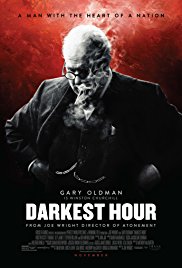
 Greetings again from the darkness. Cinematic historical dramas, by definition, face the challenge of overcoming a known and documented outcome. Director Joe Wright (ATONEMENT) and writer Anthony McCarten (Oscar nominated for THE THEORY OF EVERYTHING) attempt to re-create the tension-packed few days that literally changed the course of history and the free world.

It’s May 9, 1940 and the film takes us through the next 3 weeks of political wrangling that begins with Winston Churchill (Gary Oldman) being named Prime Minister almost by default, as he’s the only candidate acceptable to both parties to replace an ill and weak war time leader Neville Chamberlain (Ronald Pickup). Even King George VI (Ben Mendelsohn) is skeptical of Churchill and prefers Lord Halifax (Stephen Dillane), his friend who is likely better suited as Churchill’s adversary and a contrarian than as the actual decision-maker in this crucial time.

Uncertainty abounds within the government and the top priority of debate is whether to negotiate a peace treaty with Hitler and Nazi Germany, or fight on against seemingly impossible odds in hope of maintaining the nation’s freedom. Perspective is required here, as at this point, Germany was viewed as an unstoppable military force with Hitler as the leader. The war atrocities and his despicable vision were not yet fully understood. FDR and the United States declined to help and Churchill had few allies inside or outside his country.

We can talk all you’d like about history, but more than anything, this is a showcase for the best working actor who has never won an Oscar, Gary Oldman. This is an actor who has played Lee Harvey Oswald and Sid Vicious, and probably should have won the award in 2012 for TINKER TAILOR SOLDIER SPY. Earlier this year, I was impressed with Brian Cox as the lead in CHURCHILL (which was set four years later), but Oldman’s Churchill looks, sounds and moves like the real thing. We see the familiar profile and silhouette in numerous shots, and it’s actually kind of thrilling.

The always great Kristin Scott Thomas plays wife Clementine, and she shines in her too few scenes. Lily James plays Elizabeth Layton, Churchill’s bright-eyed secretary and confidant, and she has a couple of nice exchanges with Winston – especially the one explaining the “V” hand gesture. Another favorite line has a character state, “I love to listen to him. He has 100 ideas every day … 4 of which are good … 96 of which are dangerous.” It’s this type of writing that emphasizes the opposite approaches between this film and Christopher Nolan’s DUNKIRK, which utilized minimal dialogue as opposed to the emphasis on words taken by Mr. Wright’s film.

We go inside the House of Commons to experience real political gamesmanship, and see the hectic activities inside the war room as typewriters are being pounded while strategies and alliances are being formed. It’s an example of politics driven by a fear of action (by most) while there is a touch of hero worship as Churchill stands alone for much of the film. Some creative license is taken as Churchill rides the Underground (subway) in order to connect with citizens and take their pulse on war … despite most having no clue just how desperate things are. We see tremendous and tragic shots of Calais, and the wide range of camera work really stands out thanks to cinematographer Bruno Delbonnel, who also masters the indoor lighting and shading.

Operation Dynamo at Dunkirk is discussed briefly (this would be the perfect companion piece to Christopher Nolan’s masterpiece from earlier this year), but mostly this is the personalization of those who politicize war. The good and bad of history is made up of people, good and bad. Yes, there are a few too many Hollywood moments here, but Oldman does capture the pressure, isolation and belief of the historical figure who helped save a country, and perhaps the world. We hear two of Churchill’s most famous speeches: the “Never Surrender” speech to Parliament and “We shall fight them on the beaches …” prompted by the red glow of the “on air” radio light. There are many published books that provide more detail, but Oldman’s performance does guide us through what the Prime Minister must have gone through … and that’s worth a ticket and a gold statue.

watch the trailer:


WONDER WHEEL (2017)

December 7, 2017

 Greetings again from the darkness. It’s worth saying again – Woody Allen (age 82), regardless of what you think of him personally, is remarkable in his ability to create, write and direct a new movie each and every year. That being said, after watching his latest, it should be noted that he is the one filmmaker who really shouldn’t ever write a story with a step-daughter as a character … especially if romance is involved. Sometimes we just can’t separate the art from the artist, no matter how hard we try.

The setting is Coney Island in the 1950’s, and our narrator is a charming lifeguard recounting the ‘one summer’ story of a carousel operator, his beaten-down (and beaten-up) wife, and a surprise visit from the husband’s adult daughter. The lifeguard is Mickey, a dreamer and would-be writer played by Justin Timberlake. The carousel operator is known as Humpty and is an alcoholic lout played by Jim Belushi, while his wife Ginny, disillusioned that life has crushed her dreams, is played by Kate Winslet. Humpty’s daughter Carolina (Juno Temple) is on the run from her mobster husband, and seems to cause trouble without really trying. Ginny’s young son Richie (Jack Gore) also lives with them. He is a pyromaniac and movie fanatic – two pastimes effective at avoiding school.

Director Allen utilizes a beautiful color palette combined with nostalgic sounds and music to create a look that he then blends with a story and performances that seem to intentionally knock-off Tennessee Williams. Belushi, Timblerake and Winslet in particular come across as overly-theatrical in their approach to heavy dialogue – these characters are defined more by what they say than what they do.

Ginny plots to keep Humpty off the booze so he doesn’t hit her; all the while, she is sneaking off to enjoy the talents of the young lifeguard who lacks the fortitude to prevent her from falling too hard. Humpty is thrilled for a do-over with Carolina and reverts to treating her as his little girl … despite the mob contract lingering over her head. It’s impossible to miss the similarities between the redheaded Richie and young Alvy from Mr. Allen’s classic ANNIE HALL (who described living under the Cyclone).

As Ginny half-efforts parenting her troubled young son, she also juggles the guilt she carries from cheating on her first husband. Simultaneously, Mickey the lifeguard starts falling for Carolina, as the mobsters close in. Periodically Woody flashes his writing brilliance, as in this exchange between Carolina and Mickey: She says, “You’ve been around the world”, and he responds, “Yeah, but you’ve been around the block.” So despite the look and feel of nostalgia, the themes are timeless … cheating and abusive spouse, disillusioned adults, and youngsters rebelling in hopes of attracting attention.

The too-often blustery dialogue syncs with the too-often over-acting, yet cinematographer Vittorio Storaro (winner of 3 Oscars – APOCALYPSE NOW, REDS, THE LAST EMPEROR) keeps things visually appealing throughout. The only “quiet” moments occur as Richie is lighting yet another fire. Recurring issues of migraines, booze, stress, moodiness, and rain are prevalent, and perhaps the saving grace is that we are left singing Jo Stafford’s “You Belong to Me”.

watch the trailer: