REBEL IN THE RYE (2017)

September 7, 2017

 Greetings again from the darkness. “Holden Caulfield is dead.” So states Jerry’s letter to his mentor. You likely know Jerry better as J.D. Salinger, and he wrote that while hospitalized with Post Traumatic Stress Syndrome after WWII. Of course, we know this proclamation is premature, as Holden Caulfield is the main character from Mr. Salinger’s famous (and only) novel, “The Catcher in the Rye” … a high school literature staple for decades.

Imagine your dream is to become a great writer, but your own father continually reminds you that “meat and cheese distribution has been good for this family.” Your restlessness often works against you, and though you are hesitant to admit it, a mentor for writing and life direction is desperately needed if you are to avoid the family business. Enter Columbia professor Whit Burnett (Kevin Spacey).

This is Danny Strong’s first feature film as a director, though you would surely recognize his face from his frequent acting appearances – often as a weasly character. He is also the creator of TV’s “Empire” and wrote the screenplays for THE HUNGER GAMES: MOCKINGJAY (Parts I and II) and LEE DANIELS’ THE BUTLER. Strong does an admirable job in showing the commitment required to hone one’s writing skills and proving “the difference in wanting to be a writer and actually being one.”

Jerome David Salinger is played well by Nicholas Hoult. His scenes with Spacey’s professor are the film’s best, and Hoult also shoulders the responsibility of Salinger’s writing frustrations, personal life challenges, military service, and finally, his decision to become the most famous and long-lasting recluse (by comparison, Howard Hughes was an amateur).

We learn that Burnett was instrumental in getting Salinger’s first short story published, which finally gave Jerry the answer needed for a writer’s most dreaded question, “Have you been published?” Quite a bit of time is devoted to his odd romantic relationship with Oona O’Neill (Eugene’s daughter and the future, long-time wife to Charlie Chaplin). Zoey Deutch (daughter of Lea Thompson) plays Oona as an enigmatic lover attracted to Salinger’s genius, but incapable of being patient for his career that might happen (and might not). She opts for the sure bet.

Salinger’s military service included Utah Beach on D-Day, and nearly as remarkably, his toting the tattered manuscript ‘Catcher’ pages throughout his tour. He returned home in 1946, and in 1951 “The Catcher in the Rye” was published. It’s been referred to as the Great American novel and a rite of passage, while also being banned and derided for its whiny Holden.

Director Strong emphasizes Salinger’s turn to Zen Buddhism and his sessions with Swami Nikhilanda, as well as his evolving distrust of stalking fans and two-faced media. Support work is provided by Sarah Paulson as Salinger’s salty agent, Lucy Boynton as his wife, Victor Garber as his father, and Hope Davis as his supportive mother. Just as in real life, we get nothing of Salinger’s later years of solitude and isolation in New Hampshire, where he died at age 91.

The book has sold more than 65 million copies, and continues to sell well today. In a shift from the recent documentary SALINGER by Shane Salerno, and the book “J.D. Salinger: A Life Raised High” by Kenneth Slawenski, this dramatization doesn’t dig too deep, but it does allow a new generation to personify the legend. Perhaps it even paints a picture of a better/nicer man than what his real life actions showed. Regardless, the older Salinger certainly seemed to embrace the cause of “write and get nothing in return”.

watch the trailer:


IT (2017)

September 7, 2017

 Greetings again from the darkness. There are two clown schools: Funny clowns (Bozo, Ronald McDonald), and Terrifying clowns (the one in POLTERGEIST, Pennywise the Dancing Clown). Stephen King first introduced Pennywise in the 1986 novel, and the great Tim Curry brought him to life (and our nightmares) in the 1990 TV mini-series (2 episodes). So, that’s 27 years since the TV version. How fitting that director Andy Muschietti (MAMA) introduces a new generation 27 years later, since that’s how often the supernaturally evil clown visits Derry, Maine to frighten and feast on kids. It’s a terrific update.

Horror films are similar to comedy films in that it often comes down to one’s own personality quirks … what makes you laugh, and what scares you. This new version covers the first half of King’s novel, focusing on “The Losers Club” – the seven kids who band together to fight their fears. Director Muschietti sets the story in 1989 (rather than the 50’s) and the obvious comparisons are to THE GOONIES, STAND BY ME (another King story), and the recent hit “Stranger Things”.

The opening sequence gets us off to a great start. You’ve probably seen it in the trailer. Young Georgie (Jackson Robert Scott) is joyfully splashing through the rain puddles following his paper boat as it disappears into the storm drain. It’s there that he meets, and we get our first look at, Pennywise (Bill Skarsgard, son of Stellan and brother of Alexander). Giving us an early peek at what we came to see creates time for the development of a long list of characters. Of course the mini-series and the novel didn’t have the time restrictions of a feature film, so it’s impressive how quickly we connect with the kids.

Georgie’s older brother Bill (Jaeden Lieberther, MIDNIGHT SPECIAL) is the leader of The Losers despite his propensity to stutter, and his belief that little Georgie may still be alive. Motormouth Richie (Finn Wolfhard, “Stranger Things”) is the bespectacled wiseass, while Beverly (Sophia Lillis, an Amy Adams lookalike and star in the making) is the tough-on-the-outside female who deals with the rumors that accompany being a teenager. Hypochondriac Eddie (Jack Dylan Grazer), straight-laced son of the Rabbi Stanley (Wyatt Oleff), chubby brainiac new kid Ben (Jeremy Ray Taylor), and home-schooled Mike (Chosen Jacobs) round out this group of outsiders who are all frequently the target of bully Henry Bowers (Nicholas Hamilton), creepy parents, and of course, Pennywise.

A couple of the set pieces are outstanding. Beverly’s bathroom (especially the sink), the creek for the rock fight, and the rickety old house and its corresponding clown lair all contribute to the overall level of menace. Rising star composer Benjamin Wallfisch produces a score that guides us through the thrills and spills, as well as the quieter moments. As for Pennywise, even though the dancing clown had more screen time in the mini-series, Skarsgard is memorable, although the modern day special effects (those teeth!) often diminish the humanistic feel of Curry’s clown and escalate things to an other-worldly level.

Expect more of the Halloween Haunted House type of scary rather than the emotionally crippling stuff of horror films like THE EXORCIST or THE SHINING. The sudden bursts of sinister are surprisingly balanced with the humorous one-liners from the kids, and the actualization of the infamous “you’ll float too” is a stunning effect. The nostalgic feel complements the best part of the story … the power of friendship and connected groups. Watching these kids face their biggest fears certainly provides a bit of a chill to the upcoming fall season … and as a bonus, it’s a fun time for viewers.

watch the trailer:


HOME AGAIN (2017)

September 6, 2017

 Greetings again from the darkness. Let’s just get this out of the way upfront. There is a proven and established market for mindless fluff designed to allow women to laugh at the messes created by “real life” relationships, careers, and parenting. In fact, first time writer-director Hallie Meyers-Shyer is merely continuing the traditions set by her bloodline. She is the daughter of filmmakers Nancy Meyers and Charles Shyer who shared an Oscar screenwriting nomination for PRIVATE BENJAMIN (1980), and collaborated on other Romantic-Comedies such as FATHER OF THE BRIDE (I and II), and BABY BOOM (1987). Rom-Coms exist to bring some balance to the universe of Comic Book film adaptations for fan boys. It is possible to have quality filmmaking on both sides … no matter how rare it seems.

Oscar winner Reese Witherspoon stars as Alice Kinney. It’s her 40th birthday, and she’s a chipper lady recently separated from her music industry husband (Michael Sheen) and moved with their two daughters (Lola Flanery, Eden Grace Redfield) from New York to Los Angeles. Alice is in full “starting over” mode, including kicking off a new home decorating business. During a drunken birthday celebration with her friends, Alice hooks up with a younger man. The next morning, Alice’s mom (Candice Bergen) invites Harry (the young man played by Pico Anderson) and his two buddies (Nat Wolff, Jon Rudnitsky – all 3 are budding filmmakers) to move into Alice’s house. What follows is a maybe/maybe not romance between Harry and Alice, a bonding between the fellows and Alice’s daughters, new business struggles for Alice, the sudden return to the scene of Alice’s husband, and an endless stream of movie-making meetings for the 3 guys.

That’s a recap of the story, but it doesn’t address the real issue. For years, we have been hearing that the good-old-boy Hollywood network needed to back more female-centric projects: movies about women, movies directed by women, movies written by women, movies produced by women. Well this one has ALL of that, and yet I can only imagine the outrage if a man had written/directed/produced this exact film. Let’s discuss.

Alice is positioned as a “brave” and “strong” woman for moving her kids across the country and starting over. What allows this woman to be so courageous? Well see, she is the daughter of a deceased filmmaker who had a successful career and left her a multi-million dollar California estate … conveniently, one with a guest house for the three young men to live in. And who in their right mind, and with two young daughters, would invite three total strangers to move in – especially the night after – even if one of them looks to be yanked right out of an Abercrombie ad? There is also Alice’s interaction with her first client (played by Lake Bell). Despite despicable treatment from the rich lady, Alice doesn’t stand her ground until yet another drunken bout of liquid courage occurs. The two daughters are smart and cute, but there is an obvious shortage of daily parenting happening here – the daughters seem to show up only when a dose of precociousness is required. The scenes with Alice and her estranged husband are appropriately awkward, but the communication seems hokey … at least until we witness true hokeyness in the cartoonish exchanges between the (now) four gentlemen. In fact, all male characters are written as cartoons, which we might view as “getting even” with the many times female characters were poorly written; however, since the female lead here is just as unreal, that theory doesn’t hold.

The paint-by-numbers approach carries through as we check all the boxes: cute kids, a pet dog, apologetic ex, hunky new suitor, no financial hardships, loads of delightful dialogue, Ms. Witherspoon flashing more facial contortions than Jim Carrey at his peak, at least two cheesy musical montages, a mad dash to the kid’s play/recital/game, and even the cherry on top … a Carole King song at the end. In a year with so many wonderful female-centric films, this one is difficult to comprehend – except that maybe, given who her parents are, perhaps Ms. Meyers-Shyer is actually the beneficiary of that good old boy network of which we’ve heard tell.

watch the trailer:


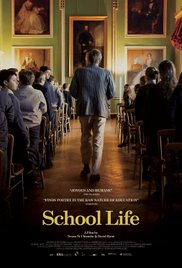
SCHOOL LIFE (2017, doc)

September 6, 2017

 Greetings again from the darkness. With all the talk about statues these days, maybe it’s career teachers like John and Amanda Leyden who deserve their bronzed images displayed in public so that we may all pay proper respect. The film follows the married couple during their 46th and final year as educators at Headfort School, the only remaining primary boarding school in Ireland. These two have been inspirational and influential to so many students over the years, and now they find themselves in a quandary about how to leave the only life they’ve known since becoming adults.

Co-writers and co-directors Neasa Ni Chianain and David Rane, along with script consultant Etienne Essery, use a loose structure in documenting the daily activities, and the blending of traditions with modernity, within the somewhat imposing walls of Headfort. We find it pleasurable to focus on passionate, dedicated teachers rather than on what’s broken with today’s education system.

John’s hard line stance and frequent use of sarcasm (“That wasn’t entirely bad”) effectively masks his caring nature and desire to help students learn and improve. He teaches Latin, Math and coaches the student band that plays many familiar rock songs. He considers this just as important as any class. Amanda takes a more traditional approach in teaching Literature. She uses a well-refined mixture of encouragement and books to facilitate the lessons and motivate students to read more.

The past and present are always on display here … with both the institution and this couple. School and home are blurred lines for the students as well as for John and Amanda. “If we don’t come here, what’ll we do all day?” This line speaks to the uncertainty and wariness that are weighing on the couple as their career end approaches.

As viewers, we must keep in mind that these are privileged children, all of whom are likely to move on to elite secondary schools. In fact, the arrival of selection letters plays a role near year end. When alone at home, we hear John and Amanda complain about students, not unlike you probably complain about your co-workers. The difference here is that this man and woman are truly dedicated to helping each student become their best self.

The film style allows the day-to-day challenges to appear as they may, and while little is learned about individual students, it’s clear that John and Amanda are lost about leaving the only working life they’ve experienced … a devotion to helping kids develop. In fact, the Headmaster, Dermot Dix, is a former student of the Leyden’s. The film’s original title, In Loco Parentis, translates to “in place of parents” … we wish these pseudo-parents nothing but the best in the biggest transition of their life. They certainly have earned happiness, and maybe even a statue.

watch the trailer: