YOUTH (2015)

December 17, 2015

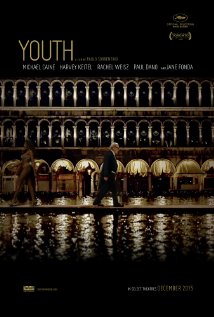
youth Greetings again from the darkness. With a Best Foreign Language Oscar for his previous film The Great Beauty (La grande bellezza), expectations were sky high for this one from writer/director Paolo Sorrentino. Cinematographer Luca Bigazzi is also back and the two create yet another artistic entrée that is a visual extravaganza, worthy of the admission price even if no dialogue existed. Combine the visual artistry with a commentary on age and emotions, and the result is a film that will either enchant or stultify … with probably no middle ground.

Michael Caine stars as Fred Ballinger, a renowned Orchestra conductor, who is vacationing at a stunning Swiss Alps spa with his daughter Lena (Rachel Weisz) and his long-time best friend, screenwriter Mick Boyd (Harvey Keitel). Fred, a self-professed retiree, is being pursued by Queen Elizabeth’s representative to perform one last concert. Fred is adamant in his refusal … for personal reasons we later learn are due to his nostalgic belief that his wife (no longer able to sing) is the only one who will sing his “simple” songs as long as he is alive. In the meantime, Mick is working with a group of ambitious young writers in an attempt to leave a legacy with his most important film ever. So you can already see that both men are working through their golden years in different ways.

Lena is devastated when her husband dumps her for a young pop singer (played by the real pop singer, Paloma Faith). Oh, one other detail … Lena’s husband is also Mick’s son (Ed Stoppard). This makes for some awkward (but entertaining) moments, and also leads to one of the film’s best scenes – Lena spilling her emotional guts to Fred while they are both covered in a mud bath. Director Sorrentino is a master at twisting these poignant moments with dashes of levity or irony. Another example is when Miss Universe (Romanian model Madalina Diana Ghenea) puts a condescending movie actor (Paul Dano) in his place with a devastating shift in tone and a comeback for the ages.

Sorrentino executes a couple of bizarre dream or fantasy sequences – one with Fred conducting a cow pasture (replete with cows and other bits of nature), and another with Mick being haunted in a meadow by all the female stars from his films (each in costume of their character). Suffice to say, this is not a conventional look at aging. What’s also clear is that Sorrentino believes our emotions drive our actions. The most jarring example is the aftermath when Mick’s long-time leading lady Brenda Morel (played by Jane Fonda) declines to appear in his latest film.

Even the most bizarre segments are presented with a visual artistry that forces our brains to process overtime. How about an obese Diego Maradona (played by Roly Serrano) repeatedly kicking tennis balls into the air? Or big time actor Jimmy Tree (Dano) struggling with his decision to sellout by appearing in a popular robot movie instead of pursuing his desire to be taken seriously as an actor? Or Lena bouncing back with a socially awkward mountain man? Or the seemingly minor role of a young masseuse (played by Luna Zimic Mijovic) who has us yearning for more? In addition to how each of these segments is startling to look at, Jane Fonda’s role has so many nuances that an entire movie could be made about her.

As with The Great Beauty, the film will have the most profound impact on those of us old enough to be looking through the binoculars and noticing how far away the past looks … and wondering just how long until “Life’s Last Day”.

watch the trailer:


THE DANISH GIRL (2015)

December 17, 2015

danish girl Greetings again from the darkness. There was a time when movies were cultural trendsetters in such areas as speech, style and behavior. Somewhere along the way, a transition occurred, and these days movies are more a reflection of the times – showing us who we are and focusing mostly on what society focuses on. Oscar winning director Tom Hooper (The King’s Speech) capitalizes on the current movement to mainstream the LGBT community by telling the story of Einar Wegener/Lili Elbe, a transgender from more than 40 years before Dr. Renee Richards, and 75 years before Bruce/Caitlyn Jenner.

Lucida Coxon has adapted the 2000 novel from David Ebershoff, which is a fictionalized version of the 1933 “Man Into Woman” … the personal letters and diaries of Einar/Lili (edited by Niels Hoyer). The film opens in 1926 Copenhagen as successful landscape artist Einar Wegener and his struggling-to-gain-respect portrait artist wife Gerda appear to be happily married and quite attracted to each other. During this segment, Hooper and cinematographer Danny Cohen utilize a somewhat distracting quasi-fisheye lens that distorts most every shot … presumably making the point that this couple’s life is itself distorted. There is no shortage of foreshadowing despite the bohemian artist lifestyle. Einar doesn’t miss a chance to caress the silks and frills as he visits his ballet dancing friend Ulla (Amber Heard), and things escalate quickly once he poses in stockings for one of Gerda’s portraits.

The best and most interesting segment of the film is the middle as Einar begins to explore his Lili persona, and Gerda is diligent in her support … going as far as to encourage her husband to attend a party as Lili (introduced as Einar’s visiting cousin). The public interactions with their friends and acquaintances are a little difficult to accept, though the scenes with her initial male suitor Henrik (Ben Whishaw) make it clear this is a point of no return. Despite this, the times are such that Einar willingly attempts to repress the Lili side, and even visits multiple medical and psychological specialists. It’s this segment that reminds us how quickly the medical profession of the era overreacted by prescribing radiation, electrotherapy, and even by institutionalizing those who were so inclined.

Gerda and Einar/Lili “escape” to Paris, where it becomes obvious that it’s Lily who has been masquerading as Einar, rather than the other way. The duality of Einar/Lily soon dissolves and daily life is filled with lessons … such as a Paris peep show where hand and body movements become part of the transition. Eddie Redmayne (last year’s Oscar winner for The Theory of Everything) gives an extraordinary performance, and is at his best when exploring the subtle nuances of Lili. It’s crucial to note that while Redmayne’s performance is a physical marvel, it’s Alicia Vikander (A Royal Affair, Ex Machina) as Gerda who provides the real heart and soul of the story. Though the film glosses over some traits of the real life Gerda, Ms. Vikander is stunning in more than a few scenes, which in the hands of a lesser actress, could have proved cringe-inducing.

Adding some depth in limited roles are Matthias Schoenaerts (Rust and Bone) as Hans, Einar’s childhood friend all grown up, and Sebastian Koch (The Lives of Others) as the pioneering doctor who performs the sex reassignment surgeries that physically transition Einar into Lili. Even with the strong supporting cast, there is no mistaking this as anything other than a film that belongs to Mr. Redmayne and Ms. Vikander.

Director Hooper takes a very conventional approach to an unconventional story, and this “safe” direction seems designed to make the uncomfortable story more palatable for mainstream audiences (similar to how Brokeback Mountain handled homosexuality). However, don’t mistake this for Tootsie or Mrs. Doubtfire. There are two serious stories here: the struggles of one person’s identity, and the corresponding challenges of a married couple. Hooper’s style is by no means cutting edge, but does feature one of the best lines of the year … “I’ve only liked a handful of people in my life, and you’ve been two of them.” This story has bounced around the movie world for awhile, and for many years was rumored to have Nicole Kidman in the Einar/Lili role. Your imagination can determine if that would have made for a better fit.

watch the trailer:


THE EMPEROR’S NEW CLOTHES (2015, doc)

December 17, 2015

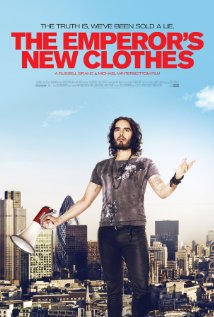
emperors new clothes Greetings again from the darkness. I’m not one of those who subscribe to the belief that documentary films should present all sides to the story in a “just the facts, ma’am” style. In fact, I respect a filmmaker who is so passionate about a topic that he/she enthusiastically attempts to overwhelm the viewer with “proof” that their opinion is the definitive truth and no further debate is needed. Here, renowned director Michael Winterbottom (The Trip, 2010) supports comedian/actor/activist Russell Brand in his agenda to educate the masses on the evil of big banks and rich people, and the need for re-distribution of wealth.

Now that agenda may seem a bit odd coming from an admitted rich guy, but in fact, Brand’s professional success lends some credibility to his argument … or at least it’s a different approach than having a group of people living in poverty talk about how they got screwed by “the man”.

To say that Brand dumbs-down his explanation is certainly an understatement. To emphasize this, there are a couple of segments where he utilizes elementary level students to differentiate between rich and poor – what’s fair and what’s not. Concentrating mostly on the British economy, while also noting the similarities to the United States 2008 crash, Brand makes the argument that the turning point was approximately 35 years ago as Margaret Thatcher assumed power and Free Market Capitalism took over. It’s a bizarre point coming from a native of a country whose Monarchs (not known for their “fairness”) date back for centuries. However, this is an example of the keep-it-simple approach in getting the masses to join his quest.

Borrowing a page from Michael Moore’s long-successful script, Brand presents the big banks and the super rich as the villains of society. It’s a common theme and one that’s pretty easy to agree with … the banks were bailed out, and then proceeded to pay their upper management huge bonuses. The viable argument is, why don’t they pay “us” back? Brand attempts to follow Moore’s lead again (while referencing Joseph Campbell) by walking into the banks and asking to see the CEO’s. These attempts fall flat, and leave us with Brand wise-cracking while bystanders try to figure out if it’s all a prank.

The most effective sequences involve Brand walking the streets of Grays London where he was raised. His discussions with the locals are real, and infinitely more enlightening than his storming into bank lobbies. The statistics don’t lie – the rich are getting richer, while the rest of society struggles. George Carlin said it best … the poor are needed to keep the middle class motivated to work so the rich can benefit. Brand also rails against legal tax evasion via offshore accounts – especially in Grand Cayman. He lobbies for those accounts to be taxed and the money returned to the country of origin.

Most of Brand’s mission is preaching the importance of fairness, and the claim is made that by definition, capitalism is the inequality of power. Whether you agree with him or not, Brand is to be respected for using his celebrity status for a cause much more important than the best table in a restaurant, or courtside seats to a game.  His simple-is-best approach carries right through to the end where he does offer up his list of recommendations to create a more fair system.  If his simple and sometimes funny approach allows more people to enter into discussions, then his cause is worthwhile, even if his recommendations are a bit lacking in substance and depth.

watch the trailer:


THE LETTERS (2015)

December 3, 2015

the letters Greetings again from the darkness. All we need is one more miracle. Having been beatified with one “confirmed” miracle, it’s that missing second one that stands between Mother Teresa and Sainthood. At times the film from director William Riead plays like a highlight reel for Mother Teresa’s induction into the Catholic Hall of Fame, as the dual emphasis is on all the good things she did for the poor, as well as the surprising sense of isolation and abandonment she felt most of her life.

The film is structured in flashback form as a priest played by Rutger Hauer is charged with researching the case for canonizing the late Mother Teresa. He crosses paths with Father Celeste van Exem (Max von Sydow), who shares the saved correspondence from Mother Teresa that provides the title of the movie. These very personal letters spanned 50 years and act much as a journal of her work and emotions.

Most of the movie takes us through the progression of Mother Teresa’s life. A slump-shouldered Juliet Stevenson portrays the nun as a woman on a mission from God … despite the obstacles from her detractors: jealous and disapproving nuns, many in the Catholic Church, and even some of the local citizens whom she desired to help. Her commitment to assist “the poorest of the poor” placed her in some tough situations and undesirable environments. She seemed to take on the suffering of those she was serving.

Given her proclamation that “It’s God’s will, not mine”, the Vatican approved her plan to go outside the Loreto Order to serve the poor. Two years later, her application for a new order was approved, resulting in the congregation of The Missionaries of Charity. Her mission then had structure and backing, and so began to make real progress.

Capturing the essence of this woman is what the film does best. We absolutely understand how she became “an icon of compassion for all religions” by giving “voice to the poor”. Perhaps, given the times we are in, this ability to serve multiple religions could itself by considered a miracle. As with any person who serves others, Mother Teresa had (and has) her detractors and critics. She (like her Catholic Church) opposed contraception … despite the needs within the community she served. Others accused her of mismanaging the millions in contributions, and spending too much effort recruiting new Catholics. Again, those accusations are not the purpose of the film, which instead profiles a woman who helped so many who otherwise would have been ignored in their misery.

As a Nobel Peace Prize winner in 1979, her commitment to the cause resulted in her most public recognition and brought her full circle from an early line of dialogue: “I may not be wanted here, but I am needed.” Regardless of the Catholic rule book requirements, it’s difficult to imagine a modern day person more worthy of being considered a Saint.

watch the trailer:


THE GOOD DINOSAUR (2015)

December 3, 2015

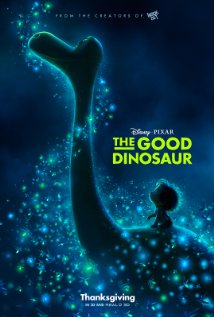
the good dinosaur Greetings again from the darkness. Two Pixar films in one year? Earlier this year, the brilliant Inside Out reminded us just what sets Pixar apart from other animation studios … the film was intelligent, insightful, thoughtful, beautiful, funny and emotional enough to bring tears to the eyes of many parents. In other words, it’s a tough act to follow – even for Pixar!

Of course, 2015 was not intended to be a double-header for Pixar. The Good Dinosaur ran into serious production and story issues at the same time the studio was going through layoffs and reorganization. So the six year project turned into eight, as a new creative team was brought in (led by director Peter Sohn), and the story and characters were re-worked and re-imagined. The finished product is likely the most staggeringly beautiful animation to ever hit the big screen, while at the same time being some of the darkest and bleakest material ever presented by Pixar.

The premise is pretty interesting: What would Earth be like if THE asteroid had missed, and the dinosaurs survived? That’s about as sciency as the story gets, other than it does portray nature as a colossal adversary (what’s with the hallucinogenic berries?). We first meet Momma and Poppa Apatosaurus as they work their corn fields (huh?) and wait for their baby eggs to hatch. The runt of the litter is Arlo, who just can’t keep up with his more active siblings and who feels inadequate in comparison to his majestic father.

Arlo and nature are responsible for the tragedy that sends Arlo off on a journey that features the full spectrum: the importance of family, the sadness of loss, the strength of friendship, and the self-discovery that leads to independence. While there are quite a few laughs along the way, the fear and isolation that Arlo experiences takes up most of the movie, and could leave all but the strongest kids feeling anything but upbeat and happy.

There is a life lesson about making one’s mark, and an oddball friendship between Arlo and young boy (named Spot??) who is wise to nature. But this one lacks the charm of most Pixar outings, while at the same time reaching technical levels that are breathtaking to behold. It’s difficult to imagine many kids wanting to watch this one again and again, but for all you Pixar nerds, you can rest easy … John Ratzenberger does make a vocal appearance.

watch the trailer:


ORION: THE MAN WHO WOULD BE KING (2015, doc)

December 3, 2015

Orion Greetings again from the darkness. “Believe it or not”. That’s the catchphrase that Ripley’s used for its books, TV shows and museums, and it could just as easily describe this latest from award-winning documentarian Jeanie Finlay (The Great Hip Hop Hoax, 2013). When Elvis Presley died in 1977, legions of his emotionally distraught fans refused to believe he had truly left the building forever. This is the crazy story of how one music industry huckster cashed in on the opportunity by taking advantage of talented nice guy who just wanted to sing.

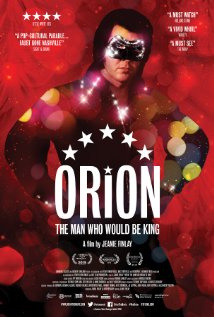
If you can play golf like (pre-scandal) Tiger Woods or throw a fastball like Nolan Ryan, then you have a chance to create a name for yourself. However, if you sing like Elvis (and even favor him physically), your music options are mostly relegated to being a sideshow act as an impersonator. That option was twisted a bit in 1979 by music producer Shelby Singleton, who had purchased Sun Records from Sam Phillips and relocated it to Nashville. Singleton contracted with Jimmy Ellis, a nice young man from rural Alabama whose singing voice was eerily similar to that of Elvis. But rather than impersonate Elvis, Ellis donned a bedazzled eye mask and assumed the public stage name of Orion – the title and character of Gail Brewer-Giorgo’s novel that explored what might have happened if Elvis had faked his own death to escape the claws of celebrity. Orion became a fantasy experience for those Elvis fans who wanted to believe their King was still alive.

Ms. Finlay’s film exposes yet another example of how cruel the music industry can be. Talent is no guarantee of success. Mr. Ellis definitely had talent, but his ambition and trusting nature allowed him to be exploited (along with Ms. Brewer-Giorgo) by Singleton, who paid him no royalties despite a hand full of charting singles, and some albums that found a market. To her credit, the filmmaker doesn’t dwell on the ugliness, instead using archival audio interview from Ellis (and plenty of his songs) and numerous talking head interviews from his son and those who were associated with the time period, to create a biography of a man who just wanted to sing and live a good life. Ellis may not have been The King, but he was the kind of guy it seems we would all like to call a friend … and listen to him sing as often as possible.

watch the trailer: