THE 33 (2015)

November 12, 2015

the 33 Greetings again from the darkness. How do you structure a film based on a true story that lasted 69 days, occurred 5 years ago, and was followed live on TV by half of the global population? Director Patricia Riggen (Girl in Progress, 2012) delivers a film designed to tug on heartstrings, and is based on the book “Deep Down Dark” from Hector Tobar, as well as interviews with the key players.

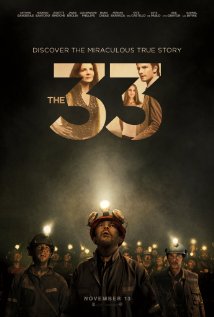
In 2010, the San Jose copper/gold mine collapsed trapping 33 Chilean miners more than 2300 feet under tons of rubble and an unstable rock that dwarfed the Empire State Building. Through some pretty solid special effects, we are there for the collapse. It’s this segment and the immediate reactions from the miners that provide the film’s best segment. We feel the miner’s sense of panic and doom as they begin to come to grips with their plight.

The film rotates between three struggles: the isolation of the miners struggling to survive, the tent city populated by their families struggling to maintain hope, and the Chilean government struggling with the politics and public relations of a rescue mission. From a character standpoint, each of these three segments is given a face. Antonio Banderas as Mario becomes the focal point of the miners. He searches for an escape route, takes charge of the (very limited) food rations, and acts as referee and light of hope in an extremely volatile situation. Juliette Binoche (yes the French actress) is Maria, the sister of one of the trapped miners and the most assertive of those pushing the government to attempt a rescue. Rodrigo Santoro plays Laurence Goldborne, Chile’s Minister of Mining, and the one who pushes the government to move forward with the costly rescue mission.

Other key characters include Bob Gunton as Chile’s President Pinera, Lou Diamond Phillips as “Don Lucho”, the safety inspector, Gabriel Byrne as the chief engineer, James Brolin as Jeff Hart (leading the U.S. drilling team), Naomi Scott as Mario’s wife, and three of the other miners: Oscar Nunez, Mario Casas, and Juan Pablo Raba.

The most bizarre segment comes courtesy of miner hallucinations. It’s a fantasy-infused Last Supper sequence that plays out to the sounds of a Bellini opera, while the food and drink flow and the family members join in the joy. It’s not difficult to imagine the brain taking these poor gentlemen to such places of mental torture.

As if the approach is to make the most viewer-friendly buried miner film possible, we aren’t witness to much underground conflict, and the internal bickering within the Chilean government officials is kept to a minimum. We do get to see the media circus that occurred during the ordeal … of course, most of us witnessed it in real time.

Director Riggen has delivered a film that taps into the multitude of emotions for the different groups of people, rather than concentrating on the miserable situation of the miners. It’s a challenge to keep us interested in a true story of which we all know the ending, but most viewers will stay engaged with the characters. It should also be noted that the minimalistic score is some of the last work from the late, great James Horner.

Watch the trailer:


SPOTLIGHT (2015)

November 12, 2015

spotlight Greetings again from the darkness. Faith. A word that easily could have been the title of this gripping and heart-wrenching film. Faith can be defined as trust and belief. Faith can also be defined as religion and ideology. Few things are more devastating than broken faith … the core of this “based on actual events” story of The Boston Globe’s exposure of rampant child molestation by dozens of Catholic priests, and the systematic cover-up by “The Church”.

It’s challenging to name a movie that is as well-made as this one, while also being as difficult to watch. We know the story … we even know how it snow-balled globally … but the raw emotions of disgust and sheer anger permeate much of our being as we watch it unfold on screen. Director Tom McCarthy (The Station Agent, The Visitor) co-wrote the script with Josh Singer (The Fifth Estate) and it’s worthy of favorable comparison to other investigative newspaper films like The Insider (1999), Zodiac (2007), and even the granddaddy of them all … All The President’s Men (1976).

The opening scene takes place in a 1976 Boston police station. A priest has been accused of molesting a child. Within a couple of minutes we witness the empty promises, the intimidation, and the cover up. So much is conveyed in this brief opener, not the least of which comes courtesy of the ambivalence of the veteran cop as he shrugs it off as ‘just another day’ in front of an idealistic rookie cop. This is accompanied by Howard Shore’s spot-on score, with the best parts featuring only a piano and bass.

Flash forward to 2001 as we meet the investigative journalist team called “Spotlight”. It’s led by editor Walter “Robby” Robinson (Michael Keaton) and his three reporters: Mike Rezendes (Mark Ruffalo), Sacha Pfieffer (Rachel McAdams), and Matt Carroll (Brian d’Arcy James). They report to Ben Bradlee Jr (John Slattery), whose father was the editor of The Washington Post during the Woodward/Bernstein/Watergate era. New to The Globe is managing editor Marty Baron (Liev Schreiber). Unlike the others, Mr. Baron is neither a Boston local nor a Catholic. In fact, we catch him reading Dan Shaughnessy’s book “The Curse of the Bambino”, just so he can get a better feel for the community and its people.

What is most fascinating about the movie is that it focuses on the investigative aspects – just how diligent the reporters were in putting the story together – and how fluid the process was … the story led them, not vice versa. There was no media agenda to “get” the church. Instead, the reporters experienced natural shock as each piece of the puzzle was discovered. One of their key sources was a priest-turned-psychologist (voiced by Richard Jenkins) who helped them put scope to the numbers. Another was Phil Saviano (Neal Huff), the leader of a victim’s group, who had tried before to provide documentation to the press. Saviano is the perfect example of how someone so passionate about a cause can be viewed with such skepticism … right up to the point when they are proven correct. Three attorneys add perspective to the cover-up. Eric Macleish (Billy Crudup) made a career of settling cases (and silencing victims) for the church. Mitchell Garabedian (Stanley Tucci) is the polar opposite – he fights vigorously to get the victims heard, while Jim Sullivan (Jamey Sheridan) is caught in the middle – settling cases for the church and struggling with his conscience. Other interesting characters include Paul Guilfoyle as Pete Conley, a smooth-talking power-broker for the church, and Len Cariou as Cardinal Law – the man at the top who eventually apologized and was rewarded with a high-ranking position at The Vatican.

The film is so well crafted and acted that it features more than a few “best scenes”. Sacha has a brief encounter with a former priest on his front door stoop. The priest freely admits to molesting kids and his rationalization will certainly deliver chills to most any viewer. Since this is Boston, it makes perfect sense for the reporters to be so distracted by the story, that it supersedes the Red Sox game they are attending at Fenway Park. Being that the investigation lasted well into 2001, it’s quite informative to watch a news agency shift directions for the September 11 tragedy, and along with the nation, put all else on hold. Finally, there is a point in the movie where we as viewers have just about had our fill of extreme emotions – we either need to hit something or throw up – and reporter Rezendes comes through with exactly what is needed: an emotional outburst and release of exasperation rivaling anything previously seen on screen. It’s a wonderful moment for Ruffalo as an actor, and a peak moment for viewers.

The story hit the front page of The Boston Globe in January 2002. The paper won a Pulitzer Prize in 2003 for its superlative investigative journalism. The report vindicated so many who had been taken advantage of, and exposed the colossal arrogance of the church. The innocence of a child vs the power of God. The story broke the faith that so many once held, and started a global (as evidenced by the closing credits) reckoning and awakening that was desperately needed. The film offers a line of dialogue, “It takes a village to raise a kid … or abuse one.” In other words, it took the often silent actions of so many to allow this despicably evil horror to continue. In a tribute to the newspaper profession, it took a small group of dedicated reporters to pull back a curtain that should never again be shut. Let’s have faith in that.

watch the trailer:


INGRID BERGMAN IN HER OWN WORDS (2015, doc)

November 12, 2015

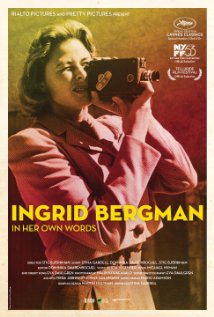
ingrid Greetings again from the darkness. A seven time Oscar nominee and three time winner. One of the best known and most beloved actresses of all-time. Fifty year acting career. Died at age 67, mere weeks after her final performance. These are all bullet points to highlight Ingrid Bergman, the cinematic icon. However, documentarian (and fellow Swede) Stig Bjorkman pays little attention to the icon, and instead focuses on the woman.

What sets this apart from many biographical portraits is Bjorkman’s access to Bergman’s diaries, journals, personal letters, photos, home videos, and most importantly, interviews with her four children: Pia Lindstrom, Roberto Rossellini, and twins Isabella and Ingrid Rossellini. It’s a treasure trove of memories, documentation and insight into a woman who lived life on her own terms … often in direct opposition to what societal norms dictate. The film neither defends nor celebrates her free spirit; it simply reports it and allows us to sit in judgment, should we be so inclined.

One of the best clips is young Ingrid’s screen test where her natural beauty radiates on screen, and her expressive eyes make it obvious why David O Selznick recognized her star quality. But there are numerous other clips and photographs which show her mostly involved with her family … one of her husbands and some combination of her kids. Not fitting into the typical “motherly” box, Ingrid spent an enormous amount of time away from her kids as they were growing up. She clearly loved them very much, as evidenced by the words in her diaries and letters, and the visuals from their time together. And the interviews with her children today make it obvious they viewed her as a fun friend, rather than the nurturing mom.

Another aspect that is crystal clear is the ambition and drive possessed by Ingrid. She even states “no one can have everything”, and her actions and words make it obvious that acting was what brought her to life – whether on screen or on stage. It never took long on the home front for her to feel the pull of her true adventurous nature, and soon enough she was back on a movie set … leaving the kids behind.

Specifics of her movie career are mostly glossed over. Casablanca has a quick segment, as does her time with Alfred Hitchcock. Instead, we get a broad perspective of the scandal that rocked the movie world … a pregnant Ingrid left her first husband (Petter Lindstrom) for her director-lover Roberto Rossellini. For the times, this was extreme impropriety and there were even boycotts of her films. No place was harder on her than the United States. Absolutely unapologetic and without remorse, Ingrid took her career to Europe. Ingrid and Roberto had three kids together, and since history has a way of repeating itself, it was only a matter of time before Roberto was with his pregnant girlfriend in India, and Ingrid moved on to producer Lars Schmidt (and his private island).

The most impact from the timeline comes courtesy of the four adult children as they recall the extended times away from their mother, followed by memorable and fun stints together. Of course, they have each had many years to come to terms with a mother who frequently chose pursuing her career dreams to spending time with them. Imagine having a mother who said “I belong more to the make-believe world of theatre and film”. It can make you tough and independent, or it can have the opposite effect. We hear each of them discuss.

This is the wrong place to look for a career retrospective of Ingrid Bergman the actress, but it’s an intimate and fascinating look at a woman who understood what was important to her, and refused to be ruled by societal expectations. Young Swedish actress Alicia Vikander provides voice-over for much of Ingrid’s written word, but it’s Ms. Bergman’s actions and the insight from Pia, Roberto, Isabella and Ingrid that complete the full portrait of a most unusual woman. Ms. Bergman died in 1982 (age 67), just weeks after her final role in the TV movie A Woman Called Golda… a fitting portrait of another woman who lived life by her own rules.

watch the trailer:


SPECTRE (2015)

November 8, 2015

spectre Greetings again from the darkness. Don’t come to me looking for objective judgment on Bond. By the time we hear that familiar opening trumpet blast of Marty Norman’s Bond theme, I’ve already been swept away into the land of MI6 enchantment – gadgets, cars, women, over-the-top stunts, globe-trotting, global villains and quintessential coolness. And it doesn’t help that this time director Sam Mendes treats this 24th (official) Bond film as an homage to those that came before. At times it plays like a tribute – and maybe even a closing chapter (for Mendes and Daniel Craig?).

A long tracking shot drops us into the Day of the Dead festival in Mexico, complete with skeleton masks and giant parade props. We follow a masked couple as they maneuver through the crowd and into their hotel room, where 007 quickly leaps out the window and makes his way across roof tops towards his mission. It’s one of the more visually stimulating and explosive openings in franchise history.

The story combines the personal back-story of Bond’s childhood with his relentless pursuit of the evil empire known as Spectre … the crime syndicate that has been part of the Bond universe for many years and films. The tie-in to the iconic Bond nemesis Blofeld, this new mastermind Franz Oberhauser, and Bond’s adoptive family make for an interesting chain of custody. However, as is customary, it’s the characters and action sequences that deliver the entertainment bang.

Oberhauser is played by Christoph Waltz (understated given his track record), and the two Bond “ladies” are played by Lea Seydoux (the daughter of Mr. White, and the key to finding Spectre), and Monica Bellucci (the widow of Bond’s Mexico victim). Mr. Waltz takes advantage of his limited screen time, while Ms. Bellucci is limited to a few lines and a chance to model some lingerie. Reprising their roles are Rory Kinnear as Tanner, Ralph Fiennes as M, Naomie Harris as Moneypenny, Ben Whishaw as Q, and Jesper Christensen as Mr. White. New to the mix is Dave Bautista as Hinx (in the mode of Oddjob and Jaws), and Andrew Scott as C … the latest of those trying to shut down the “00” program. Whishaw brings a nice element to his role, while Bautista’s Hinx gets to participate in both a car chase and train fight … while uttering only a single word of dialogue.

The evil doers have gotten more intellectual over the years, and Oberhauser and Spectre have the goal of global surveillance and controlling information and data. It’s a modern theme for a Bond film that also seems intent on reminiscing. There are nods to most (if not every) previous Bond film via (among other things) Nehru jackets, cats, scars, and a white dinner jacket. And it’s nice to see the gun barrel sequence back in the opening credits where it belongs. As for the new song, Sam Smith has a very nice voice, but his Bond song lacks the punch of the best.

In terms of globe-trotting, we get Mexico, Rome, Tangier (Morocco), London and Austria. The (prolonged) car chase occurs on the deserted streets (and steps) of Rome and features two stunning cars – Aston Martin DB10 and Jaguar C-X75. In addition to the cars and previously mentioned train, it’s helicopters that earned a couple of worthy action sequences.

It’s Daniel Craig’s fourth turn as Bond, James Bond. He brings his own brand of emotion and cheekiness, while also possessing a physicality that allows the action sequences to work. He has made the role his, much like Christian Bale took ownership of Batman. For those who refuse to accept the new generation, director Mendes delivers enough nostalgia that even the old-timers should be entertained.

R.I.P. Derek Watkins

watch the trailer:


ALL THINGS MUST PASS (2015, doc)

November 6, 2015

all things must pass Greetings again from the darkness. I do not envy those experiencing their childhood in this modern era. Sure, they have far superior electronics and hundreds more TV channels, but they also have very little independence (most can’t even walk alone to a friend’s house or a park) and they likely will never experience the pure joy of perusing the stacks at Tower Records (or any other record store) for hours … experiencing the thrill of discovering a new artist or style of music that rips into their soul. OK, I admittedly suffer from a touch of “old man” syndrome, but filmmaker Colin Hanks (yes, the actor and son of Tom) has delivered both a cozy trip down memory lane and a stark accounting of good times and bad at Tower Records.

With humble beginnings as little more than a lark, Tower Records began when Russ Solomon’s dad decided to sell used 45 rpm singles in his cramped Sacramento drug store. He bought the singles for 3 cents and sold them for 10 cents. Within a few years, Russ purchased the record business from his dad, and proceeded to run it as only a rebellious kid from the 1960’s could. From 1960 through 2000, the business grew each year. It expanded the number of stores (peaking at 192 worldwide) and constantly adjusted to the musical tastes and the delivery method – 45’s, LP’s, cassettes, CD’s, etc.

Using some terrific photographs and video clips, accompanied by spot on music selections, director Hanks brilliantly and generously allows the actual players to tell the story. The expected celebrity drops are present, and even the words of David Geffen, Dave Grohl, Bruce Springsteen and Sir Elton John carry emotion. However, far and away the most impact comes from extended interviews with the unconventional and charismatic Tower Records founder Russ Solomon and his devoted and forthright employee team. Their sincere recollections provide the roadmap through the phenomenal growth, as well as the devastating end in 2006. We understand how these stores became so much more than retail outlets … they were cultural hotspots for at least two generations. We also learn some things we probably shouldn’t … like the definition of “hand truck fuel”, and the reason Russ installed hot lighting in the listening booths.

Mr. Hanks surprises with his ability to balance nostalgia and the harsh realities of the downfall of an iconic cultural business. The film captures the key role Tower Records, while also pointing out that the crash was due to more than just Napster and digital music delivery. An interesting case study for business majors highlights the importance of vision vs debt. For more insight from Colin Hanks, check out the interview from film critic Chase Whale: http://www.hammertonail.com/reviews/documentary/a-conversation-with-colin-hanks-all-things-must-pass/

“No Music. No Life”. The motto of Tower Records was somehow inspirational, and fit perfectly for stores that featured mammoth album artwork on their store fronts, their own “Pulse” magazine, and staff that couldn’t fathom life without music … much less wearing a suit and tie to work. This was truly “a chain of independent stores”, and trust me when I tell you that hanging out at Tower Records was more fun than having hundreds of cable channels.

watch the trailer:


MISS YOU ALREADY (2015)

November 5, 2015

miss you already Greetings again from the darkness. The theatre was filled with the sounds of sobbing. And by sobbing, I mean bawling … not the typical post-movie sniffles. While I was a little confused on just where my fellow movie watchers thought this story was headed, it’s understandable that sometimes a dark theatre is simply the best place to have a good cry. Director Catherine Hardwicke and screenwriter Morwenna Banks deliver an unfettered look at friendship, sickness and loss … and a reason to bring tissues.

Tearjerker movies have quite the history of success. Some of the more popular sob fests include: Love Story, Brian’s Song, Terms of Endearment, Beaches, Steel Magnolias, and The Notebook. This latest is probably most similar to Beaches in that the focus is on two lifelong female friends (polar opposites in personality) who ride the rollercoaster of life together – through good times and bad.

Milly (Toni Collette) and Jess (Drew Barrymore) meet in elementary school and experience many of life’s “firsts” together. We know this because the film begins with a bit of a clumsy flashback sequence that shoots us through their high school years, heavy partying, and finally picks up after they are married.

There are many mysteries of the female gender that those of us with Y chromosomes will never comprehend. One of those is the close friendship between the vain, center-of-attention type, and the always supportive enabler. Milly is the classic taker, while Jess is a giver. Milly is the high-flying socialite who dresses flashy and draws a crowd, while Jess is the dependable sidekick, always there to make sure Milly is never alone. It’s confounding and a bit sad to those of us who view friendship as something much different.

Both Ms. Collette and Ms. Barrymore are strong in their performances, though Collette has the much meatier role. What’s impressive about the movie is how it takes head on the horrific travails of those with breast cancer. The emotional and physical and medical aspects are all dealt with no compromise. Some of it is tough to watch, but admirable in its directness. Milly’s breast cancer takes center stage, while Jess’ struggle to get pregnant is low-keyed. Fitting for their personalities, but each based in real life sagas. Milly’s husband Kit (Dominic Cooper), and Jess’ husband Jago (Paddy Considine) both provide understandable reactions to the obstacles faced by their spouses. Add in a bleached blonde Jacqueline Bisset as Milly’s eccentric mom, and the five lead actors each contribute a relatable element to the story.

Two other actors make an impression: Frances de la Tour as a wise and direct wig-maker, and Tyson Ritter (front man for The All-American Rejects) as a free-spirited bartender who may or may not be a good influence on Milly. Even though Jess is the heart of the story, it’s Milly who dominates … just like their friendship. Green vs glamour.

Director Hardwicke will always hold a special place in my movie memories thanks to her sparkling 2003 debut Thirteen. She and writer Banks clearly understand women, and believe it crucial to show the courage required in the fight against breast cancer. Fortunately, their main character is funny and spirited, and pals around with someone we would all be proud to call a friend. And that’s nothing to cry about.

watch the trailer:


SUFFRAGETTE (2015)

November 5, 2015

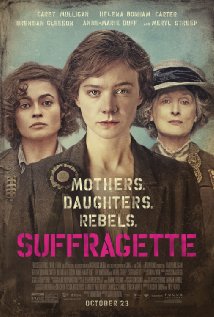
suffragette Greetings again from the darkness. Most “issues” movies go big in their approach to society-changing events and those that led the charge. Director Sarah Gavron (Brick Lane, 2007) and writer Abi Morgan (The Iron Lady, 2011) instead show us one little corner, a building block if you will, of the larger movement towards gaining women the right to vote in the UK. By focusing on the efforts of a small group of working class women in 1912, the struggle becomes one of flesh and blood, rather than granite statues.

Carey Mulligan stars as Maud Watts, a manual laborer at a commercial launderer. Her character is a composite of working class women of the time, and we come to appreciate her strength and the incredible sacrifices she makes for the greater cause. Maud seems to be a simple woman. She works hard, loves her son and is loyal to her husband Sonny (Ben Whishaw). When first exposed to the civil disobedience of the suffragettes, Maud is caught in the crossfire of a rock-throwing frenzy. She recognizes faces and becomes intrigued with the mission. At first, Sonny tries to be supportive, but soon enough, he is confused, embarrassed and finally forced to take extreme measures. After all, no self-respecting man of the time could allow his wife to sneak about town throwing rocks, setting off bombs, and attending secretive meetings … all for the sake of some ridiculous notion of equality for women!

Helena Bonham Carter appears as the neighborhood pharmacist who is a key cog in the local movement – a movement that had been ongoing peacefully for decades. What’s interesting about her appearance is that Ms. Bonham-Carter is the great-granddaughter of H.H. Asquith, the Prime Minister of UK from 1908-1916. He was an outspoken opponent of the suffragette movement during its most critical time. Her appearance and role in the film is a bit of redemption for the actress and her family.

Deeds not Words. This became the rallying cry for these women thanks to their leader Emmeline Pankhurst. Meryl Streep makes an all-too-brief appearance as Ms. Pankhurst, but it’s a key moment in the film as it solidifies the cause for this group of women who needed to believe that they could make a difference.

Gender inequality seems such an insufficient term for what these women endured. Sexual abuse, domestic violence, unequal pay, hazardous work environments, and almost no child custody rights in disputes with men … these were all commonplace at the time, and the film does a terrific job of making the points without distracting from its central message. Director Gavron’s subtle use of differing color palettes is effective in distinguishing the man’s world from that of the women.

It’s clearly a snapshot of a society on the brink of a revolution, and a grounded yet emotional glimpse at those foot soldiers in the war on injustice. Though this story focuses on the UK, the end credits remind us that in the U.S., it took until 1920 to ratify the 19th Amendment giving women the right to vote; and even more startling, Switzerland took until 1971 and the women of Saudi Arabia only this year obtained voting rights. The movie is a powerful personal story, and also an effective history lesson on the irrationality involved in bringing about humanistic change.

watch the trailer:


STEVE JOBS (2015)

November 5, 2015

steve jobs Greetings again from the darkness. Does it take the smartest guy in the room to write about the smartest guy in the room? Probably not, but as Aaron Sorkin shows in writing about Steve Jobs, it can’t hurt. It’s an impressive filmmaking team that, in addition to Sorkin, includes director Danny Boyle, and a cast of Michael Fassbender, Kate Winslet, Jeff Daniels, Michael Stuhlbarg, Katherine Waterston, Seth Rogen, John Ortiz and Perla Haney-Jardine … that’s a lot of talent, prestige, and award-winners.

The film is based on the terrific authorized biography written by Walter Isaacson (which I recommend). Rather than tackle the entirety of the book or Jobs’ life, a theatrical approach is taken with three distinct acts covering 16 years centered on product roll-outs: Macintosh, 1984; NeXT, 1988; and iMac, 1998. You might notice that two of those products are considered major flops, but the focus is on the persona of Jobs, not the performance of the products. Director Boyle makes his presence felt by filming appropriately in each of the segments: 16mm for 1984, 35mm for 1988, and digital for 1998. He also brings a sweeping beauty to the visuals … whether it’s Jobs storming through a hallway, or the maze of activity backstage at each roll-out.

In today’s world, it’s humorous to witness the cult-like atmosphere that develops around Apple products, and it’s equally comical to see the small-minded types who refuse to credit Jobs or Apple for catapulting consumer technology ahead by decades, and for achieving levels of financial success never before reached. Although it’s difficult to separate Jobs from Apple, Sorkin and Boyle are very clear in their focus on the man. In fact, the movie could be viewed as a kind of dysfunctional family – both genetic family and work family.

Rogen plays Steve Wozniak and Stuhlbarg plays Andy Hertzfeld, both part of the original Apple team with Jobs. There are some pointed exchanges between these three characters, with the most eye-raising being when Woz asks Jobs, “What do you do?” It’s the best display of what makes Jobs different than others, and his answer is one of the most disheartening compliments ever heard. There are multiple extended sequences with Jobs and his quasi-father figure John Sculley (Jeff Daniels). These two rip through Sorkin dialogue the way Michael Jordan once sliced through defenses. Most cruel are the exchanges between Jobs and Chrisann Brennan (Ms. Waterston) – the mother of his daughter Lisa (though he refused to acknowledge being her father).

For those familiar with the role of Joanna Hoffman in Jobs’ career, you will be duly impressed with the performance of Kate Winslet … playing the only one who could consistently stand up to the relentless pressure and lofty expectations.

There are soft references to (future) iPods and iPads, and Jobs’ break-up with Apple is dramatized, but it’s the individual scenes of interaction with others that makes this entertaining and challenging to watch. There is nothing likable about Steve Jobs the man, but Fassbender’s fine performance does allow glimpses of humanity beneath the God-like aura Jobs presented. Was Jobs a genius? Was he an extreme social misfit?  Was he a cruel family man due to his botched adoption as a kid? Regardless of where you place him in the realm of technology development, it’s difficult to argue with Woz’s proclamation that one can be “decent AND gifted”. It’s not binary.

watch the trailer: