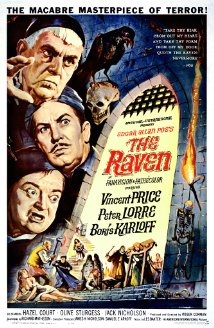
THE RAVEN (1963)

July 5, 2014

raven Greetings again from the darkness. It’s been more than 50 years since this one was released, so it seems a good time to offer up some thoughts and observations. Let’s start with the fact that you probably read Edgar Allen Poe’s poem “The Raven” in high school. Director Roger Corman and writer Richard Matheson take Poe’s work as a starting point in a most unique story of their own.

If you aren’t familiar with Roger Corman, he is one of the most prolific and entertaining “B” movie makers of all time. His writer here, Mr. Matheson, is best known for his work on numerous episodes of “The Twilight Zone“. Poe – Matheson – Corman would be enough, but we also get Vincent Price, Peter Lorre, Boris Karloff, Hazel Court and a young and not yet well known Jack Nicholson. Price is always a treat to watch (especially in horror films), Lorre appeared in 3 of the greatest movies of all-time (M, The Maltese Falcon, Casablanca), Karloff is the master of monster (and much more), Ms Court was one of the first stars of Hammer Films, and of course, Nicholson (fresh-faced here) went on to become one of the most successful actors in movie history.

Price, Karloff, Lorre and Nicholson offer up four of the most unique and recognizable voices ever heard in movies, and they each partake in the fun provided by Corman here. Yes, I said fun. This is almost slapstick comedy, and at a minimum, it’s a parody of the much darker series of Poe films. If you consider it as an influence of the 1960’s “Batman” TV series, you wouldn’t be wrong. Even the music (heavy on the tuba) has an air of comedy.

Watching Peter Lorre as a matador is pretty funny, as is Nicholson as the frenetic stagecoach driver.  Some of the back-and-forth with Lorre and Nicholson as father and son is clearly ad-libbed, but the classic comedic sequence occurs when Price and Karloff take their wizardry duel to the death and turn it into a special effects highlight reel.

This may be the only time you hear the phrase “precious viper” used to describe a woman, and if that, combined with all of the above reasons, isn’t enough to motivate you to seek this one out, then maybe you will never discover why so many adore the films of Roger Corman. Compared with films of today, this style is nevermore.

watch the trailer:


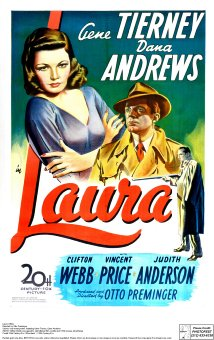
LAURA (1944) revisited

April 27, 2014

laura Greetings again from the darkness. Some movies from the 1940’s remain fun to watch for mostly nostalgia reasons. Others still hold up well today and can be enjoyed for the story, script, acting and production value. Director Otto Preminger’s Laura falls easily into the latter category. This quasi-film noir, murder mystery, creepy love story is based on the novel from Vera Caspary is probably more respected today than when it was released … 5 Oscar nominations, but not one for Best Picture.

To fully appreciate the film, it helps to know the tortured back story. This was always Otto Preminger’s baby, but Daryl Zanuck initially chose a different cast, a different director and a different ending. In the end, Preminger (Anatomy of a Murder) won all of his battles – directing Gene Tierney with the ending he wanted (thanks to Walter Winchell). TCM’s Robert Osborne correctly states that the film has one of the best opening lines: “I shall never forget the weekend Laura died“. The line is spoken by narrator Waldo Lydecker (great screen name) played by the elegant Clifton Webb.

Playing out as mostly a murder investigation led by the detective (Dana Andrews), we are treated to a stream of unusual story choices and only one scene at the police station … a terrific interrogation scene. Instead, we spend the entire movie on the turf of rich, high society types. There are at least four credible murder suspects and they are strung along by a mostly monotone detective, who only flashes personality on his date night with the dead girl’s portrait (well, that’s how it plays!) and when he is messing with a pocket baseball toy.

gene tierney Gene Tierney plays the titular Laura, and every time she appears on screen her startling beauty distracts us … just as it does the other characters in the film. Tierney was only 23 years old when this was filmed, and a couple years later she had a romance with young John F Kennedy (though she became a long time supporter of Richard Nixon). Her tragic personal story was the basis for Agatha Christie’s novel and movie The Mirror Crack’d. In the 1950’s a suicidal Tierney was treated with shock therapy in a sanatorium, and though she recovered, she struggled for the rest of her life. Her second husband was Houston oil man W Howard Lee, who had previously divorced actress Hedy Lamarr … another of the all-time screen beauties, who also turned down the lead role in Laura. Lucky guy.

The spirit of the movie comes courtesy of the magnificent performance of Clifton Webb as Waldo Lydecker. He is mesmerizing in his ability to take over every scene. This was Webb’s first “talkie” feature film – he left for the stage 15 years prior. The 30 year age difference between Waldo and Laura only works because Webb plays it as her society mentor, though it’s obvious he is obsessed.

Some of the best scenes and banter occurs with Webb and Vincent Price, who plays Laura’s fiancé. If you are only accustomed to Vincent Price in horror films, you will certainly get a kick out his odd role here as the virile, insecure fiancé. He also has some very good and uncomfortable scenes with the great Judith Anderson, who clearly lusts after the Price character.

The aforementioned portrait of Ms. Tierney was also used in 3 other films, and it’s interesting that Tierney and Andrews made 5 total films together. David Raskin’s haunting “Laura’s Theme” plays throughout the film in various fashions, and Joseph LaShelle won the film’s only Oscar – best black & white cinematography. This is certainly one of the best from the 1940’s and holds up very well today … enjoy the many facets of quality filmmaking.


**NOTE: None of the available online trailers are of acceptable quality, so I have decided not to post one