BOOM BUST BOOM (doc, 2016)

March 12, 2016

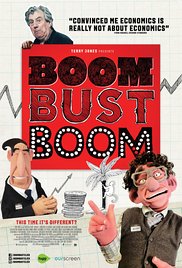
boom bust boom Greetings again from the darkness. On the heels of Adam McKay’s scathing and entertaining explanation of the 2008 financial collapse comes Terry Jones (of Monty Python fame) with a more global perspective of the same era. McKay’s Oscar nominated The Big Short was designed to let us know who did what and why, while Jones’ version applies a British spin and his wildly creative approach in breaking down the long-standing economic models that wreak havoc with our money.

Jones has joined forces with Economics Professor Theo Kocken to school us on the “leftover” strategies and economic models used by Politicians and Bankers … models that assume the market (investors and institutions) will act rationally. Our education comes courtesy of a multi-media show featuring animation, puppets, music and expert interviews (economists, authors, academic leaders, and at least 3 Nobel Prize winners).

According to the movie (and it’s difficult to argue otherwise), human nature is the Achilles heel of Capitalism. In fact, they use the term euphoria to describe the phenomenon that occurs as “stable” economic times lead to more risk and more debt. Debt clearly is the most profound 4-letter word in economics.

A film within the film … “Terry Jones’ Short History of Financial Crisis” takes us back to the 1500’s and through modern times, as the same mistakes recur. One of the more effective sequences shows State of the Union addresses from President Calvin Coolidge (1928) and President George W Bush (2006). Both speeches proclaim solid economies only 1-2 years prior to the two biggest collapses in U.S. history … just two extreme examples that the experts have no idea where the economy is headed as long as they continue to utilize the models that have proven to be ineffective.

It’s fascinating to get specifics on Hyman Minsky’s “Financial Instability Hypothesis”, as well as an explanation of the Neoclassical Economic Model (better known as the Free Market). Insight is provided by University of Texas Professor James Galbraith, son of famed economist John Kenneth Galbraith, and it’s quite enlightening to hear Allan Greenspan (a long time believer in the Free Market system) admit to being wrong about expecting rational behavior from those in the market.

The movie will forever act as a reminder for us to pinch ourselves should we think “this time is different”. In fact there is a movement by Economics students to change the way Economics degrees and PhD programs are structured – more emphasis on learning from history, and re-thinking and re-designing economic models.

The applicable websites are:

http://www.rethinkeconomics.org/

http://www.ecnmy.org/


MONTY PYTHON AND THE HOLY GRAIL (1975) revisited

August 5, 2014

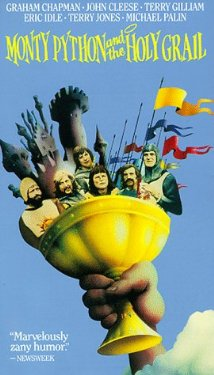
monty python Greetings again from the darkness. Consistently landing in the Top 10 whenever a film publication posts an all-time Best Comedy Movie list, this Monty Python classic should be a rite of passage for all teenagers. It is loaded, start to finish, with sight gags, one-liners, outright jokes, satire and overall outlandish behavior. It’s also a reminder that comedy need not be filled with profanity, and that once upon a time, a certain level of grossness was considered tongue-in-cheek.

In 1975, the Monty Python troupe was in between seasons 3 and 4 of their BBC comedy series “Monty Python’s Flying Circus“.  While on break, they came up with the movie’s theme of King Arthur and his quest for the Holy Grail, though mostly it’s just one related sketch after another.  The six members of Monty Python are each cast in numerous roles, and one of the fun games to play while watching is identifying each new character.  As a hint, Michael Palin plays the most characters (12) and four of Terry Gilliam’s characters die on-screen.  You might also note that the witch is played by Connie Booth, the wife (at the time) of John Cleese.

Terry Jones and Terry Gilliam co-directed, while all members received writing credits. The endless stream of classic sketches include: The Black Knight (“it’s just a flesh wound“), Song and Dance at Camelot (it inspired the Spamalot play), the ridiculing French guard, Trojan Rabbit, the on-camera modern day historian, the Knights who say “Ni”, the 3-headed giant, Castle Anthrax, Swamp Castle, Rabbit of Caerbannog, the Holy Hand Grenade of Antioch (spoofing Sovereign Orb), the Bridge of Death (3 questions), the abrupt ending with organ music. Other classic moments include “bring out your dead“, the recurring “run away” strategy, an (over) abundance of details on swallows, difficulties in counting to 3, and the best film uses ever of shrubbery and coconut shells. LOADED, I tell ya’!

While it would take multiple viewings to catch everything thrown into this one, it clearly jabs (all in good nature) such targets as Royalty, politics and politicians, Religion, and of course, the French. The animated God in the sky is actually a photo of 19th century cricket legend W.G. Grace, and the barbs directed at the French military are downright hilarious.

Graham Chapman (King Arthur, et al) passed away in 1989 due to complications from cancer, but he was one of the first celebrities to publicly come out as gay.  He spent much of his life as a gay activist.  John Cleese has had much success as an actor, appearing in A Fish Called Wanda, as well as two “James Bond” movies, two “Harry Potter” movies, and voicing the king in three Shrek movies. Cleese was also the creative force (with his wife) behind “Fawlty Towers“.  Terry Gilliam has had most of his success as a film director.  His films include Brazil, The Adventures of Baron Munchausen, The Fisher King, and 12 Monkeys.  He was also the main animator for most of Monty Python’s work. Eric Idle is very familiar to audiences after decades of movie and TV acting.  He was also a member of The Rutles (look it up!) and was the musical director and co-creator of the Tony Award winning play SpamalotTerry Jones was the sole director of Monty Python’s next and final two films, Life of Brian and The Meaning of LifeMichael Palin also appeared in A Fish Called Wanda, but these days is renowned for his work as a Travel writer and Travel documentarian.

The five surviving members recently (July 2014) reunited for a live performance that was simulcast to many theatres around the world. They stated this was to be their final appearance as Monty Python, and that this was the best way to say goodbye.  Making people laugh for almost 40 years is quite a legacy, and few have done it better than this comedy troupe and this classic comedy movie.   And just remember, when life gets tough, rather than “run away”, simply tell yourself “it’s only a flesh wound“.

Here is a re-cut trailer that presents the movie as a dramatic action film, rather than uproarious comedy. If you’ve seen the movie, you will “get” this.  If you haven’t seen the movie … it’s high time!