THE OUTRUN (2024)

October 3, 2024

Greetings again from the darkness. The best movies revolving around alcoholism usually make us feel like we are intruding on someone’s personal train wreck. Three that come to mind, each resulting in at least one Oscar, are LEAVING LAS VEGAS (1995), DAYS OF WINE AND ROSES (1962), and THE LOST WEEKEND (1945). This one is based on the 2016 memoir by Amy Liptrot, who also adapted the book for the screen with director Nora Fingscheidt (known for her festival favorite SYSTEM CRASHER, 2019).

Having already been nominated for four Oscars, there is little debate that Saoirse Ronan is one of the top actors of her generation. And this may be her best performance yet. As Rona, she captures the quiet desperation and loneliness that isn’t always so quiet. We see Rona as the unemployed, Masters-degreed, sloppy drunk party girl. We see her as the drunken victim of sexual violence. We see her as the next-day apologetic drunk who destroys a relationship. We see her in rehab and attending AA meetings. We see her relapse. We see her strained parental relations, and we see her in near isolation in hopes of kicking an addiction that she’s not even sure she wants to kick. It’s heartbreaking when she admits, “I can’t be happy sober.” We feel for those who have experienced this with loved ones.

Living in London, Rona is all about the excitement and energy of dancing and partying and socializing … and drinking. She says she likes how it makes her feel, ignoring the next day misery and regret. Her boyfriend, Daynin (Paapa Esiedu) is supportive and understanding, right up until the point where he’s had too much of her self-destructive ways. Rona finally accepts rehab and after 90 days, she heads home to Orkney – a sparsely populated archipelago off the north coast of Scotland. Rona’s parents are divorced. Her mom (Saskia Reeves) has turned to religion, while her bipolar dad (Stephen Dillane) lives in a caravan and works his sheep farm on his good days. The desolate environment lacks the constant temptations of London (though she still finds a few), and Rona hopes time in Orkney will be restorative to her health and spirit.

Filmmaker Fingscheidt makes some interesting choices. The film jumps around in time with Rona’s flashbacks to moments in her past – some going back to childhood. This jumping around reflects the mental struggles she goes through in her quest for sobriety. There is also a substantial amount of science and nature included. In voiceover, Rona details the specifics of addictive drinking, as well as the mythology of seals and selkies. Saoirse Ronan is superb throughout, yet two scenes stood out for me. The first is when she meets a stranger on the street, displaying her desperation for companionship and socialization. The second comes when she explains to her mother how seaweed is her new passion (her new addiction?) and is her focus for the future.

The only thing close to being as photogenic as Saoirse Ronan is the coastal Scottish landscape. It’s both breathtaking for us and claustrophobic at times for Rona as she fights the urges. Rona’s job with RSPB had me doing a quick Google search for endangered Corncrakes, and though most of the film left me emotionally drained, watching Rona ‘conduct the ocean’ provided a welcome jolt of joy.

*** For those who are interested in reading Amy Liptrot’s thoughts on the film about her life, I recommend this commentary she published: 

https://www.theguardian.com/books/2024/sep/22/amy-liptrot-outrun-life-as-alcoholic-on-big-screen

Opens in theaters on October 4, 2024

WATCH THE TRAILER


THE MAN IN THE HAT (2021)

May 12, 2021

Greetings again from the darkness. Who is the woman in the picture? What did the five men toss in the river? Why are those men chasing the man in the hat? Why is that other man wet? If the man in the hat is running from the five men, why does he keep running into the same people? What are those two measuring now? Why doesn’t anyone (ok, almost no one) speak? Why are there so many questions, and why, by the end, do we not care that most go unanswered?
John-Paul Davidson, known mostly as a travel documentarian, and Stephen Warbeck, an Oscar-winning composer, have teamed up as co-directors and co-writers to deliver an unusual and whimsical road trip movie that tips a cap to the silent comedy films of yesteryear. Adding to the unusual elements is Ciaran Hinds starring as the titular man in the hat. Mr. Hinds is a long-time terrific actor, but not one we think of for jocular comedies requiring exaggerated facial expressions, physical pratfalls, and squeezing into a tiny Fiat for a back roads drive through rural France.

As the film opens, the man in the hat spends the day sharing a table with the woman’s photo at a charming riverside café. That evening, while still seated at the table, he witnesses 5 grown men pile out of a clown car Citroen and dump what appears to be a body into the river. The man escapes with the framed photo and one of the film’s recurring gags is the close calls he has with the five men as they drive through the countryside. The film plays a bit like Homer’s Odyssey in that the only real story occurs as the man interacts with various folks he meets along the way. The Damp Man is played by the always interesting Stephen Dillane, and a lovely woman on a bicycle who exchanges flirtations with hat man is played by Sasha Hails.

Among the strange and wacky paths that cross are a couple of onion-chomping geezers who fix his car, a cluster of singing female mechanics, a solo French biker, and a pair of city workers with a measuring tape and eyes for each other. Music plays a huge role here, which is not surprising given the presence of Mr. Warbeck. Not only does the accompanying music feature an unusual and varied blend of music types, but we also see and hear many local musicians, including Mathilda Homer. And for the finale, music again plays a role, bringing things full circle.

Coming up with a comparison movie is not easy, though one description could be director Michael Winterbottom’s “The Trip” franchise … if Steve Coogan and Rob Brydon were not allowed to speak! This isn’t a laugh out loud type of comedy, rather it’s mostly just pleasant and odd. For a drive through rural France or a chance to watch Ciaran Hinds chase his shoe down a drain, this bizarre little ditty from Davidson and Warbeck will work just fine.

In theaters and on demand on May 14, 2021

WATCH THE TRAILER


OUTLAW KING (2018)

November 10, 2018

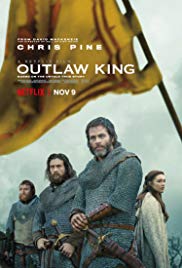
 Greetings again from the darkness. Much was made of the ‘artistic license’ director Mel Gibson took in creating his own version of historical events and actions of William Wallace for his Oscar-winning BRAVEHEART (1995). Director David Mackenzie (in his follow up to the excellent HELL OR HIGH WATER, 2016) pays a bit more attention to historical details as he picks up the story at the end of Wallace’s rebellion – and the beginning of the uprising led by Robert the Bruce.

Chris Pine plays Robert the Bruce, a man forced to pledge loyalty to Kind Edward I and England prior to leading the rebellion. It’s the year 1304 and director Mackenzie’s opening sequence is a several minute long tracking shot that is simply superb. It features our introduction to Robert the Bruce (Pine), King Edward I (Stephen Dillane) and Prince Edward (Billy Howle, ON CHESIL BEACH), as well as an early swordfight and an eye-popping fireball shot from an enormous catapult into the protective wall of a distant castle.

Not long after, we learn William Wallace has been killed, the King has provided Robert the Bruce a wife in Elizabeth de Burgh (Florence Pugh, LADY MACBETH) and Robert  takes the life of fellow Scotsman John Comyn … an act that costs him dearly in the early going. However, it does lead to his being named King of Scots by the Church, and he slowly begins to build his forces. Of course, Scotland’s forces are always dwarfed in numbers by that of the English Empire, but never in spirit.

Pine plays Robert the Bruce as the strong, (mostly) silent leader, while Howle and Aaron Taylor-Johnson cross into camp in their respective portrayals of Prince Edward (yet another wide-eyed son intent on making his father proud) and James Douglas (a manic, crazy-eyed Scotsman bent on revenge). Ms. Pugh brings courage and a headstrong nature to Elizabeth (in far too limited a role), while Mr. Dillane shows us a worn down King Edward I who gets the film’s best line … “I am so sick of Scotland!”

The two words of the title are actually separated by a slash in the opening credits; a device meant to emphasize the dual sides to the man and his actions. In addition to that opening long shot, there is a visually stunning sequence of a nighttime raid on a camp site. Unfortunately after that, we get mostly mud and blood, including the pivotal Battle of Loudon Hill which features the ultimate in home field advantage. There are some terrific costumes and set pieces, but mostly it’s elaborate and detailed moviemaking (with a few downright silly moments) that never fully clicks. Perhaps that’s a factor of having 5 different writers involved. With many familiar faces from “Game of Thrones”, it will be interesting to see how this plays on laptops and TVs via Netflix. Another Robert the Bruce film is scheduled for theatrical release in 2019, and the inevitable comparison will be made at that time.

watch the trailer:


DARKEST HOUR (2017)

December 7, 2017

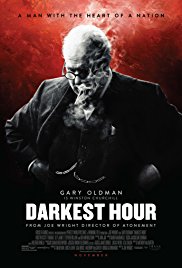
 Greetings again from the darkness. Cinematic historical dramas, by definition, face the challenge of overcoming a known and documented outcome. Director Joe Wright (ATONEMENT) and writer Anthony McCarten (Oscar nominated for THE THEORY OF EVERYTHING) attempt to re-create the tension-packed few days that literally changed the course of history and the free world.

It’s May 9, 1940 and the film takes us through the next 3 weeks of political wrangling that begins with Winston Churchill (Gary Oldman) being named Prime Minister almost by default, as he’s the only candidate acceptable to both parties to replace an ill and weak war time leader Neville Chamberlain (Ronald Pickup). Even King George VI (Ben Mendelsohn) is skeptical of Churchill and prefers Lord Halifax (Stephen Dillane), his friend who is likely better suited as Churchill’s adversary and a contrarian than as the actual decision-maker in this crucial time.

Uncertainty abounds within the government and the top priority of debate is whether to negotiate a peace treaty with Hitler and Nazi Germany, or fight on against seemingly impossible odds in hope of maintaining the nation’s freedom. Perspective is required here, as at this point, Germany was viewed as an unstoppable military force with Hitler as the leader. The war atrocities and his despicable vision were not yet fully understood. FDR and the United States declined to help and Churchill had few allies inside or outside his country.

We can talk all you’d like about history, but more than anything, this is a showcase for the best working actor who has never won an Oscar, Gary Oldman. This is an actor who has played Lee Harvey Oswald and Sid Vicious, and probably should have won the award in 2012 for TINKER TAILOR SOLDIER SPY. Earlier this year, I was impressed with Brian Cox as the lead in CHURCHILL (which was set four years later), but Oldman’s Churchill looks, sounds and moves like the real thing. We see the familiar profile and silhouette in numerous shots, and it’s actually kind of thrilling.

The always great Kristin Scott Thomas plays wife Clementine, and she shines in her too few scenes. Lily James plays Elizabeth Layton, Churchill’s bright-eyed secretary and confidant, and she has a couple of nice exchanges with Winston – especially the one explaining the “V” hand gesture. Another favorite line has a character state, “I love to listen to him. He has 100 ideas every day … 4 of which are good … 96 of which are dangerous.” It’s this type of writing that emphasizes the opposite approaches between this film and Christopher Nolan’s DUNKIRK, which utilized minimal dialogue as opposed to the emphasis on words taken by Mr. Wright’s film.

We go inside the House of Commons to experience real political gamesmanship, and see the hectic activities inside the war room as typewriters are being pounded while strategies and alliances are being formed. It’s an example of politics driven by a fear of action (by most) while there is a touch of hero worship as Churchill stands alone for much of the film. Some creative license is taken as Churchill rides the Underground (subway) in order to connect with citizens and take their pulse on war … despite most having no clue just how desperate things are. We see tremendous and tragic shots of Calais, and the wide range of camera work really stands out thanks to cinematographer Bruno Delbonnel, who also masters the indoor lighting and shading.

Operation Dynamo at Dunkirk is discussed briefly (this would be the perfect companion piece to Christopher Nolan’s masterpiece from earlier this year), but mostly this is the personalization of those who politicize war. The good and bad of history is made up of people, good and bad. Yes, there are a few too many Hollywood moments here, but Oldman does capture the pressure, isolation and belief of the historical figure who helped save a country, and perhaps the world. We hear two of Churchill’s most famous speeches: the “Never Surrender” speech to Parliament and “We shall fight them on the beaches …” prompted by the red glow of the “on air” radio light. There are many published books that provide more detail, but Oldman’s performance does guide us through what the Prime Minister must have gone through … and that’s worth a ticket and a gold statue.

watch the trailer:


PAPADOPOULOS & SONS (2013)

August 14, 2013

papa Greetings again from the darkness. There is always a risk in stamping a movie with a particular label … “Greek” in this case. It can limit the audience to which it appeals if there are too many in-jokes or cultural references. Despite the heavy dose of Greek-ness, writer/director Marcus Markou offers up a terrific little story that most can enjoy. It’s certainly not at the level of My Big Fat Greek Wedding, but it’s charming and entertaining enough.

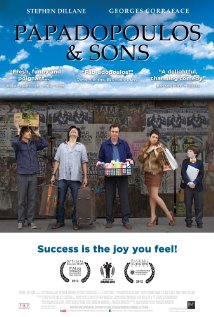
Stephen Dillane stars as Harry Papadopoulos, a self-made millionaire who loses everything during a financial market collapse. You will recognize Mr. Dillane as Thomas Jefferson from the excellent HBO mini-series “John Adams“. Here he plays a single dad to 3 kids: a stuttering plant loving son, a pop star-wannabe teenager daughter, and a nerdy young son with a penchant for picking stock trends. Joining them is screen veteran Selina Cadell as the housekeeper/nanny. The crisis sends the family back into the life of Harry’s brother Spiros (Georges Corraface), and they proceed to re-build the old family business … Three Brother Fish & Chips.

Sure, it’s a formulaic story, but the characters are interesting enough and Uncle Spiros is so full of life and spirit that he can’t help but get you excited for this second chance. Watching the family re-connect with each other and their past is not just pleasant, but also well presented. Mr. Dillane is wonderful as the uppity millionaire type, however, when he gives his hospital soliloquy regarding never feeling “so alive”, I do wish we had actually seen more proof of that.

While I most enjoyed the interactions between Harry and Spiros, the two musical/photo medleys seemed to interfere with the flow … rather than shortcuts, they proved a bit annoying. However, it’s always refreshing to see a movie where a family bonds together, and puts the past where it belongs.

watch the trailer:

http://www.youtube.com/watch?v=J1ymQF1Dnl8