Greetings again from the darkness. Car chases are prevalent throughout movie history. Some are quite exhilarating and famous: BULLITT (1968) and THE FRENCH CONNECTION (1971). Some are over-the-top: pretty much every driving sequence in the F&F franchise. The directorial debut of writer-director Shawn Simmons revolves around a talented getaway driver, and there are certainly a couple of heart-pumping sequences, but the movie is as much a look at how bad decisions impact one particular character, Edie.
We first see Edie as a 14-year-old (played by Elle Graham), who is coerced by her father (Steve Zahn) to “punch it” to save her mother from an unfortunate (and illegal) occurrence. Flash-forward a few years and we find Samara Weaving (so good in READY OR NOT, 2019) as Edie, now stressed out over being robbed at her bank job, her relentless poverty, a broken-down car, and prepping for her college exams. Her bad day is topped off by an unwelcome surprise from her doctor at a check-up.
This surprise leads Edie (nicknamed Eenie Meanie) to track down the bad news boyfriend she’s been diligently working to move on from. John (Karl Glusman, who exposed his full talents in LOVE, 2015) is the kind of guy that creates chaos simply by living. If he doesn’t find trouble, it’s not long before trouble finds him. So when Edie finds John, she of course also finds trouble. This time her man-child owes crime lord Nico (Andy Garcia) so much money, that Edie agrees to be the driver in a high-risk casino robbery that Nico says will save John’s life.
We get the expected montage of heist planning, and along the way, Edie crosses paths with characters played by Jermaine Fowler, Randall Park, Chris Bauer, Mike O’Malley, and most memorably, Marshawn Lynch – a rival driver in a fancy red mink robe and customized Continental. The movie feels like it’s Shawn Simmons answer to Edgar Wright’s superior BABY DRIVER (2017). The fallout from bad decisions are the recurring theme, and it’s really the screen presence of Samara Weaving (Hugo’s niece) and her interactions with Andy Garcia that provide a bit of interest here.
Greetings again from the darkness. “I want to go to Dreamland.” One might assume that phrase is related to Hollywood being the place where dreams can come true, but co-creators Ryan Murphy and Ian Brennan take us down a much different path. The two have collaborated on the TV series “Glee”, “Scream Queens”, and “The Politician”, and here they offer up a revisionist history on the post- WWII Golden Age of Hollywood, in the vein of what Quentin Tarantino did in INGLORIOUS BASTERDS and ONCE UPON A TIME … IN HOLLYWOOD. Mr. Murphy and Mr. Brennan seemingly focused on idealistically imagining a film industry where one’s race, ethnicity, or sexual preference made little difference. In doing so, they devote significant time to racism and homophobia.
While the series mixes fact and fiction in such a way that the lines are often blurred, there are two main storylines that provide the backbone of the series: the actual suicide of 24 year old actress Peg Entwistle, which occurred in 1932 when she jumped from atop the Hollywoodland sign; and the mostly fictional crossing paths of a handful of aspiring actors, writers and filmmakers as they navigate the treacherous film industry waters. We see the new generation clashing with the establishment – a tale as old as time.
The 7 episodes cover approximately 7 hours, but it was somewhat challenging to make it through the first three. However, I’m so glad I stuck with it. The series starts off with what seems like a concerted effort to push every boundary possible in regards to sex and racism, with an emphasis on the proliferation of homosexuality within the industry. The characters that are new to town are trying desperately to survive as cling to the dream of their big break.
The series elevates significantly in Episode 4 when the attention turns to filmmaking and acting and running a studio. There is a terrific sequence where we bounce back and forth between two pairs of actors rehearsing for their auditions. We feel the pressure that actors endure during the audition process, and note the fine line … almost an indiscernible line … between success and failure. In addition to the newcomers trying to secure roles, we follow a gay, black first time screenwriter and a half-Filipino first time director. As a bonus, Eleanor Roosevelt is portrayed as preaching the social importance of a studio breaking from the industry norm.
“What if you could re-write the story?” is the tagline, and it applies not only to the screenplay of “Peg” (the movie within the movie), but also to Murphy and Brennan as they show how the industry should be, well except for the illicit sex, marital affairs, and mob interventions. Hypocrisy and double-standards are part of the fabric of the movie industry, but what if that gay, black screenwriter didn’t have his work defined by those labels, or the half-Filipino director wasn’t selected because he could pass as white, or if the talented black actress wasn’t relegated to playing domestic help? Those are the core issues at play here, and each of the characters has hopes of changing things in Hollywood.
As you would imagine, the cast here is deep and crucial to whether the project works or not. There are some acting veterans mixed with some regulars from Murphy’s previous projects. The newcomers in town are actor Jack Castello (David Corenswet), actor Rock Hudson (Jake Picking), actress Camille Washington (Laura Harrier), director Raymond Ainsley (Darren Criss), and screenwriter Archie Coleman (Jeremy Pope). These newcomers intermingle with industry types such as super-agent Harry Wilson (Jim Parsons, who gets the best dialogue in the series), Ace Studios owner Ace Amberg (Rob Reiner), his wife Avis Amberg (Patti Lupone), their daughter wannabe actress Claire (Samara Weaving), Ace’s mistress actress Jeanne Crandall (Mira Sorvino), Ace casting director Ellen Kinkaid (Holland Taylor), studio producer Dick (Joe Mantello), and Eleanor Roosevelt (Harriet Sansom Harris). Dylan McDermott shines as Ernie, the owner of Gold Tip Service Station, where customers come for the special service offered with the code word ‘dreamland’.
There is an underlying theme where most everyone here is acting – pretending to be something they aren’t. It begs the question, how much of yourself would you surrender for fame or money, or simply to avoid discrimination and hardship? There seems to a lust for fame, and a lust for just about everything except dignity. Three real life actors are noted for how they were marginalized as people and/or professionals based on either their race or sexual preference. The stories of Rock Hudson, Anna May Wong (Michelle Krusiec), and Hattie McDaniel offer up real life proof of the injustice that was prevalent during this era.
Movie history buffs will enjoy the name dropping, such as George Cukor’s party, and Noel Coward, Tallulah Bankhead, and Vivian Leigh. There is also fun to be had with industry terminology, but the purpose of the project has higher meaning. The dreams of those who arrive versus the power of those already there is on full display. The internal struggles and fallout that occurs when folks are trying to fit an image rather than stay true to themselves – that message is delivered. Dylan McDermott’s Ernie is meant to represent the reality of broken dreams that happen right down the street from where dreams come true.
Stylistically, the series is beautiful to look at. Even the opening credits have a surreal quality. The set/production design is top notch, from the studio lot to the sound stages to the small apartments decorated to the era … and the cars are spectacular. Black and White images are used sparingly, but effectively to stay true to his period in cinema, and the music/soundtrack is perfectly used and could be a top seller as a standalone. Watching the great Patti Lupone is reward enough, but seeing Dylan McDermott and Jim Parsons deliver their best ever work is really something to behold. The debate of Money versus Art versus Social Responsibility could fill many textbooks, and Murphy and Brennan succeed in getting us to think. For those that can fight through the first three episodes, the payoff is there (OK, the ending is a bit hokey), and as Hattie McDaniel tells us, “the most important thing is being in the room.”
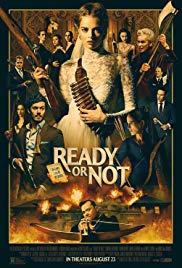
Greetings again from the darkness. Rich people aren’t like you and me (unless you happen to be rich, in which case you fall into the first category). Their houses are different. Their vacations are different. Their family traditions are different. And that’s where this latest from co-directors Matt Bettinelli-Olpin and Tyler Gillet (known collectively with Producer Matt Villella as Radio Silence) really kicks in. Yes, the Le Domas estate is a maze of dark wood, music rooms, and hidden passages, but it’s the wedding day tradition of post nuptial game night that provides the thrills, chills, shocks and laughter for about an hour and a half.
Former foster child Grace (a star-making performance from Samara Weaving, THE BABYSITTER, THREE BILLBOARDS OUTSIDE EBBING MO), is nervous and excited just before her wedding ceremony begins. Her husband to be is Alex Le Domas (Mark O’Brien), the black sheep of an ultra-rich family, and the ceremony is being held within the lush garden and fountain grounds of the Le Domas mansion. Grace loves Alex and seems to have come to grips with his family: alcoholic brother Daniel (Adam Brody) who is always hitting on her, Daniel’s gold-digger wife Charity (Elyse Levesque), father and patriarch Tony (Henry Czerny) who is outspoken in his belief that Grace isn’t good enough for the family, mother and matriarch Becky (Andie MacDowell) who seems confused about her feelings towards Grace, crazy-eyed and wild-haired Aunt Helene (Nicky Guardagni) who seems to hate all living creatures, and coke-head sister Emilie (Melanie Scrofano) who, along with her douche-husband Fitch (Kristian Bruun) couldn’t even get to the ceremony on time.
The above lineup of players is crucial because of what happens next. For wedding day game night, Grace draws the “Hide and Seek” card, rather than the much preferred checkers or Old Maid. There is a nice set up for this tradition which includes a Faustian deal made by Great Grandfather Le Domas. It’s that deal that turns ‘hide and seek’ into ‘hunt and kill’. Oh yeah, Alex forgot to warn Grace about the stakes and it’s a blast to watch her transition as she figures it out. A torn wedding gown and yellow Chucks make up the visual of a bride fighting back against the antique weapons of crossbow, pocket pistol, elephant gun and battle-axe. You got it right – this family tradition is absolutely bonkers … and bloody … and deadly.
As has become the favorite pastime of Hollywood recently, the film torches the ultra-rich. But if you can overlook the political posturings, you’ll find a devilishly fun irreverent farcical zinger that offers some similarities to CLUE and SLEUTH, as well as many other games and movies. It has some of the look of SAW, but with significantly more tongue-in-cheek. In fact, dark comedy thriller might be a proper description, but you’ll likely find yourself laughing more often than jumping in your seat. It’s a wonderfully crafted and paced film that understands exactly what it is … an instant classic Midnight Movie (along with this year’s SATANIC PANIC from director Chelsea Stardust).
Co-writers Guy Busick and Ryan Murphy take full advantage of the ominous setting and the wicked set-up, however, a minor quibble would be that the dialogue could have been a bit wittier. Most of the laughs come courtesy of the moment or the actors, and the banter falls just a little short. The prologue provides a 30 year ago flashback that cautions us for the ride we are about to take, and even offers some insight into the characters as much younger versions of themselves. The opening credit sequence is a beautifully staged and filmed running shot of some classic board games, informing us of the industry closely associated with the Le Domas ‘dominion’.
It must be noted that a studio recently postponed the theatrical release of THE HUNT because of the political backlash to their premise – rich people hunting poor people. While the themes of these two films could be considered similar, only the most extreme hard-liners could view READY OR NOT as anything more than good demented fun. Much of the primary production was filmed on location at the Parkwood Estate in Ontario, and it’s the perfect setting for a family that chooses murder and fortune over all else. Two standouts on the soundtrack include “The Hide and Seek Song” by Headquarters Music and “Love Me Tender” by Stereo Jane (definitely not Elvis). For those who enjoy the twisted comedy approach to in-law jokes and violence, there are plenty of macabre moments that will deliver a smile … till death do us part.
***I’ve elected not to post the trailer here. If this is the type of movie you enjoy, it’s better that you allow the surprises and twists to sneak up on you. If you aren’t a fan of this type of movie, the trailer wouldn’t convince you to see it.
 Greetings again from the darkness. Car chases are prevalent throughout movie history. Some are quite exhilarating and famous: BULLITT (1968) and THE FRENCH CONNECTION (1971). Some are over-the-top: pretty much every driving sequence in the F&F franchise. The directorial debut of writer-director Shawn Simmons revolves around a talented getaway driver, and there are certainly a couple of heart-pumping sequences, but the movie is as much a look at how bad decisions impact one particular character, Edie.


 Posted by David Ferguson
 Movie Reviews from the Dark