“Hollywood” (Netflix limited series, 2020)

May 1, 2020

Netflix limited series premiering May 1, 2020

 Greetings again from the darkness. “I want to go to Dreamland.” One might assume that phrase is related to Hollywood being the place where dreams can come true, but co-creators Ryan Murphy and Ian Brennan take us down a much different path. The two have collaborated on the TV series “Glee”, “Scream Queens”, and “The Politician”, and here they offer up a revisionist history on the post- WWII Golden Age of Hollywood, in the vein of what Quentin Tarantino did in INGLORIOUS BASTERDS and ONCE UPON A TIME … IN HOLLYWOOD. Mr. Murphy and Mr. Brennan seemingly focused on idealistically imagining a film industry where one’s race, ethnicity, or sexual preference made little difference. In doing so, they devote significant time to racism and homophobia.

While the series mixes fact and fiction in such a way that the lines are often blurred, there are two main storylines that provide the backbone of the series: the actual suicide of 24 year old actress Peg Entwistle, which occurred in 1932 when she jumped from atop the Hollywoodland sign; and the mostly fictional crossing paths of a handful of aspiring actors, writers and filmmakers as they navigate the treacherous film industry waters. We see the new generation clashing with the establishment – a tale as old as time.

The 7 episodes cover approximately 7 hours, but it was somewhat challenging to make it through the first three. However, I’m so glad I stuck with it. The series starts off with what seems like a concerted effort to push every boundary possible in regards to sex and racism, with an emphasis on the proliferation of homosexuality within the industry. The characters that are new to town are trying desperately to survive as cling to the dream of their big break.

The series elevates significantly in Episode 4 when the attention turns to filmmaking and acting and running a studio. There is a terrific sequence where we bounce back and forth between two pairs of actors rehearsing for their auditions. We feel the pressure that actors endure during the audition process, and note the fine line … almost an indiscernible line … between success and failure. In addition to the newcomers trying to secure roles, we follow a gay, black first time screenwriter and a half-Filipino first time director. As a bonus, Eleanor Roosevelt is portrayed as preaching the social importance of a studio breaking from the industry norm.

“What if you could re-write the story?” is the tagline, and it applies not only to the screenplay of “Peg” (the movie within the movie), but also to Murphy and Brennan as they show how the industry should be, well except for the illicit sex, marital affairs, and mob interventions. Hypocrisy and double-standards are part of the fabric of the movie industry, but what if that gay, black screenwriter didn’t have his work defined by those labels, or the half-Filipino director wasn’t selected because he could pass as white, or if the talented black actress wasn’t relegated to playing domestic help? Those are the core issues at play here, and each of the characters has hopes of changing things in Hollywood.

As you would imagine, the cast here is deep and crucial to whether the project works or not. There are some acting veterans mixed with some regulars from Murphy’s previous projects. The newcomers in town are actor Jack Castello (David Corenswet), actor Rock Hudson (Jake Picking), actress Camille Washington (Laura Harrier), director Raymond Ainsley (Darren Criss), and screenwriter Archie Coleman (Jeremy Pope). These newcomers intermingle with industry types such as super-agent Harry Wilson (Jim Parsons, who gets the best dialogue in the series), Ace Studios owner Ace Amberg (Rob Reiner), his wife Avis Amberg (Patti Lupone), their daughter wannabe actress Claire (Samara Weaving), Ace’s mistress actress Jeanne Crandall (Mira Sorvino), Ace casting director Ellen Kinkaid (Holland Taylor), studio producer Dick (Joe Mantello), and Eleanor Roosevelt (Harriet Sansom Harris). Dylan McDermott shines as Ernie, the owner of Gold Tip Service Station, where customers come for the special service offered with the code word ‘dreamland’.

There is an underlying theme where most everyone here is acting – pretending to be something they aren’t. It begs the question, how much of yourself would you surrender for fame or money, or simply to avoid discrimination and hardship? There seems to a lust for fame, and a lust for just about everything except dignity. Three real life actors are noted for how they were marginalized as people and/or professionals based on either their race or sexual preference. The stories of Rock Hudson, Anna May Wong (Michelle Krusiec), and Hattie McDaniel offer up real life proof of the injustice that was prevalent during this era.

Movie history buffs will enjoy the name dropping, such as George Cukor’s party, and Noel Coward, Tallulah Bankhead, and Vivian Leigh. There is also fun to be had with industry terminology, but the purpose of the project has higher meaning. The dreams of those who arrive versus the power of those already there is on full display. The internal struggles and fallout that occurs when folks are trying to fit an image rather than stay true to themselves – that message is delivered. Dylan McDermott’s Ernie is meant to represent the reality of broken dreams that happen right down the street from where dreams come true.

Stylistically, the series is beautiful to look at. Even the opening credits have a surreal quality. The set/production design is top notch, from the studio lot to the sound stages to the small apartments decorated to the era … and the cars are spectacular. Black and White images are used sparingly, but effectively to stay true to his period in cinema, and the music/soundtrack is perfectly used and could be a top seller as a standalone. Watching the great Patti Lupone is reward enough, but seeing Dylan McDermott and Jim Parsons deliver their best ever work is really something to behold. The debate of Money versus Art versus Social Responsibility could fill many textbooks, and Murphy and Brennan succeed in getting us to think. For those that can fight through the first three episodes, the payoff is there (OK, the ending is a bit hokey), and as Hattie McDaniel tells us, “the most important thing is being in the room.”

watch the trailer:


SHOCK AND AWE (2018)

July 12, 2018

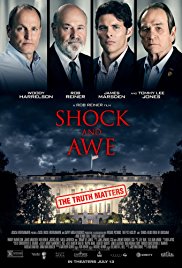
 Greetings again from the darkness. The film begins with a Bill Moyers quote about the importance of a free and open press, has a line about ‘reporting stories for families who send their kids to war’, and is directed by liberal activist Rob Reiner … who labels the film as a true story. So it’s no surprise that the approach is to paint the folks at Knight Ridder News Service as the sole saints on an island of integrity … even as it is blessed with perfect vision in hindsight.

Written by Joey Hartstone, who also collaborated with Mr. Reiner on LBJ (2016), which also starred Woody Harrelson, the film continues the recent cinematic trend of placing the media on a pedestal of righteousness and beacon of truth as it serves the role as a check on political process and power. In this case, the ‘spotlight’ is on the Bush administration and the questionable decisions that led to the war in Iraq. The film begins with a 2006 Veterans’ Affairs Senatorial committee hearing where a wheelchair bound soldier ends his statement by asking the committee members a fair and legitimate question, “What the hell went wrong?”

We then flashback to September 11, 2001 and the aftermath of the bombings. Patriotism, pride, activism, volunteerism, and charitable contributions all increased, as did the Bush administration’s focus on going to war. Was it a war to get those responsible for the bombings or was there another agenda? Knight Ridder reporters Warren Strobel (James Marsden) and Jonathan Landay (Woody Harrelson) are dedicated to finding the truth, and are led down the path of discovery by D.C. Bureau Chief John Walcott (played by director Rob Reiner).

This is presented as a time more extreme than the mainstream media not often questioning the administration, but the film actually labels The New York Times as a shill or puppet of the Bush/Cheney/Rumsfeld/Powell/Rice regime.  Only these two courageous Knight Ridder reporters (Strobel, Landay) were questioning the administration’s efforts to turn the focus from Afghanistan and Al-Qaeda leader Osama bin Laden to Iraq and Saddam Hussein. My how times have changed since the most recent election. Though it could be argued that rather than questioning the current administration’s policies, it might better be described as written and verbal attacks.

The preaching here is relentless, especially by Reiner’s Walcott, who is posed as something of a truth guru. Missteps abound in the presentation, and the film is crushed under the weight of the obvious and necessary comparison to ALL THE PRESIDENTS MEN (an influential era noted by the characters). The banter between Strobel and Landry often seems forced like what we see in buddy flicks, and the needless and distracting romantic interlude plays like a meager attempt by director Reiner to humanize the message with a grinning Jessica Biel. The same could be said for Tommy Lee Jones’ curmudgeonly portrayal of respected military reporter Joe Galloway.

We really want to commend the filmmakers for bringing light to inexcusable government actions, but the manner in which it does this is so aggravating that kudos can’t be justified. The incessant patronizing wears thin quickly. The story deserves to be told without the sermonizing. Somehow we and the reporters are supposed to be stunned that political corruption, misleading statements from government officials and power struggles even exist. With this discovery, the reporters seem as ‘shocked’ as Captain Renault (Claude Rains) in CASABLANCA when he is told gambling is occurring (even as he pockets his winnings). With a stated emphasis on truth, we should never forget that politicians and the media are both selling something … and it’s still caveat emptor.

watch the trailer:


LBJ (2017)

November 2, 2017

 Greetings again from the darkness. More than 50 years after his death, President John Kennedy casts an ever-present shadow over Lyndon Baines Johnson’s career as a stellar politician and a President with significant accomplishments. Part of the reason is presentation – JFK was a story book leader straight from the fashion magazines, while LBJ was a vulgar-at-times comic book adversary who looked and talked funny. Each has been portrayed on film numerous times and from various perspectives.

Woody Harrelson and his facial prosthetics play LBJ, and Mr. Harrelson seems to be enjoying the swagger and emotional range of the titular man. What this film does that’s a bit different from others is embrace the comedic elements – enhanced by both the performance and the script from Joey Hartstone. It seems odd (a somewhat awkward) to have so many laughs in a movie where the infamous 1963 Presidential motorcade, and subsequent assassination, form the backdrop.

Director Rob Reiner presents LBJ in all his crude and gruff glory, but also shows the ultimate politician – a man who was constantly negotiating. Intimidation was always part of the LBJ motif, and the film effectively displays the tactics used by John and Bobby Kennedy (Jeffrey Donovan, Michael Stahl-David) to take the wind out of LBJ’s sails after the election.

There are reenactments throughout the film that place us back in the middle of iconic images seared into our memories … the motorcade after the shots, the scene at Parkland, and the swearing in aboard Air Force One with Jackie still wearing her blood-stained Chanel suit. This was an incredible time in our history, as the nation was emotionally shattered. It’s for this reason that much of the film seems disjointed or misguided. Too much (or maybe not enough) attention is on LBJ’s strained relationship with Georgia Senator Richard Russell (Richard Jenkins), one of the most racist men we’ve seen on screen. Their discussion of race relations while being served dinner by the black woman is beyond uncomfortable – yet still somehow too stagey.

Most of the film is spent on LBJ’s time as Senator and Vice President, with only the final act being about his famous networking upon ascending to the Presidency … after which the entire focus is on the Civil Rights Act. The flow of the film seems a bit off, though most will enjoy watching Harrelson’s performance – especially when paired with Jennifer Jason Leigh’s Lady Bird. Together, the two almost rescue the script.

watch the trailer:


THE LAST LAUGH (2017, doc)

March 5, 2017

last-laugh Greetings again from the darkness. The best comedy often touches a nerve. Jokes can make us feel uncomfortable and even a bit embarrassed for laughing. Although the best comedians are traditionally those who attack the politically correct world we live in, there are certain topics that remain taboo even to the bravest comedians: child molesting, rape, AIDS, 9/11, and the Holocaust. Director Ferne Pearlstein examines the issue of taboo comedy through numerous interviews with some well known and successful comedians, authors, and even Holocaust survivors.

Much of the focus here is on the Holocaust, and some of the familiar faces providing insight include Mel Brooks, Sarah Silverman, Gilbert Gottfried, and Rob and Carl Reiner. We learn the most important rule is … never tell a crappy joke about a dark subject – it better be really funny! We also learn that while the Holocaust is mostly off-limits, the Nazi’s are fair game. Bugs Bunny, Charlie Chaplin, The Three Stooges, and The Marx Brothers have all mined the Nazi world for the sake of comedy and satire, though maybe none have done so as frequently or successfully as Mel Brooks (“Springtime for Hitler”)

One of the most interesting recurring threads of the film involves Auschwitz survivor Renee Firehouse. North of 90 years old, this remarkable lady is extremely sharp and understands the importance of laughter … while also never being shy about what she thinks is NOT funny. Ms. Firestone even meets up with the effervescent Robert Clary, a fellow Holocaust survivor, and known to many as LeBeau on the TV show “Hogan’s Heroes”.

A trip to the Holocaust Survivor Convention on the Las Vegas strip offers up more thoughts on the role comedy played in keeping these folks alive. We see rare footage of carefully staged Cabaret acts from within the concentration camps … who even knew this went on? The recently re-discovered footage of Jerry Lewis’ “The Day the Clown Cried” is also shown, and the commentary from Harry Shearer makes it clear that the rest should never find an audience.

Authors Etgar Keret, Shalom Auslander and Abraham Foxman each provide their thoughts on forbidden comedic topics, and clips are shown from “Curb Your Enthusiasm” and Brooks’ The Producers, as well as scandalous moments from Louis CK, Joan Rivers, Chris Rock, and the most censured comic of all, Lenny Bruce. Laughter may be the best medicine, but sometimes it’s interesting to take a step back and determine exactly what is off-limits. When has a joke gone too far? It appears from Ms. Pearlstein’s project that the line in the sand is determined by personal taste, preference and judgment.

watch the trailer:


AND SO IT GOES (2014)

July 26, 2014

and so it goes Greetings again from the darkness. It’s very painful to witness the aftermath of an artist who has surrendered all creative efforts. Rob Reiner seems to be the director’s version of actor Nicolas Cage … just keep churning out projects that require no effort, yet provide a paycheck. Pride be damned!

This movie is clearly aimed at the over 55 group, and falls into the genre I fondly call “gray cinema”. Although a more fitting description of this movie’s specific genre would be “insipid cinema”. It’s one of those movies that assumes anyone watching it has no interest in thinking, and only goes to the theatre for air conditioning and popcorn.  It’s not condescending, as that would imply it thought itself to be sharper/wittier than the audience.  Instead, it treats the audience as if we have reverted to the level of adolescence for comedy, romance and dialogue.

Michael Douglas stars as Oren Little, a selfish, racist, bitter, lonely Realtor faced with the insurmountable life decision of leaving Connecticut for his lake house in Vermont. The only thing left is selling off his $8 million family house … that is, until his estranged, former drug-addicted son shows up on his way to jail and drops off Oren’s 10 year old granddaughter (Sterling Jerins). Fortunately for the little girl, Oren’s neighbor is the kindly Leah (Diane Keaton) who embraces the girl despite Oren’s aloofness.

Enough about the story … though it is written by Mark Andrus who also wrote the decent As Good As it Gets. If you were to subject yourself to this movie, you would see: Michael Douglas and Diane Keaton alternating between scripted, lifeless flirtations and scripted, lifeless bickering; a pathetic attempt at slapstick by having Oren deliver another neighbor’s baby on his sofa; the running gag of Ms. Keaton’s character breaking into tears while singing during her nightclub act; and a paintball gun used to ward off a dog doing business on the manicured lawn. If you don’t overdose on lameness with those scenes, you should be warned that somehow a little boy’s penis is the subject for multiple one-liners. Somehow this even overrides Oren’s racism for levels of inappropriateness (without the laughs).

Mr. Reiner has directed 3 classic films: This is Spinal Tap, The Princess Bride, and When Harry Met Sally. He also has some other entertaining films to his name including A Few Good Men and Misery. All of that just makes his last decade the more disappointing ( a very kind word for it). I will never be convinced that “gray cinema” cannot be entertaining and thought-provoking. Douglas and Keaton shouldn’t have to limit themselves to supporting roles only in order to part of a quality film. However, if this is all they get offered, I recommend working personally with writers to develop projects that don’t embarrass themselves or the audience.

Other than the obvious questions about how this script received the “go-ahead”, two questions have stuck with me since seeing this one:  Why did Frankie Valli appear in this and not Jersey Boys?  Why doesn’t Frances Sternhagen work more?

SEE THIS MOVIE IF: you clearly understand that there are no refunds for movie ticket purchases

SKIP THIS MOVIE IF: you are not at the age where dog pooping jokes crack you up.

* The trailer is not being posted here just in case it might trick you into going to the movie.  If you still go, I absolve myself of any blame.


THE WOLF OF WALL STREET (2013)

December 28, 2013

wolf Greetings again from the darkness. A brilliant and expertly made film that is excruciatingly painful to watch, yet impossible to look away. That would be my one line review. Of course, that line could be followed by a 10 page essay, to which I won’t subject you. How to do justice to this extraordinary three hours of excess and debauchery? How to give due credit the craftsmanship of director Martin Scorcese? How to acknowledge the pure physicality and kinetic energy of Leonardo DiCaprio’s performance? How to heap praise on a project so lacking in morality and decency? There are no easy answers to these four questions, but there is plenty to discuss.

Let’s be clear. This is a vulgar film telling the disgusting story of a crude and egotistical scam artist who defrauded many innocent people. Jordan Belfort’s autobiography serves as the source material for the screenplay from Terrence Winter (“The Sopranos”, “Boardwalk Empire“). Leonardo DiCaprio (in his fifth collaboration with Martin Scorcese) portrays Belfort as the talented stock broker who soaks up lessons from both his mentor and the real world stock market crash of 1987. That Black Monday led him right into the world of penny stocks and huge commissions. Those commissions and his stunning sales skills take him right into a world that rivals that of Caligula or Fellini’s Satyricon. This is certainly DiCaprio’s most free and limitless performance to date … it’s also his most comedic.

wolf5 Sex. Drugs. Rock and Roll. Sorry, that’s not enough for Belfort. He is also driven by money, greed, power and the need to take advantage of the weak. I lost count, but surely Belfort displays more than seven deadly sins. Everything is extreme. Nothing in moderation. Belfort is both smart and stupid. He is the worst of human nature, and when combined with his charisma, becomes very dangerous. Watching him give his invigorating and over-the-top pep talks to the team recalls the cult evangelists we have seen over the years. His religion is money and winning … never accepting “no”. His followers eat it up.

While most of the movie is pedal to the metal, there are two exceptional scenes that really stood out. When a young, eager, new to Wall Street Belfort has lunch with his mentor (played by Matthew McConaughey), we sense him soaking up the lessons … we see the wheels turning to a new way of thinking. McConaughey is in top form here. The other standout scene takes place aboard Belfort’s yacht as he interacts with the FBI agent played by Kyle Chandler. This agent is the closest thing to a moral barometer the movie allows and their dance of dialogue and acting is pure cinematic magic.

wolf6 Jonah Hill as Belfort’s business partner is his physical opposite, and possibly even less morally-centered than Belfort. He is also extremely funny in a demented way. Three very talented film directors have supporting roles. Rob Reiner (in a rare acting gig) plays Belfort’s bombastic dad and firm accountant. Jon Favreau is the high priced attorney fighting off the SEC and FBI. Spike Jonze plays the boiler room manager who first schools Belfort on penny stocks, and sets the wheels in motion. There is also a very sexy, funny performance from Margot Robbie as Belfort’s second wife.

My words don’t do justice to the manic existence and frenzied scenes of sex, profanity and drug use. The black comedy mixed in prevents this from being the bleak portrayal that it could have been, but don’t underestimate the depths to which the characters will stoop to get what they want. This one makes a similarly themed American Hustle look like a Disney flick. Consider yourself warned … and don’t think you can just turn away from the screen.

**NOTE: the soundtrack is quite diverse and complements the pace of the film.  The musical director is Robbie Robertson, who was part of The Band when Martin Scorcese directed The Last Waltz

watch the trailer:

https://www.youtube.com/watch?v=iszwuX1AK6A