*** This is an entry into my “Revisited” series where I re-watch a classic movie and then write about it – not with a traditional review, but rather a general discussion of the movie, those involved with it, and its impact or influence.
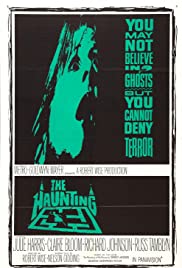 Greetings again from the darkness. Long ago, filmmakers figured out how to have fun with ‘things that go bump in the night’. Of course some do it better than others, and how scary or creepy you find a movie will depend on your personal phobias and preferences. For a combination of haunted house, ghost story, and psychological thriller, few are better than this 1963 gem from director Robert Wise. I’ve strategically planned this after the recent success of two limited series from Netflix: “The Haunting of Hill House” (2018) and “The Haunting of Bly Manor” (2020). Although the two series were marketed as being related, in fact only the 2018 series was based on the 1959 novel from Shirley Jackson … the same as Wise’s 1963 film.
The story begins with Dr. John Markway (Richard Johnson) being contracted to conduct a scientific study of psychic phenomena and paranormal activity in the now vacant Hill House mansion that has a 90 year history of strange and tragic endings for its past inhabitants. He will be joined by two hand-picked volunteers, Eleanor Lance (Julie Harris) and Theodora (Claire Bloom), as well as Luke Sanderson (Russ Tamblyn), the young man who stands to inherit Hill House. Eleanor has a history of paranormal connection (as a child) and Theo is a clairvoyant with ESP tendencies. Luke is mostly an obnoxious rich kid hoping to cash in on his inheritance.
We get an early introduction to Eleanor’s home life, and in those days she would likely have been labeled a spinster. She has spent many years taking care of her recently deceased mother, and is now out of step with reality … and burdened with guilt from her sister, who not only treats her like a child, but also blames Eleanor for their mother’s death. Being selected for the Hill House research is a dream come true for her – a chance to do something for herself. Her arrival at the gates of the manor provide a glimpse of just how important this is to her. She refuses to heed the caretaker’s (Valentine Dyall) warning, and demands to be allowed in.
Our first view of Hill House is seen through Eleanor’s eyes and we hear her inner voice acknowledge the feeling of having the house “watch her” as she drives up. The exterior shots of the neo-Gothic mansion are truly awe-inspiring and intimidating. She is greeted at the door by the other caretaker (Rosalie Crutchley), who takes socially awkward to a new level with her zombie-like warnings of the night and the dark. Soon the others arrive, and the initial conversations allow us to understand the differing personalities and get our first look at the interior of Hill House.
The initial set-up is for a scientific, first hand analysis of supernatural occurrences inside the house … all led, of course, by Dr. Markham. Sexual tension plays a role here as Eleanor is attracted to Dr. Markham, who conveniently has not mentioned that he’s married. Simultaneously, Theodora teases and flirts with Eleanor, while only admitting to not being married, yet still cohabiting as an “us”. What is abundantly clear from the beginning is that Hill House itself is a featured character. Director Wise and cinematographer Davis Boulton utilize creative camera angles and specialized lighting, and capture the essence of the home through terrific set design. In a rare case for horror movies, very few special effects are present outside of sounds; although the spiral staircase in the library and the heaving wooden doors are quite memorable.
Director Robert Wise was a 4 time Oscar winner (THE SOUND OF MUSIC, 1965, WEST SIDE STORY, 1961) and was also Orson Welles’ film editor on CITIZEN KANE (1941). Wise directed such diverse films as STAR TREK: THE MOTION PICTURE (1979); the sci-fi classic THE DAY THE EARTH STOOD STILL (1951); SOMEBODY UP THERE LIKES ME (1956), which turned Paul Newman into a star; RUN SILENT RUN DEEP (1959) a submarine movie starring Clark Gable and Burt Lancaster; THE SAND PEBBLES (1966), which was Steve McQueen’s only Oscar nomination; and another horror gem AUDREY ROSE (1977). Well-liked by actors and respected in the industry, Mr. Wise died in 2005 at age 91.
Screenwriter Nelson Gidding and director Wise both previously received their first Oscar nominations for I WANT TO LIVE (1958), and were frequent collaborators, including: ODDS AGAINST TOMORROW (1959), THE ANDROMEDA STRAIN (1971, adapted from Michael Crichton’s novel), and THE HINDENBURG (1975). Gidding adapted Shirley Jackson’s tremendous novel, “The Haunting of Hill House”, with some variations that turned it into more of a psychological cinematic experience. Mr. Gidding passed away in 2004 at age 84.
 Julie Harris received her Oscar nomination for EAST OF EDEN (1955), where many fell in love with her as Abra, the girl torn between two brothers, one of which was played by Oscar nominee James Dean in his star-making turn. Ms. Harris’ career spanned seven decades (1948-2009), and, as a 5-time Tony winner, she remains one of the most honored and respected stage performers of all-time. Much of her later career was on stage and television, including a long run on “Knot’s Landing”. She passed away in 2013 at age 87.
Claire Bloom, who plays Theodora, is still alive today and turns 90 the day after Valentine’s Day 2021. He acting career has spanned eight decades (1948-2019), and one more gig will get her to a remarkable nine! Never one to shy away from controversy, Ms. Bloom shines here as the lesbian with ESP, and she is also a renowned stage actress recognized for her Shakespearian work. She had marriages to Oscar winning actor Rod Steiger and Pulitzer Prize winning author Phillip Roth, and many will recall her role as Queen Mary in THE KING’S SPEECH (2010).
The two male leads in the film were played by Richard Johnson and Russ Tamblyn. Mr. Johnson is known as the actor who turned down the role of James Bond in 1962, setting the stage for Sean Connery’s historic run. Johnson was briefly married to Kim Novak (VERTIGO, 1958), and his career lasted seven decades (1950-2015), and he remained working until his death in 2015 at age 87. Mr. Tamblyn was coming off his role as Jets’ leader Riff in Robert Wise’s WEST SIDE STORY (1961), and he had earlier appeared in SEVEN BRIDES FOR SEVEN BROTHERS (1954). He was Oscar nominated for his role in PEYTON PLACE (1957), and during his 8 decade career (1948-2018), he appeared in 6 movies that were Oscar nominated for Best Picture. He is 86 years old and recently appeared in the 2018 limited series “The Haunting of Hill House”. He is the father of actor Amber Tamblyn.
For fans of James Bond movies, you’ll be pleased to see Lois Maxwell appear in this film as Dr. Markway’s wife. Of course, Ms. Maxwell is known to fans as Miss Moneypenny in 14 James Bond movies, second only to Desmond Llewelyn’s 17 appearances as Q. She passed away in 2007 at age 80.
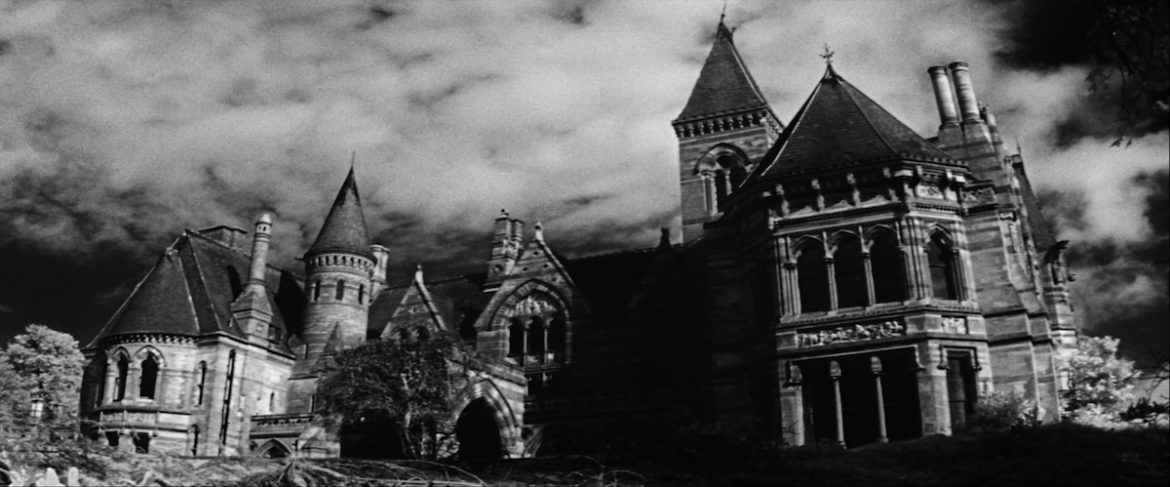 In the movie, Hill House is described as a 90 year old New England house with a history of psychic phenomena. However, the exterior shots are actually of a neo-Gothic mansion (hotel) in Ettington Park near Stratford-Upon-Avon. It’s an active hotel with a history tracks back to the 11th century. The interior shots were conducted on a UK studio set. In 1999 director Jan De Bont (SPEED, 1994) delivered a second adaptation (not a remake) of Jackson’s novel, starring Liam Neeson and Catherine Zeta Jones. A different house was used for Hill House.
Wise’s film is now nearly 60 years old, and it holds up today thanks to the house, the performances, the direction, and the decision to create a psychological thriller and character study. The power of suggestion is key, yet it never loses the core of being a haunted house story … a house that seems to want Eleanor (note the parallels to the origin story of Abigail told in one of the early scenes). There have been debates about whether that initial set-up takes too long, or if more attention should have been paid to why the house is drawn to Eleanor (and vice versa), but overall, it holds up very well as classic horror. On a separate note, no one could accuse the film of being cursed, as most everyone associated, enjoyed a long a fruitful career and life … even the house!


 Posted by David Ferguson

 Movie Reviews from the Dark