AMERICAN: AN ODYSSEY TO 1947 (2023, doc)

September 8, 2023

Greetings again from the darkness. Let’s begin with this: Danny Wu’s documentary ties legendary filmmaker Orson Welles into one of the most tumultuous periods of history. This is done not so much in a FORREST GUMP or ZELIG style, but more like one of those push pin boards Claire Danes used in “Homeland” by looping red thread around all the key characters and events. Wu opens with Webster’s 1913 definition of an “American” – originally applied to the aboriginal inhabitants, now applied to descendants of Europeans born in America, and especially to the citizens of the United States.

For cinephiles, much of Welles’ personal and professional story is well-known. Born in 1915, his mother died when he was ten. His father shipped him off to a liberal boarding school where he was free to pursue his passion in the theater, and all things creative. Fellow actor Simon Callow spends a good amount of time on camera recounting Welles’ passion for the theater, and especially acting, and how playwright Thornton Wilder and another legend, John Houseman, were instrumental in assisting Welles with early career breaks.

It’s at this stage where Wu drops in some ‘strange bedfellow’ politics, showing media mogul William Randolph Hearst playing a key role in getting Franklin Delano Roosevelt elected President. As the film progresses, we learn how this relationship shifted 180 degrees, and also how Welles later bore the brunt of Hearst’s powerful reach. FDR pushes through the Federal Theater Project, which keeps Welles working, and it’s in 1938 when Welles’ infamous broadcast of H.G. Well’s “War of the Worlds” puts folks on edge, and it’s the year Howard Kakita is born. We only get bits and pieces of Kakita’s story, but he and his family are linked to the United States, Hiroshima, and the internment camps established by FDR during the war.

By this stage, we have a grasp on what Wu is doing with his film – a blend of historical and biographical material. As a 25-year-old wunderkind, Welles secured an unprecedented contract with RKO, giving him total control of his work. The rough draft of his initial project is co-written with Herman Mankiewicz and John Houseman, and is titled “American”. This work is fine-tuned and becomes the 1941 classic, CITIZEN KANE. It’s at this point that Welles experiences the power of William Randolph Hearst, who crushes the distribution and box office of the film. Of course, even more than 80 years later, it’s still considered a cinematic masterpiece.

What many may not know is how Welles used the theater for many projects promoting anti-racism, at a time when Jim Crow laws were booming. Wu uses the example of Isaac Woodard to bring home the often-disgusting nature of this era. Sgt Woodard was headed home after serving in the war, when he was severely beaten to the point of having his eyes gouged out by a small-town sheriff and deputy. The tragic story is told by Woodard’s nephew and author Laura Williams. The blinding of Isaac Woodard is described as igniting the Civil Rights Movement.

Mr. Kakita offers more details of his family revisiting Hiroshima after the bomb, and we learn how J Edgar Hoover started a file on Welles during the era of McCarthyism and blacklisting suspected communists. After RKO re-edited (butchered) Welles’ film, THE MAGNIFICENT AMBERSONS, Welles felt rejected at most every turn and decided to move to Italy and live a quiet life focusing on the art of moviemaking. Described as transitioning from “Boy Wonder” to the “youngest has-been”, Welles did visit the U.S. periodically, and here his life has provided quite the perspective for Danny Wu’s innovative storytelling.

The film has a limited theatrical release on Sept 8, 2023 and digital release on Sept 12.

WATCH THE TRAILER


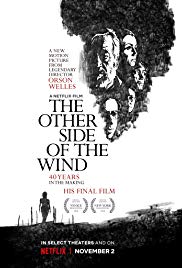
THE OTHER SIDE OF THE WIND (2018)

November 1, 2018

 Greetings again from the darkness. Film nerds unite! Most of us who (proudly) wear that label have known that filmmaker Orson Welles left a few unfinished projects when he died in 1985. The most famous – or infamous – of these was THE OTHER SIDE OF THE WIND. It was to be the comeback film for Mr. Welles, who had slipped from the artistic throne with his run of TV projects, shorts, and unsuccessful features during the 1960’s. Known as a perfectionist, and as someone more dedicated to the filmmaking part more than the “finishing” part, Welles filmed scenes for the movie from 1970-1976, and then picked it back up in the early 1980’s to begin the editing process … a process he never finished.

Best known for his all-time classics CITIZEN KANE (1941) and TOUCH OF EVIL (1958), Welles left mountains of copious production notes, and almost 100 hours of footage in multiple formats, and in both color and black and white stock, on this project that, even today, might best be described as experimental. Over the past 30 years there have been numerous attempts to raise the money required to finish the film, but all fell short until this one spearheaded by Peter Bogdanovich and Beatrice Welles (Orson’s daughter).

In what we can only interpret as semi-autobiographical, what we see on screen is the making of a documentary on a legendary director’s comeback film (his poke at artsy filmmakers). Clips of the unfinished film are shown throughout, while an industry party plays out, and numerous documentary filmmakers capture the scene from various angles with their always-present cameras. Got that?  Don’t worry, it takes at least a few minutes as a viewer to get the rhythm and layers of what’s unfolding before our eyes.

John Huston (himself an industry legend with 2 Oscars and 15 nominations) plays director Jake Hannaford, who is walking the fine line between Hollywood power and has-been. It’s his 70th birthday party, and Hannaford is compared to Hemingway (a description that better fit Huston than Welles), silently endures insinuations of his closeted homosexuality, desperately seeks funding to finish his film, and skulks around his own party winding through the hangers-on and those waiting for the final curtain.

Hannaford’s artsy film within a film, at least the clips we see, feature an inordinate amount of nudity from the leading lady (played by Welles 4th wife and the film’s co-writer Oja Kodar), and some ultra-coolness from the lead actor John Dale (played by Robert Random). Part of Hannaford’s desperation (both professional and persona) stems from a James Dean-type Dale walking off the set mid-picture.

Guests at the party include Peter Bogdanovich as director Brooks Otterlake, a young director once mentored by Hannaford. It’s an example of the student becoming the teacher. Susan Strasberg (daughter of famed acting coach Lee Strasberg) plays film critic Juliet Riche, a thinly-veiled portrait of Welles nemesis Pauline Kael. Other familiar faces in the cast include: Lilli Palmer, Mercedes McCambridge (Oscar winner), Edmond O’Brien (Oscar winner), Cameron Mitchell, Paul Stewart (from CITIZEN KANE), Tonio Selwart, Geoffrey Land, Norman Foster, Dennis Hopper (2 Oscar noms), Claude Chabrol, Stafford Repp (Sgt O’Hara from “Batman” series), plus Cameron Crowe (Oscar winner), William Katt, Frank Marshall (5 Oscar noms), Rich Little, Leslie Moonves (recently fired in disgrace CBS President), and Paul Mazursky (5 Oscar noms). It’s fascinating to see so many we recognize from more than 40 years ago. Of course, it’s Huston, with his face that’s made for black and white film, who is the dominating figure (his scenes were filmed prior to his work on CHINATOWN).

It’s easily viewed as a satire on the film industry, and it’s quite a fun, messy-by-design, now retro look at a fragile industry – and the even more fragile people who make movies. Welles’ love/hate relationship with the industry takes on an art form. He shows what’s good and what’s deplorable. Is it an experimental movie commenting on the post-studio world of independent filmmaking, or is it an iconic filmmaker, glory days behind him, in the midst of self-reflection. Perhaps it’s both. In addition to Welles’ early editing efforts, Oscar winning editor Bob Murawski (THE HURT LOCKER) was brought in to finish up what can now be described as a master class in film editing. It’s a wild ride for us film nerds. Are you ready to join us?

watch the trailer:


TMI (2-18-12)

February 18, 2012

TMI (Today’s Movie Info)

February: Director’s Month

ORSON WELLES (1915-1985) directed what many consider to be the greatest film ever, Citizen Kane (1941). Amazingly, it was his first feature film and he was only 26 years old. He won the Oscar for Best Screenplay, but the Best Picture went to How Green Was My Valley … and not Citizen Kane, The Maltese Falcon or Suspicion.  Welles is one of the few writer/directors whose work has become more appreciated over time … many of his films were box office failures. He was also a prolific actor and radio personality, and is still remembered for his Halloween prank gone bad … the radio rendition of “The War of the Worlds”, in which many listening actually thought aliens had invaded earth.  Welles was also a talented musician, painter and magician. His other must-see film is Touch of Evil (1958). He turned down the offer to be the voice of Darth Vader in Star Wars (James Earl Jones accepted).  Commenting on his early career success, he said “I started at the top and worked down.”  In the late 70’s and early 80’s, Welles became the commercial spokesperson for Paul Masson wine … his “we shall sell no wine before it’s time” became the stuff of advertising legend.  Watch one of the ads:


TMI (1-19-12)

January 19, 2012

TMI (Today’s Movie Info)

STAGECOACH (1939) directed by John Ford (his first with sound), is the movie that turned John Wayne into a star.
 
The film was nominated for 7 Academy Awards, including Best Picture … winning for Best Supporting Actor (Thomas Mitchell) and Best Score
 
The box office success of Stagecoach is credited for pulling the western genre out of the B-movie rut and back into the mainstream
 
Orson Welles watched this film in private at least 40 times in preparation for filming Citizen Kane.  He claimed the film taught him how to direct.
 
First movie made in Monument Valley (and one of seven Ford classics that he filmed in the area)
 
John Wayne eventually appeared in 24 John Ford movies (plus 3 TV episodes), and almost 250 movies in total.  He won an Oscar for True Grit (1969).  He died in 1979.
 
John Ford directed approximately 140 films, including documentaries and shorts.  He won 6 Academy Awards and is often called “The Great American Director”.  He died in 1973