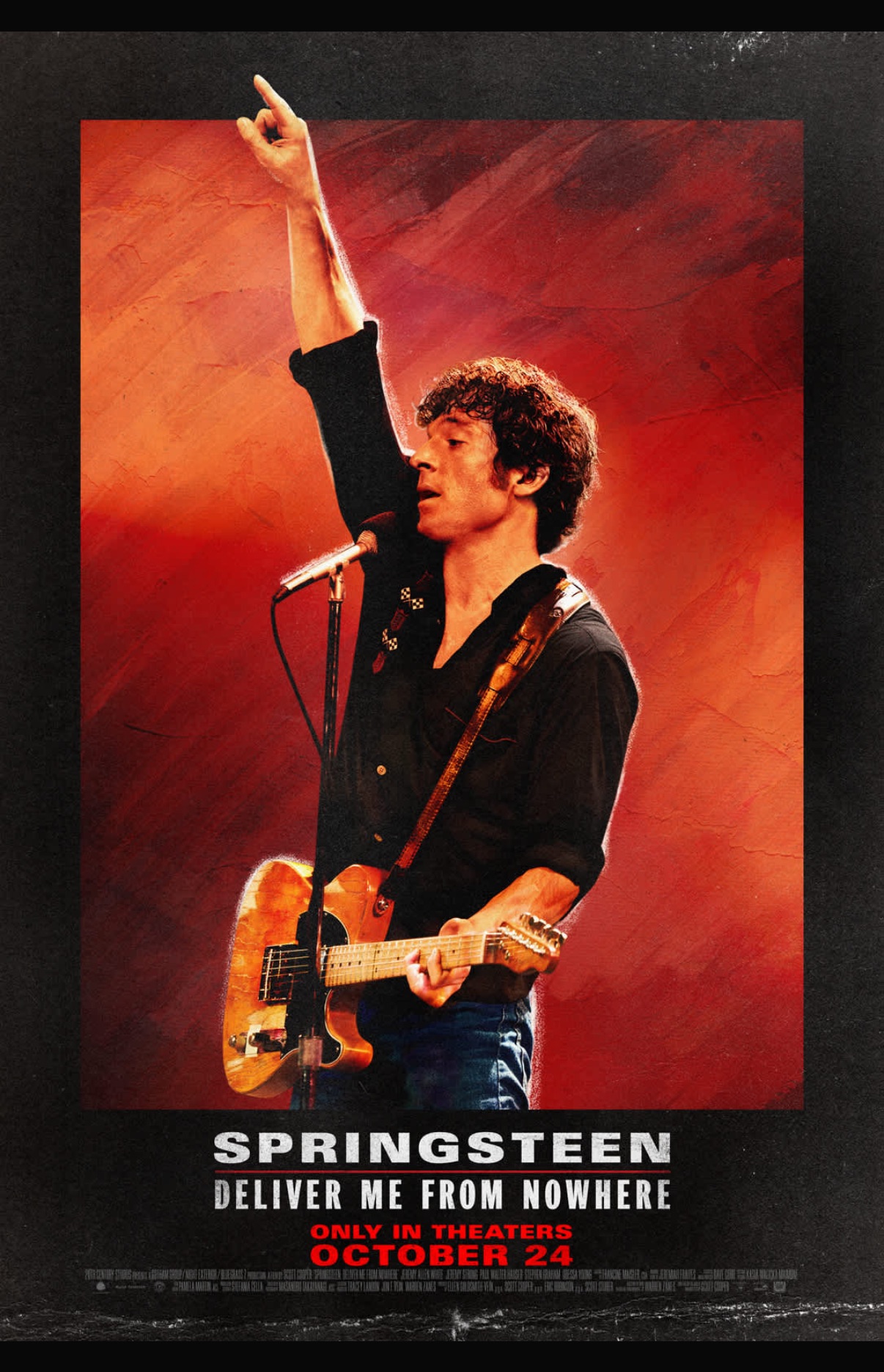
SPRINGSTEEN: DELIVER ME FROM NOWHERE (2025)

October 23, 2025

Greetings again from the darkness (on the edge of town). My connection to Bruce Springsteen’s music dates back more than 50 years and includes hitchhiking (from San Antonio) to a gig at the Armadillo World Headquarters in Austin. As much as I loved the early tunes from his first two albums, it was the 1975 release of the “Born to Run” album that spoke to me on a mystical level. His storytelling and anthems on that instant classic, as well as the next two albums, “Darkness on the Edge of Town” and “The River”, had a way of drawing us in for a pure escape. By 1981, Springsteen’s albums were huge and his live performances were legendary and exhilarating. It’s the time period just after that serves as the basis for this film from writer-director Scott Cooper, based on the 2023 book, “Deliver Me From Nowhere: The Making of Bruce Springsteen’s Nebraska” by Warren Zanes.

A black & white opening takes us to Bruce’s childhood (he’s played by newcomer Matthew Anthony Pellicano Jr) where we get a feel for his rocky home life with mom Adele (Gaby Hoffman, C’MON C’MON, 2021) and on-the-verge of violence dad “Dutch” (a terrific Stephen Graham, “Adolescence”). Cooper then cuts to the closing night of the 1981 tour in Cincinnati, where Jeremy Allen White (“Shameless”) as Bruce belts out “Born to Run” with the E Street Band (decent lookalikes). At this point, I found myself a bit deflated. It all felt too cliché and the song just wasn’t up to the standard I’d hoped. Fortunately, things were about to get much more interesting with a deep dive into the birth of “Nebraska”.

Bruce was 31 years old and on the verge of superstardom after his first true hit, “Hungry Heart” (which fortunately is mentioned but never heard). The record company is itching for the next round of hits, while Bruce is clearly dealing with some mixed emotions. His rented house in Colts Neck, New Jersey affords him the solitude he needs to obsess over Terrence Malick’s BADLANDS (1973) with Martin Sheen as a psychotic killer based on real life killer Charles Starkweather (the last name plays an interesting part of Springsteen trivia). Bruce fans know what happens next – in the sanctity of the home’s bedroom, and with the help of guitar tech Mike Batlan (Paul Walter Hauser, RICHARD JEWELL, 2019), he records the songs for the “Nebraska” album using low-tech equipment. His insistence on releasing the album in raw form sends the record company into a tizzy. Bruce also works in a few jam sessions at the infamous club, The Stone Pony, where we see him cut through Little Richard’s “Lucille” and John Lee Hooker’s “Boom Boom”.

It’s here where the deep friendship between Bruce and his agent, Jon Landau (a wonderful Jeremy Strong, THE APPRENTICE, 2004) becomes the heart of the film. Nope, it’s not the music that makes this story work … it’s the support of Landau for his friend, whom he also recognizes as a genius. During this dark emotional time, Bruce somehow begins a romance with Faye (Odessa Young, MOTHERING SUNDAY, 2021), a local single mom – who is also an amalgam of women in Bruce’s life at the time. This contributes to the complexities of Bruce’s mental state during this time, and helps us (and him) understand why this particular music is so necessary for him.

“I have seen rock & roll’s future and his name is Bruce Springsteen”. That’s a quote from a 1974 concert review by music writer Jon Landau. Yes, the same man who became Springsteen’s long-time manager and close friend. But this movie isn’t about Bruce Springsteen the rock icon. It’s a meditative and exploratory peek at a soulful artist during a dark and confusing time. He is sliced open to reveal someone still dealing with a less-than-joyous childhood while balancing the pressure of becoming an international sensation. This was the calm before the storm of “Born in the U.S.A.” … only it wasn’t anything near calm for Bruce. He was in pain – a true tortured soul working through the emotions of finding himself. It’s quite fascinating to watch, though most assuredly, a departure from the mainstream music biopics we have seen over the past few years.

Scott Cooper’s film, CRAZY HEART (2009) won Jeff Bridges an Oscar, and proved the director had a feel for angst in musicians. Warren Zanes wrote the book this film is adapted from, and as guitarist for the Del Fuegos and Tom Petty biographer, Zanes absolutely understands this life. It’s because of these two gentlemen and superb performance in Acts 2 and 3 by Jeremy Allen White and Jeremy Strong that this film never wallows in melodrama, despite the lead character suffering with depression and anxiety.  While we hear cuts from the Nebraska album, Springsteen fans should know this is not a concert film. The music is utilized precisely and purposefully, but the music does not drive this film. The exception might be White’s rendition of “Born in the U.S.A.” while in the studio. That’s the one time audience members might be tempted to yell: “BRRUUUUUCE!

Opens wide on October 24, 2025

WATCH THE TRAILER


MOTHERING SUNDAY (2022)

April 8, 2022

Greetings again from the darkness. Every writer has a story about what inspired them to put words on the page. What we have here is Eva Husson directing a script from Alice Birch (LADY MACBETH, 2016) who has adapted the 2016 novella from British author Graham Swift. We follow Jane Fairchild through three stages, as her work as a maidservant allows her to become “an occupational observer of life.”
It’s Mothers’ Day 1924 and Jane (Odessa Young, SHIRLEY, 2020) is anticipating her latest romantic tryst with Paul Sheringham (Josh O’Connor, EMMA., 2020). Both know this is their final time together, and they take full advantage. Jane’s employers, Godfrey and Clarrie Niven, are meeting Paul’s parents for a celebratory luncheon with Emma (Emma D’Arcy), the ‘proper’ woman Paul is to marry. Oscar winner Colin Firth (THE KING’S SPEECH, 2010) and Oscar winner Oliva Colman (THE FAVOURITE, 2018) play the Nivens, and deaths from WWI hang over all of these families like the darkest of clouds.

The story is told in non-linear fashion, with Jane and Paul’s final lovemaking session being that which all other events seem to revolve. We also spend some time with Jane in her 40’s as she is living with her philosopher husband Donald (Sope Dirisu), and then in her 80’s as she is celebrated as a renowned and prize-winning author. In this last stage, Jane is surprisingly played by the great Glenda Jackson, a two-time Oscar winner (A TOUCH OF CLASS, 1973, and WOMEN IN LOVE, 1969), who has only appeared in a handful of TV movies these past thirty years. Ms. Jackson turns 86 next month, and spent time as an elected member of Parliament. She’s always been an interesting person, and it’s terrific to see her back on the big screen – even if she only gets a couple of brief scenes followed by one substantial one near the end.

It’s a beautiful film and it’s sensuously photographed, though maybe a bit odd in that it focuses so diligently on the visuals (thanks to cinematographer Jamie D Ramsay), while actually following a woman’s journey into writing. Love (or lack of it) and grief and life’s transitions are all on display, as are the harsh realities of class differences. Ms. Young and Mr. O’Connor are both terrific, and though she has minimal screen time, we are stunned again at just how much emotion Ms. Colman can convey with her face.

Memories and recollections of “that day” play a crucial role as the mature Jane wrestles with writing her novel … one that her publisher expects to be a thriller. Of course, we watch as Jane’s story plays out, so we know where her writing is headed. The film has a vagueness to its storytelling that prevents us from ever fully engaging with Jane or any of the rich, sad people, yet it’s such a beautiful film to look at that we never seem to mind.

In theaters on April 8, 2022

WATCH THE TRAILER


SHIRLEY (2020)

June 4, 2020

 Greetings again from the darkness. “Thrillingly awful”. That’s how Rose describes the feeling she had from reading Shirley Jackson’s 1948 short story “The Lottery.” It’s also a likely reaction many will have to watching director Josephine Decker’s (MADELINE’S MADELINE, 2018) mostly fictionalized biography of the author known for her widely diverse novels, short stories and articles. The film is uncomfortable to watch and challenging to process, yet thanks to the performances and fascinating interactions, we remain enthralled the entire time.

As the film opens, Rose (Odessa Young, ASSASINATION NATION, 2018) is on the train reading Jackson’s divisive story. We gain some insight into her personality as she allows a sly grin to cross her face, and then gets frisky with her husband Fred (Logan Lerman) in a train cabin. Soon they arrive at the home of Ms. Jackson (Elisabeth Moss) and her husband Stanley Edgar Hyman (Michael Stuhlbarg), a professor and literary critic. Shirley is suffering through a bout of depression brought on by writer’s block, and though she’s initially against the young couple staying with them, she slowly finds a use for Rose. It doesn’t take long for us to realize everyone here wants something from the others. Stanley is worried about Shirley’s mental stability, so he convinces Rose to take on the domestic chores. Fred hopes Stanley will bless his thesis so that Bennington College will hire him. Stanley seizes on Fred’s ambition by having him take over some of his teaching load. Rose endures some harshness from Shirley, but the two ladies end up with an awkward bond which has Rose serving as a quasi-muse for Shirley’s new novel.

The new novel is “Hangsaman”, which Shirley actually wrote years before this story is set. It’s about the disappearance of a college student named Paula, and it’s at this point where the visions and/or projections begin. Things get a bit hazy for us … and for Rose. At times, Shirley is downright creepy. Are we watching something supernatural?  Is she a good with or a bad witch … or something else altogether? At times, Shirley appears to be unraveling – and possibly bringing Rose down with her. But then we hear another of the razor sharp verbal sparring matches between Shirley and Stanley. These are works of art. Stanley needling her just enough to inspire more writing. Shirley fires off cutting remarks as brutal as any wounds a knife fight might cause. It’s an advanced course in the creative mind vs the pompous academic. Stanley understands that allowing her to become unhinged is all part of the process, and will likely lead to her best work.

Multiple dynamics between characters creates chaos for viewers. Shirley and Stanley have their gamesmanship, while Shirley and Rose are going down an entirely different twisted path. And then there is odd relationship between pregnant Rose and husband Fred, and again between Fred and Stanley. And we haven’t even gotten to what the outside world thinks of Shirley, and how Stanley’s disclosed infidelities keep a fire burning inside Shirley, despite her humiliation. There is a lot to take in – domestic life in the era of “little wifey”, the strains of starting and maintaining a career, and the inner-demons of the creative mind. One of the key elements that sticks out is how each character is striving desperately to establish their own identity, and given the times, this should be much easier for the men.

Sarah Gubbins’ first feature film screenplay is based on the 2014 novel “Shirley” by Susan Scarf Merrell. Again, this is mostly fiction, albeit with nuggets of Shirley Jackson’s real life mixed in. Of course Shirley’s and Stanley’s four kids are nowhere to be found, allowing for more focus on the contrasting featured couples. In fact, Ms. Young’s Rose is the perfect “opposite” for Ms. Moss’ Shirley, both in looks and demeanor. It’s impossible to miss the similarities between this and director Mike Nichols’ classic WHO’S AFRAID OF VIRGINIA WOOLF? (1966) starring Richard Burton and Elizabeth Taylor. That one had more yelling, but this one cuts just as deeply. One of the best ever onscreen jabs occurs when Stanley sourly describes Fred’s thesis as “terrifically competent”, and then adds in a disgusted tone, “There’s no excuse for that.”

Special notice should be made for the music and cinematography. Composer Tamar-kali (MUDBOUND, 2017) pierces us with music often limited to plucks of cello and/or piano, adding a near-horror element to the frightening interactions we are watching. And with most of the film taking place in the creaky, book-filled house, cinematographer Sturla Brandth Grovlen (WENDY, 2020 and VICTORIA, 2015) expertly captures the harrowing glares of Shirley and the bemused smirks of Stanley in close quarters. The camera work adds to the constant immediacy of each moment.

Shirley Jackson’s most famous full-length work was “The Haunting of Hill House” (1959), which was adapted into director Robert Wise’s 1963 film THE HAUNTING, as well as another version in 1999. Most recently, it was the source material for the very popular Netflix limited series in 2018. Ms. Jackson did suffer with anxiety issues and agoraphobia, and her writing influenced many who came along later. While Mr. Lerman is a bit short-changed, the other three leads are superb in this film that likely will have very little appeal to the masses … you know … those people who can’t find pleasure in almost two hours of misery and a head-scratching ending. The end result is a story about Shirley written in a manner that we can envision it as one of Shirley’s own.

Neon will release SHIRLEY on Hulu, VOD, Virtual Cinemas and participating Drive-Ins June 5th, 2020

watch the trailer:


SWEET VIRGINIA (2017)

November 15, 2017

Greetings again from the darkness. Murders-for-hire evidently have a better success rate in real life than in movies, because cinematically speaking, they usually result in quite the mess for all involved (and some who aren’t). Fresh off the 2012 Black List for best unproduced scripts, the screenplay from twin brothers Benjamin China and Paul China offers up a neo-noir with a familiar enough premise in a not-so-familiar setting.

Director Jamie M Dagg offers little chance for us to settle in, as a violent and seemingly senseless triple murder occurs within the first few minutes. We get our Bang Bang, with the Kiss Kiss soon to follow. The usually friendly game of poker among friends goes south quickly thanks to Elwood (Christopher Abbott, IT COMES AT NIGHT), a stranger in town. We soon enough learn that he is in town on “business”, and now that the job is done, he expects to be paid.

Elwood not-so-patiently awaits his pay day while staying at the Sweet Virginia Motor Motel. It’s a simple inn inherited by, and now run by, Sam Rossi (Jon Bernthal) – a former rodeo star who these days battles multiple physical issues with pain dulled only by his morning weed ritual, and an ongoing affair with one of the ladies recently widowed by the Elwood’s gun. Sam is shaggy looking, mellow and quite a pleasant fellow who seems like many in this quite small Alaska town … living here for the solitude and anonymity.

Imogen Poots plays Lila, and Rosemarie DeWitt plays Bernadette. Their unhappy marriages of 3 and 18 years respectively have ended abruptly, and while neither is much into grieving, they both have new problems with which to deal. There is an unusually scarce police presence given that a triple homicide of local citizens has just occurred, but the focus here is on the four main characters, and especially on the two men.

Elwood is exceedingly high-strung and prone to violent outbursts, while Sam is congenial to all, and generous with his time and advice to local high schooler and motel employee Maggie (Odessa Young). To ensure that no viewer is left behind, there is a diner scene that emphasizes the polar opposite personalities of Elwood and Sam. Rather than pack the intended punch, it mostly just comes across as obvious and unnecessary. And that in a nutshell, is what keeps the film from being a bit more intriguing.

While there is not a lot of excess talking, death hovers over most scenes and conversations. The connection between Sam and Elwood marks the sometimes easy bond of strangers, while the fractured marriages of Lila and Bernadette show how character flaws are unveiled over time. Jessica Lee Gagne’s cinematography and the slow pacing to match the setting are both to be admired, but the film lacks any type of artistic or stylish differentiation, and relies solely on the fine performances of the cast. It’s certainly no BLOOD SIMPLE or HELL OR HIGH WATER, but it’s interesting enough to hold attention for 90 minutes … despite the mess being all cleaned up and tidy by the end.

watch the trailer: