 Greetings again from the darkness. In the opening sequence of Saving Private Ryan, director Steven Spielberg provided us with one of the most horrific and terrifyingly realistic and violent examples of war ever shown on screen. Here, he takes a much different approach. Though the bulk of the movie takes place during World War I, Spielberg manages to withhold the brutal atrocities, while never once losing the impact and fear experienced by the soldiers. And while it’s uncertain whether this approach makes for a better film, it is obviously a more accessible and uplifting story because of it.
 Based on the children’s book by Michael Morpurgo, and of course on the hugely successful stage runs in both London and New York, this movie is really the story of an unbreakable bond between a sincere farm boy named Albert (newcomer Jeremy Irvine) and a majestic horse named Joey. We witness the early bonding and training sessions between the two, which allows us to swallow some of the more improbable coincidences that occur later in the story. When the war breaks out, Albert’s dad (Peter Mullan) sells the horse to the cavalry so that he can save the farm by paying the landlord (David Thewlis). Fortunately, Captain Nicholls (Tom Hiddleston) agrees to keep Joey as his personal horse and return him to Albert after the war.
 War is unpredictable, and Joey gets passed from the British to the Germans to a French farmer’s daughter, back to the Germans and back to the British. Along the way, we witness what a remarkable creature the horse is. Were he a man, he would be a most decorated officer. Instead, we witness how little value the military places on animals … even the beautiful ones. There are numerous scenes that make will make you uncomfortable with the cruelty shown, but just as many that will make you smile with joy. The already famous scene that features Joey’s unfortunate conflict with barbed wire and fence posts will have you squirming in your seat, while also scratching your head in wonderment.
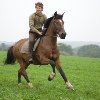 Though many of the events and sequences are a bit of a stretch to believe (the time-out in No Man’s Land), the one thing you will never doubt is the beauty of the film. It’s epic nature recalls Doctor Zhivago or Lawrence of Arabia (though not at the overall level of either of those films), and the photography reminds me of John Ford‘s best work. Off the top of my head, I would say it is the most beautifully photographed movie since Terrence Malick‘s Days of Heaven in 1978. Spielberg’s long time DP Janusz Kaminski is at his best here and will surely be recognized by the Academy for his cinematography.
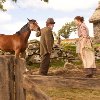 Many of the British actors are recognizable (Emily Watson, Benedict Cumberbatch, Toby Kebbell, Eddie Marsan, David Kross), but it’s key that Spielberg cast no “movie stars”, only quality actors. The stars of the film and the story are the horse and the visuals. It should also be noted that the great John Williams delivers another perfect score … one that would run away with the Oscar in many years.
No need to be frightened off because the story is based during World War I. It’s not for the youngest of kids, but this is an uplifting, sentimental and emotional movie for most everyone. It is peak Spielberg working with sentiments and subject matter with which he so excels.
SEE THIS MOVIE IF: you enjoy being swept away by the emotions and grand scale of an epic film OR you would like a primer to war films that goes a bit easy on the gore.
SKIP THIS MOVIE IF: you are expecting similar war reality to Saving Private Ryan OR you have a hard time suspending disbelief for some rather remarkable coincidences
watch the trailer:


 Posted by David Ferguson
  Movie Reviews from the Dark