FRANKENSTEIN (2025)

December 29, 2025

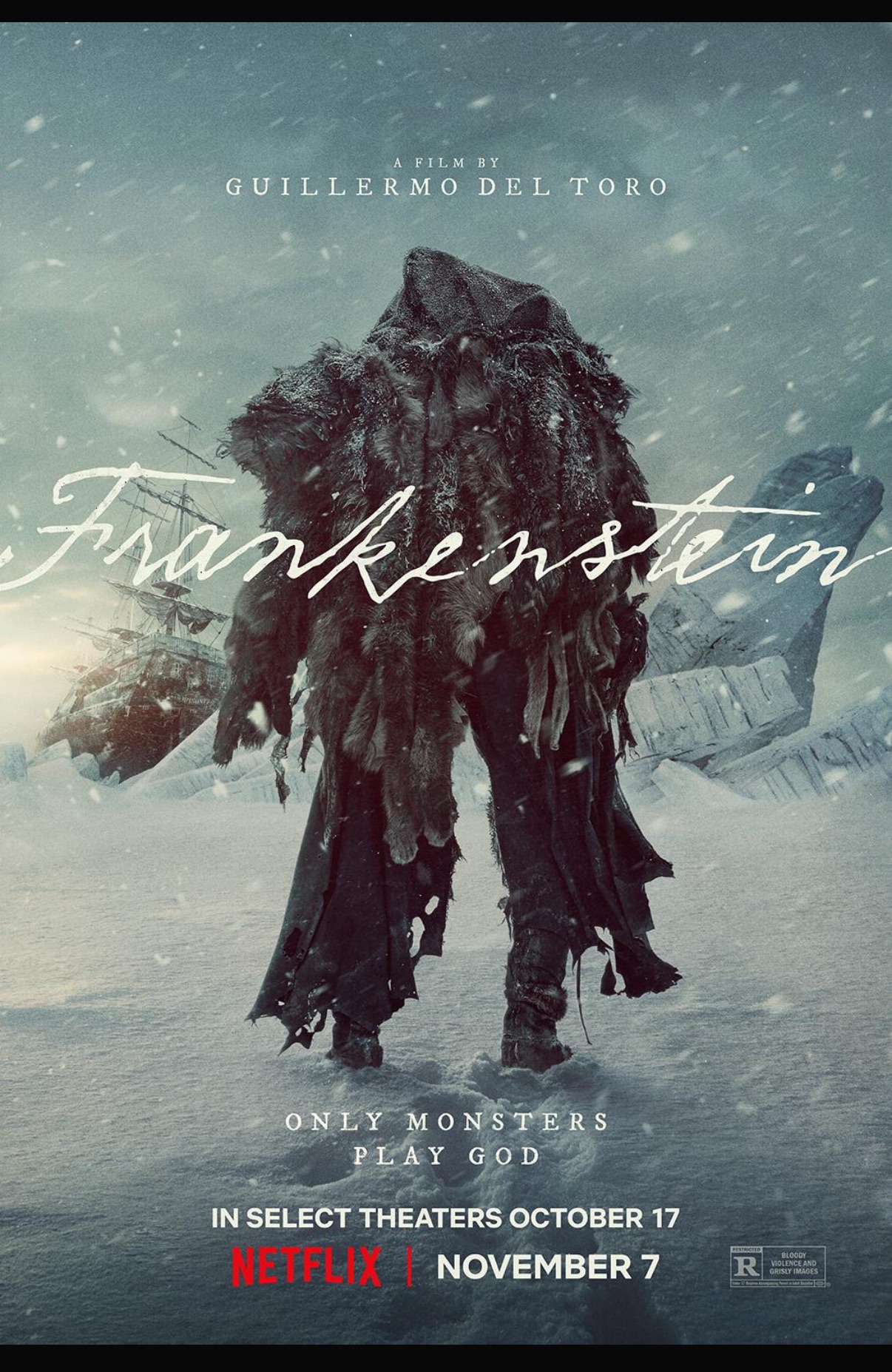
Greetings again from the darkness. As a lifelong lover of cinema, I tend to latch on to the works of those who so obviously feel the same. Among those who have achieved some level of mainstream success are Martin Scorses, Quinton Tarantino, Steven Spielberg, and Christopher Nolan. Another filmmaker who definitely belongs in the group, and it may surprise some, is Guillermo del Toro (an Oscar winner for PINOCCHIO, 2022, and THE SHAPE OF WATER, 2017). Other gems in his oeuvre include CRIMSON PEAK (2015) and PAN’S LABRYNTH (2006).  The esteemed director has long claimed that his “dream project” is a film version of Mary Shelley’s 1818 novel, “Frankenstein: Or, The Modern Prometheus”.

The dream is now a reality, and what a thing of beauty it is. The visuals here eclipse all expectations, and the only caution I would offer is that the tone and themes are a bit of a twist from traditional takes on the story … and we all know there have been many previous takes. All of this confirms what a remarkable source material Mary Shelley’s novel is. That’s not to say del Toro’s version is ‘new’, yet it’s certainly an oddity and an outlier to what we’ve come to expect from Frankenstein movies.

Setting the film in 1857 (nearly 40 years after the novel) affords del Toro some benefits of advancements, as well as audience familiarity to the times. It may seem strange, or even contrary, but to me, this film’s central theme is humanity – how we use it and how we sometimes work against it. An opening in the Arctic where creature (Jacob Elordi) and creator (Oscar Isaac) cross paths yet again – after chases that only become clear later in the film – and it’s horrifying and stunning. Pivotal to the sequence is Captain Anderson’s (Lars Mikkelsen, “House of Cards”, and brother of Mads) ship and crew.

Victor Frankenstein, the human God/creator, is played with enthusiastic ambition that often drifts into mania. He’s a man of science whose vision refuses to be contained. Even in success, his need to control override his accomplishments … meaning the creature is truly born into misery and pain, resulting in confusion and a need to find where and how he belongs. Is it possible for a laboratory experiment to be a tortured soul? Director del Toro clearly believes this … as did James Whale in those early versions. It’s in these moments where Elordi truly shines as the creature – it’s a terrific performance through prosthetics.

Two-time Oscar winner Christoph Waltz and Mia Goth (a dual role) are both terrific in supporting roles, and it’s best if nothing further is disclosed about their characters as each are key to the story. Beyond the fascinating, tragic, and heartbreaking story is a film with such stunning visuals that it stands alone as a work of art. Guillermo del Toro’s talented crew includes cinematographer Dan Laustsen, Production Designer Tamara Deverell, Oscar winning Set Decorator Shane Vieau, and two-time Oscar winning composer Alexandre Desplat, who delivers an incredible score (one certain to be nominated). Of course, as previously stated, this was the “dream project” of Guillermo del Toro, and he has delivered one for the ages … dreams really do come true!

WATCH THE TRAILER


EMMA. (2020)

February 27, 2020

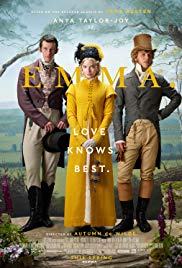
 Greetings again from the darkness. Choosing Jane Austen’s beloved 1815 novel for one’s feature film directorial debut is an ambitious decision, and one for which photographer Autumn de Wilde proves she is up to the challenge. Ms. de Wilde and screenwriter Eleanor Catton may have added a period to the title to distinguish this version from the 1996 film starring Gwyneth Paltrow, or perhaps it was a personal stamp proclaiming this to be the definitive version. Regardless, coming on the heels of Greta Gerwig’s superb LITTLE WOMEN, both films blend a timeless literary classic with contemporary talent and attitude. Additionally, viewers may note some tonal similarities to this and the 2018 hit THE FAVOURITE (for which Oliva Colman won an Oscar).

It’s one of the finest crafted and most famous opening lines in the history of literature: “Emma Woodhouse, handsome, clever, and rich, with a comfortable home and happy disposition, seemed to unite some of the blessings of existence; and had lived nearly twenty-one years in the world with very little to distress or vex her.” The decision to cast mega-talented rising star Anya Taylor-Joy (THOROUGHBREDS, THE WITCH) as Emma provides a level of deliciously wicked entertainment that we can only hope Ms. Austen envisioned. Emma is spoiled and not really very likable, and though she sees herself as an all-knowing matchmaker, her family wealth and social status do little to override the quite common level of immaturity and faux-wisdom associated with her age.

For those unfamiliar with the novel, you may experience a slow build-up to connection with the characters … of which there are many who appear early on and with little introduction. Emma lives in her “comfortable” home Hartfield with her father (an offbeat and slyly comical Bill Nighy). Days are spent visiting and being visited by a community of folks who seem to have little to worry about in life other than who might marry whom. When young Harriet Smith (a terrific Mia Goth, A CURE FOR WELLNESS, 2017) comes to live with Emma, Harriet’s naivety causes her to easily fall under Emma’s matchmaking spell – resulting in some awkward moments and regretful decisions.

Interesting characters are everywhere we turn. Mr. Elton (an energetic and riotous Josh O’Connor) is the local vicar who is both amusing (“Inn-O-cence”) and a bit difficult to read, as Emma misinterprets his intentions causing one of the more startling developments. Frank Churchill (a stout and smirking Callum Turner) is initially one of the community’s more mysterious characters, and his looks and future holdings make him a desirable catch. Jane Fairfax (Amber Anderson) carries on a nuanced rivalry with Emma, and brings a new dynamic when she visits her chatty and ‘’try-so-hard” aunt, Miss Bates (a marvelous turn from Miranda Hart). As viewers we find Miss Bates to be at least as entertaining as Emma herself. Later in the film, Mr. Elton takes a bride (Tanya Reynolds), and her character provides a welcome and unsettling spark at just the right time.

Of course, it’s Mr. Knightley (played by musician Johnny Flynn, BEAST, 2017) who provides the moral backbone of the story. He seems to be the only one (other than her father) who recognizes the shred of goodness buried within Emma. Mr. Flynn gives a soulful performance, and is responsible for the single most touching scene in the film – a simple gesture of asking for a dance. Beyond that, his verbal sparring with Emma is usually morality based, or at straddling the line between politeness and rudeness. Ms. Taylor-Joy and Mr. Flynn and Ms. Hart are stand-outs in a superb cast that delivers the goods in each and every scene.

What makes the Austen novel, and the film, so captivating are the issues of romance, marriage, age, and social status woven into each moment – each dramatic turn laced with comedic undertones. Subtext abounds in every conversation and interaction, and words spoken do not always carry the same message as body language or a glance. To top things off, the film is beautiful to look at. The dreary lighting often associated with period pieces is non-existent, and the costumes and set design are extraordinary. The score from Isobel Waller-Bridge and David Schweitzer is a perfect fit, and allows us to recall that for the 1996 EMMA, composer Rachel Portman won the Oscar … the last female to win until this year when Hildur Guonadottir won for JOKER. It should also be noted that the 1995 film CLUELESS with Alicia Silverstone was a modern-day take on the Austen novel, and regardless of the format (or whether there is a period in the title), Emma continues to be “handsome, clever, and rich.”

watch the trailer:


SUSPIRIA (2018)

October 25, 2018

 Greetings again from the darkness. It makes perfect sense when you think about it. After three artsy prestige projects (CALL ME BY YOUR NAME, A BIGGER SPLASH, I AM LOVE), Oscar nominated Italian filmmaker Luca Guadagnino decides to let his freak flag fly. And what better way than to pay homage to his fellow countryman Dario Argento’s 1977 surreal cult classic that featured a blinding color palette, obtuse camera angles, and enough schlock-horror (in a good way) to remain a midnight movie favorite for more than 40 years? While both movies are B**S**T crazy, we can’t help but think a filmmaker of Mr. Guadagnino’s caliber should have done better.

Dakota Johnson (FIFTY SHADES OF GREY) stars as Susie, a Bambi-eyed self-trained dancer raised in Ohio by her Mennonite parents. Following her dream, she shows up for an audition at the world renowned Markos Dance Company in Berlin. The film is set in 1977 (the same year as the original was released) and Susie sufficiently impresses the company director Madame Blanc (Tilda Swinton) to be invited to join.

A title card informs us that we are about to undertake “Six Acts and an Epilogue set in divided Berlin”. It should have added the run time of two-and-a-half hours (it seemed longer). For those of us who would pay to watch Tilda Swinton in any role, this one does deliver bonus value. The enormously talented actress who has disappeared into numerous characters over the years, plays two other roles here – disguised by heavy make-up in both. The trade-off is that Ms. Johnson is the lead, so not only are we subjected to the limitations of her acting, but also camera-trickery when it comes to her dance scenes. A bushy bushy red hairdo conceals her face during the most physically demanding dance sequences … think Cousin It from “The Addams Family”.

An almost entirely female cast features some interesting choices from across generational and geographical boundaries. Angela Winkler and Ingrid Caven have long been familiar faces on the big screen, and Mia Goth and Chloe Grace Moretz are fine choices for the younger company members. As an added bonus, Jessica Harper appears in one segment towards the end. Ms. Harper played the lead role of Suzy in the original. Other fun comparisons between the two films are the original score by Goblin compared to the updated (and more serene) score by Thom Yorke of Radiohead, and the muted color palette chosen by Guadagnino and cinematographer Sayombhu Mukdeeprom for this updated version.

The reason there is an open spot in the company for Susie is that Patricia (Chloe Grace Moretz) has disappeared after unloading her ‘coven of witches’ theory on an aged psychiatrist Dr. Josef Klemperer. Dr. Klemperer initially thinks the hysterical Patricia is delusional, and would prefer to wallow in his grief over his beloved wife Anke – missing since WWII. When Susie gets her shot at the lead in what is to be the company’s final performance of its most famous dance piece Volk, we get the film’s best sequence and one of a few WTF moments. A mirrored dance studio is the site of unexplained violence, and some terrific editing shoots us back and forth between art and mayhem. It’s difficult to watch but exceedingly well done.

Unfortunately, the truly bizarre and horrific moments are much too rare. In fact, some of the segments come off as unintentionally funny, which is not a good thing for a horror flick. The primal dancing never seems sensual, the bloodbath finale is too far over the top, and the political subtext with the Baader-Meinhof terrorist group just never seems to fit. While watching this, a few films came to mind: BLACK SWAN, THE WICKER MAN, MOTHER!, and ROSEMARY’S BABY, though this one doesn’t reach the level of any of those. Sometimes a movie just doesn’t lend itself to analysis or review, and it comes down to whether this is your cup of tea.

watch the trailer:


A CURE FOR WELLNESS (2017)

February 15, 2017

a-cure-for-wellness Greetings again from the darkness. It might seem peculiar for the director of the Pirates of the Caribbean franchise, The Lone Ranger, and the Oscar winning animated Rango to be the driving force behind an atmospheric Gothic mystery-thriller, but Gore Verbinski seems to ignore any attempt to generalize or label his films. In fact, this latest film (written with Justin Haythe) attempts to challenge genre conventions by cloaking us in familiar themes and expecting us to be surprised by the late twist.

Dane DeHaan has established himself as an actor with no boundaries. He has played characters as diverse as James Dean in Life, and Cricket in Lawless. This time he dons a business suit as Lockhart, an ambitious, young, morally flexible, workaholic financial hotshot. By bending a few FCC regs, Lockhart has maneuvered himself into a plush corner office on Wall Street, and is now strong-armed by senior management into taking on the less-than-appealing task of traveling to a “wellness spa” in Switzerland in order to bring back the CEO whose signature is necessary to complete a lucrative merger.

The cinematography of Bojan Bazelli is gorgeous throughout, and it’s literally breathtaking as we view the Manhattan cityscape, and then follow Lockhart’s train streaming through the Swiss Alps mountains and tunnels. These are the “wow” shots, but the camera finds beauty even once the story takes us inside the sanitarium with the dark history … and confounding present. The building’s history seems somewhat sinister, but its current day secrets are every bit as creepy. What exactly is the sickness that “the cure” is treating? Why does no one ever leave? What’s with the eels? What’s with the water? Why are teeth falling out? Why are the townfolks so off-put by those on the hill? What answers do the puzzles bring?

Shutter Island offers the most obvious comparison with its similar tone and atmosphere, but others that come to mind include The Island of Dr. Moreau, One Flew Over the Cuckoo’s Nest, and especially, Hitchock’s Rebecca. Verbinski makes marvelous use of sound throughout – whether it’s Lockhart’s creaking crutches, the squeak of doors, the drip of ever-present water, or the metallic whir of machines. The look, sound, and feel create the tension necessary to prevent viewers from ever really relaxing, even if we wish the movie wasn’t so darn long.

Filmed at Castle Hohenzollern in Germany, it’s a perfect example of how on filming on location adds an element that no soundstage can hope to achieve. Support work comes from some familiar faces like Jason Isaacs as Dr. Volmer, Celia Imrie, Carl Lumbly, Ivo Nandi, Harry Groener, and Adrian Schiller. However, it’s Mia Goth (Everest, 2015) who has the biggest impact on screen outside of DeHaan. Her unusual look and slightly-off mannerisms are perfect for the role of Hannah, who is so crucial to the twist.

Spanning two-and-a-half hours, the film abruptly flies off the rails in the final 15 minutes. It acts as a release for the stress it has caused, and as a reminder that director Verbinski likes to have fun with his films. It’s quite possible that the film will struggle initially to find an audience, but later find success as a cult favorite and/or midnight movie. Whether you deem it silly or creepy, love it or hate it, you’ll likely appreciate the look of the film and the creative surge of Verbinski. At a minimum, it will generate some talk about Big Pharma and how we seem to always be searching for a “cure” of the latest societal ailment … or you may just have nightmares about eels in your bathtub!

watch the trailer: