THE NEST (2020)

September 17, 2020

 Greetings again from the darkness. I’m not sure how to officially protest, but this is writer-director Sean Durkin’s first feature film since the excellent and thought-provoking MARCY MARTHA MAY MARLENE in 2011.  Okay, he directed a TV mini-series (“Southcliffe”) in that span, but there really should be some kind of ordinance mandating (or at least pleading with) Mr. Durkin to share his art more frequently. His approach is not conventional, and it challenges the eye and mind. The story doesn’t move at the pace we’ve come to expect, and the characters – though quite believable – don’t always act the way we expect.

Jude Law stars as Rory O’Hara, a business man with big dreams … dreams far bigger than his work ethic. Carrie Coon (“Fargo”, GONE GIRL) co-stars as his wife Allison. This husband and wife couldn’t be more different. Where Rory is the big-talking blow-hard who, Allison is the down-to-earth horse trainer. Oona Roche plays teenage daughter Samantha, and Charlie Shotwell (CAPTAIN FANTASTIC, 2016) is the younger Benjamin. Durkin does a nice job with the family set-up in the first few minutes of the film. We get a sense of each, as well as the family dynamics. There is a great shot of Rory sitting idly at his desk, and soon after he wakes up Allison with a cup of coffee and the announcement that they need to move to London.

The film is set in the 1980’s (the Reagan-Thatcher era), and Rory’s desperation to prove his business acumen is on full display when he meets his old (now new again) boss Arthur (Michael Culkin). Rory is a social climber, intent on keeping up with the Joneses (or whatever they’re called in London), and he’s referred to as “Old British – New American”. He takes it as a compliment, but we soon witness Rory as little more than a fast-talking salesman. A restaurant scene featuring Allison, Rory, and his co-worker Steve (Adeel Akhtar) is brilliantly played, as Rory’s professional life begins to unravel at a pace matching that of his family life.

We see each of the family members cut loose in their own way, in an attempt to deal with the strain. Timid Benjamin lashes out at school. Samantha throws a wild bash at the family home. Allison guzzles gin and lets go on the dance floor. Speaking of the family home – it’s an old mansion that is the loudest symbol of Rory’s stretch to impress. The film seems to tease us a couple of time in regards to possible paranormal activity within the home, but that’s simply Durkin’s misdirection. The only thing rotten or haunted is the make-up of the family. Their domestic dysfunction is horror in its own right.

Rory’s delusions of grandeur and worshipping of money are finally thrown back in his face during a tremendous scene of Taxicab philosophy. When asked what he does for a living, Rory answers, “I pretend to be rich”, in what may be his only moment of clarity. Jude Law is superb as the charming guy we don’t really like, and Carrie Coon goes toe-to-toe as his polar opposite, and she’s exceptional. Mr. Durkin and cinematographer Matyas Erdely (SON OF SAUL, 2015) keep us off balance with the fascinating shots within the mansion, and startling close-ups that make a point. There is certainly no abundance of light, but this isn’t the type of family that the spotlight tends to find. It’s likely to be a divisive film not embraced by mainstream audiences, but adored by those who crave projects that are creative and different. It played Sundance prior to the pandemic, and now we have to hope we aren’t forced to wait another 9 years for the next Sean Durkin film. Although I will I have to.

In theaters and VOD September 18, 2020

watch the trailer:


SUNSET (Napszallta, 2019)

April 13, 2019

 Greetings again from the darkness. Hungarian filmmaker Laszlo Nemes mesmerized us with his first feature film, SON OF SAUL (2015), the Oscar winner for Best Foreign Language film. That debut was an incredibly unique viewing experience centered on the Holocaust at Auschwitz. Mr. Nemes got much of the band back together for this follow up, and their collaboration, while a bit frustrating to watch, is again quite fascinating to look at.

Mr. Nemes co-wrote the script with his SON OF SAUL writing partners Clara Royer and Matthieu Taponier (also the film’s editor). And for those that share my frustration in watching the film, it’s the story that is likely to blame. Is there a story?  Certainly not in the traditional sense – which makes it difficult to follow or try to explain. Irisz Leiter (played by Juli Jakab) is first seen being fitted for fine hats in the elegant shop that bears her family name. We soon learn her parents both died, and she has been absent from the city for many years. The new owner, Oszkar Brill (Vlad Ivanov, 4 MONTHS, 3 WEEKS AND 2 DAYS, 2007) is startled to learn of Irisz’s return, though we aren’t sure why he is so uncomfortable around her. Irisz soon discovers she has a brother (a surprise to her) and that he is quite notorious in these parts.

Much of the film focuses on Irisz trying to track down her brother, and then track him down again. That’s the closest thing to a plot we get. Mostly it’s a succession of scenes where people ask questions that never get answered. In fact, there is minimal dialogue to go with the now-familiar camera work of cinematographer Matyas Erdely who utilizes his SON OF SAUL first person perspective with background fuzzed out so that we see what one person is seeing. There is an underlying theme of what is apparently a corrupt part of a mysterious sub-culture in the society – even involving the Royal family. Keep in mind this is 1913 Budapest and war is at hand.

The set design and costume design are extraordinary … especially the lavish hats from the era. The score is from Laszlo Melis (also from SON OF SAUL), and while Ms. Jakab is pleasant to look at, the story is disorienting and unfulfilling. The approach with the camera work is designed to force us to see things through the characters’ eyes, but it’s not enough to offset the incoherent and aimless wanderings of Irisz as she collects scraps of information that may or may not be pertinent. Perhaps you are smarter than I am, and will be able to connect the dots … or at least find dots to work with.

watch the trailer:


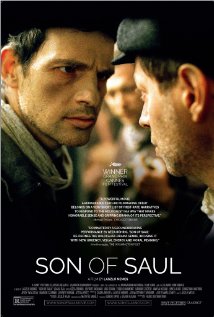
SON OF SAUL (Saul fia, Hungary, 2015)

January 21, 2016

son of saul Greetings again from the darkness. Not wanting to watch another movie related to the Holocaust is understandable. Why should you purposefully agree to experience the misery and unfathomable horror that occurred? The simple answer is that we should never forget one of the darkest and inexcusable periods in human history. Director Laszlo Nemes delivers a new approach … a different viewpoint … and it grabs us and doesn’t let go.

The startling opening is a long-tracking shot featuring Saul Auslander (played by Geza Rohrig) and his duties as part of the Sonderkommando unit at 1944 Auschwitz-Birkenau concentration camp. The red X on his jacket relegates Saul to corralling the next round of Jews into the gas chamber and then cleaning up for the next group. The reward of this position means the delay of his own inevitable death. It’s a closer, more intimate look at a process that we have not prevented ourselves to think much on.

What we soon realize is that dialogue is minimal and most of what we see is as if we were standing right beside or just behind Saul. The shallow focus means much in our sight line is blurred, and we are exceptionally dependent on the sound – what we hear often conveys more of the message than what we see. Cinematographer Matyas Erdely never allows our eyes to drift … he shows us only so much, forcing our brain to process and interpret so many more clues.

The horrific proceedings may be blurred, but it’s a devastating experience nonetheless. Saul’s stoic face masks his true emotions and disgust, and prevents him from drawing any unwanted attention. Saul’s dependability as a Sonderkommando changes in the blink of an eye – he sees the body of a young boy whom he claims is his own son. He becomes obsessed with finding a Rabbi to allow for a proper burial for the boy. It seems clear that this mission is a chance to break from his soul-crushing duties and grab a bit of redemption before it’s too late. Unfortunately, the timing of this mission conflicts with a planned prisoner uprising … adding more complexity to a nearly impossible quest.

This is the feature film debut of director Laszlo Nemes, who also co-wrote the story with Clara Royer. Some of the specifics are drawn from “Voices from Beneath the Ashes” (edited by Ber Mark) and “Auschwitz: A Doctor’s Eyewitness Account” by Miklos Nyiszli. It’s a fearless vision for Holocaust storytelling with many open-ended issues (we don’t always know identities and positions of those we see) and few conclusions provided. But then we all know the ultimate conclusion, and this look may be the most devastatingly intimate look we have ever had.

It’s not a movie that allows you to kick back on the sofa and simultaneously catch up with Facebook. It demands and deserves attention and patience. Nothing here is designed to allow us a “hands off” view from a safe distance. In fact, the lack of traditional story structure and dialogue direction forces us to face the ugliest reality through a different perspective than we’ve ever considered. Powerful stuff.

watch the trailer: