PEE-WEE AS HIMSELF (2025, doc)

May 22, 2025

Greetings again from the darkness. Even the title is a form a trickery. First of all, there was no Pee-wee Herman other than the character portrayed by Paul Reubens. Secondly, much of what this documentary presents is not from Pee-wee, but rather from Paul Reubens ‘himself’. And it goes directly to the point – the public adored Pee-wee Herman, while Paul Reubens was a bit more complicated. Documentarian Matt Wolf (SPACESHIP EARTH, 2020; the excellent RECORDER: THE MARION STOKES PROJECT, 2019) presents a two-part documentary for HBO that strives to clarify the line between man and character.

Paul Reubens died of cancer in 2023. Prior to that, he sat for 40 hours of recorded interviews with Matt Wolf, offering perspective on his career, his background, his motivation, and his self. While we see Reubens speaking directly to the camera quite a bit, Wolf utilizes a treasure trove of clips and photographs, as well as other interviews to paint the full picture of how the man and character came to be so closely associated.

PART ONE details Reubens’ influence from children’s television shows like “Captain Kangaroo”, “Howdy Doody”, “Kukla, Fran and Ollie”, and “The Little Rascals”. It’s because of these programs that from an early age, he wanted to be an actor … and was convinced Lucy and Desi were his real parents. Art School (with classmates David Hasselhoff and Katie Segal) drew him to performance art, and also led to his first serious romantic relationship with Guy. Reubens eventually decided to focus on his career, and described himself as out and then back in (the closet), since he was able to “pass” (as heterosexual). We see clips of him performing on “The Gong Show” and with The Groundlings, including Phil Hartman and Laraine Newman … which is where he laid the foundation for the Pee-wee character. Clips from “The Dating Game” proved Pee-wee had appeal.

The commitment to the Pee-wee Herman character was a career choice, and it’s fascinating to learn that actress Shelley Duvall recommended Tim Burton to direct PEE-WEE’S BIG ADVENTURE (1985). The story behind the bicycle is a gem, and the film jump-started the career of both Burton and Pee-wee … errr … Reubens. Reubens admits to his ambition and willingly hiding behind the Pee-wee alter ego.

PART TWO focuses on the iconic stardom of Pee-wee Herman in the 1980’s. Building on the popularity of the first film, “Pee-wee’s Playhouse” was developed as a 1986 children’s TV show, in the vein of those that so influenced a young Reubens. There was even a Pee-wee doll that became a best-selling gift. Reubens explained that beyond entertainment, his goal with the show was to make inclusion the “norm”. He wanted a place where all kids felt they belonged. Laurence Fishburne admits he didn’t “get” Pee-wee, but needed the work and gladly took the job as Cowboy Curtis. BIG TOP PEE-WEE (1988) followed, and may have been the last enjoyable moment for Pee-wee/Reubens to bask in the spotlight.

After years of living an extremely private life, his 1991 arrest for indecent exposure at an adult theatre instantly changed his life. ‘Playhouse’ re-runs stopped immediately, as did sales of the doll. Paul Reubens’ mug shot became a meme … early 90’s style. Unfortunately, this wasn’t his last public scandal, yet remarkably, Reubens was able to create a second half of his career as a character actor and voice actor – with only a few additional roles in the Pee-wee Herman suit.

The documentary includes clips of his parents and an interview with his sister, as well as input from directors Tim Burton and Judd Apatow. Reubens explains the inner turmoil of having his creation, Pee-wee Herman, be awarded a star on the Hollywood Walk of Fame, while Reubens himself has not. Towards the end of the film, Wolf plays the self-recorded audio that Reubens recorded the day before he died. Although he discusses his desire to bring joy to the masses, we can’t help but question the failed friendships along the way. And though Paul Reubens may very well have been a creative genius, we must finally ask, “I know you are but what am I?”

Premiering on HBO on Friday May 23, 2025

WATCH THE TRAILER


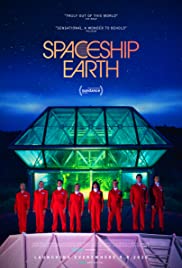
SPACESHIP EARTH (2020, doc)

May 7, 2020

 Greetings again from the darkness. Most all of us built a terrarium for science class when we were in junior high. Did you ever fantasize about living in it? Well that’s basically what happened in 1991 when 8 scientists were sealed up in Biosphere 2, a giant terrarium built in Oracle, Arizona. Their mission was to live a self-sustained existence for two years, and this was done in the name of scientific research that might one day lead to humans living in space. It was known as Biosphere 2 since they considered Earth to be number one, and filmmaker Matt Wolf kicks off the documentary with actual news clips from that day in 1991 when the door was shut behind the eight biospherians.

After running those initial clips, Mr. Wolf immediately takes us back 25 years prior, and introduces us to The Synergists – a group of resourceful, very smart, free-thinkers who assembled in San Francisco under the charismatic leadership of John Allen. At first, it’s a little confusing why we are watching these old ‘home movies’ from what appears to be a commune, and listening to these people, now 50 years older, talking about the good old days. Of course, the backstory of these folks with nicknames like Johnny Dolphin, Flash, Salty, and Firefly turns out to be the foundation of Biosphere 2 … but not before they form Synergia Ranch in 1969 New Mexico, and then build a ship in Oakland from scrap metal in 1974. Their ship was named Heraclitus, after the Greek philosopher, and their inspiration was derived from writers Buckminster Fuller (“Spaceship Earth”), Rene Damaul (“Mount Analogue”), and William S Burroughs.

It’s understandable if your thoughts drift towards ‘cult’ or ‘commune’, but as one of them states, they were “a corporation, not a commune.” With international interests in a hotel, an art gallery, and a theatrical group, amongst other enterprises, they were able to sustain their creative pursuits … unlike the many hippies of the era numbed by drug use. Inspired by the 1972 movie SILENT RUNNING, Mr. Allen and their in-house architect Phil Hawes began working on the idea of a self-contained space colony. By 1986, design work for Biosphere 2 had begun and Ft Worth oil billionaire Ed Bass was bankrolling the project. It was a massive undertaking both from planning and construction, plus the training and selection of biospherians began in 1990.

Given today’s ‘social distancing’ due to COVID-19, it’s a bit ironic that we are looking back at a 28 year ago small group isolation in a self-contained environment. Filmmaker Wolf doesn’t shy away from the science world skeptics who, with a smidge of jealousy labeled the venture “trendy ecological entertainment.” Whatever you call it, this was an international event and drew interest from all walks of life, right up until 1993 when the biospherians walked out of the dome. In another sign of remarkable symmetry to today’s world, in 1994 Mr. Bass fired most of the original group, and put Steve Bannon (yes THE Steve Bannon) in charge of Biosphere 2. It might not surprise you that most of the scientific data and research soon disappeared.

Wolf takes us 25 years after the mission to catch up with Mr. Allen and other Synergists. The Synergia Ranch still exists and John Allen remains as energetic and idealistic as he was in the 1960’s. Biosphere 2 is now open to the public and being managed by the University of Arizona, and we still aren’t sure whether a pre-fab paradise will work in space. Wolf’s film is filled with interesting tidbits from 3 different eras, and though the early days are quite entertaining, it seems entirely too much time is devoted to the time prior to the Biosphere. And because of that, many of our questions remain unanswered as to whether the two years advanced research, or whether the effort was nothing more than a glorified publicity stunt. Either way, capturing this in documentary form allows the 1991 Biosphere 2 project to be explained to future generations … some we hope will be as innovative, and dream as big as the Synergists.

The documentary will release May 8, 2020 on Hulu, VOD, Virtual Cinemas, and participating Drive-Ins.

watch the trailer:


RECORDER: THE MARION STOKES PROJECT (2019, doc)

June 12, 2019

2019 Oak Cliff Film Festival

 Greetings again from the darkness. Yes, many of us still use the word “taping” when referring to recording a TV show, movie or something else. Nomenclature changes slowly, even if technology progresses quickly. In the mid-1970’s, when Marion first started recording TV programs … initially news reports before also spreading to other topics … taping was her only option. VHS and Betamax tapes. This was long before TiVo became a common gift, and certainly prior to most cable services including a DVR with their bundles.

Director Matt Wolf takes us back to a time, not so long ago, when the term “fake news” had not yet become a familiar phrase. Marion Butler-Metelits-Stokes was a Philadelphia librarian and socialist/communist/activist who spent many years, up until her death, recording TV broadcasts. This resulted in more than 70,000 VHS tapes documenting how the daily news was presented to us. The real mystery here is “why”?  Why did Marion feel the need to do this religiously for 35 plus years? It’s the “why” where the movie’s approach is a bit stretched. Through interviews with her son, and the kids of her second husband, we are led to believe Marion was some type of crusader for the truth, and concerned that crucial information was being purposefully omitted from broadcasts.

Her son, Michael Metelits, inherited the tapes and donated them to the Internet Archive, which has been methodically digitizing them ever since with the goal of making the information searchable and available for research. Through interviews with Michael, as well as her second husband’s daughter, we come to realize that Marion was more focused on recording than on raising kids. When she married John Stokes, they shared a world view, and his family money provided her a chauffeur and secretary, as well as multiple houses and storage units. Yes, not only was Marion obsessive about her recordings, but she was a world class hoarder. When she died, she had nearly 50,000 books, plus a massive collection of newspapers, magazines, and even Apple Macintosh computers.

Since Marion never recorded her own story or what motivated her, we can only marvel at what she left behind. It’s clear that her mission shifted into high gear with the Iran Hostage Crisis, which led to the development of “Nightline”. We see clips of a very young CNN host named Kellyanne Fitzpatrick (better known today as Conway), and a young attorney named Jefferson Sessions up for a judicial appointment. There are many other snippets of the big stories through these years, but it’s the 4-way split screen of CNN, NBC, CBS, and ABC on the morning of September 11, 2001 that will stick with you. We watch in real time as CNN shows the first tower and then the slow progression as the other networks catch up. It’s still devastating to watch.

We will never know if Marion was a crusader of curiosity or obsessed due to paranoia. What we do know is that her collection leaves a treasure trove of TV news that might one day be properly studied to determine if it’s the foundation for today’s fake news.

(I couldn’t find an online trailer)