MANK (2020)

December 3, 2020

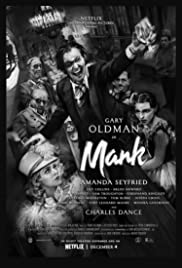
 Greetings again from the darkness. “Just a writer.” The line made me laugh. How many times have writers not received the recognition they deserved, or were underestimated, only to have their words create a lasting impact? Hollywood often likes to portray writers as socially-awkward, loner types who rarely contribute much during conversations. Not this time. The subject is Oscar winning screenwriter Herman J Mankiewicz, who was as quick with a dinner table zinger as he was writing the script to CITIZEN KANE (1941) while bedridden.

More than 20 years in the works, this is director David Fincher’s first film since GONE GIRL (2014), and it’s based on a screenplay written by his late father, Jack Fincher. Dad receives sole writing credit here, though David and producer Eric Roth (Oscar winner for FORREST GUMP, 1994) admit to some polishing. It’s a film seemingly designed for us film nerds, but likely entertaining and interesting enough for expanded appeal. CITIZEN KANE is often regarded as the “best” movie of all-time, though the origin of the film is much debated. We do know that struggling RKO Pictures gave 24 year old wunderkind Orson Welles free reign over his first film, and the result was something quite special. Director Fincher’s film offers up three distinct aspects here: a look at Mankiewicz’s writing process for ‘Kane’, some background on Mankiewicz’s career, and a somewhat fictionalized dissection of 1930s Hollywood politics.

Oscar winner Gary Oldman (DARKEST HOUR, 2017) stars as Herman J “Mank” Mankiewicz, an international correspondent-turned NYC cultural critic-turned playwright-turned screenwriter. Herman was the older brother of Joseph L Mankiewicz, a four time Oscar winning writer-director (ALL ABOUT EVE, 1950), and grandfather to Ben Mankiewicz, a well-known host of Turner Classic Movies. Herman was also renowned as a boozer and gambler, and in 1940 (where this movie begins), he was a bedridden mess recovering from a car accident. Herman was part of the sphere of the infamous Algonquin Round Table, and in most of this film, he talks like he’s still at one of those gatherings.

Mank is taken to a desolate ranch house in Victorville, California, along with his assistant Rita Alexander (Lily Collins), his nurse (Monika Gossman) and his handler John Houseman (Sam Troughton). Orson Welles (Tom Burke) has given Mank 60 days to finish the script, and his only guidance seems to be “write what you know”, and don’t drink. The result was a controversial, yet brilliant script that Welles and his crew (Oscar winning Cinematographer Gregg Toland, Editor Robert Wise, a 4-time Oscar winner) turned into a classic film that still holds up 80 years later.

We immediately start seeing flashbacks, as noted by old style on-screen typing. Ten years prior, Mank was the Head Writer at Paramount, where his staff included Ben Hecht, George S Kaufman, and Charles Lederer … writers whose work would later include NOTORIOUS (1946), multiple Marx Brothers movies, and GENTLEMEN PREFER BLONDES (1953), respectively. Lederer was also the nephew of starlet Marion Davies (played here by Amanda Seyfried), who was the long time mistress of media mogul William Randolph Hearst (Charles Dance). Are you starting to see how this wicked web all fits together? Of course, Hearst was the model for Charles Foster Kane in Welles’ classic movie, while Ms. Davies was supposedly the inspiration for Kane’s wife, Susan. Other key players in these flashbacks are Producer David O Selznick (Toby Moore), Irving Thalberg (Ferdinand Kingsley, son of Oscar winner Ben), MGM founder Louis B Mayer (Arliss Howard), Mank’s brother Joseph (Tom Pelphrey), and Mank’s wife “Poor” Sarah (Tuppence Middleton).

Director Fincher’s masterful film features a couple of standout sequences. The first involves the initial meeting between Mank and Hearst, while Marion Davies is filming a scene on the grounds of San Simeon (Xanadu in CITIZEN KANE). Rapid fire dialogue, multiple characters, and terrific editing with Mank keeping pace as Hearst overlooks the filming. Much later there is a scene following Mank and Marion as they stroll through the manicured gardens with the nearby exotic animals on display. The scene is fascinating to watch, while also reinforcing the kindred spirits of Mank and Marion – both talented, yet not quite allowed in the “club”. Beyond those two sequences, we also get a quite funny segment where Mank and his Paramount writers are improvising a pitch to Selznick and director Josef von Sternberg, plus a telegram sent by Mank to Lederer that states, “Millions to be made here and your only competition is idiots” (a sentiment some believe still holds true today).

Quite a bit of the film is focused on Hollywood politics of the 1930s, both in the studios and nationally. In particular, the 1934 Governor’s race focuses on the campaign of writer and socialist Upton Sinclair (played by Bill Nye, the Science Guy), and the concerted efforts by Hearst and studio capitalists to prevent Sinclair from being elected. The symmetry and contrasts of modern day Hollywood and politics cannot be overlooked. Also made abundantly clear is the disconnect between studio heads, directors, and writers – quite the mishmash of disrespect.

The brilliance of Fincher’s movie is that it can be relished from multiple perspectives. Is Mank attempting to salvage a near-dead career or is he settling a grudge against Hearst? Did Welles intend to hold firm to Mank’s contract and prevent him from receiving a screenwriting credit? And then there is the filmmaking side. Superb performances from Oldman and Seyfried highlight the terrific cast. It’s filmed in black and white by cinematographer Erik Messerschmidt (“Mindhunter”), but not the razor-sharp images we are accustomed to these days, rather soft and hazy in keeping with the look of the times. The production design from Donald Graham Burt takes a couple of viewings to fully appreciate, and the music from Trent Reznor and Atticus Ross is spot on, as usual. Even the opening credits provide nostalgia, as does the 1942 Academy Awards ceremony, which neither Mank nor Welles attended. Netflix delivers another winner, and one likely to receive awards consideration.

watch the trailer


TOLKIEN (2019)

May 9, 2019

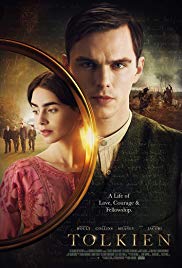
 Greetings again from the darkness. As fascinated as we are with great writers, the cinematic appeal of watching someone put pen to paper, clack away on a manual typewriter, or peck at their laptop keyboard is at best negligible, and more likely, non-existent. Still, award-winning Finnish director Dome Karukoski chose renowned writer J.R.R. Tolkien as the subject of his first English language film. Tolkien’s actual writing time on screen is mostly limited to a single shot at the film’s conclusion; however, the script from David Gleeson and Stephen Beresford attempts to connect the dots between his real world life to his Middle-earth characters and adventures from “The Hobbit” and “The Lord of the Rings”.

Harry Gilby portrays the young John Ronald Reuel Tolkien, and then Nicholas Hoult stars from college age forward. The film bounces between Tolkien’s childhood as an orphan, his elite private school education at King Edward’s School in Birmingham, matriculating at Oxford University, and soldiering in WWI. It’s during his stay at Ms. Faulkner’s (Pam Ferris) boarding house when he meets Edith Blatt, the love of his life. While attending prep school, he and three friends: Robert Gilson, Christopher Wiseman and (poet) Geoffrey Smith, form the TCBS (Tea Club and Borrovian Society), a club dedicated to changing the world through art. It’s at Oxford where Tolkien’s love of language kicks into a yet higher gear, though it’s during his time in The Somme – one of the deadliest battlefields of WWI, that we see his ‘trench fever’ contribute to many of the visuals later associated with his books.

Lily Collins portrays Edith at the age where Tolkien must choose between her and his Oxford education, but as often happens with true love, the two later reconnect and remain married for more than 50 years (until her death). This film doesn’t cover their later years, and instead focuses on the formative ones – both for his imagination and their relationship. We see his early childhood games (The Shire inspired from his time in Sarehole outside Birmingham) and the film often slaps us with an ‘obvious stick’ on how certain segments of life translate directly to his familiar stories in future years. In fact, there is no mention of C.S. Lewis and The Inklings – his friends who later supported his writing efforts. We do, however, get a sequence with Tolkien and Edith backstage at Wagner’s “The Ring Cycle” Opera … a dot that requires the simplest of connectors.

The film looks terrific – especially in the battle scenes which are staged dramatically and horrifically (much as we imagine the war was) by cinematographer Lasse Frank Johannesson. Unfortunately, that’s the highlight. This is mostly a generic biography of an extraordinary writer. Adding to the frustration is the fact that Nicholas Hoult recently portrayed reclusive writer J.D. Salinger in REBEL IN THE RYE … roles too similar for the same actor.

“The Hobbit” was published in 1937 and “The Lord of the Rings” trilogy in 1954-55, the latter being the best-selling fiction of all-time before being overtaken by JK Rowling’s ‘Harry Potter’ series. Tolkien’s key seems to have been his lifelong fascination with language. He even created his own – not just words, but complete languages. That would likely have made a better focus here. Seeing the foundation of “the fellowship” was somewhat interesting, although much of that segment came across like a poor man’s DEAD POET SOCIETY. Supposedly the Tolkien family has refused to endorse the film, likely placing the script “In a hole in the ground …”

watch the trailer:


RULES DON’T APPLY (2016)

November 23, 2016

rules-dont-apply Greetings again from the darkness. Few films can match this one for pedigree. Actor/Director/Producer/Writer Warren Beatty is a 14-time Oscar nominee (won for Best Director, Reds, 1982) and Hollywood legend. Screenwriter Bo Goldman is a 3 time Oscar nominee, and has won twice (One Flew Over the Cuckoo’s Nest, Melvin and Howard). The cast includes 4-time Oscar nominee Ed Harris, 4-time Oscar nominee Annette Bening (Beatty’s wife), and other Oscar nominees: Alec Baldwin, Amy Madigan, Candice Bergen, and Steve Coogan. The all-star production also features Cinematographer Caleb Deschanel (a 5 time Oscar nominee), Co-Editors Leslie Jones and Billy Weber (both Oscar nominees), and two-time Oscar winner, Costume Designer Albert Wolsky. It’s Mr. Beatty’s first time directing since Bulworth (1998) and first time acting since Town & Country (2011). Being such a filmmaking icon, he attracts some of the most talented folks in the industry whenever he decides to work.

Of course, this isn’t a career retrospective and there are no brownie points won for surrounding yourself with the cinematically decorated elite. It still comes down to the movie, and unfortunately, this one is never as exciting, entertaining or funny as it seems to think it is.

Rumors of Warren Beatty making a Howard Hughes movie have bounced around for decades, and it appears this is as close as we’ll get. The director himself plays the billionaire, and the story mostly revolves around the time the enigmatic man (Hughes, not Beatty) was most involved with Hollywood and the movie business. Much of the dialogue and the majority of the scenes involving Hughes emphasize (and enhance?) the man’s idiosyncrasies that bordered on mental instability. Beatty mostly plays him as a mumbling and shrugging goofball who dines on TV dinners and is frightened of children.

The best parts of the movie don’t involve Hughes, and instead feature the youngsters trying to make their way in his convoluted organization. Lily Collins (Phil’s daughter) plays Marla Mabrey, a wanna-be starlet committed to her staunch religious upbringing – said beliefs incessantly reinforced by her distrusting mother (Annette Bening). Her driver is Frank Forbes played by Alden Ehrenreich (Hail, Caesar!), and his own agenda involves convincing Howard Hughes to invest in a real estate development project on Mulholland Drive. As expected, sparks fly between the young actress and the equally conservative young visionary, and we find ourselves engaged with them – in good times and bad.

The two youngsters have some nice screen chemistry that multiple times is brought to a screeching halt by the inclusion of yet another cockamamie Howard Hughes scene – most of which feel more like Beatty’s desire to be on screen rather than an extension of the story. These intrusions prevent any real flow to the film and actually bog down the most interesting aspects of the story. In fact, the disruptions cause us to spend more time “spotting the celeb” than caring about the characters. The list of familiar faces that pop up include: Ed Harris, Amy Madigan, Taissa Farmiga, Alec Baldwin, Matthew Broderick, Chase Crawford, Martin Sheen (as Noah Dietrich), Oliver Platt, Steve Coogan, Dabney Coleman, Paul Sorvino, and even Candice Bergen (as Hughes’ secretary).

It’s easy to see the nostalgia and fond memories that Mr. Beatty has of this late 50’s – early 60’s era in Hollywood. It was all about glamour and the magic of what’s on screen. The real Howard Hughes story is at least as interesting, if not more so, than the history of Hollywood, but the cartoonish aspects of the billionaire here don’t hold up to such previous works as The Aviator, or even Melvin and Howard.

These days, the Howard Hughes Hollywood legacy is barely a blip – a few recall Jane Russell’s close-up or the aerial battles of Hell’s Angels, while fewer know the RKO Studios story. Warren Beatty’s movie legacy is much more than a blip; however his latest adds little to the legend.

watch the trailer:


LOVE, ROSIE (2014)

March 8, 2015

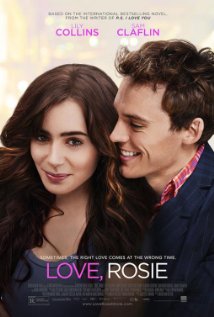
Love, Rosie Greetings again from the darkness. More Romantic-Drama than Romantic-Comedy, the story spans 12 years – a necessary change of structure from the 45 year saga of Cecilia Ahern’s novel and source material “Where Rainbows End”. It’s a familiar theme of boy-girl friendship muddled by quasi-romantic interludes of frustration, confusion, missed signals, and misplaced pride.

Rosie (Lily Collins) and Alex (Sam Clafin) have been friends since they were 5 years old, and their bond means they discuss everything from Alex’s weird dreams to leaving England together. Well, everything except what they really think of each other. On Rosie’s 18th birthday, a poorly executed, drunken spin atop a barstool, leads to the proverbial fork in the romantic road … and off to the dance go Rosie and Alex with other partners. One cringe-inducing condom mishap later and Alex is headed off to school in the U.S., while Rosie stays behind to tend to other responsibilities.

In the mode of One Day, or Four Weddings and A Funeral, we track the separate lives of Rosie and Alex. Though connected mostly through texts, the next dozen years bring more than enough opportunity for these two to right a wrong, but predictably bad timing is always their worst enemy. The adapted screenplay from Juliette Towhidi (Calendar Girls) and the direction of Christian Ditter allow us to really understand Rosie and care for her, while the supermodel dalliances of Alex keep him at arm’s length.

The film’s best scenes and most interesting sequences are those centered on Rosie. Lily Collins (Phil’s daughter) really steps up her game here and shows some promise for things to come in her career. Most enjoyable are her scenes with the more streetwise Ruby (played by Jaime Winston, daughter of the very cool Ray). The film’s weakest moments involve the attempts at slapstick humor. The two worst: a scene involving handcuffs and a headboard and an elementary school; and another scene with the group awkwardly scurrying through an airport. Both seem out of place with the almost pensive nature of so many other moments in the film.

In an attempt to lighten the mood and ensure the viewers are on track, numerous songs are utilized and act almost as a narrator for the dramatic turns. Most of these are a bit overbearing rather than serving as a complement to the story. Despite the shortcomings, the message of friendship and dreams is one worth delivering … even if the presentation may be a bit cheesy except for the most hopeless of romantics amongst us.

watch the trailer:


MIRROR MIRROR (2012)

April 6, 2012

 Greetings again from the darkness. Fairy Tales. The Brothers Grimm. Expectations for a delightful story and fascinating characters should not be doused. Blah is the best word I have for this version of the classic children’s story. The “updated” story is a mess, the characters are quite bland, and the few sets are limited in scope. On the bright side, the costumes are colorful and, for a change, disliking Julia Roberts will not place me in the minority … she is after all, the evil Queen.

It seems logical that a classic fairy tale movie should be either designed for kids, enhanced for adults, or a mixture of each (The Princess Bride comes to mind).  Despite being one of the most beloved stories of all time, this one appears to have been made for an audience not consisting of kids or adults.  I spent much of the movie distracted by Julia Roberts’ lips and Lily Collins eyebrows. Both are characters unto themselves. Julia Roberts should be the perfect evil Queen, but she seemed to put forth little effort with her lines … an odd mix of sarcasm for a kids’ movie. Lily Collins (daughter of Phil) is just bland. She has no screen presence at all and is swallowed up in her scenes with Roberts, Armie Hammer (the Prince) and the band of dwarves.

There are so many things I could comment on, but most would be negative, so I’ll just (mostly) leave it alone. Being a fan of director Tarsem Singh (The Fall), there were moments where his remarkable eye for colorful visuals provided hope, but the lack of quality story-telling was just too much to overcome. The evil Queen spa treatment just seemed to be a one-off idea that got stuck into the film … scorpion and bee stings, parrot poop, and grub worms in ears probably seemed comical on the page.  Not so much on the screen.  The story has always made a statement on the quest for eternal beauty/youth, but this queen just comes across as desperate.  It was nice to see Danny Woodburn (Mickey on “Seinfeld”) as one of the dwarves, and I thought Armie Hammer found the proper chord in his performance.  As a viewer, stick to the 1937 Disney version, or hold out hope for the much darker version coming out later this year, Snow White and the Huntsman (with Kristen Stewart).

SEE THIS MOVIE IF: you want to see how a creative director can turn a fascinating fairy tale into a bland ball at the palace.

SKIP THIS MOVIE IF: you have young kids … they probably won’t enjoy it, laugh much or even be frightened of the witch.

watch the trailer: