DEATH OF A LADIES’ MAN (2025)

September 25, 2025

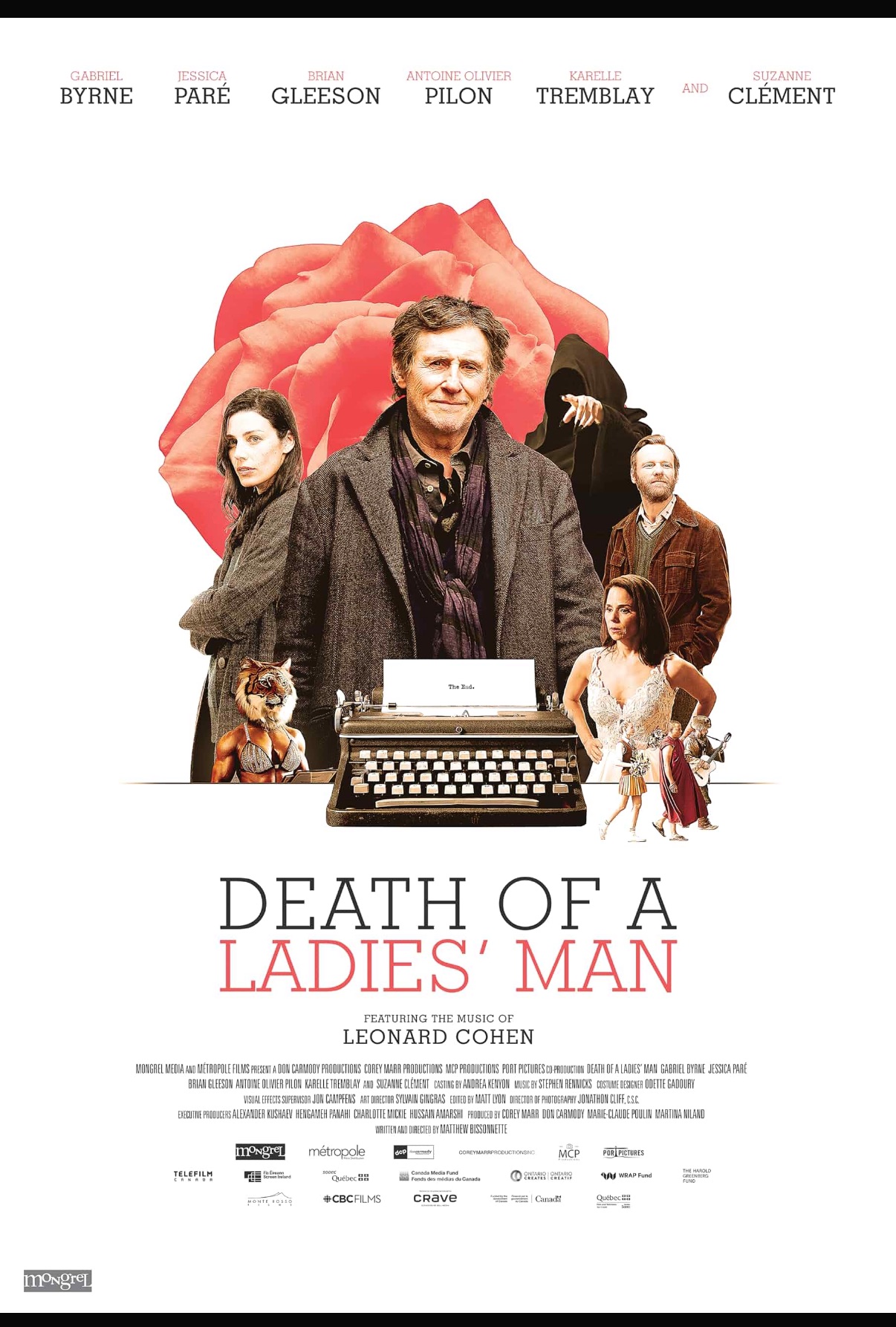
Greetings again from the darkness. For a film that takes its title from a 1977 Leonard Cohen album and includes (I counted seven) songs from the icon throughout the film, we can expect something other than a light-hearted rom-com. And that’s before we discover that the leading character is diagnosed with a brain tumor. Writer-director Matt Bissonnette’s film was well received on the festival circuit in 2021 and is now being released VOD.

Gabriel Byrne (brilliant, as usual) stars as Samuel O’Shea, a twice-divorced professor based in Montreal and spending entirely too much time with drink(s) in hand. Samuel begins experiencing hallucinations … all too real hallucinations. Initially these include the Frankenstein monster at the pub, and a bizarre, choreographed hockey ice dance at his son’s (Antoine Olivier Pilon) game. From there, the visions get even stranger – often including lip-synching to a Leonard Cohen song. One exception is the recurring vision of his late father (Brian Gleeson), who died as a young adult. These interactions are ‘normal’ conversations, often filled with fatherly advice.

Once he receives the fatal diagnosis, Samuel does what anyone would do – he heads to the family cottage in Ireland in order to take stock of his life. He also decides to write the novel that he’s always wanted to write. This stage of life (waiting to die) and writing the novel can both take many shapes. In fact, Samuel’s novel is about his life, his regrets, and about whether a late-life romantic relationship can work. Charlotte Lafleur (Jessica Pare, “Mad Men”) enters, having a significant impact on Samuel, his outlook, and his writing.

Younger viewers may find this one a bit difficult to connect with; however, I expect many of those over age 50 will relate very well to what Samuel goes through. The film was well received on the festival circuit in 2021 and is only now getting streaming distribution. It’s not perfect, yet it’s a creative view of what one experiences after being told their time is limited.

Releasing on VOD beginning September 26, 2025

WATCH THE TRAILER


HALLELUJAH: LEONARD COHEN, A JOURNEY, A SONG (2022, doc)

July 1, 2022

Greetings again from the darkness. He’s not an easy man to figure out. His many written and spoken words can be challenging to interpret, and his art comes in many forms: poems, novels, drawings, and songs. Leonard Cohen was an enigma, yet also a treasure trove of thought-provoking work crafted over fifty years. Collaborators for more than 25 years, documentarians Daniel Geller and Dayna Goldfine knew tackling Cohen as a subject would be too much, so by taking inspiration from Alan Light’s book, “The Holy or the Broken: Leonard Cohen, Jeff Buckley, and the Unlikely Ascent of ‘Hallelujah’”, they were able to approach him through his most recognizable and most oft-covered song, “Hallelujah.” The result is a captivating two hours that will appeal to Leonard Cohen devotees and enlighten those new to his work.

We open on December 21, 2013 in Auckland, New Zealand. Leonard Cohen is on stage and sings the immediately recognizable first “secret chord” line of “Hallelujah.” This would be his final live performance. Someone offers the description of LC as “a spiritual seeker”, and that appears to have been the case most of his life. Perhaps there is no better evidence of this than his pursuit of writing lyrics to “Hallelujah.” We see the dozens of notebooks filled with his handwritten lyrics. We know there are multiple versions of the song, and Leonard admits the song was never finished … it was ever-evolving, same as the writer. Although Cohen passed away in 2016 and was not interviewed for this film, precious archival footage allows us to see him expressing his own thoughts alongside new and recorded interviews of those who knew him for so long.

The great Judy Collins tells of the time she encouraged Leonard to come on stage and sing his song “Suzanne” with her. It was 1966 and though to that point, he had been mostly a poet, he now immersed himself and his words into songwriting. In regards to his poetry, so many believe one must suffer to have anything of value to say; however, Leonard was born into a wealthy family, and he created reems of meaningful passages as a deep thinker and observer. Other terrific interviews come courtesy of music journalist “Ratso” Sloman (who also shared tapes of his own Leonard interviews with the filmmakers), long time back-up singer and co-writer Sharon Robinson, Cohen’s former girlfriend and renowned photographer Dominique Isserman, lifelong friend and fellow Canadian Nancy Bacal, Canadian journalist and lifelong friend Adrienne Clarkson, and John Lissauer who first produced “Hallelujah” and also composed the score to this documentary.

The song itself took a journey worth exploring. Leonard initially worked on the lyrics for years. Once the song was recorded, it (and the entire album, ‘Various Positions’) was rejected by Columbia, the record label that had already paid for it. The album and song were finally released on a small independent label. Ultimately, Bob Dylan began performing the song in concert, and it was gradually adopted by other artists, and reached mainstream status when it was included in the animated hit movie, SHREK. How is that for an unusual journey for a song?

Even the SHREK saga wasn’t straightforward. Rather than use Cohen’s version of the song, the director chose the version sung by Rufus Wainwright, but then decided it didn’t fit, and shifted to the John Cale version. As a final twist, it’s Wainwright’s version on the released movie soundtrack. It’s not just the lyrics that have multiple versions. As of last count, more than 200 artists have their own version, with those of John Cale and Jeff Buckley being the most frequently listened to. Both get their due in this documentary, and it’s quite moving to compare the different approaches … one’s mood must be the determining factor on which fits the moment, as it’s impossible to say one is “better” than the other. We also hear from other artists who testify to the song’s personal importance to them. And to reinforce the point of how the song has become part of the fabric of society, there is a montage of TV contestants singing their version in hopes of moving on to the next stage.

Although the filmmakers use “Hallelujah” as the structural force for this film, they expertly weave in Leonard Cohen’s personal history throughout. They remind us that his early song “Suzanne” was written well before he met and married Suzanne Elrod. We hear a bit from the cringe-inducing partnership with producer Phil Spector for one album. The filmmakers highlight Cohen’s 1993 decision to isolate at the Mount Baldy Zen Center through 1999, before returning ‘back down the hill’ to write more songs. It was in 2005 when Cohen discovered that his long time manager had bilked him out of his earnings and assets. This sent Leonard back on tour for the first time in 15 years … he performed 379 shows over 5 years, thrilling his fans and introducing many new ones to his music.

There have been other documents focusing on Leonard Cohen, most notably, LEONARD COHEN: I’M YOUR MAN (2005), and MARIANNE & LEONARD: WORDS OF LOVE (2019). Both have their merits, yet neither capture the remarkable story of this ‘spiritual seeker’ as thoroughly as this one. He was an unusual and remarkable man who wrote, “I did my best. It wasn’t much.” Maybe the only false words he ever penned.

Opens in theaters beginning July 1, 2022

WATCH THE TRAILER

THE BRIDE (2016, La Novia, Spain)

February 16, 2017

the-bride Greetings again from the darkness. The pitch for this movie might have come across as blending a Greek tragedy with a romance novel, and then adding a dash of revenge. Fortunately director Paula Ortiz’s vision for the Federico Garcia Lorca play “Bodas de sangre” is more poetic and lyrical than such an overview would suggest.

Love triangles are the core of many stories and movies, but it’s the opening sequence here that clues us in that the trouble has already occurred, and though it removes some of the suspense of “what”, it certainly sets the stage for an interesting “how” and “why”.

Inma Cuesta plays Novia (billed only as the titular bride) who is engaged to Asier Etxeandia (billed only as Novio, the groom). The abundance of family stress (on both sides) has little to do with the wedding plans, and more to do with Leonardo (Alex Garcia). Leonardo is more than the local hunk who is always lurking about on horseback; he’s also the third wheel who can’t let go of his desire for Novia … in spite of his young child and pregnant wife. To make things messier, Novia seems to answer his heightened desire for her with her own uncontrollable passion for him.

It’s Yin and Yang. Safe and Dangerous. The bride’s conflicted choice leads the groom’s mother (Goya winner Luisa Gavasa) to be a foreboding presence throughout, and keeps most of the village on edge. Additionally, there is an element of mysticism as Maria Alfonsa Rossa appears periodically as the figure of death – and we are never quite sure of the motivations behind her advice.

Goya winner Miguel Amoedo provides beautiful cinematography that balances between fantasy, harsh realities, and the romance of the moment. There are many intimate close-ups, as well as some stunning desert wide shots of Leonardo riding the horse. The score and soundtrack are terrific, including Soledad Velez with a haunting version of Leonard Cohen’s “Take this Waltz”.

The concept of destiny vs. choice hovers over most scenes, and the twisted family and childhood histories give the film a Shakespearian feel. Last year, the film received numerous Goya nominations (including Ms. Cuesta, Ms. Ortiz, Mr. Garcia) are resulted in the wins for Ms. Gavasa and Mr. Amoedo. It may not make the best Valentine’s Day date movie, but it is an interesting watch from the romance-tragedy-revenge-horseback genre.

watch the trailer:


A SONG FOR YOU: THE AUSTIN CITY LIMITS STORY (doc, 2016)

May 1, 2016

Dallas International Film Festival 2016

a song for you Greetings again from the darkness. It’s difficult to believe now, but Austin City Limits was once “the little engine that could” … and now it’s the longest running music program on television. Willie Nelson played the 1974 pilot, and the rest – as they say – is history … and continues to be history in the making.

This is a show about music.” That simple quote from the film says a great deal. There is no place to hide on the small stage in the small studio with the audience right on top of you. These aren’t music videos, but rather these are the artists performing their songs live in an intimate setting (with the ever-present TV cameras).

Director Keith Maitland, who also presented his powerful documentary Tower at the festival, spends a great deal of time allowing producer Terry Lickona to reminisce and tell stories about how the show has always walked a fine line between success and the threat of cancellation … what’s also known as life in public television.

Much of the structure of the film is around the show’s 40th anniversary and the formulating of the initial class of the ACL Hall of Fame. As interesting as it is to listen to Mr. Lickona and ACL founder Bill Arhos, it’s the music that shines here. There are too many clips to name here, and certainly some of the choices speak to the age of the director, but the highlights include a soulful Townes Van Zandt in 1976, a spirited Lightnin’ Hopkins in 1979, Ray Charles (and a shot of my head in the crowd) in 1980, the infamous Stevie Ray Vaughn show in 1983, and the always smooth and debonair Leonard Cohen from 1989. There are also clips of The Pixies, Radiohead, Dolly Parton, Buddy Guy and, well, just too many to name … yet somehow not enough.

We also see Lyle Lovett’s show which was the final filming in the original Studio 6A, before ACL got a building/studio designed just for them (one a bit more fire code friendly). It’s a wonderful trip down Memory Lane for someone like me who spent many a night in the old studio, and for those of us who have so appreciated the straightforward approach to music that the TV show has maintained through the years.

http://www.asongforyoufilm.com/

a song for you2


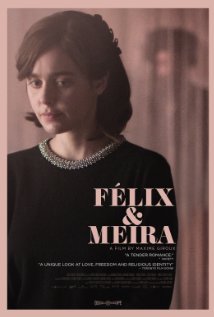
FELIX AND MEIRA (2015)

May 21, 2015

felix Greetings again from the darkness. This movie is filled with quiet and stillness. Maybe moreso than any movie I can recall. With a backdrop of Montreal, New York and Venice, and a theme of forbidden love and self-discovery, the quiet of the actors belie the undercurrent of emotion driving the three leads.

Meira (Hadas Yaron) is a Hasidic Jew living with her husband Shulem (Luzer Twersky) and their toddler daughter within an Orthodox community where women are forbidden from listening to “outside” music, creating art, or even looking men directly in the eye. Their mission in life is to serve their husband, have lots of babies, and respect the religion. While many women in the community seem fine with their lot, Meira hides records under the sofa, draws pictures in a pocket-sized notebook, and longs for the excitement and color of the real world.

One day, by happenstance, the paths of Meira and Felix (Martin Dubreuil) cross in a neighborhood corner store. He compliments her on her drawing, as she tries to ignore him. By the time they next meet, we have witnessed the painful bedside farewell of Felix to his dying father. It’s difficult to tell which is the stronger emotion here – guilt or grief.

Soon enough Felix and Meira are finding ways to meet, but there is no crazed display of passion between the two. There is a devastating scene as Felix patiently waits while Meira musters the courage to actually look into his eyes. It’s like 50 Shades of Restraint. It turns out, for different reasons, these two lost souls share a common bond of loneliness. Meira‘s individuality and creativity are stifled by religious oppression, while Felix is coming to grips as the black sheep of a family that no longer exists. When Felix says of his father, “He hated me to death. And then he died.”, we understand it’s the missed opportunity that weighs on him more than the passing of a long-lost parent.

Music plays a vital role in how director Maxine Giroux presents the characters and the story. Wendy Rene’s “After Laughter Comes the Tears” is used beautifully, as is Leonard Cohen’s “Famous Blue Raincoat”. Heck, even a mousetrap becomes music to the desperate ears of Meira. As stated before, the film is incredibly quiet, and I challenge any movie lover to come up with a more painful argument than the one featuring Meira and Shulem whispering at each other from separate beds, or a more powerful scene with fewer spoken words than Shulem and Felix at the kitchen table. On the bright side, watching her walk around in her first ever pair of jeans is a freeing sight to behold.

Mr. Giroux presents something very real, yet outside the bounds of what cinema usually brings when forbidden love, religion, loneliness and grief are involved. Ms. Yaron delivers an astounding performance, and it’s little wonder this has been such a hit on the festival circuit.

watch the trailer: