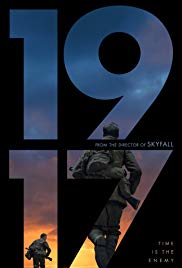
 Greetings again from the darkness. It’s now been over 100 years since World War I ended. The Great War garners barely a mention in high school history books these days, and Hollywood has devoted much more time and energy to WWII. Filmmaker Peter Jackson did his part with last year’s stunning documentary THEY SHALL NOT GROW OLD, a video and photographic look at the actual people involved in the First World War. And now, Oscar winning director Sam Mendes (AMERICAN BEAUTY) delivers another glimpse … and another technical marvel.
Mr. Mendes, working with Oscar winning Cinematographer Roger Deakins (BLADE RUNNER 2049) and Oscar winning Film Editor Lee Smith (DUNKIRK), has shot and edited the film to give the look of one continuous take in real time. Although used previously in such films as Hitchcock’s ROPE and Inarritu’s BIRDMAN, the single take approach is certainly no gimmick here. We open on two young British soldiers lounging in a prairie as they are summoned to report to the commander. Their mission is described as critical, as a British battalion is preparing to walk into a deadly trap set by the Germans. More than 1600 lives are at stake and the phone lines are down. It’s up to Lance Corporal Blake and Lance Corporal Schofield to work their way across No Man’s Land to the front line and hand-deliver an order stopping the attack. Oh, and one more detail: Blake’s older brother is in the battalion he is tasked with warning.
The real time approach serves the purpose of allowing viewers to take on the urgency of Blake and Schofield. We experience the tension and horrors of war. Barbed wire, booby traps, slushy trenches, snipers, rats, dead bodies, dogfights (the aerial type) and towns under siege all play a part here as the men rush towards their goal of saving fellow soldiers lives, including a beloved family member. Dean-Charles Chapman (“Game of Thrones”) plays Blake, and George MacKay (CAPTAIN FANTASTIC) plays Schofield. We spot the personality differences between them. Blake is super focused and determined to save his brother, while Schofield doesn’t welcome the assignment, but is a dutiful soldier and loyal friend.
It’s really the Schofield character with whom the viewer mostly relates. He’s no super soldier or Jason Bourne-type, but rather a young man trying to stay alive and fulfill his orders. With the relentless pacing of the film, we feel the fear and admire the courage. There is an especially touching scene in a bombed-out town where paths are crossed with a French woman (Claire Duburcq) caring for an orphaned infant. It’s a reminder that humanity still exists, even within the bounds of war.
There is no clock ticking in the corner of the screen, but we know time is of the essence, and quite limited. The camera seems to be always moving forward, rarely allowing for us or the characters to exhale. As you might expect, running is done frequently – sometimes towards something, sometimes from it. Roger Deakins is in prime form here with his camera, and there are too many remarkable moments to mention them all; however, the river rapids and waterfall, and the town under siege at night, are two of the most incredible sequences I’ve seen on screen.
Along the journey, some familiar faces pop up as military men: Andrew Scott, Benedict Cumberbatch, Richard Madden, Mark Strong, and Colin Firth. Although each appears only briefly, it’s a testament to their acting prowess that each is memorable. The chaos and relentless terror of war is on display, more often than not. But this isn’t a film designed to create deep thoughts or serious debates on the merits of war. Instead, it’s meant to focus on one of the countless personal stories that occur during war. War is fought by people, not faceless countries, and each person has their own story.
Non-linear story telling has been a movie-thing since even before MEMENTO, but director Mendes (and co-writer Kristy Wilson-Cairns, “Penny Dreadful”) show us the true presentation of linear … in the moment and by the moment. GALLIPOLI and PATHS OF GLORY are about the closest comparisons I can come up with, and the weight of the film is felt physically and emotionally as we are drawn in. The exceptional score from Thomas Newman (14 time Oscar nominee) serves to accentuate the chaos and relentless terror. It’s a work of art and a unique viewing experience.
watch the trailer:


 Posted by David Ferguson
 Movie Reviews from the Dark