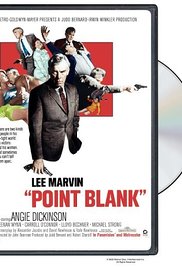
 Greetings again from the darkness. In the not-inconsequential sub-genre of 1960’s tough guy crime thrillers, it’s tough to beat this neo-noir that carries the lineage of a fine wine, but the taste of a stout beer. Familiar faces are everywhere, bullets fly, double-crossing is expected, Angie flaunts, and revenge is the mission.
While not a box office hit on its release in 1967, the film grew into a cult classic and is now appreciated as one of the era’s best. The set-up is certainly not too complicated. During a heist (filmed at Alcatraz), one of the gang members shoots another at “point blank” range and takes off with both the money and the poor guy’s wife. The shot guy survives and seeks his money ($93,000) and revenge on those who wronged him.
Sure it sounds simple and common, but it’s made special thanks to top notch work from the writer, director, cinematographer, composer and cast. The story (adapted by Alexander Jacobs, David Newhouse, Rafe Newhouse) is based on “The Hunter” from acclaimed crime novelist Donald Westlake (as Richard Stark). The book was also the source material for Mel Gibson’s 1999 movie Payback. Oscar nominated director John Boorman (Deliverance 1972, Hope and Glory 1987) works with Oscar nominated cinematographer Philip H Lathrop (Earthquake 1974) to create a stylish and gritty look and feel, while Oscar winning composer Johnny Mandel (The Sandpiper, MASH theme) adds just the right musical touch.
If that’s not enough for you, Lee Marvin commands attention as the revenge-obsessed tough guy who won’t get fooled again. To call Lee Marvin a tough guy seems redundant and unnecessary, as his screen presence oozed dominance. He was coming off an Oscar win for Cat Ballou and one of his best performances in The Dirty Dozen. In other words, he was an actor at the peak of his Hollywood power.
Joining Mr. Marvin on screen is a prestigious group led by Angie Dickinson and Carroll O’Connor. With a career that spanned more than 50 years, Ms. Dickinson starred in such films as the original Ocean’s 11 and Brian DePalma’s homage to Hitchcock, Dressed to Kill. Of course, she also starred in one of the biggest TV shows of the 1970’s “Police Woman”. And speaking of 1970’s TV, few were more jarring to the culture than “All in the Family” with Carroll O’Connor as Archie Bunker. In this film, Ms. Dickinson plays the sister of Marvin’s double-crossing wife and she gets to flail away in anger at him before the two fall into bed together … a terrific piece of editing. Mr. O’Connor plays Brewster, one of the three heads of “the Organization”, and one of the targets that Marvin chases to retrieve his money.
Playing another of the three heads is Lloyd Bochner, who capitalized on his smooth demeanor and velvety voice during a 7 decade career in TV and movies. Mr. Bochner is the father of Hart Bochner, who (as Ellis) tried to out-smart Hans Gruber in Die Hard. Keenan Wynn appears as a mysterious figure feeding information to Marvin’s character to assist in his quest of taking down the organization. Mr. Wynn is the son of legendary entertainer Ed Wynn who was known for his work in vaudeville, Ziegfeld Follies, TV and movies (Mary Poppins). Keenan also appeared in many TV shows and movies, with Dr. Strangelove: Or How I Learned to Stop Worrying and Love the Bomb being his most famous. Appearing as Lynn, the two-timing wife, Sharon Acker was on the verge of movie stardom … only that stardom never came. By choosing to focus on TV roles, she had a nice long career, but never reached the superstar status many had predicted. Sandra Warner plays the waitress that Marvin talks to, and Ms. Warner simply walked away from the business after this role … despite a successful career that started when she was 18 years old. Yet another familiar face in the cast belongs to John Vernon, who was making his feature film debut. Here he plays the guy pulling the trigger at point blank range, and many will recognize him as Dean Wormer in Animal House. James Sikking plays the sharpshooter employed by the organization, and fans of “Hill Street Blues” will remember him as the slightly annoying Howard.
There are a few other notes of interest regarding actors in the movie … though you’ll have to look quickly. Sid Haig plays a henchman at the hotel. Mr. Haig has had a prolific career as a heavy, bad guy, villain, horror film staple, and even Tarantino favorite. Barbara Feldon, the beloved Agent 99 in “Get Smart” makes an appearance on a Ponds face cream commercial as Marvin watches TV, and Lauren Bacall is seen/heard quickly on a TV set as well. Also, Felix Silla has one scene as a hotel guard. The diminutive Mr. Silla also starred as Cousin Itt in “The Addams Family”. As a final note and shout out to “the Chevies”, it must be noted that Angie Dickinson and Keenan Wynn would also appear together in the deliciously twisted 1971 film Pretty Maids all in a Row from that lover of the female form, director Roger Vadim.
It’s pretty easy to see how all of these factors came together to create this cult favorite. From a filmmaking perspective, the use of flashbacks, editing and sound effects (footsteps) all add to the experience, as does Brewster’s stunning home – which in real life, now belongs to Drew Barrymore. If you are a fan of 1960’s film, it’s one you probably already have seen a few times, but if not, it’s one to watch if for no other reason that Lee Marvin firing shots into an empty bed … I’m still not sure how that was supposed to help him obtain his $93,000, but he really wants his money!
watch the trailer (it’s a hoot!):


 Posted by David Ferguson
 Movie Reviews from the Dark