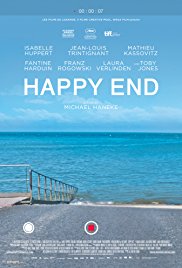
 Greetings again from the darkness. Austrian filmmaker Michael Haneke has blessed us with, what I consider, at least five excellent movies (AMOUR, THE WHITE RIBBON, CACHE, FUNNY GAMES, THE PIANO TEACHER), and though it’s been 5 years since his last, there is always a welcome anticipation for his next project. Unfortunately, this latest is esoteric and disjointed even beyond his usual style. In fact, at face value, it just seems only to be an accusation lobbed at the wealthy, stating that their privilege and cluelessness brings nothing but misery and difficulty to themselves and the rest of society.
We open on an unknown kid’s secretive cell phone video filming of her mother getting ready for bed, followed by the mistreatment of a pet hamster as a lab rat, and finally video of her mother passed out on the sofa – just prior to an ambulance being called. Our attention is then turned to a family estate in Calais, which is inhabited by the octogenarian patriarch Georges (Jean-Louis Trintigant), his doctor son Thomas (Mathieu Kassovitz) and daughter Anne (Isabelle Huppert), Anne’s malcontent son Pierre (Franz Rogowski), Thomas’ wife and infant son, and the Moroccan couple who are household servants. While her mother is being treated for an overdose, 13 year old Eve (Fantine Harduin), moves in to the estate (Thomas is her re-married father). It’s here that we learn the opening scenes were Eve’s video work … clearly establishing her as a damaged soul.
Initially, it seems as though we will see the family through Eve’s eye, but what follows instead is the peeling back of family layers exposing the darkness and menace that haunts each of these characters. Georges appears to be intent on finding a way out of the life that has imprisoned his body and is now slowly taking his mind through dementia. Thomas is carrying on an illicit affair through raunchy email exchanges. Anne is trying to protect the family construction business from the incompetence of her son Pierre, while also looking for love with solicitor Toby Jones. At times, we are empathetic towards Eve’s situation, but as soon as we let down our guard, her true colors emerge. The film is certainly at its best when Ms. Harduin’s Eve is front and center. Her scene with her grandfather Georges uncovers their respective motivators, and is chilling and easily the film’s finest moment.
The film was a Cannes Palme d’Or nominee, but we sense that was in respect to Mr. Haneke’s legacy, and not for this particular film. The disjointed pieces lack the necessary mortar, or even a linking thread necessary for a cohesive tale. What constitutes a happy end … or is one even possible? Perhaps that’s the theme, but the film leaves us with a feeling of incompleteness – or perhaps Haneke just gave up trying to find such an ending, and decided commentary on the “bourgeois bubble” was sufficient.
watch the trailer:


 Posted by David Ferguson



 Movie Reviews from the Dark