CONCLAVE (2024)

October 24, 2024

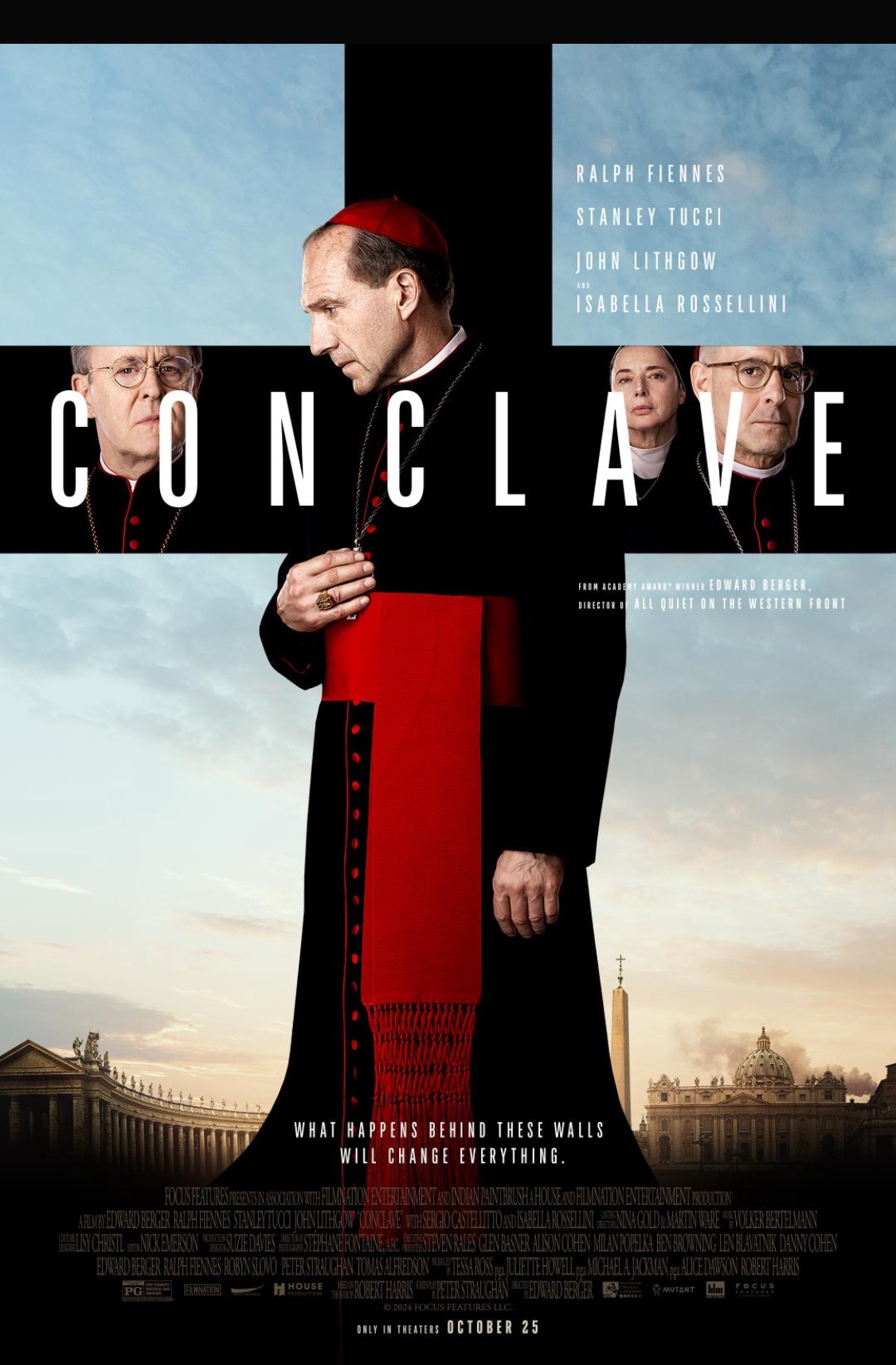
Greetings again from the darkness. It feels like it’s been a while since we had a good old fashioned serious-minded, tension-packed, “big” drama film featuring big movie stars. Well, that’s exactly what director Edward Berger, fresh off his Oscar-winning ALL QUIET ON THE WESTERN FRONT (2022), serves up with his latest. Writer Peter Straughan (TINKER TAILOR SOLDIER SPY, 2011) has adapted the 2016 Robert Harris novel, and the result is a welcome crowd-pleaser that may garner some Oscar consideration.

Ralph Fiennes delivers what may be his best performance yet. And that’s saying something for the much-respected actor who has previously excelled in such films as SCHINDLER’S LIST (1993), THE CONSTANT GARDENER (2005), IN BRUGES (2008), A BIGGER SPLASH (2018), and THE MENU (2022). His impressive career is only enhanced by this most recent role of Cardinal Lawrence, saddled with the heavy burden of facilitating the titular Conclave charged with electing the new Pope. As the film opens, the beloved Pope has just passed … and as they say, “let the games begin”. Of course, these games are all about political maneuverings and power struggles and backroom promises. Director Berger opts to show us very little of the actual negotiations, and instead puts the various iterations of loyalty on display during each successive secret (of course) vote.

Within the confined walls of Vatican City and the Sistine Chapel, Cardinal Lawrence’s time is mostly spent investigating tips, scolding others for their behavior, and dealing with the immense egos of the few being considered (including himself). Stanley Tucci plays Cardinal Bellini, who pretends to not want the job while campaigning as the ‘progressive’ voice the church needs now. John Lithgow is Cardinal Tremblay, one of the most assertively ambitious who may or may not have purposefully undermined the work of another. Either way, Lucian Msamati’s Cardinal Adivemi is the victim of Tremblay’s actions. Cardinal Tedesco, portrayed by Sergio Castellitto, is the most outspoken in his desire to return the church to the old ways (Latin masses forever!), what he sees as proper. Bryan F O’Byrne plays O’Malley, assistant to Lawrence, and yet, despite all of these men, it’s Isabella Rossellini as Sister Agnes who manages to shoot (figurative) fire from her eyes, while maintaining her ‘place’ and significantly impacting the process. She is stunning and memorable in her limited role.

Early on, a big surprise arrives in the form of Cardinal Benitez (Carlos Diehz) of Kabul, who was the most recent appointee by the previous Pope, and unknown to the others. As a novel, this may be a real page-turner, and yet the movie never rushes from one moment to the next. Tension builds with each revelation and tarnished robe and secretive plot. Although the film barely skims the years-long sexual abuse scandal in the church, there is a stream of twists and turns that keep us on our toes as the Cardinals are sequestered. It’s fascinating to see how cinematographer Stephane Fontaine keeps things visually interesting in an enclosed environment filled with characters who aren’t allowed to go anywhere else. Another aspect I truly appreciated was the unusual musical score composed by Oscar winner Volker Bertelmann. This is the type of movie which often features overbearing music to ‘enhance’ tension, yet Bertelmann’s notes are effective jabs at just the right times.

Power plays, corruption, and political stunts are all present as these Men of God bungle the process of picking their next leader. Importance of the mission and tradition pale in comparison to ego and self-interest. The symmetry to U.S. politics is unmistakable and surely a purposeful approach by Berger. The final twist may be a bit out of proverbial left field, but in a room filled with secrets, perhaps that’s as it should be. To balance the tension and seriousness, anyone paying attention will appreciate the subtle humor, especially as it plays out as these relics muddle through modern day situations (technology, social progressiveness, terrorism). This is certainly not a film created for Catholics only, although for a brief moment, I worried we might have one that could be subtitled, “The Catholic Crying Game”. Fortunately, it’s one with a tension-filled story, terrific visual shots, a perfect score, and superb acting … a fun movie to watch.

Opening in theaters on October 25, 2024

WATCH THE TRAILER


SPACEMAN (2024)

February 29, 2024

Greetings again from the darkness. Have you hugged a spider today? Adam Sandler has. Well, technically it’s his character who does the hugging. Jakub Prochazka, is a Czech astronaut 189 days into his year long mission. He’s flying solo on “the outskirts of Jupiter” to explore the Chopra cloud which is expected to reveal the beginning of time.  Honestly, it feels like a job worthy of more than one man, however, that’s what the source material provides. Based on the 2017 book “Spaceman of Bohemia” by Jaroslav Kalfar, Johan Renck directs the adapted screenplay by Colby Day. Mr. Renck is not one that jumps to mind when thinking of an Adam Sandler movie. His previous credits include the excellent mini-series “Chernobyl”, as well as multiple episodes of acclaimed series, “Breaking Bad” and “Bloodline”.

The reality is that Adam Sandler is a solid dramatic actor, as evidenced by his roles in PUNCH-DRUNK LOVE (2002), and more recently, THE MEYEROWITZ STORIES (2017) and UNCUT GEMS (2019). In fact, many of us much prefer heavy-drama Sandler to goofy-comedy Sandler. In this latest, he goes low-key extreme. In fact, Jakub is rapidly sinking into depression, though it has little to do with the loneliness and solitude of space. That’s right … it’s a woman. His pregnant wife, Lenka (the always stellar Carey Mulligan) is missing and won’t communicate with her galactic husband. We know what’s going on with her, but the mission Commander (Isabella Rossellini) refuses to tell Jakub due to his fragile mental state. On top of that, his deteriorating spacecraft is preventing him from sleeping properly.

Soon, that rickety old space toilet is the least of Jakub’s worries. He’s sharing the claustrophobic space with a giant talking spider. Jakub is unsure if this is a figment of his imagination or some alien creature. Passively voiced by Paul Dano, Hanus the arachnid initially appears to be a manifestation of Jakub’s subconscious, but as time goes on, it appears he’s a creature with knowledge of the universe. The low-key vocals from Jakub and Hanus don’t generate much excitement for us viewers, but the therapy Hanus provides, allows Jakub to better understand himself … and also drives Hanus to binge eat. There are no Sandler tantrums or screaming moments … instead his sad eyes and droopy face tell us much about Jakub.

Hanus calls Jakub “skinny human” so many times, it feels like that should be the film’s title. It gets old pretty quickly. Other supporting work comes from Kunal Nayyar as Jakub’s virtual doc, and Lena Olin as Lenka’s mother, although the film struggles to give anyone beyond Jakub much definition (including the underutilized Mulligan). It’s a bit baffling to look at this cast and associate them with the Czech Republic space program, but it’s Hollywood, where the 20-year age cap between Sandler and Mulligan also matters little. The film spent almost three years in post-production for reasons I don’t know, but it’s safe to say it’s one of the better talking spider movies you’ll see, yet not one of the finest lonely astronaut flicks.

Begins streaming on Netflix on March 1, 2024

WATCH THE TRAILER


MARCEL THE SHELL WITH SHOES ON (2022)

July 7, 2022

Greetings again from the darkness. For proof that social media and the internet can be used for good, I offer as evidence this film from writer-director Dean Fleisher-Camp and co-writers Elizabeth Holm, Nick Paley, and Jenny Slate. The first ‘Marcel’ short film hit the internet in 2010 and was such a hit that there were two follow-up short films and a best-selling picture book. Now expanded to a feature length film of 90 minutes, the innovative and curious premise holds up due to the fully-formed character of a precious one-googly-eyed mollusk shell wearing … yes … shoes.

Why do we connect with Marcel? Well, the instantly recognized voice created by Jenny Slate plays a huge part. There is a welcoming innocence in the wispy tone, and when combined with the exceptional writing, the result is a relatable character full of warmth and wit, and pain and humor. Marcel is naïve, yet persistent. He’s someone we like and pull for. The story is told via faux-documentary as a filmmaker (played by director Fleisher-Camp) stays in the Airbnb where Marcel lives with his aging grandmother Connie (voiced by Isabella Rossellini). During interviews, we learn that Marcel longs for his family and community that was disrupted when the home’s original owners broke up and moved out. Since then, Marcel has looked after his grandmother and helped her tend the garden. They have been quite creative in their use of household resources, including a tennis ball for transportation.

The filmmaker posts the interviews online and soon Marcel has a huge following, giving him hope that his family can be tracked down. This leads to a terrific “60 Minutes” segment with journalist Leslie Stahl. The best description I can offer of Marcel is adorable – not a word I use very often. Marcel forces us to view the world through a child’s eye, but it’s important to note, that while young children may find Marcel cute, the dialogue, wit, and life issues covered will be way over their heads (though not offensive in the least). Young kids (under 10) should probably stick to the shorts. The sad and painful context is balanced by sweetness and optimism. Marcel’s story inspires us to embrace all stages of life with an open heart and mind – dealing with grief and sadness, while coming out the other side with spirit intact.

A24 specializes in distributing innovative and creative movies, and this certainly qualifies. It’s not really a mockumentary because it’s not mocking anything. The stop-motion approach in documentary style may initially seem like whimsy, but we quickly realize it’s more substantive. Individual strength and the power of community are on full display, and somehow Marcel the Shell teaches us … while wearing shoes.

Opens in theaters on July 8, 2022

WATCH THE TRAILER


VITA & VIRGINIA (2019)

August 22, 2019

 Greetings again from the darkness. The historical landscape of relationships is littered with the remains of artist couples who began with a cosmic connection and ended with a sonic boom. Add in the socially toxic matter of same-sex attraction from a century ago, and you have a starting point for the romance-friendship-inspiration between writers Vita Sackville-West and Virginia Woolf. Director Chanya Button co-wrote the script with Eileen Atkins, and it’s adapted from Ms. Atkins play and the personal letters of Virginia and Vita … correspondence that covered many years and hundreds of letters.

Gemma Arterton (TAMARA DREWE, 2010 and QUANTUM OF SOLACE, 2008) stars as writer Vita Sackville-West, a successful poet, novelist, and columnist. Vita was also known for her free spirited ways, and sometimes scandalous behavior. Virginia Woolf is played by Elizabeth Debicki (“The Night Manager”, THE GREAT GATSBY), and she does really nice work capturing the troubled genius, and the glimmers of hope during her time with Vita. The two women were so very different in their approach to life and writing, although each faced their own challenges.

We see their first meeting, and the immediate enchantment that occurs as their eyes meet across the room. However, what makes their relationship interesting is the long and winding path to consummation. The interesting parts come as Vita toys with the fragile Virginia, though it’s clear their connection is quite strong. Though the connection was strong, the relationship was quite complex. Vita was a fan of Virginia’s talent. Virginia was an admirer of Vita’s strength and confidence. They seemed to push each other – sometimes for the better, other times for the worse.

The film opens as Ms. Woolf’s book “Jacob’s Room” is being typeset and printed. It’s quite an artistic way to show the mechanics of the process, and credit goes to Cinematographer Carlos De Carvalho for a segment that would typically be little more than filler. We learn about Vita’s secretly “open” marriage to diplomat Harold Nicholson (Rupert Penry-Jones) and her constant battle with her mother Lady Sackville (Isabella Rossellini) over scandals and the family reputation. Virginia’s husband Leonard (Peter Ferdinando) runs their printing business, and is seen as vital to his wife’s emotional stability, despite the void in other marital aspects. Virginia’s artist sister Vanessa Bell (Emerald Fennell) is quite an interesting character whose backstory (also a part of the Bloomsbury Group) is teased enough that she might deserve her own film.

The film features a couple of memorable lines of dialogue, both spoken by Vita. During a BBC radio program she boldly claims “Independence has no sex”, and in an early discussion with Virginia states “Popularity is no sign of genius”. Vita’s brazen step traveling as a man with her previous lover Violet Keppel is mentioned, but mostly this is focused on the class differences and the ‘snatched moments’ for Vita and Virginia. Vita’s exotic spirit and Virginia’s struggle with mental health are made clear (even using special effects for the latter). “Visions” of conversations bring the words on the letter pages to life, though it does seem that the filmmakers played things a bit too safe in order to capture a mainstream audience. The music of Isobel Waller-Bridge (Phoebe’s sister) brings a contemporary feel but it’s at times in contrast to the high gloss presentation. For the women who wrote and inspired the amazing novel “Orlando”, and led one of the more tumultuous historical lesbian affairs, it could be argued that they deserved a bit more risk taking on the big screen. Still, “X” marks the spot for Virginia’s writing room, and we do understand why discretion might be the right call.

watch the trailer:


INCREDIBLES 2 (2018)

June 12, 2018

 Greetings again from the darkness. In 2004 THE INCREDIBLES became the 6th Pixar film in a row to dominate the box office, and also the 6th straight to “WOW” us with a combination of animation, story, action and characters. All these years later, Brad Bird, the creative force behind the original, is back with the much anticipated sequel. Mr. Bird’s career over those years has featured a blend of other animation (RATATOUILLE, 2007) and live-action (MISSION: IMPOSSIBLE – GHOST PROTOCOL).

Bird is not the only returnee for the sequel. Also back is the entire Parr Family: Holly Hunter as Elastigirl/Helen/Mom, Craig T Nelson as Mr. Incredible/Bob/Dad, Sarah Vowell as Violet, Huck Milner as Dash, and Eli Fucile as baby Jack Jack. The story picks up not long after the original ended. “Supers” have been outlawed, and the Parrs are in some type of Super Protection Program – similar to Witness Protection. Of course when one is a superhero, doing the right thing just comes naturally, and the opening scene finds them battling their old nemesis Underminer (voiced by Pixar good luck charm John Ratzenberger, who voices a character in each of the studio’s films). Our heroes stop the crime, but cause significant damage to the city. This leads to our first social commentary when the powers that be scold the Parrs and inform them that the banks have insurance, and it’s cheaper to let the criminals get away so that the damage is minimized.

As superheroes non-grata, the Parrs try to go “straight” and live a normal life. That is until a powerful brother and sister corporate duo offer a proposal. Winston Deavor (Bob Odenkirk) and Evelyn Deavor (twist that pronunciation just a bit, voiced by Catherine Keener) want to generate a PR plan to help rebuild the reputation of supers. The idea is to make Elastigirl the public face of the program by having her wear a body cam to show off her heroic deeds (in this age of ‘pics or it didn’t happen’). She’s chosen over Mr. Incredible for economic reasons, and he’s relegated to stay-at-home parent (or as we called Michael Keaton in 1983, MR. MOM – an unacceptable sexist term these days).

Elastigirl enjoys her time in the limelight, while Bob doesn’t much like being just Bob. Plus he can’t understand why they changed math, as he gets frustrated trying to help Dash with his homework. He’s also challenged with Violet’s teen angst over a boy, and even moreso over the discovery that Jack Jack has POWERS! In fact, Jack Jack has multiple powers, but as a baby, he has little control – though his battle with a raccoon is not a segment you’ll soon forget.

Also returning is Frozone – voiced by Samuel L. Jackson (minus his trademark “MF’er), and costume designer Edna Mode – voiced by director Bird. Other new voices include (Odenkirk’s fellow “Better Call Saul” castmate) Jonathan Banks as Rick Dicker, Isabella Rossellini as the Ambassador, and Sophia Bush as Voyd, one of the new generation supers (which includes Reflux – one you’ll just have to experience).

The big new villain causing problems for Elastigirl is ScreenSlaver, who hypnotizes large groups of people through their screens – more social commentary on our dependence on technology and the addiction/affliction we have toward device screens. The flood of superhero movies over the years since THE INCREDIBLES exposes the not-so-complex story in this one, but it’s terrific that the film keeps much of the original look and feel, and yet brings something new … baby Jack Jack is a star!

Filled with the beautiful colors and art design we’ve come to take for granted from Pixar, the film also features some of the best action sequences you’ll see in any movie. The train sequence with Elastigirl is simply spectacular – as is the final action sequence. It’s also nice to see the flip in gender roles as Mom (Holly Hunter) takes the lead. Michael Giacchino returns as the composer and he blends in a touch of James Bond theme with his wonderful work. If the film needed extra credit (which it doesn’t), certainly the inclusion of a “Jonny Quest” clip would qualify. Family films don’t get much better than this, and even though it runs 2 hours, the closing credits feature the theme song for each of the superheroes, and could easily have been a short film unto itself.

Speaking of short films, a Pixar tradition is to include one before new releases. This time it’s BAO, a Chinese mother/son and food-oriented story from director Domee Shi (animator on INSIDE OUT)

watch the trailer:


JOY (2015)

December 26, 2015

joy Greetings again from the darkness. The movie is inspired by the true story of entrepreneur Joy Mangano (listed here as an Executive Producer) and her 1990 invention of the Miracle Mop. You should know that neither “Mangano” nor “Miracle Mop” is mentioned, and much of the story sprung from the mind of writer/director David O Russell. Also, if you have been a fan of Mr. Russell’s past few Oscar nominated films (American Hustle, Silver Linings Playbook, The Fighter), you should be warned that even though there is a large cast of familiar supporting players, it doesn’t play like his usual ensemble piece, but rather as a true star vehicle for Jennifer Lawrence (who plays Joy).

This is a working class Italian-American family, and the multi-generational aspect is in full play as Joy (a single, working mom) and her two kids share the house with Mimi (Joy’s grandmother played by Diane Ladd), Joy’s mom (Virginia Madsen) who is a recluse dressed in 60’s party attire and addicted to daytime soap operas, and Joy’s dad (Robert DeNiro) and her ex-husband Tony (Edgar Ramirez) who share the basement. Tony is the rare combination of slacker-Tom Jones impersonator. Also involved are Joy’s agitating and envious step-sister Peggy (Elizabeth Rohm) and Dad’s new wealthy girlfriend Trudy (Isabella Rossellini). This family makes The Royal Tenenbaums look suburban stale.

Flashbacks and dreams, along with the supportive words of Mimi, convince us that Joy is a creative genius, whose once promising abilities have been stifled by the harsh realities of raising kids, and overseeing a bunch of free-loaders who mostly never miss a chance to steal a bit of Joy’s light. All of that changes one day thanks to glass shards in her palm and the close proximity of crayons and drawing paper. Poof! Just like that, Joy has invented a revolutionary new kind of mop.

Given her family history and current situation, even when things go right for Joy, they never go all the way right. Having to borrow money from Trudy and depend on those who may or may not have her best interest at heart, makes for an endless chain of obstacles and challenges. But Joy is all about perseverance and self-actualization. The story emphasizes Joy’s stick-to-it-ness, and the process of learning about the legalities and pitfalls of starting and running one’s own business. Even those who should be supportive often ridicule and voice their doubts.

The film shifts when Joy meets Neal Walker (Bradley Cooper) who runs QVC. This was the time period when TV home shopping was in its infancy. Joan Rivers (played here by her daughter Melissa) was one of the early stars, and Joy’s Miracle Mop was one of the early successes. It’s a new world to Joy, but she’s a quick study and her tough-mindedness and sense of fairness and right come in to play on multiple occasions.

The above is much more story than I would typically describe, but it helps make the point that although Jennifer Lawrence continues to prove she is something quite special as an actress, the story is a bit of a mess and the pacing of the film is clumsy – slapstick blended with ultra-serious. It’s impossible to connect with this oddball group of folks, who mostly seem to be pulled right off of various TV sitcoms. Even using the soap opera (complete with Susan Lucci, Donna Mills, and Laura Wright) as a parallel to Joy’s life never quite works.

Jennifer Lawrence’s performance deserves to be ranked right with Joan Crawford’s in Mildred Pierce, but the different styles of the two movies results in only one being unforgettable. Director Russell mines the fractured family/group in many of his projects, and given his immense talent, we can be sure future projects will be more in line with the level of his recent past.

watch the trailer:


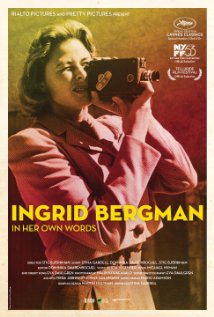
INGRID BERGMAN IN HER OWN WORDS (2015, doc)

November 12, 2015

ingrid Greetings again from the darkness. A seven time Oscar nominee and three time winner. One of the best known and most beloved actresses of all-time. Fifty year acting career. Died at age 67, mere weeks after her final performance. These are all bullet points to highlight Ingrid Bergman, the cinematic icon. However, documentarian (and fellow Swede) Stig Bjorkman pays little attention to the icon, and instead focuses on the woman.

What sets this apart from many biographical portraits is Bjorkman’s access to Bergman’s diaries, journals, personal letters, photos, home videos, and most importantly, interviews with her four children: Pia Lindstrom, Roberto Rossellini, and twins Isabella and Ingrid Rossellini. It’s a treasure trove of memories, documentation and insight into a woman who lived life on her own terms … often in direct opposition to what societal norms dictate. The film neither defends nor celebrates her free spirit; it simply reports it and allows us to sit in judgment, should we be so inclined.

One of the best clips is young Ingrid’s screen test where her natural beauty radiates on screen, and her expressive eyes make it obvious why David O Selznick recognized her star quality. But there are numerous other clips and photographs which show her mostly involved with her family … one of her husbands and some combination of her kids. Not fitting into the typical “motherly” box, Ingrid spent an enormous amount of time away from her kids as they were growing up. She clearly loved them very much, as evidenced by the words in her diaries and letters, and the visuals from their time together. And the interviews with her children today make it obvious they viewed her as a fun friend, rather than the nurturing mom.

Another aspect that is crystal clear is the ambition and drive possessed by Ingrid. She even states “no one can have everything”, and her actions and words make it obvious that acting was what brought her to life – whether on screen or on stage. It never took long on the home front for her to feel the pull of her true adventurous nature, and soon enough she was back on a movie set … leaving the kids behind.

Specifics of her movie career are mostly glossed over. Casablanca has a quick segment, as does her time with Alfred Hitchcock. Instead, we get a broad perspective of the scandal that rocked the movie world … a pregnant Ingrid left her first husband (Petter Lindstrom) for her director-lover Roberto Rossellini. For the times, this was extreme impropriety and there were even boycotts of her films. No place was harder on her than the United States. Absolutely unapologetic and without remorse, Ingrid took her career to Europe. Ingrid and Roberto had three kids together, and since history has a way of repeating itself, it was only a matter of time before Roberto was with his pregnant girlfriend in India, and Ingrid moved on to producer Lars Schmidt (and his private island).

The most impact from the timeline comes courtesy of the four adult children as they recall the extended times away from their mother, followed by memorable and fun stints together. Of course, they have each had many years to come to terms with a mother who frequently chose pursuing her career dreams to spending time with them. Imagine having a mother who said “I belong more to the make-believe world of theatre and film”. It can make you tough and independent, or it can have the opposite effect. We hear each of them discuss.

This is the wrong place to look for a career retrospective of Ingrid Bergman the actress, but it’s an intimate and fascinating look at a woman who understood what was important to her, and refused to be ruled by societal expectations. Young Swedish actress Alicia Vikander provides voice-over for much of Ingrid’s written word, but it’s Ms. Bergman’s actions and the insight from Pia, Roberto, Isabella and Ingrid that complete the full portrait of a most unusual woman. Ms. Bergman died in 1982 (age 67), just weeks after her final role in the TV movie A Woman Called Golda… a fitting portrait of another woman who lived life by her own rules.

watch the trailer:

https://www.youtube.com/watch?v=TEh5Nh4a9WE