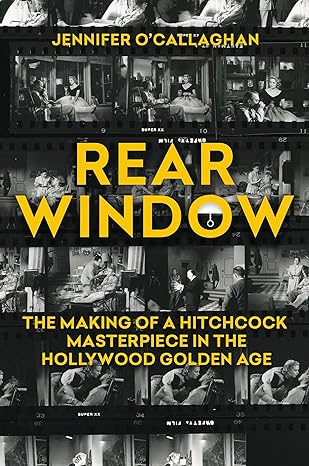
 Writing a book about a beloved movie is a tricky undertaking. Viewers who love the movie typically have their own memories and perspectives regarding what they saw on the big screen … why the film had such an emotional impact. On the other hand, anyone who hasn’t bothered to watch a movie that was released more than seventy years ago either has no interest in it, or isn’t likely to take the time to read a book to determine if they should watch it now. So, while the market for potential readers may not be massive, author Jennifer O’Callaghan is surely very aware that anyone reading her new “Rear Window” book is likely a raving fan of the movie and excited to learn as many ‘behind-the-scenes’ details as possible.
Yours truly is certainly one of those raving fans of REAR WINDOW (1954) and of its director, the legendary Master of Suspense, Alfred Hitchcock. Ms. O’Callaghan delivers all the scoop fans of the film could possibly want, yet after reflecting on the content, I believe it fair to state that the book’s title actually undersells what has been researched and reported here. Readers will benefit from numerous history lessons on Hollywood (not just the movie), as well as various personal profiles. In other words, cinephiles and classic film lovers will likely be as absorbed in these stories as I found myself.
Author O’Callaghan chooses an unusual structure for the book. While the timeline and stories bounce around, she always ties a particular detail or person to the film, REAR WINDOW. This results in something much broader than the “making of” projects that have become so prevalent these days. An argument could be made that Hitchcock’s wife, Alma, deserves a bit more attention, or that their daughter Patricia could have provided additional familial anecdotes (she has 2-3 quotes included); however, this is offset by the fascinating personal and professional elements – especially for stars Jimmy Stewart and Grace Kelly.
Of particular interest to this reader was the profile of the luminous Grace Kelly. Most of us are aware that she left Hollywood when she married Prince Rainier of Monaco, and we learn that although she embraced her duty to her new country, she also held on to the hope that she could someday return to acting … even going so far as considering the lead in Hitchcock’s MARNIE (1964), a role that ultimately went to Tippi Hedren, who also starred in THE BIRDS (1963). We learn that Grace left home after high school, determined to pursue an acting career. She was one of many famous tenants of the Barbizon Hotel for Women in New York, before heading to California for movie roles … her first being Henry Hathaway’s FOURTEEN HOURS (1951). Grace Kelly’s eleven movie career included three films with her favorite director, Alfred Hitchcock: DIAL M FOR MURDER (1954), REAR WINDOW (1954), and TO CATCH A THIEF (1955). Consistent throughout her film career was how highly her directors and lead actors spoke of her – adoration that was later shared by the citizens of Monaco.
This gives you a pretty good idea of the type of insight to expect from this book. Just know that the details provided also cover some of Hollywood’s power structure, and insight into the realization that what we saw on screen with Jimmy Stewart was basically the man he was when the cameras weren’t rolling. The comparison to Tom Hanks seems apropos. Stewart’s military service and influence are also outlined, and alone would have made him a hero and idol. Some of Hitchcock’s renowned ego is touched on, including a spat with one particular writer – an interesting reveal that won’t be spoiled here.
Of course, this is a book about one of the all-time great movies, REAR WINDOW, and author O’Callaghan never loses sight of that. The remarkable Greenwich Village apartment set is detailed, as are the supporting characters that make the film such an emotional deep dive. Details on the great Thelma Ritter (who plays wise-cracking Stella) are provided, and we get some inside info on Raymond Burr (the villain Lars Thorwald) and Wendell Corey (Detective Doyle). Just as interesting as those key characters is the breakdown of the other residents who have become so familiar to us: dancer Georgine Darcy (as Miss Torso), Judith Evelyn (as Miss Lonelyhearts), and Ross Bagdasarian, a real-world composer who also created “Alvin and Chipmunks” and the corresponding popular Christmas song.
This may not be the book for casual movie fans, but for those who revel in the history of cinema and behind-the-scenes secrets, you’ll very much appreciate the bits of previously unknown facts, data, and trivia. It also works as a better understanding of how Alfred Hitchcock worked on his films, how he put them together, and his strategy during the era of The Hays Code and blacklists. Entertainment Journalist Jennifer O’Callaghan has researched and written a book that will surely be treasured by cinephiles and Hitchcock fans.
Available beginning September 30, 2025


 Posted by David Ferguson


 Movie Reviews from the Dark