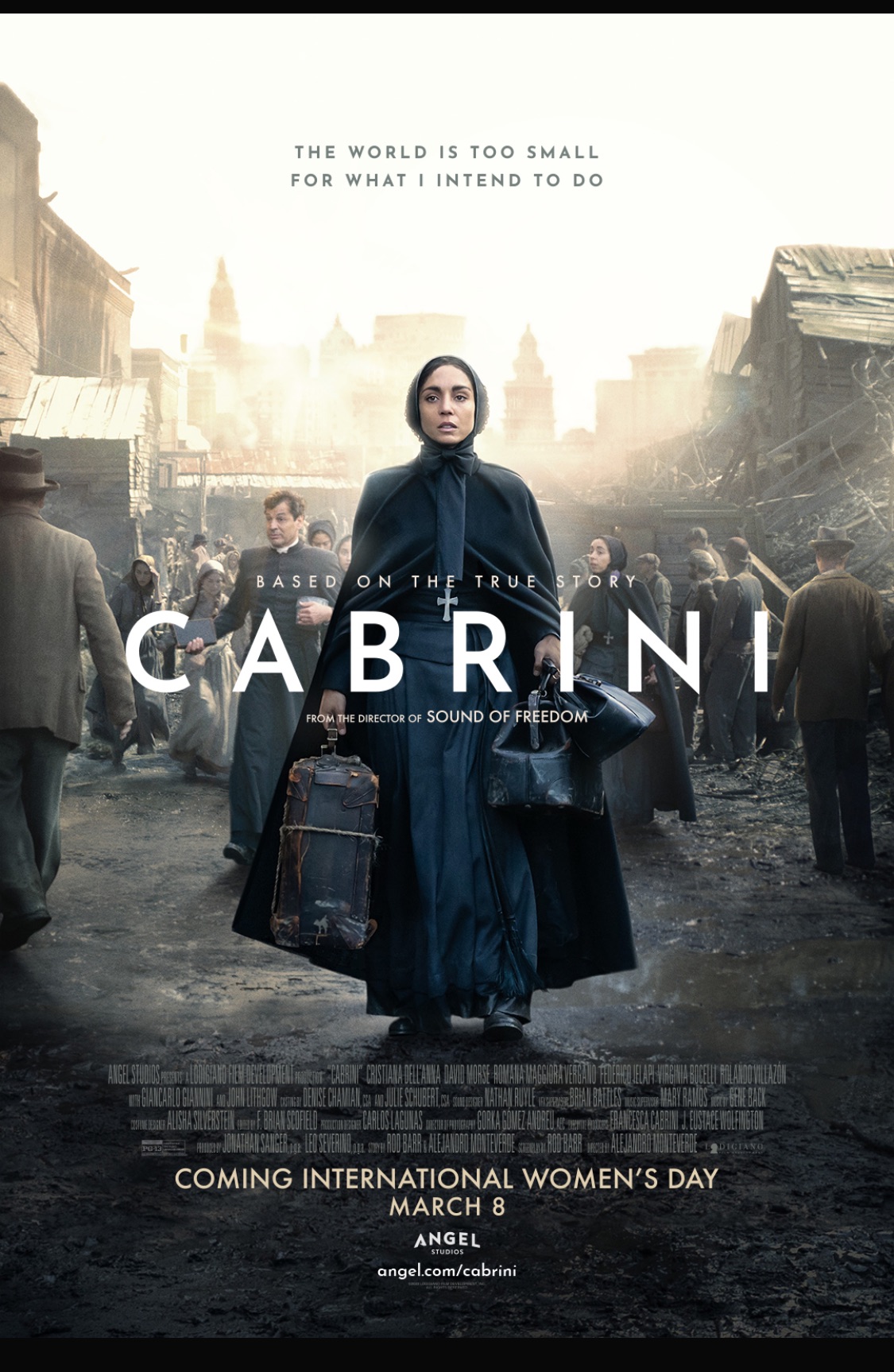
 Greetings again from the darkness. ‘Where there’s a will, there’s a way.’ That famous saying should be known as a “Cabrini”. For anyone whose impression of nuns is that of irascible old women swatting misbehaving students with rulers during school hours, filmmaker Alejandro Monteverde (SOUND OF FREEDOM, 2023) and co-writer Rod Barr have just the biopic for you.
Cristiana Dell’Anna stars as Mother Francesca Cabrini, the most stubborn and persistent nun you’ll ever see, and one’s whose accomplishments deserve to be known by all. The film opens by informing us that between 1889 and 1910 more than two million Italian immigrants came to the United States. Lest you believe the image of immigrants has never been worse than it is today, the film portrays the extreme racism and bigotry of the times. On top of that, Cabrini faced vile misogyny and the hatred that accompanied it. So what was her sin? Well, her vision was to create orphanages and hospitals so that immigrants, especially kids, would have a decent place to live and a community that could care for them. Imagine the nerve.
Not just nerve, but backbone, guile, and the strength to not accept “no” for an answer from the men in power. This is the true story of the early days of Cabrini’s mission. After being told in Italy to “stay where you belong”, Pope Leo XIII (Giancarlo Giannini) refuses to allow her to go to China; however, she accepts his compromise of New York City. Arriving in the Five Points area, she witnesses poverty and squalor for Italians, yet is initially rebuked by Archbishop Corrigan (David Morse), a man who doesn’t want to ruffle the feathers of Mayor Gould (John Lithgow).
The story is remarkable and the acting solid. Also deserving of mention is the look of the film. Production Design is superb and the cinematography of Gorka Gomez Andreu gives the film the beautiful throwback look of yesterday’s masterworks. If there’s a flaw here, it’s that we are never really certain how much time has passed as Cabrini goes toe-to-toe with various power brokers and moves from one project to the next. Still, we understand that the film covers just the early stages of her work, not the complete story. More than two dozen books have been written on Cabrini’s achievements before her death at age 67. She was remarkable and accomplished so much for one who was told to remain bedridden as a youngster. All of this was on borrowed time.
Her story is inspirational, as she built a charitable empire worldwide run by women. The film features a song by Virginia Bocelli and her father Andrea Bocelli over the end credits. It should also be noted that the religion aspect here is not overplayed. Instead, it’s the story of a woman (later canonized as a Saint) who believed, “Begin the mission and the means will come.”
Available on streaming services


 Posted by David Ferguson
 Movie Reviews from the Dark