Greetings again from the darkness. For live theater lovers, the film version of a favorite play or musical comes with pros and cons. The film’s director, Maria Friedman (a renowned stage actor) strives to deliver the intimacy of a stage performance with cinematic qualities. What we see was the filming of a stage presentation in June 2024 at The Hudson Theater in New York City. The story was written by George Furth with music by Stephen Sondheim, only the production has quite an interesting history, with an original production in 1934 written by George S Kaufman and Moss Hart.
The story structure is fascinating in that it’s presented in reverse order. The opening sequence shows the resulting breakdown of friendship between three: composer Franklin Sheperd (Jonathan Groff), playwright and lyricist Charley Kringas (Daniel Radcliffe), and theater critic and author Mary Flynn (Lindsay Mendez). All three actors are Tony Award winners and are in prime form here. We then proceed to go back in time across three decades as the years are noted. Instead of watching this friendship triumvirate breakdown, we watch the bonds grow stronger … only of course this is actually putting the causes of the breakdown on center stage – one phase at a time.
It’s not just the three leads who are standouts. Katie Rose Clarke as Beth Sheperd, Krystal Joy Brown as Gussie, and Reg Rogers as Joe Josephon are all excellent. It’s rare to find so many superb soloists in one program, and each has their moment (or moments) to shine. Beth is Franklin’s first wife and the mother of his child. Gussie is a Broadway star and Franklin’s second wife, while Joe is a producer who experiences the highs and lows of show business.
While the play-it-in-reverse structure provides a uniqueness to the presentation, the story itself has quite a bit to offer in terms of complexity. The fragility of friendship and the importance of constantly working at relationships is front and center, yet it’s only one element. Also on display here is how cruel show business can be. Sometimes you are loved and showered with adulation, while other times they say you are too old for a role. Ego and emotions are constantly in play here, including envy and arrogance. Although it’s the sneakiest element, perhaps my personal favorite is the unrequited love Mary carries towards an unaware Franklin. It leads to her bitterness and alcoholism, and her story is the most interesting when you read about the origins of Kaufman’s story. When the opening number is a robust, “How did you get to be here?”, the rest of the play is spent showing us.
Westerns tend to be one of most divisive film genres. “I hate westerns” is proudly proclaimed by otherwise intelligent and open-minded movie goers. Ask these anti-western types for specifics on what it is they don’t like and their answers often include: boring/slow pace, hard to relate to characters, simplistic dialogue, too few women characters and too much machismo. Western lovers wouldn’t attempt to argue any of those points. Instead, we prefer to believe that some of those are the BEST features of westerns!
What’s fascinating is, despite the haters, westerns have achieved immense popularity through the years. Some have provided us the strong, quiet hero: High Noon, Tombstone, The Magnificent Seven. Many have shown us the joy of revenge: True Grit, Django Unchained, The Searchers. Some provided us with wonderful villains: The Wild Bunch, Once Upon a Time in the West (nice guy Henry Fonda as a badass). Still others offered up the conflicted gunslinger: Unforgiven; The Good, The Bad and The Ugly. Westerns can even be tearjerkers: Shane; comedies: Blazing Saddles, City Slickers; and animated: Rango.
The one western which seems to be the exception … it’s even beloved by western haters … is Butch Cassidy and the Sundance Kid. It’s a mainstream film with three movie stars, a strong director, a renowned writer, one of the best ever cinematographers, a love story, a #1 charting pop song, enough action (but not too much), and a level of comedy that is witty and quotable. Released 44 years ago in 1969, it was recently part of Cinemark’s Classic Film series.
Paul Newman (Butch) and Robert Redford (Sundance Kid) charmed audiences even as they made their way through the west robbing banks and trains. It’s interesting to note that Steve McQueen was originally cast as the Sundance Kid. Unfortunately, there was a disagreement over top billing and McQueen dropped out. Newman and McQueen wouldn’t work together until 1974 in Towering Inferno. On the bright side, Newman and Redford were terrific together and would team up again in 1973 for The Sting (Oscar winner for Best Picture). It’s no coincidence that George Roy Hill directed the Newman/Redford duo in both films. He was known as an “actor’s director” and recognized the mass appeal of these two.
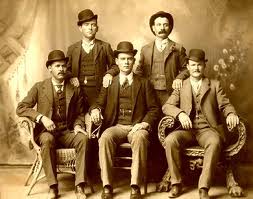
“Much of what follows is true” is our introduction to the film, along with a polychromatic montage of film clips and photographs of Butch and Sundance with The Hole in Wall Gang (renamed from The Wild Bunch, to avoid confusion with Sam Peckinpah’s recent release). Butch (Robert LeRoy Parker) and Sundance (Harry Longabaugh) were real life outlaws in the early 20th century. The Wild Bunch is pictured at left. The real Butch is seated on the right, and the real Sundance is seated on the left. Of course, many of the facts from the wild west have been displaced by colorful legend and lore. It’s apparently true that their holdups rarely involved violence and they were in fact pursued by a posse, which in the film is portrayed as the Dream Team of posse’s assembled by Mr. E.H. Harrison of the Union Pacific Railroad.
One of the first real scenes in the movie has Sundance playing poker and being accused of cheating. And we all know what that means in a saloon card game – it’s time for a gunfight. The young stud making the accusations is none other than Sam Elliott, making his big screen debut. Elliott went on to star in many movies and TV shows, and of course used his manly voice for “Beef. It’s what’s for dinner”. In 1984, Elliott married Katharine Ross (they are still married today). Ms. Ross became the dream woman of the 1960’s for many after appearing as Elaine in The Graduateand Etta Place in Butch Cassidy and the Sundance Kid.
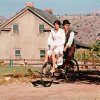
There are many individual scenes or moments that have become classics over the years: the bicycle scene while BJ Thomas sings “Raindrops Keep Fallin’ on My Head”; watching the great Strother Martin call Butch and Sundance morons as he spits chewing tobacco while riding a mule; the looks on their faces as Butch, Sundance and Etta arrive in the garden spot of Bolivia. It also remains one of the most quoted movies with eternal lines such as: “Who are those guys?” “I’m better if I move” “I’m not crazy. I’m colorful” “Think you used enough dynamite there Butch” “Are you crazy? The fall will probably kill you” and my personal favorite “You just keep thinking Butch. That’s what you’re good at”.
Although it’s certainly a star vehicle for Newman and Redford, and to a lesser extent, Katharine Ross, the supporting cast is diverse and exceptional. In addition to Strother Martin and Sam Elliott, Butch has an infamous knife fight with Ted Cassidy (as Harvey Logan). Cassidy is the 6’9” actor who also played Lurch on TV’s “The Addams Family”. He is not 7’2” Richard Kiel who played Jaws in two James Bond films, though many people get them confused. 75 year old Percy Helton plays Sweetface. Mr. Helton had over 200 career screen credits dating back to 1915. Henry Jones plays the opportunistic bicycle salesman, George Furth plays the young and loyal Woodcock, and the still active today (at age 86) Cloris Leachman plays the working girl who is so giddy to see Butch again.
The movie received 7 Oscar nominations and won 4: Cinematography (Conrad Hall), Original Score (Burt Bacharach), Original Song (“Raindrops Keep Fallin’ on My Head”), and Original Screenplay (William Goldman). It was also nominated for Best Picture, but that award went to the controversial Midnight Cowboyand its director John Schlesinger. It should also be noted that there was a 1956 movie titled The Three Outlawsthat featured Neville Brand as Butch, and Alan Hale, Jr as Sundance. Mr. Hale is best known as the Skipper on “Gilligan’s Island”. In 1979 a pre-quel was released, Butch and Sundance: The Early Days. It featured Tom Berenger as Butch and William Katt as Sundance. Mr. Katt is best known as the unfortunate prom date in Carrie. Most recently, in 2011 Sam Shepard starred in Blackthorn, a film about an aging Butch Cassidy quietly hiding out in Bolivia.
So whether you “like” westerns or not, if you have never taken in the exploits of Butch Cassidy and the Sundance Kid, I would encourage you to do so. If, after that, you still don’t like westerns, all I can say is “Boy, I got vision and the rest of the world wears bifocals.”
 Greetings again from the darkness. For live theater lovers, the film version of a favorite play or musical comes with pros and cons. The film’s director, Maria Friedman (a renowned stage actor) strives to deliver the intimacy of a stage performance with cinematic qualities. What we see was the filming of a stage presentation in June 2024 at The Hudson Theater in New York City. The story was written by George Furth with music by Stephen Sondheim, only the production has quite an interesting history, with an original production in 1934 written by George S Kaufman and Moss Hart.


 Posted by David Ferguson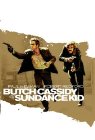


 Movie Reviews from the Dark