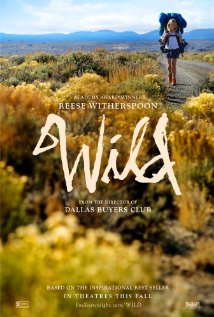
 Greetings again from the darkness. The best movies expertly provide a visual representation of quality writing. However, the film medium is somewhat limited, and especially struggles, in displaying the complexities of human introspection … something the best writers are able to capture with words on a page. Director Jean-Marc Vallee (Dallas Buyer’s Club) and writer Nick Hornby (An Education, High Fidelity) are simply unable to capture the guts of Cheryl Strayed’s memoir “Wild: Lost to Found on the Pacific Crest Trail” – despite the likely Oscar nominated performance of Reese Witherspoon.
It’s quite likely, given the steady stream of rave reviews, that my lack of connection with the film is firmly planted in a small minority of movie goers and film critics. On the bright side, it’s a real pleasure to see Reese Witherspoon follow-up her no frills supporting role in Mud with a strong portrayal of uber-flawed Cheryl.
The story picks up with Cheryl getting ready for her 1100 mile hike of the Pacific Crest Trail in the summer of 1995. Her lack of trail experience is obvious from the unwrapped, shiny new contents of her “monster” backpack. While walking alone with her thoughts, memories are triggered by such things as a song, a horse, and even a phrase. It’s through these flashbacks that we learn the reasons for Cheryl’s trek towards self-discovery. The illness and death of her beloved mother, a childhood marred by an abusive father, her own crumbled marriage brought on by her promiscuity (“I cheated on him a lot”), and her attempts to dull the pain through heroin abuse, have led Cheryl to the trail head of re-discovering her true self.
Cheryl’s mother is played by Laura Dern (a terrific performance) and while her inspiration is obvious, there is one especially poignant scene that takes place in the kitchen … Bobbi tells Cheryl that she fully understands their plight, and refuses to let that define her life. That powerful scene is negated by the awkward and unexplained relationship Cheryl has with her ex-husband (Thomas Sadoski), the underdeveloped best friend support shown from an intriguing Gaby Hoffmann, and the voice mail connection with her brother (Keene McRae). More of these key people and fewer flashbacks might have allowed us to better relate to Cheryl as a person, rather than someone who hasn’t dealt well with a few life obstacles.
The familiar guitar strumming of Simon and Garfunkel’s “El Condor Pasa” is heard throughout, as are numerous literary quotes that Cheryl used to leave her mark in the trail journals. There are, of course, similarities here to other films such as Into The Wild, 127 Hours, and Eat Pray Love. Also present is the element of a solitary woman in the wilderness … every male presence is greeted with anxiety from Cheryl, especially in contrast to the warm greeting she offers another female hiker.
The biggest missing link for me was Cheryl’s apparent epiphany. We witness a couple of emotional breakdowns along the trail, plus big time blisters, damaged toenails, rain and snow, and nature’s beauty. What’s not explained is her personal growth and self-discovery – the moment when Cheryl put the past behind and went “above her nerve”. While her desire and efforts are commendable, the real story would be her inner thoughts … those conversations going on inside her brain (and in the book) that led to a conclusion of which we aren’t privy.
SEE THIS MOVIE IF: you want to see a likely Oscar performance from Reese Witherspoon (including frequent use of the F word)
SKIP THIS MOVIE IF: a damaged toenail makes you nauseous
watch the trailer:


 Posted by David Ferguson
 Movie Reviews from the Dark