 Greetings again from the darkness. Despite my fascination and quasi-obsession with movies, the Science Fiction genre has never really appealed to me. Sure, there have been a few dozen exceptions over the years (and it depends how you categorize certain movies), but it’s the non-classics in the genre that just never seem to connect with my love of film. So when Steven Spielberg states that he doesn’t consider his beloved CLOSE ENCOUNTER OF THE THIRD KIND (CE3K) to be a “sci-fi” film, you won’t see me get offended, or even offer a contrary argument. Of course, the difference is that Mr. Spielberg makes his claim based on his belief of life “out there”, while I simply have no desire to defend the category label.
For its 40th anniversary, the film is making the rounds in selected theatres, and the big screen is a must for this gem. Released in the same year and just a few months after George Lucas’ groundbreaking STAR WARS, Spielberg’s follow-up to JAWS confirmed his status as a revolutionary filmmaker, and cemented 1977 as one of the finest movie years of all-time (including ANNIE HALL, SATURDAY NIGHT FEVER, A BRIDGE TOO FAR, JULIA). CE3K would become the first of 7 Best Director Oscar nominations for Spielberg (inexplicably only one win to date).
Spielberg is credited as the writer, though many contributors are “uncredited”: Hal Barwood (now known for video games), Jerry Belson (Emmy winner for “The Odd Couple” and his work with Tracey Ullman), and John Hill (QUIGLEY DOWN UNDER), and Matthew Robbins (CRIMSON PEAK). Paul Schrader and Walter Hill also contributed to the script, making this the veritable vegetable soup of screenplays. The film came at a time when Columbia Pictures was struggling, so in order to remain under budget, Spielberg had to make some compromises on the final version. In a highly unusual development in the movie industry, Spielberg was able to revise, re-edit, and add new scenes to a 1980 re-release of the film – realizing his original vision.
Richard Dreyfuss stars as Roy Neary, a blue collar family man from Muncie, Indiana. With an acting career spanning more than 50 years (many recognize his baby face in THE GRADUATE as he offers to call the cops), it was AMERICAN GRAFFITI that caused his career to take off, leading to JAWS in 1975, and his stellar 1977 with both CE3K and THE GOODBYE GIRL. He later overcame a severe drug habit to star in such crowd favorites as WHAT ABOUT BOB?, MR. HOLLAND’S OPUS and “Madoff”. His wife Ronnie in CE3K is played by Teri Garr, whose acting career also covers more than 50 years, including small roles in five different Elvis movies in the 1960’s and her best known roles in YOUNG FRANKENSTEIN and TOOTSIE (for which she received a Best Supporting Actress Oscar nomination). In recent years, she has had to turn her energy and attention to health issues.
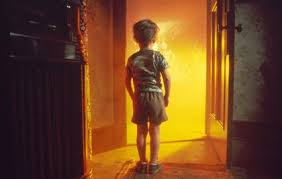
Melinda Dillon stars as Jillian, mother to young Barry (Cary Guffey) who is abducted by the aliens. Ms. Dillon received her first (of two) Oscar nomination for her work in the film, and is still seen annually breaking a leg lamp in the holiday favorite A CHRISTMAS STORY, although she retired from acting ten years ago. Young Mr. Guffey is now 45 years old and hasn’t acted since 1985. Director Stanley Kubrick considered him for the role of Danny in THE SHINING, but ultimately decided on Danny Lloyd, another youngster who decided against remaining in showbiz.
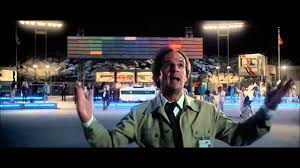 Francois Truffaut was an Oscar nominated director known for kicking off the French New Wave of Cinema with his all-time classics THE 400 BLOWS and JULES AND JIM, and it was quite surprising to see him cast in the role of UFO expert Claude Lecombe. It’s likely that cinephile Spielberg loved the idea of working with a peer whose work he so admired. Truffaut is a significant screen presence despite his challenges with the English language (which led to “dialogue cheat sheets” throughout filming). Bob Balaban, so familiar to “Seinfeld” fans, plays the translator, while Justin Dreyfuss (Richard’s real life nephew) is the noisy and obnoxious son during the hectic family scene. Roberts Blossom is the one in the film who admits to spotting Bigfoot, and is best known as Kevin’s neighbor in HOME ALONE and the braced-up car seller in CHRISTINE. He was also a well-respected poet before passing away in 2011. Other familiar faces include Lance Henrikson (ALIENS), George DiCenzo (BACK TO THE FUTURE), Carl Weathers (ROCKY), CY YOUNG (OK, more a name than a face), Bill Thurman (Coach Popper from THE LAST PICTURE SHOW), and gas mask salesman Gene Rader, who hails from Paris, Texas.
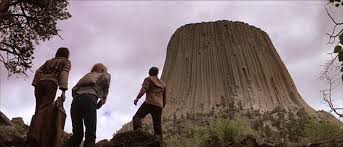 Desert discoveries are a key here, and offer more insight into Spielberg’s attention to history. The “lost” plane is a tribute to real life Flight 19 which disappeared in 1945, and The Cotopaxi was a real cargo ship that sunk … both becoming part of Bermuda Triangle lore. Devil’s Tower in Wyoming is also significant here, and it’s Spielberg’s nod to John Ford’s frequent use of Monument Valley in his westerns. Spielberg has admitted to watching Ford’s THE SEARCHERS dozens of times while filming CE3K. Another tribute comes in the form of a wind-up monkey with cymbals. It was previously seen in REBEL WITHOUT A CAUSE, and can also be viewed as a precursor to the infamous clown in POLTERGEIST.
Spielberg acknowledges being inspired by President Nixon and the Watergate scandal. He wondered what else the government might be hiding from us. Remarkably, he gets his point across with a total absence of modern day cynicism. As opposed to what we usually see these days, the military isn’t trying to bomb the mothership and citizens aren’t retreating in a panic to bunkers. Instead, the military is working to keep the public safe (albeit through some sneaky strategy), the scientists are approaching communication through a protocol steeped in research and data gathering, and Dreyfuss and Dillon are trying to figure out why they were “chosen”. Spielberg delivers sweetness and warmth rather than a show of power and might. It’s such a pleasant viewing experience to watch people we like and to whom we can relate.
Some points of interest related to the film include a cameo from famed UFOologist J Allen Hynek, who is seen smoking a pipe as the abductees are released from the mothership. Mr. Hynek actually created the phrases Close Encounters of the First, Second, and Third Kinds. ABC news anchor Howard K Smith is seen since CBS would not grant permission for Walter Cronkite to appear. The film’s stunning visual effects come courtesy of Douglas Trumball, who also collaborated with Stanley Kubrick on 2001: A SPACE ODYSSEY. Of course, the Visual Effects Oscar that year went to STAR WARS, and that speaks to the contrast between the films. STAR WARS is clearly a special effects movie, while CE3K is much more of a character study … a study of human emotions.
 As for other Oscar categories, the film was nominated for 9 total, with the only win going to Cinematographer Vilmos Zsigmond, though it was also awarded a Special Achievement Oscar for Sound Effects Editing. Spielberg was nominated, but Woody Allen won Best Director for ANNIE HALL, and Richard Dreyfuss actually won the Best Actor Oscar that year for THE GOODBYE GIRL. The great John Williams was of course nominated for his iconic 5 note melody (following up his immortal JAWS theme), and he instead won the Oscar that year for … repeat after me … STAR WARS. A quirky note on the music – the “voice” of the mothership was a tuba, not an instrument that typically gets much publicity.
While Stanley Kubrick opted not to show aliens in 2001: A SPACE ODYSSEY, this film not only puts the aliens front and center, it reminds us to keep an open mind to those unfamiliar to us … a lesson that is still important today. The film was named to the National Film Registry in 2007, and seeing it on the big screen allows for the full impact of awe and wonderment. It’s rated PG and can be enjoyed by most ages. Spielberg only asks that you leave the cynicism at home.
watch the trailer:


 Posted by David Ferguson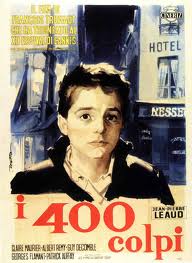
 Movie Reviews from the Dark