“Adventure-a-thon” THE LOST CITY OF Z

May 3, 2025

Blogathon “Adventure-a-thon”

The blogathons administered by Cinematic Catharsis and RealWeegieMidget Reviews are always fun to participate in … and the entries from talented writers make for interesting and enlightening reading. Unfortunately, my movie review schedule often prevents me from dedicating the necessary time, so I’m always excited when my lull corresponds to their next collaborative blogathon.

This time the topic is “Adventure”, and since so many movies and TV shows fall into that category, the challenge was in selecting one that I not only left me in awe, but also hasn’t received the recognition it deserves (in my opinion). On this basis, my choice became:

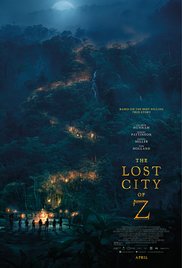
 THE LOST CITY OF Z (2016)

It’s been almost ten years since this film from director James Gray was released, and I’ve recommended it many times to folks who were unfamiliar or unaware. The film is expertly photographed by cinematographer Darius Khandji (a two-time Oscar nominee) and is based on the book by the absurdly talented David Grann, whose books also include one of my personal favorites, “Killers of the Flower Moon”. The screen is filled with green and golden hues (similar to OUT OF AFRICA), providing a sense of realism and a touch of romanticism to the true adventures of the bold explorer, Percy Fawcett.

Charlie Hunnam (fresh off his “Sons of Anarchy” run) portrays military man and explorer Fawcett (often) through quiet strength and a doggedness to discover what is ahead. Helping us to understand this man’s heroic actions, director Gray divides the presentation into three areas: the stuffy, poorly lit backroom of London’s power brokers; the 1916 WWI front line where Fawcett’s courage is on full display; and the Amazon jungles where Fawcett strives for glory and redemption. No matter that we viewers would be satisfied with a film focusing only on those last two circumstances of action, Gray wisely recognizes that it’s the debates and conversations within the backrooms that motivate Fawcett to never give up the fight.

With a run time of 2 hours and 21 minutes, the film is quite long, yet it never seems so thanks to the three main Fawcett expeditions of focus. In 1906 the Royal Geographic Society enlisted Fawcett for a “mapping” journey to distinguish boundaries around Bolivia in what had become a commercially important area to the abundance of rubber. It’s on this adventure where Fawcett cracks wise about overcoming his “poor choice in ancestors”. He’s joined on this expedition by the great Franco Nero, and it’s also the one that lights Fawcett’s lifelong obsession with proving the existence of Z (Zed), an earlier advanced society.

1912 brings the second Amazonia expedition – the one in which renowned Antarctic explorer James Murray (played her by a snarling Angus Macfayden) joins Fawcett and his loyal and expert travel companion, Henry Costin (a terrific Robert Pattinson). The trip proceeds as one might expect when an ego-driven, unqualified yet wealthy passenger hitches a ride for glory alone. Murray’s history is well documented, and the film treats him just as we’d expect.

It’s the third trip (1925) that Fawcett makes with his son that will not only prove to be his last, it’s also the one that left unanswered questions which writer Grann felt compelled to research for his book. What possesses a man to hop into a wooden canoe on unchartered waters and trek through lands and jungles with no known back story? The spirit and mettle of such a man defines the legacy of Percy Fawcett. The film also offers us glimpses of life at home for Fawcett with his wife Nina (Sienna Miller), who flashes signs of early feminism. One of their kids is played by Tom Holland (giving us a future Spider-Man and future Batman – Pattinson in the same movie).

The film leaves an impact for many reasons: it looks stunning, Fawcett’s life was fascinating, the adventures are dangerous and breathtaking, we gain a sense of the courage required for such explorers. This was also the year of LA LA LAND – and the MOONLIGHT mess on stage – and James Gray’s film was overlooked for awards, but even all these years later, it still offers an movie-watching experience like few others.

Trailer: THE LOST CITY OF Z


THE MAN FROM ROME (2023)

June 29, 2023

Greetings again from the darkness. It appears as if Catholicism has gone high-tech! Of course, with that comes the risk of being hacked, and that’s how this film from writer-director Sergio Dow begins. Based on the 1995 novel “La Piel del Tambor” (“The Skin of the Drum”) by Spanish author Arturo Perez-Reverte, the list of those with a writing credit includes: Adrian Bol, Beth Bollinger, Gretchen Cowan, Carolina Lopez-Rodriguez, Sheila Willis, and Luis Zelkowicz, Yes, so while the premise is appealing, it’s likely too many fingers in the writer’s pie created the tangled web that prevented this one from reaching greater heights.
Richard Armitage stars as Father Quart, the best Priest-Investigator the Vatican can offer. Mr. Armitage performed admirably in a couple of Harlan Coben limited series, “Stay Close” and “The Stranger”, and he has a unique and quietly compelling screen presence … and probably very few other actors could come across as somewhat believable in the role of Priest-Cop. Still dwelling on a tragic error in his last case, Quart is sent to Seville, Spain where a 17th century church has been the scene of some recent unexplained deaths. Upon arrival, he learns the church is also a key element in a family squabble related to a pending land development deal.

Macarena (Alma Salamanca) and her mother Duquesa Cruz Bruner (Fionnula Flanagan, dropping her familiar Irish brogue for a Spanish accent) are self-funding the church renovations, while Macarena’s estranged husband, the ambitious and unscrupulous Pencho (Rodolfo Sancho) is pushing for the razing of the church so the large development project can proceed. Also included in this battle are Gris (Alicia Borrachero), who is the church’s architectural restorer, Monsignor Spada (screen veteran Paul Guilfoyle) pushing Quart to close the case, Padre Ferro (Paul Freeman), the Priest from the small church who believes Quart is the bad guy, Padre Cooey (Carlos Cuevas), a Priest with other-worldly tech skills, and the always great Franco Nero who plays the Pope in a couple of scenes (interesting that he also played a different era Pope in Russell Crowe’s recent thriller, THE POPE’S EXORCIST).

The deaths occurring inside Our Lady of Tears church may or may not be mysterious, but what is clear pretty quickly is that greed and corruption are quite prevalent in this situation. The film opens with Father Quart offering his own personal confession, and this is meant to convey that he really is a good guy (not a perfect one) looking for answers … not a lackey sent to get the high-dollar deal closed. The film is at its best when Armitage is on screen, yet the story might have benefitted from a deeper dive into the corruption aspect.

These days, a money-laundering scheme is the preferred scandal for the Catholic Church, and it’s kind of humorous to think that the Vatican might have a bullpen of programmers wearing Priest collars as they cyber-protect the Church. There are some fight scenes that aren’t particularly well-staged, although the work of renowned Spanish composer Roque Banos is a highlight, as are the beautiful locales. We are left feeling like this could have worked best as a limited series on Netflix.

Opening in theaters and On Demand June 30, 2023

WATCH THE TRAILER


ICEMAN (Der Mann aus dem Eis, 2019)

March 14, 2019

 Greetings again from the darkness. Some writers struggle with how to end their story. In this case, writer-director Felix Randau had his ending served up in newspaper headlines almost 30 years ago, and his challenge was to come up with an interesting beginning and middle (as well as meaning for the ending). In 1991, at almost 10,000 feet above sea level, a body was discovered. Originally thought to be a missing hiker, it was determined instead to be a 5300 year old Neolithic man. Thanks to the ice, he was well-preserved along with his clothes, tools, and supplies.

Nicknamed Otzi the Iceman since he was found in the Otztal Alps (Italy), some basic information could be derived about his existence and death. Filmmaker Randau then created a fictional account of his final days, speculating on and imagining the life he led. German actor Jurgen Vogel stars as Kelab (Otzi the Iceman), and we get our first glimpse of native Neolithic life in the community of his clan. The mother of his child dies giving birth, and we see Kelab display a magical box used as a shrine of worship to pay respect. The contents of the box are not revealed until near the end of the film.

While Kelab is out hunting for food, the village is violently attacked. The invasion kills most of the inhabitants and destroys their homes and supplies. Kelab takes the surviving infant child with him as he sets off to seek revenge. As he tracks those who attacked, we see him balance his incredibly strong survival instincts with his emotional need for revenge. Another community led by the legendary Franco Nero offers Kelab a place to rest and a safe haven for the infant child that couldn’t possibly make the trek that lies ahead for his father. The scenery is breathtaking and environment treacherous.

Very little dialogue is spoken, and what there is must be interpreted by the situation. The filmmakers and researchers decided on an early form of Rhaetian for the film, so unless you are a world renowned linguist, you’ll likely have to join the bulk of viewers in interpreting meaning. Mr. Vogel is quite believable in his performance … at times we forget he’s an actor rather than the Neolithic man he’s portraying.

The costumes and makeup are excellent and realistic, while the setting, scenery and environment (nature) are the true co-star. We feel the cold and grasp the harsh conditions. This was a violent life … typically out of necessity, yet sometimes out of emotion. QUEST FOR FIRE (not CAVEMAN) and the brutal elements of THE REVENANT (without the bear) are recalled; however, Mr. Randau’s dramatized account of Kelab’s last days in pursuit of vengeance are a perfect fit for this coldest of all cold cases. Otzi the Iceman’s preserved mummy can be viewed at the South Tyrol Museum of Archaeology in Bolzano, Italy.

watch the trailer:


THE LOST CITY OF Z (2017)

April 20, 2017

DALLAS INTERNATIONAL FILM FESTIVAL 2017

 Greetings again from the darkness. We aren’t likely to watch a more beautiful or expertly photographed film this year. Director James Gray’s (The Immigrant, We Own the Night) project looks and feels like a throwback to days of epic filmmaking, and cinematographer Darius Khandji (Se7en, Evita, The Immigrant) fills the screen with green and gold hues (similar to Out of Africa) that deliver both a sense of realism and a touch of romanticism. The minor quibble here is with the emphasis on the biographical rather than the more interesting and compelling and adventuresome expeditions to the “new” world.

Our true to life hero (and the film’s portrayal provides no other description) is military man and explorer Percy Fawcett played by Charlie Hunnam. Based on the book by David Grann, the film divides focus into three areas: the stuffy, poorly lit backrooms of London power moguls; the 1916 WWI front line where Fawcett proves his mettle; the jungles of Amazonia wherein lies Fawcett’s hope for glory and redemption. It’s the latter of these that are by far the most engaging, and also the segments that leave us pining for more detail.

The three Fawcett expeditions form the structure for the quite long run time (2 hours, 21 minutes). In 1906 the Royal Geographic Society enlisted Fawcett for a “mapping” journey to distinguish boundaries around Bolivia in what had become a commercially important area due to the black gold known as rubber. Fawcett was not just a manly-man, he was also obsessed with overcoming his “poor choice in ancestors” and gaining a position of status within society. Using his military training and personal mission, that first expedition (with help from a powerful character played by the great Franco Nero) was enough to light Fawcett’s lifelong fixation on proving the existence of Z (Zed) and the earlier advanced society.

Back home, Fawcett’s wife Nina (Sienna Miller) shows flashes of turn-of-the-century feminism, though lacking in judgment when she suggests a ridealong with her husband on his next expedition. Although the couple spends little time together, given the years-long trips, they do manage to produce a hefty brood of kids, the eldest played by Tom Holland (the new Spider-Man).

1912 brings the second Amazonia expedition, the one in which renowned Antarctic explorer James Murray (a snarly Angus Macfayden) joins Fawcett and his by now loyal and expert travel companion Henry Costin (a terrific Robert Pattison). The trip proceeds as one might expect when an ego-driven, unqualified yet wealthy passenger is along for only the glory. Murray’s history is well documented and here receives the treatment he earned.

It’s the third trip in 1925 that Fawcett makes with his son that will be his last, and the one that dealt the unanswered questions inspiring Mr. Grann to research and write his book. It’s also the segment of the film that leaves us wanting more details … more time in the jungle. With the overabundance of information and data available to us these days, the staggering courage and spirit of those willing to jump in a wooden canoe on unchartered waters and trek through lands with no known back story, offer more than enough foundation for compelling filmmaking. It’s this possibility of historical discovery that is the real story, not one man’s lust for medals and confirmation. More jungle could have elevated this from very good to monumental filmmaking.

watch the trailer:


DJANGO UNCHAINED (2012)

January 2, 2013

django Greetings again from the darkness. Well, after two viewings and endless analyzing, it’s time to commit thoughts to the page. Over the years, it has become very clear that a Tarantino movie generates a first reaction, and then proceeds to slither through your mind and morph into something else entirely. It would be very easy to accept this latest as an outrageous peek at slavery disguised as a spaghetti western. For most filmmakers, that would be plenty. The “whole” here is exceedingly impressive, but the real joy for cinephiles is in the bits and pieces.

One need not be a Quentin Tarantino expert to enjoy his movies, but there are a couple of things that help. First, he is at heart, a true lover of cinema and quite the film historian, showing sincere respect to the pioneers of this art form. Second, he loves to bring visibility to issues (large and small) by poking a bit of fun at the evil doers who wield unnecessary influence and control over weaker parties. Morality, vengeance, revenge and come-uppance invariably play a role in django4his story-telling … a bonus this time is the inclusion of the Brunhilde/Siegfried legend from Norse mythology and the Wagner operas.

In his two most recent films, QT has been on a kick for creative revisionist history. Inglourious Basterds made a strong statement against the Nazi’s, while this latest goes hard after slave owners. As you might expect, historical accuracy is less important to him than are the characters involved and the tales they weave. And to that point, it seems quite obvious that where in the past, Tarantino would center his attention on crackling dialogue and searing one-liners, he now offers up much more complete characterizations … these are people we understand, even if we don’t much like them.

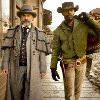
The obvious love he has for Sergio Corbucci and Sergio Leone, the driving forces behind spaghetti westerns, is plastered on the screen. We even get the beautiful camera work through the snow as a tribute to Corbucci’s The Great Silence (1968). While this is not a remake or sequel or prequel, Franco Nero’s “I know” response to “The D is silent” generates a laugh and memories django2of a 25 year old Nero in the titular role of Django (1966). The Blaxploitation genre plays a significant role here as well since Jamie Foxx plays Django, a freed slave who buddies up with a German dentist-turned-bounty hunter, so that Django can get revenge on those responsible for the torture and mistreatment of his wife.

The details of the stories will not be exposed here, however, I would encourage you to pay close attention to the moments of film brilliance. There is a running gag with townspeople and slaves alike struggling to accept the sight of Django on a horse. You’ll laugh again when Django is offered the opportunity to pick out his own clothes and we next see Foxx in a velvet Little Lord Fauntleroy outfit straight out of The Blue Boy painting from Gainsborough. There is hilarious banter django5between Big Daddy (Don Johnson) and Betina as he tries to give guidance on how to give Django a tour of the plantation.  The phrenology sequence is not just unusual, but an incredibly tense scene and fun to watch.  Watching the final shootout reminds me of Peckinpah’s The Wild Bunch … only ten times as violent!

Some of the best moments occur when we recognize the actors in the vital foundation scenes. Don’t miss: bad guy Bruce Dern, Don Stroud (the drummer in The Buddy Holly Story) as the ill fated sheriff, Tom Wopat as a patient Marshal (“Dukes of Hazzard”), father and daughter Russ and Amber Tamblyn, Jonah Hill who struggles with the eye holes in his “bag”, the eyes of Zoe Bell, Ted Neeley (Jesus Christ Superstar), “Dexter” dad James Remar in two roles, Walton Goggins as a gunslinger, Michael Parks (multiple roles in Kill Bill and Grindhouse), and of course, Mr Tarantino himself (as an explosive cowpoke from down under).

django3 While each of these provide wonderful moments, the real bingo occurs courtesy of the main performances of Jamie Foxx (Django), Christoph Waltz (Dr King Schultz, bounty hunter), Leonardo DiCaprio (Calvin Candie, plantation owner), and Samuel L Jackson (Stephen, Candyland house slave). Any combination of these characters in any scene could be considered a highlight. It’s especially enjoyable to see DiCaprio cut loose after so many uptight characters recently. Samuel L Jackson has long been a Tarantino favorite, and his delivery as the diabolical Uncle Tom house slave who has some secrets of his own, will bring the house down when he first sees Django and, in a much darker way, when his suspicions are confirmed. Power is a big player in the story, and even as a slave, Stephen knows what to do with power when he has it. Mr. Waltz won an Oscar for his Inglourious Basterds performance, and his dialogue here is every bit as rich. It’s obvious how much Tarantino enjoys hearing his words spoken by Waltz. Foxx’ performance could be easily overlooked, but it’s actually the guts of the film. He is quiet when necessary and bold when required.

django - dj We must also discuss the soundtrack. Franco Migiacci‘s original “Django” theme is featured, as are classics and a new song from the great Ennio Morricone. If you doubt the originality of the soundtrack, try naming another western that utilizes a mash-up of James Brown and Tupac Shakur. How about a spot-on use of Jim Croce’s “I’ve Got a Name”? The film is beautifully shot by Robert Richardson, and Fred Riskin takes over for Tarantino’s long-time editor Sally Menke, who sadly passed away in 2010.

It should also be noted that the script puts hip-hop to shame by using the “N-word” more than 100 times. It is a bit disconcerting, and you can google Spike Lee’s comments if you care to read more on the topic. Otherwise, dig in to the latest gem from Tarantino and appreciate his approach and genius … either that, or stay away!

**NOTE: I have purposefully avoided the scandal associated with the film.  If you are interested in reactions from the African-American community, there is no shortage of published reports on those who support the film and those who are outraged.

watch the trailer:

http://www.youtube.com/watch?v=rC8VJ9aeB_g


LETTERS TO JULIET (2010)

May 22, 2010

 Greetings again from the darkness. Admittedly, for me there is a fine line between an acceptable chick flick and one that is pure fluff. Oddly enough, this one brings a few fine moments to the screen despite its simplistic predictability and overall lack of creativity.  It easily could have been titled “Where for art thou, Lorenzo?”.

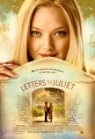
Amanda Seyfried (Mamma Mia) stars as Sophie, a wannabe writer who stumbles on a 50 year old letter at the wall of Juliet in Verona. She then tracks down the Secretaries of Juliet who let her answer the letter. Poof! Just like that, the author of the original letter (a radiant Vanessa Redgrave as Claire) shows up in Verona to meet Sophie and track down Lorenzo, the lost love of her life (the reason for the letter).

There are absolutely no twists or surprises in the movie. We recognize immediately that Sophie and her fiancé (a miscast Gael Garcia Bernal) are all wrong for each other. How this will end is very clear when Claire’s grandson (Heath Ledger clone Christopher Egan as Charlie) first confronts Sophie in cliched rude Brit manner.

The road trip to find lost love Lorenzo is of course a road of discovery for not just Claire, but also Sophie and Charlie. I am struggling to avoid typing yada, yada, yada. The coolest part of the film is when Claire finds her Lorenzo … a dashing Franco Nero on a galloping steed, who also happens to own the vineyard for Claire’s favorite wine (insert eye roll here).

Anyway, the Tuscan scenery is staggeringly beautiful. And watching real-life couple Redgrave and Nero walk hand in hand is very heart-warming. These two first fell in love during the mid-60’s while filming Camelot. This cost Ms. Redgrave her first marriage (famed director Tony Richardson), but the lovers did not marry until 2006. It’s never a good sign when real life is more interesting than the movie.

If you are cool with an obvious and uncomplicated story line (similar to Amy Adams’ Leap Year) set in the gorgeous Tuscan wine country, then the film will be fine for you. On the other hand, director Gary Winick was also responsible for Bride Wars, so the least he can do is turn in his director’s card and move into a second career dealing with pure maple syrup.