“No wire hangers ever!” Thanks to the internet and memes and gifs, that iconic line is familiar today to some people who haven’t even seen the 1981 movie, MOMMIE DEAREST. Author A. Ashley Hoff is a Hollywood historian, researcher, and writer, and he takes us on a deep dive behind the scenes of one of the most notorious cinematic camp classics of all time. “How did they do that?” “Who decided that?” “What were the filmmakers thinking?” What was it like on set?” If you are the kind who asks these types of questions about the movies you watch, Ashley’s book will deliver all the answers you could possibly desire, while also cluing us in a bit on the industry itself – including who holds the power.
Author Hoff does an excellent job distinguishing Christina Crawford’s best-selling 1978 memoir, “Mommie Dearest”, from the adapted screen version, MOMMIE DEAREST (1981). It’s likely many will be surprised at just how uninvolved Christina (Joan Crawford’s adopted daughter) was with the making of the movie. On the other hand, what’s not surprising is the amount of information and detail provided on lead actress, Faye Dunaway. By 1981, Ms. Dunaway was a true movie star. She exploded onto the screen with Warren Beatty in Arthur Penn’s BONNIE AND CLYDE (1967), and again with Jack Nicholson in Roman Polanski’s brilliant CHINATOWN (1974). It’s fair to say her career peaked from a prestige level with her Oscar winning performance in Sidney Lumet’s NETWORK (1977), and that MOMMIE DEAREST was integral to a change in the types of roles she was offered.
Personal interviews with key players, as well as previously published comments, paint the mosaic of the many moving parts beginning in pre-production, and progressing through casting (Anne Bancroft!), set design, costuming, hair, and make-up, all while balancing the first ever child’s view of abuse, and the conflicts between producer, director, and diva star. ‘The Franks’ (Producer Yablans and Director Perry) were respected industry professionals, yet we are left with the impression that neither was able to exert much control over Faye Dunaway, infamous for both her preparation and inflexible views. Two of the more interesting perspectives are sprinkled throughout with observations from actress Ratanya Alda (who plays Joan Crawford’s assistant Carol Ann) and Tracy Hotchner, who wrote the original screenplay.
Remembered as Hollywood royalty, Joan Crawford passed away in 1977, before Christina’s memoir was published and obviously prior to the film’s release. She won an Oscar for her outstanding performance in MILDRED PIERCE (1945), and later appeared alongside her big screen rival, Bette Davis, in WHATEVER HAPPENED TO BABY JANE? (1962). These days, more people associate her with the infamous wire hangers and Dunaway’s portrayal of her in the film. It’s fascinating to read how those involved were absolutely convinced they were making a serious drama featuring an ultra-serious topic and a Hollywood legend. When the reviews became progressively more scathing and audiences began to laugh at the over-the-top moments, a camp classic was born. Since then, the comparisons to THE ROCKY HORROR PICTURE SHOW (1975) are inescapable. Midnight showings found audiences dressed in costumes, waving wire hangers, and shouting lines of dialogue at the screen.
As we make our way through Hoff’s book, we find ourselves feeling empathy towards the filmmakers, the cast, the crew, Joan Crawford, and Christine Crawford. No one received the acclaim they expected (instead, the film racked up some Razzies that year). Some viewed it as a missed opportunity to drive serious conversation on child abuse, yet ‘serious’ just seemed to be the one thing never associated with the film. Hoff has provided an extraordinary amount of information for those interested in the mysterious ways of Hollywood, or for those who simply can’t get enough of “Mommie Dearest” in any format.
Greetings again from the darkness. It was the year after ONE FLEW OVER THE CUCKOO’S NEST and the year before ANNIE HALL. 1976 was good for the underdog as Sylvester Stallone’s ROCKY won the Oscar for Best Picture, edging out such (now) classic films as TAXI DRIVER, ALL THE PRESIDENT’S MEN, and the film we are going to talk about here, NETWORK.
“I’m mad as hell, and I’m not going to take this anymore.” That’s the lasting quote most recite when asked about NETWORK. And since those folks are generally energetically emphatic as they recall the line, it says quite a bit about the influence and ongoing impact of the film. In fact, many believe much of what the film warned us about has come to pass – and is even happening right now!
The story begins with (fictional) UBS network news anchor Howard Beale being let go after many years on the job. His personal issues have become a problem, and unlike his competitors Walter Cronkite and John Chancellor, he’s no longer dependable. With two weeks remaining until his final broadcast, Beale goes off script and creates a firestorm of emotion in the viewing audience as he promises on-air suicide and rants about TV programming, journalism, and society as a whole. People across the country take him up on his direction to go to the window and yell out the above mentioned catchphrase. What follows cuts to the core of the film’s theme. Beale’s friends worry about his mental well-being, while others at the network are concerned only with the ratings bump, and how best to capitalize on his revived and re-engaged audience.
What had previously been a respectable newscast, transitions into what we recognize today as a Reality TV show. Beale is provided a pulpit to rail against the establishment and the general public for its acceptance or surrender. He criticizes those who have given up reading books and have allowed TV to guide their thoughts (sound familiar?). Beale proclaims “television is a carnival” even as he becomes its lead barker, and proudly accepts his new label as “an angry prophet denouncing hypocrisies of our time.” It’s now been over 40 years since the film premiered, and the parallels to today’s world are crystal clear.
As with any quality film, there are multiple sub-plots and story lines, as well as numerous characters we get to know. There is an ambitious program director willing to make her mark by any means necessary. All of this turmoil occurs while UBS is going through a corporate takeover, so we get a glimpse at the behind-the-scenes political wranglings of those in power and those striving to be. An inner-office romance blends with the reckoning that accompanies middle age, and the resulting cracks in a long-term marriage. In yet another jab at the TV industry, a brainstorm leads to the birth of the “Death Hour”, an idea for a series based on the illegal and often violent actions of a terrorist group called the Ecumenical Liberation Army. The negotiations with this group are either the funniest or the most dangerous of the film, depending on your perspective. In keeping with the era, we are reminded of the ongoing economic recession, and get news flashes on the situation with kidnapped heiress Patty Hearst, plus the two assassination attempts on then President Gerald Ford. These doses of reality add the necessary gravitas to the film to prevent it from dipping into soap opera territory.
The cast is stellar and deep. Peter Finch plays Howard Beale. Mr. Finch died in January 1977 at age 60, and a couple of months later was named the Oscar winner for Best Actor, becoming the first acting winner to be so awarded posthumously (later joined by Heath Ledger). He was previously nominated for SUNDAY BLOODY SUNDAY (1971). Although he was talented and had a fine acting career, he might be best remembered in Hollywood lore for his ongoing affair with Vivian Leigh, who was married to Laurence Olivier at the time. Sir Olivier was also Mr. Finch’s acting mentor. In his role as Howard Beale, Finch got to chew scenery at the level every actor dreams of.
Faye Dunaway plays the ambitious program director Diana Christensen. She won the Oscar for Best Actress, and had previously been nominated for BONNIE AND CLYDE (1967, a role she chose over Elaine in THE GRADUATE) and CHINATOWN (1974). She also appeared (with her NETWORK co-star William Holden) in THE TOWERING INFERNO (1974), and is unfortunately remembered for her frightening portrayal of Joan Crawford in MOMMY DEAREST, giving wire hanger nightmares to an entire generation. Her first marriage was to Peter Wolf of the J. Geils Band, and more recently you’ll recall her as co-presenter with Warren Beatty, and part of the calamity at the 2017 Oscars when LA LA LAND was erroneously named Best Picture before the confusion was cleared and MOONLIGHT was awarded the statuette. Dunaway’s Diana is unabashedly ambitious and flounces through the newsroom taking no prisoners. Her relationship with Holden’s character has one of the more unusual on screen love-making sequences, as she continues to talk shop as things heat up.
William Holden plays Max Schumacher, the veteran news director forced out of his job for placing more importance on protecting his friend Howard than in increasing the ratings and revenue of the broadcast. Mr. Holden died in 1981 at age 63 from injuries sustained during a fall. He was a Best Actor Oscar winner for STALAG 17 (1953), and a nominee for NETWORK and SUNSET BOULEVARD (1950). Mr. Holden also appeared in other classic films as PICNIC (1956), THE BRIDGE ON THE RIVER KWAI(1957), THE WILD BUNCH(1969), and THE TOWERING INFERNO (1974). He once shared an apartment with baseball great Hank Greenberg while both were serving in the military (1943), and was Best Man at the wedding of Ronald and Nancy Reagan. As Max, Holden captures the middle-age frustrations of a man unwilling to live with the cultural change of the new conglomerate owner, and equally uneasy with a marriage that has grown too stale. His stereotypical fling with the exciting younger woman ends as expected … only with a world class monologue.
Robert Duvall is Frank Hackett, the cut-throat front line manager brought in by the new owners to shake things up and create some profit. Mr. Duvall is still working today at age 88, and began his career on TV in 1960. He won a Best Actor Oscar for TENDER MERCIES (1983), and was nominated six other times for performances in THE GODFATHER (1972), APOCALYPSE NOW (1979), THE GREAT SANTINI (1979), THE APOSTLE (1997), A CIVIL ACTION (1998), and THE JUDGE (2014). He also appeared in BULLITT (1968), MASH (as Frank Burns, 1970), THE GODFATHER II(1974), THE NATURAL (1984), and Larry McMurtry’s classic western series “Lonesome Dove” (1989). You might also remember him as Boo Radley, quietly hiding behind the door in TO KILL A MOCKINGBIRD (1962), though he’s likely best remembered for a certain character’s love of napalm in the morning. Duvall’s Hackett is a symbol of blind ambition and thirst for power.
Beatrice Straight won the Oscar for Best Supporting Actress for playing Louise, Max’s scorned wife. She’s only in only a couple of scenes, and her approximately 5 minutes on screen remains the briefest to win an acting Oscar. Ms. Straight acted in very few movies, and spent most of her acting career in TV projects and on stage, though many will recall her as one of the scientists in POLTERGEIST (1982). When Louise rips into Max, she’s speaking for the untold number of middle-aged women who have been in that situation … simultaneously angry, hurt and afraid.
Ned Beatty plays Arthur Jensen, an eccentric network executive, and with basically one powerful and memorable scene, received the only Oscar nomination of his 45 year career. Mr. Beatty’s first screen appearance was in DELIVERANCE (1972) and his pig squeals haunted many viewers (including yours truly). He has also played delicious villains, the everyman, and buffoons, and appeared in such fine movies as NASHVILLE (1975), ALL THE PRESIDENT’S MEN (NETWORK’s Oscar competition), SILVER STREAK (1976), SUPERMAN (1978), SUPERMAN II (1980), THE BIG EASY (1986), RUDY (1993), and more recently as the voice of Lotso in TOY STORY 3 (2010). He hasn’t acted in the past 5 years, and turns 82 years old this year.
You might think that is already an incredible lineup of acting legends, but we aren’t done yet. Wesley Addy appears as network executive Nelson Chaney, and Mr. Addy was also in one of my favorite film noirs, Robert Aldrich’s KISS ME DEADLY (1955). Kathy Cronkite plays radical activist Mary Ann Gilford, and Ms. Cronkite is the daughter of news icon (and University of Texas graduate) Walter Cronkite (who also appears in clips). Conchata Ferrell is part of the UBS creative team, and Ms. Ferrell is now best known as Berta on “Two and a Half Men” and as the pizza shop proprietor in MYSTIC PIZZA (1988). Ken Kercheval plays Merrill Grant, and “Dallas” fans will recognize him as JR Ewing’s nemesis, Cliff Barnes. Making a brief appearance is Lane Smith, whom we all remember as Joe Pesci’s opposing counsel in MY COUSIN VINNY (1992), and in a blink-and-you’ll miss it role in the terrorist negotiation scene is an uncredited Lance Henriksen. Mr. Henriksen now has a cult following after his chilling role in ALIENS (1986). He’s also appeared in many other classic films over the years: DOG DAY AFTERNOON (1975), CLOSE ENCOUNTERS OF THE THIRD KIND (1977), THE RIGHT STUFF (1983), THE TERMINATOR (1984), and he has over 250 screen credits. Lastly, you might recognize the voice of the film’s narrator. Lee Richardson is an actor and the voice of more than one hundred commercials.
NETWORK was directed by the great Sidney Lumet. He received one of his 5 Best Director Oscar nominations … the other four were 12 ANGRY MEN (1957), DOG DAY AFTERNOON (1975), PRINCE OF THE CITY (1981), and THE VERDICT(1982). He also directed THE HILL (1965), SERPICO (1973), MURDER ON THE ORIENT EXPRESS (1974), RUNNING ON EMPTY (1988), and his final film BEFORE THE DEVIL KNOWS YOU’RE DEAD (2007). Mr. Lumet received an honorary Oscar in 2005, and died in 2007 at age 86. One of Lumet’s four wives was Gloria Vanderbilt, and his book “Making Movies” is a must read for any aspiring filmmaker.
Writer Paddy Chayefsky gets much of the credit for the success of NETWORK, and rightfully so. The script is a work of art, and brought him one of his three Oscars. The other two were MARTY (1955) and THE HOSPITAL (1971), making him one of only five three-time writing winners. He also wrote cult favorite ALTERED STATES (novel and screenplay) and adapted PAINT YOUR WAGON (1969) for the screen. Mr. Chayefsky’s influence can be seen (and especially heard) in the dialogue written by Aaron Sorkin, one of today’s most celebrated writers. Mr. Chayefsky died in 1981 at age 58.
The film won 4 Oscars (Actor, Actress, Supporting Actress, Original Screenplay) and was nominated for six others. The 3 acting wins tie it for most ever with A STREETCAR NAMED DESIRE (1951), and it’s the only movie to date with 5 acting nominations. It’s also highly probable that NETWORKis the only film where the Best Actor and Best Actress don’t share any screen time together. Owen Roizman was nominated for Cinematography, and his other nominations include THE EXORCIST (1973), TOOTSIE (1982), WYATT EARP (1994) and THE FRENCH CONNECTION (1971) … that’s right, he filmed the infamous car chase scene. Alan Heim was nominated for Editing, an Oscar he would later win for ALL THAT JAZZ (1979).
Relevant seems too weak as a description to make the point of how the film’s message stands up today. Television should be a vehicle that informs and educates instead of serving up drivel like dating and quirky personality shows. Of course entertainment is an important piece of the puzzle, but we shouldn’t end up holding an empty bag. One of the final scenes in the film highlights the lack of scruples from the executive team. A final decision is made that at first seems over-the-top, but is it really so hard to believe? Howard Beale is a man who has lost, or is losing, his mind – but the network milks him until that cash cow is dry. We can’t help but note the themes that still hit home today: corporate and personal greed, ambition, grief, mismatched relationships, the misuse of power, the willingness to sit back and accept, and the fear of life with no purpose.
ROCKY was the only 1976 film to eclipse $100 million at the box office, and in addition to the other Oscar nominated films listed in the first paragraph, 1976 also blessed us with horror classics CARRIE and THE OMEN, thrillers like MARATHON MAN (“Is it safe?”) and KING KONG (Jessica Lange and Jeff Bridges), BOUND FOR GLORY (the 5th Best Picture nominee) and Barbra Streisand’s A STAR IS BORN, comedy classics BAD NEWS BEARS and THE PINK PANTHER STRIKES AGAIN, and Alfred Hitchcock’s final film, FAMILY PLOT. 1976 was also the year we lost Agatha Christie, Busby Berkeley, Howard Hughes, Fritz Lang, Dalton Trumbo, Alastair Sim, and Sal Mineo (a still unsolved murder). Forty-three years later, NETWORKlives on as a lesson we have yet to learn.
***NOTE: another thing to notice is the natural teeth of Faye Dunaway, Robert Duvall and Peter Finch. Comparing it to the blindingly bright pearly whites of today’s actors provides quite the contrast.
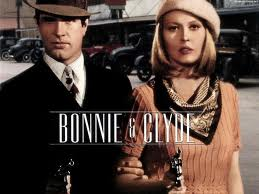
Dramatizations focusing on real life people, be they famous or infamous, require a certain mindset from the viewer. First, understand that it’s not a documentary. What you see may be different than what you have read. Second, expect the filmmakers to take some dramatic license in order to add interest and color to the story. All of this is in play for the wonderful and classic Bonnie and Clydefrom 1967.
To put this time period into perspective, know that the movie was released 46 years ago, and depicts a period during the Great Depression that was approximately 32 years prior to filming. That’s correct. The film’s release date was closer in time to the Great Depression than today is to the film’s release date. It’s also important to note that Bonnie Parker and Clyde Barrow were 23 and 24, respectively, at the time of their violent deaths at the 1934 Gibsland Ambush. Their ages and the times certainly played a role in their reckless ways and poor judgment.
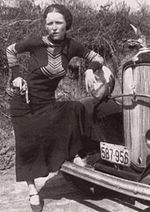
Sadly, there is a generation of movie-goers who have little knowledge of Warren Beatty’s place in Hollywood history … or worse, their only recollection is of his clunky political rapping in 1998’s Bulworth. By 1967, Beatty was already a heartthrob and up-and-coming actor, but it’s his role and contract as producer of Bonnie and Clydethat set him up as a Hollywood power player (not to mention, financially set for life). His 40% of gross pay plan has made him tens of millions over the years. In addition to his producer duties, Beatty is at his physical peak here … a glamorous actor going all out in a career-defining role. Pictured left, is the real Bonnie and Clyde.
Faye Dunaway plays Bonnie as first, a bored youngster who comes to life due to the danger and sexual attraction she senses with Clyde. She then transitions into a spirited woman very comfortable with the spotlight of notoriety and fully understanding how to pull the strings of her man. Dunaway’s career is best marked by her work as Bonnie, and her roles in Chinatown and Network… though many know her best as the mother with an aversion to wire hangers.
There are three writers associated with the film: David Newman (he also wrote the Christopher Reeve Superman scripts), Robert Benton (Oscar winner for Kramer v Kramerand Places in the Heart) and Robert Towne (known best for his Oscar winning Chinatown script). Mr. Benton was inspired by the fact that his father had attended the Texas funerals of both Bonnie and Clyde. The basic outline is based on the true stories – Joplin, Missouri; Ruston, Louisiana; Texas Ranger Frank Hamer; the numerous stolen cars; the role of Clyde’s brother and his wife; the visit to Bonnie’s mother; and even Bonnie’s poem “The Trail’s End” (aka The Story of Bonnie and Clyde). But as expected, many liberties are taken. Unlike in the movie, Frank Hamer never crossed paths with Bonnie and Clyde prior to the final ambush. Blanche (played by Estelle Parsons) was very upset at her portrayal after seeing the movie … she claims to have not been such a lunatic. The CW Moss character is actually an amalgam of drivers affiliated with the gang. Also, there is no mention of the horrible accident that left Bonnie’s legs badly burned … to the point where Clyde had to carry her everywhere those last few months. Pictured left is the famous photo of Bonnie with cigar and gun.
Director Arthur Penn was an Oscar winner and also gave us such fine films as The Miracle Worker(1962), Alice’s Restaurant(1969), and Little Big Man(1970). He and Beatty had many arguments while on set, but the finished project is packed with energy, emotion and action. Beatty and Dunaway give us an engaging couple with a dark destiny. Excellent support work is provided by Gene Hackman (as Clyde’s brother Buck), Michael J Pollard (as CW Post), Denver Pyle (as Frank Hamer), Dub Taylor (as CW’s dad), Evans Evans (the real life wife of director John Frankenheimer), Gene Wilder (in his film debut), Mabel Cavitt (as Bonnie’s mom, she was literally yanked from the group of Red Oak, Texas onlookers during filming), and Patrick Cranshaw (you might know him as Blue in Old School). It should also be noted that the violence displayed was groundbreaking at the time. The use of squibs … packets of stage blood used to enhance the gunfights … were used generously throughout. Previously, gunshot wounds rarely had blood shown onscreen.
The film received 8 Oscar nominations with wins for Estelle Parsons (Best Supp Actress) and Burnett Guffey (Cinematographer). The Best Picture winner that year was In the Heat of the Night, and nominations also went to The Graduate and Guess Who’s Coming to Dinner. This was one of the first 100 movies inducted into The National Film Registry, and it brought Lester Flatt and Earl Scruggs into the mainstream with their “Foggy Mountain Breakdown”. Initially released as a “B” movie playing drive-ins, things changed dramatically once critic Pauline Kael’s raving review was published in The New Yorker.
this is not the most artistic trailer, but it will give you a taste of the film’s style:
Greetings again from the darkness. The latest of the monthly 1970’s film screenings hosted by Dallas Film Society and The Dallas Morning News was the classic Chinatown. It was shocking to see 35-40% of the hands go up when host Chris Vognar asked how many had never seen the film. I felt a combination of guilt, pride and envy since my viewings number approximately 15 or 16, not counting “pit stops” while channel surfing. This is truly a classic film that should be seen by all lovers of movies.
This is a chance to see the work of three film greats at their absolute peak: Jack Nicholson, Roman Polanski (director) and Robert Towne (writer). I have previously discussed Nicholson’s work in the 70’s (Five Easy Pieces, The Last Detail,Chinatown, One Flew Over the Cuckoo’s Nest). He is so confident and assured and expert in his manner and delivery. It is so much fun to watch the perfect actor in the perfect role. Regardless of what you may think of Roman Polanski the man, he is unquestionably an excellent director (Rosemary’s Baby, The Pianist, The Ghost Writer). His visual flair is on full display with cars, wardrobe, colors, and camera angles. It is obvious he adores the source material. Robert Towne has some terrific screenplays on his resume (The Last Detail, Shampoo), but none better than this one. Along with Network (Paddy Chayefsky), this is one of my two favorite screenplays of all-time. It is outstanding!
Some people refer to this as “the Nose movie”, thanks to the scene where Polanski, in a cameo as a tough guy, teaches Nicholson a lesson about sticking his nose where it doesn’t belong. What I love about the story and the movie is that we are along with Gittes (Nicholson) for the whole thing. There are no shortcuts … no narrators … no flashbacks … we get to solve the mysteries right along with him. Too many movies make it easy for the viewer. I prefer to work a little. And trust me, this one makes you work. Is it a whodunit? Is it a kidnapping? Is it a political power play for control of water? Is it just outright corruption? The answer is YES to all of these!
If you have seen it before, watch it again and pay attention to the absolutely perfect mood score from Jerry Goldsmith. Check out the wardrobe – the number of suits worn by Nicholson is crazy. The same holds true for Faye Dunaway’s dresses. Pay attention to the multiple “eye” references right up to the final two … Dunaway in the car and John Huston shielding his “granddaughter” from the grisly scene. You may have missed the supporting work from John Hillerman, Diane Ladd, Rance Howard (Ron’s dad), Burt Young (Paulie in Rocky) and James Hong. James Hong? If you are a “Seinfeld” fan, you’ll recognize him from the Chinese Restaurant scene where he pages “Cartwright”. Especially pay attention to the powerful performance of John Huston as Noah Cross. And no matter how many times you have watched it, the “nose” scene will still make you cringe.
If you have never seen the film, I urge you to set aside some time to watch this classic. Don’t allow yourself to be distracted. Take it all in and then … “Forget it Jake. It’s Chinatown.”
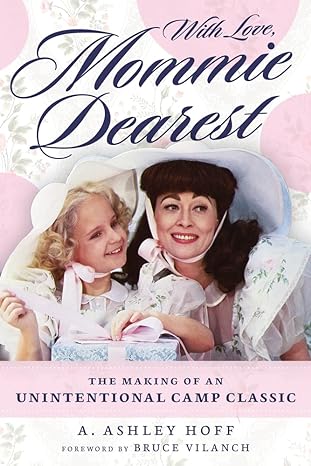 With Love, Mommie Dearest: The Making of an Unintentional Camp Classic


 Posted by David Ferguson





 Movie Reviews from the Dark