THE KING (2018, doc)

July 19, 2018

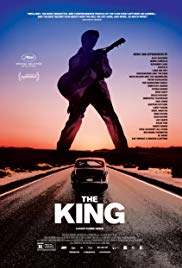
 Greetings again from the darkness. Those of us in the United States have always loved a rags-to-riches success story … it’s the personification of the American Dream. The only thing we seem to enjoy more is tearing down the pedestals that we build for those folks, and then ripping apart their legacy. Acclaimed director Eugene Jarecki (WHY WE FIGHT, 2005) strains rigorously in his attempts to connect Elvis Presley selling out his talent for money with the transformation of the U.S. from a democracy to a crumbling capitalistic empire (likened to ancient Rome). The really interesting thing is that the film, despite being a staccato mess, is quite fascinating.

Director Jarecki’s gimmick here is that he is taking a musical and historic road trip in the 1963 Rolls Royce once owned by Elvis. Along the way, he picks up passengers – some of which are musicians who perform in the backseat. The passenger list includes James Carville, John Hiatt, M Ward, Linda Thompson (ex-girlfriend of Elvis), Immortal Technique, and “best friend” Jerry Schilling (a comical description if you’ve read his book).

Chuck D from Public Enemy is interviewed due to his famous lyric: “Elvis was a hero to most, but he never meant s**t to me”. The contradictions from this interview fit nicely with the contradictions throughout the film. George Klein takes Jarecki on a quick tour of Humes High School, and Ashton Kutcher babbles about fame – though he makes one spot on remark regarding the prison of fame, something much of the film seems to ignore. Producer Ethan Hawke spends a good amount of time on camera and in the front seat, while author and activist Van Jones seems narrowly focused on cultural appropriation and angry that Elvis never used his clout to help the minorities that influenced him.

Filmed in 2016, the film works hard to include the Presidential election, and we even see the sanctimonious Alec Baldwin adamantly proclaiming that Trump won’t win. Jarecki is himself an activist, and here he stretches to prove his points – tying together everything from Elvis’ induction into the Army to the Trump election more than a half-century later (and 40 years after his death).

The road trip kicks off in Elvis’ birthplace of Tupelo, where we meet some locals who talk about the lasting impact of Elvis on their town – a town still drenched in poverty. Memphis is next, and we hear about the 3 local kings: BB, Elvis and MLK. Jarecki even inserts a shot of the Rolls next to the Lorraine Motel. There is a terrific bit with the students from Stax Music Academy who perform “Chain of Fools” in the backseat. We then head to NYC and Nashville, capping off the musically creative portion of Elvis’ career. Next up is Hollywood, Hawaii, and finally Las Vegas.

At times, the film is just flat out weird. One segment force feeds parallels with the 1933 KING KONG movie (yes, really), then Elvis as a tourist, and finally, Dan Rather’s all too familiar voice performing “America the Beautiful” … each piece featuring the Empire State Building. But just when a Bernie Sanders rally makes you want to turn off the film, we get an insightful Mike Myers effectively pointing out the hypocrisy of the American Dream as sold by the government, or David Simon questioning the choice of the Rolls over one of Elvis’ prized Cadillacs, or Sam Phillips’ (Sun Records) son re-telling the story of how his father lost Elvis to the carnival-barker Colonel Tom Parker (neither a Colonel nor a Parker).

Jarecki and co-writer Christopher St. John try to weave a tapestry of fame and money with cultural and societal shifts. Some segments work, while others fall flat. The editing of talking heads sometimes gives the feel of a debate, but often the scattered and choppy film meanders through multiple messages whilst driving the backroads of the country. We get clips of Elvis on the Ed Sullivan Show and getting his famous locks sheared in the Army, and the 1968 comeback special; however, there is little mention of Priscilla, Lisa Marie or Graceland.

Judging Elvis for money grab without seeming to take into account his young age (he was 21 when he first appeared on Sullivan, and 23 at his Army induction) and his extreme poverty of youth, much less the power of his domineering agent, seems to be harsh judgement in an era that had never seen such media giants as the Kardashians or Justin Bieber. When Jarecki’s road chief admits, “I don’t know what the hell you’re doing” (when Jarecki asks him what he thinks he’s doing with the movie), it’s the first time we can actually relate to what someone has said. Despite all of that, you’ll likely be glued to the screen for the full run time – either enjoying the songs, watching the clips, or trying to see if Jarecki’s puzzle pieces even fit together.

watch the trailer:


TMI (1-27-12)

January 27, 2012

TMI (Today’s Movie Info)

 ELVIS PRESLEY made 31 movies, from Love Me Tender (1956) through Change of Habit (1969)
He also has 349 soundtrack credits
 
His co-stars included actresses such as: Angela Lansbury, Ann-Margret, Barbara Eden (Jeannie in “I Dream of Jeannie”), Barbara Stanwyck, Carolyn Jones (Morticia in “The Addams Family”), Delores del Rio, Donna Douglas (Elly May in “The Beverly Hillbillies”), Hope Lange, Joan Blondell, Mary Tyler Moore, Maureen Reagan (daughter of Ronald), Nancy Sinatra,  Shelley Fabares (Christine on “Coach”), Sue Ane Langdon, Tuesday Weld, Ursula Andress
 
And actors such as: Bill Bixby, Burgess Meredith, Charles Bronson, Dabney Coleman, Dick Sargent, Ed Asner, Gig Young, Harry Morgan, Jack Albertson, John Carradine, Leif Erikson, Rudy Vallee, Vincent Price, Walter Matthau
 
He starred in films directed by Michael Curtiz (known for Casablanca) and Don Siegel (known for Dirty Harry) , and had NINE of his films directed by Norman Taurog.  Taurog became the youngest to win a Best Director Oscar at age 32 for Skippy (1931).  His final Elvis film Live a Little, Love a Little (1968) was also his final film as a director.
 
Elvis’ long-time manager, Col. Tom Parker, made him turn down the role in A Star is Born (1976), when the producers refused to give him equal billing with Barbra StreisandKris Kristofferson took the role instead.  Elvis died a year after the movie was released.


ELVIS ON TOUR: 75th Anniversary

July 30, 2010

 Greetings again from the darkness. Thanks to the July 29 one-night-only showing through Fathom Events, I got to see this on the big screen again for the first time since it’s initial release in 1972. In celebration of what would have been Elvis’ 75th birthday, an introduction was added that includes some clips and interviews … kind of a “making of” segment. I found it most interesting to get a behind the scenes look at how the film was put together, and the roles of Robert Abel, Pierre Adidge and Martin Scorcese.

The film itself won a Golden Globe for best documentary and it’s easy to see why. It provides a look at Elvis on the road … and a peek at what he was like as a man. In the new intro, Priscilla says “Elvis didn’t just sing a song”. She is so right. Sure, he had an amazing voice. And yes, he was an incredibly charismatic stage performer. Obviously, he was a handsome man and sex symbol of the times. But what the film reminds us is that he was a musician … a man who felt and loved the music.  Watching him breathe in a song by The Stamps (including the great J.D. Sumner) is a moment to behold.

For anyone who doesn’t “get” Elvis or thinks he was just some old guy in a sequined jumpsuit, this is the film to watch. Upon its original release, Rolling Stone magazine’s headline read “Finally, the first Elvis movie”. The montage of his early years and crowd shots of his later years, show just what an impact he had on his fans. There was, and still is, a connection to those who were captivated by the man and his songs. He truly was a musical and social phenomenon.

Seeing him carry the burden of being ELVIS is very interesting. While the songs and performances are fun to watch, the real value here is in the backstage portions. That’s where we see that he lived for the music. How else can you explain the voluminous recording library he left behind in less than 20 years. Despite the military service, pressures of fandom, and his personal issues, he continually recorded songs that we can enjoy today. Compare this to the Rolling Stones, whose careers have lasted more than twice as long as Elvis! While he was not at his physical peak on this tour, he was 37 years old and in decent condition. What is obvious is that the VOICE is still there when he wants it. The two best moments are when he records “Separate Ways” and then when he performs “Trilogy”. We hear the proof that the special gift never left him.

It’s difficult to watch this and realize that Elvis was dead 5 short years later. It really affects how you view his father, Vernon, who we see backstage and watching his son perform. It is also painful to see guys like Joe Esposito and Sonny and Red West kissing up to Elvis, now that we know they would go on to publish trash stories about him, once their golden goose was dead.

The film truly captures a part of history and a glimpse at a fascinating man.  Elvis really was the first mega-superstar who became bigger than life.