THE PRINCESS (2022, doc)

August 18, 2022

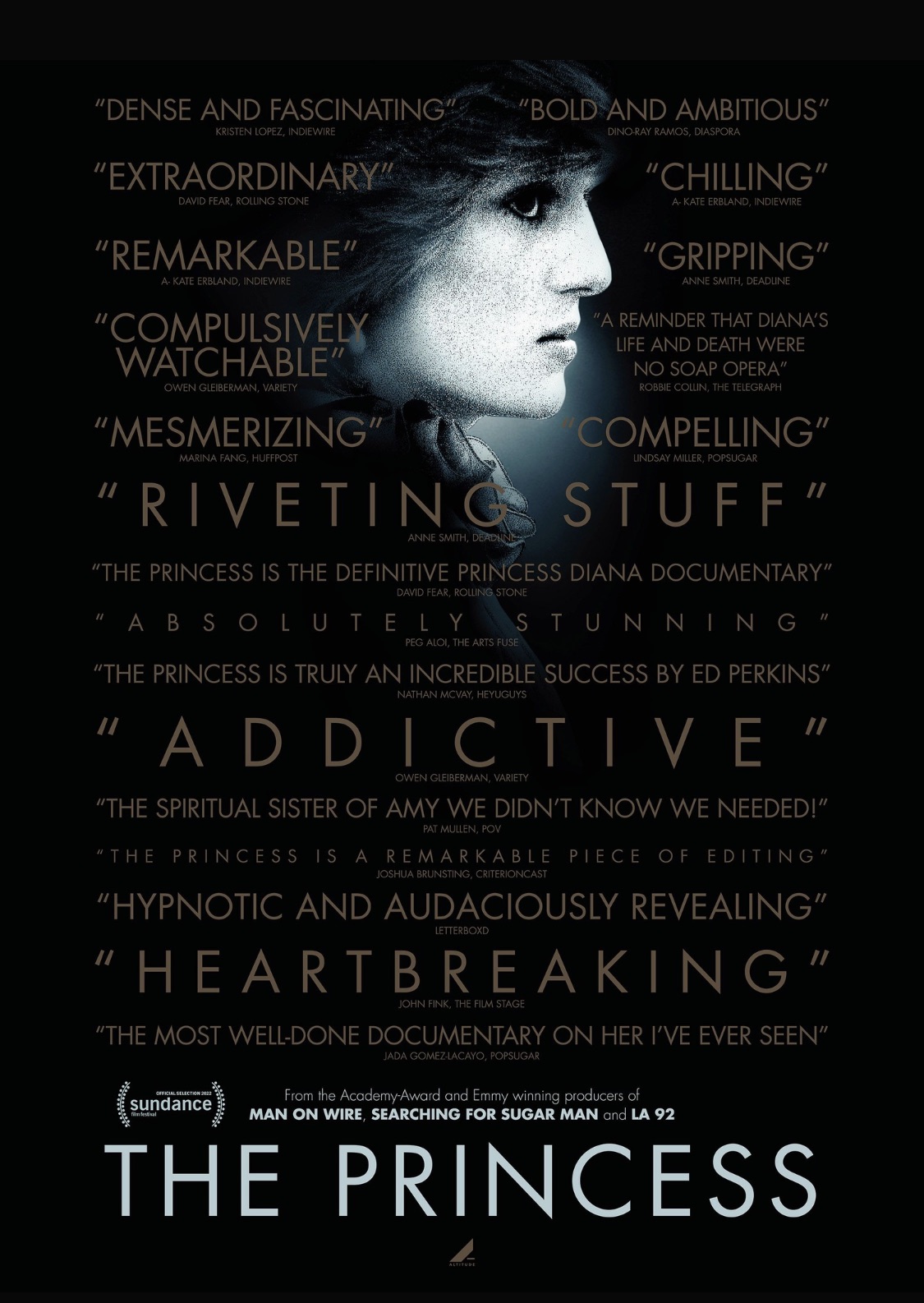
Greetings again from the darkness. It’s been 25 years since the paparazzi chased the car into that Paris tunnel. The ensuing accident took the lives of Princess Diana, her boyfriend Dodi Al Fayed, and their driver, Henri Paul. The tragic and stunning event led to global grieving for a Princess who many felt never was accepted as a member of the Royal Family. Director Ed Perkins (BLACK SHEET, 2018) uses only archival footage, stills, and news clips to show how the media covered Diana over what was less than two decades in the spotlight. No new interviews – the talking heads we are accustomed to in documentaries – are included here, only the editing of existing media materials are offered as storytelling devices.

The film opens with a tourist-shot video taken just moments before the fatal accident. What stands out is the crush of photographers, the squealing tires takeoff of Diana’s car, and the swift action of paparazzi following on scooters and cycles. It’s not until the end of the film that we see the footage of the wreckage being towed from the tunnel. The rest of the film tracks Diana over the years … less than 20 years total.

The flashback takes us to Diana Spencer as a 19-year-old girlfriend of Prince Charles. As the press hound her on the walk to her car, we note her coy and shy demeanor as she offers “no comment” before driving herself away. The strain on her face as she’s being questioned is evident, and remains through those early shared interviews with Charles. It’s not until years later when she becomes so adept at handling the media frenzy.

Throughout the film we see clips of Prince Charles, Queen Elizabeth, Sarah Ferguson, and Diana’s interactions with such notables as Henry Kissinger, Mother Teresa, John Travolta, Luciano Pavarotti, and Nelson Mandela. We watch as Diana’s hairstyles make their way around the globe, and of course, the wedding segment recalls how it became ‘the’ television event of 1981. There are segments on two babies (William and Harry), and we even see Diana holding Harry in her lap as the car drives away … and Charles heads to his polo match.

The 12-year age gap is discussed, but Diana’s surprising BBC interview with Martin Bashear provided the more likely reason for the 1992 separation. Camilla Parker-Bowles is shown while still married, but a Charles interview (along with Diana’s BBC interview) make it clear that the Diana marriage was meant to deliver ‘pure’ bloodlines to the Royal Family, and the “Fred and Gladys” (Charles and Camilla) relationship couldn’t do that. We can’t help but notice how much sadness Diana carried, and she certainly had her own detractors and critics, especially when biographers noted her own affair. It was this era that turned the Royals into their own entertainment industry – something which is disturbingly even more true today. Diana died at only 36 years of age. Both of her sons are older than that now. The global grief experienced is on full display during the segments highlighting her funeral. Perkins’ film might be a bit difficult for anyone who wasn’t around during the Diana era, but for those of us who were, the memories have not faded, and are enhanced by what we see here.

Available on HBO and HBO Max beginning August 13, 2022

WATCH THE TRAILER


Oscar Nominate Documentary Shorts 2019

February 22, 2019

Oscar Nominated Documentary Shorts 2019

By definition, films in this category pack a punch with a real life story into a run time of just a few minutes. It’s possible one or two could be transformed into a feature length documentary or narrative interpretation, and yet it’s remarkable how much information or emotion can be relayed with a short film. In an unusual twist, one of the nominated films offers only an edited clip of historical footage – yet it will likely stick with you. Below you will find the five films listed these in order of my preference. Just a reminder, these are not Oscar predictions, just personal opinion.


 PERIOD. END OF SENTENCE (USA) 26 minutes

‘It’s some type of illness that mostly affects girls.’ That’s paraphrasing the answer from a group of young Indian men when asked to define menstruation. Unfortunately, the women aren’t much better educated or informed, and the subject remains taboo in rural India. The Pad Project is designed to empower women by providing a machine that makes low cost pads, far superior and more hygienic than the “cloths” they have used for generations.

Director Rayka Zehtabchi introduces us to the man who invented the machine, but this story is about the women. Not only do the pads improve their life and health, but by marketing the pads, the women experience financial gains that dramatically impact their lifestyle. The film is surprisingly humorous and uplifting, and it’s refreshing to see such a wonderful solution to what’s referred to as “a girl problem”. The film will be available on Netflix beginning February 12.


 BLACK SHEEP (UK), 21 minutes

When a young boy, not so dissimilar to her 10 year old Nicaraguan son, is killed on the streets of her London neighborhood, a mother takes steps she feels are necessary to protect her son. They relocate to Essex for safety, unaware that extreme racism exists. With the camera in close-up mode, a now adult Cornelius Walker re-tells his story as reenactments periodically accompany his words.

Director Ed Perkins captures the pain and intimacy of the decisions that led Cornelius to try and fit in … “make friends with monsters”, as he puts it. What a stark reminder of how strong our survival instincts are. We can rationalize actions that wouldn’t typically be considered, even if the long-term price paid for those decisions is to be forever haunted by losing our true self. The reenactments may cost it some votes in this category, but Mr. Walker’s story will stick with you.


 END GAME (USA), 40 minutes

Though emotions run high in all 5 of the Doc Short nominees, none reach the tearjerker level and gut-punch of this look at palliative care by co-directors Rob Epstein and Jeffrey Friedman. Teams of medical professionals are committed to end of life care and helping patients and families deal with death.

Mr. Epstein is a two time Oscar winner for Doc Feature (THE TIMES OF HARVEY MILK, 1984; COMMON THREADS: STORIES FROM THE QUILTS, 1989) and he and Mr. Friedman previously collaborated on the 2014 doc AND THE OSCAR GOES TO … There is an interesting look at the San Francisco Zen Hospice Guest House, but there is a bit too much time spent on one patient/family and the film is very similar to the previously nominated EXTREMIS (2016).


 A NIGHT AT THE GARDEN (USA), 7 minutes

On February 20, 1939, a Nazi-American rally took place at Madison Square Garden in New York City. Perhaps you were aware of this or not, but either way, this brief 7 minute clip edited from archival footage will surely chill you to the bone.

The rally takes place shortly before WWII begins, and the pomp and circumstance, as well as the scope of the event, are startling. Standing at a podium in front of a giant George Washington portrait, Fritz Kuhn, leader of the German American Bund, spews vile hate-filled words and the crowd of 20,000 cheers.

Director Marshall Curry has been previously nominated twice for Documentary Feature, and his work here is wisely restricted to editing the footage. No commentary or interview is necessary. The name you will want to know after this 7 minutes is Isadore Greenbaum.


 LIFEBOAT (USA), 34 minutes

Thousands of refugees take to rafts and battered boats in the Mediterranean Sea in hopes of escaping an environment of poverty, torture and/or bombings. They realize it’s a life or death step, yet they believe those odds are better than staying put. This is director Skye Fitzgerald’s follow up to his 2015 doc short 50 FEET FROM SYRIA, and the second of what he plans will be a trilogy.

We follow Sea-Watch Captain Jon Castle as his crew, funded by a German non-profit dedicated to rescuing refugees, strives to save as many as possible before starvation, illness or drowning occurs. Sometimes they succeed. This one would make an interesting double-bill with last year’s winner THE WHITE HELMETS, which focused on rescues on land (after bombings). Captain Castle (who passed away last year) makes the point that the rescues are the right thing to do as humans, as it could easily be us in need of rescue sometime in the future. Director Fitzgerald pays little attention to political arguments, and presents this as a humanitarian issue.