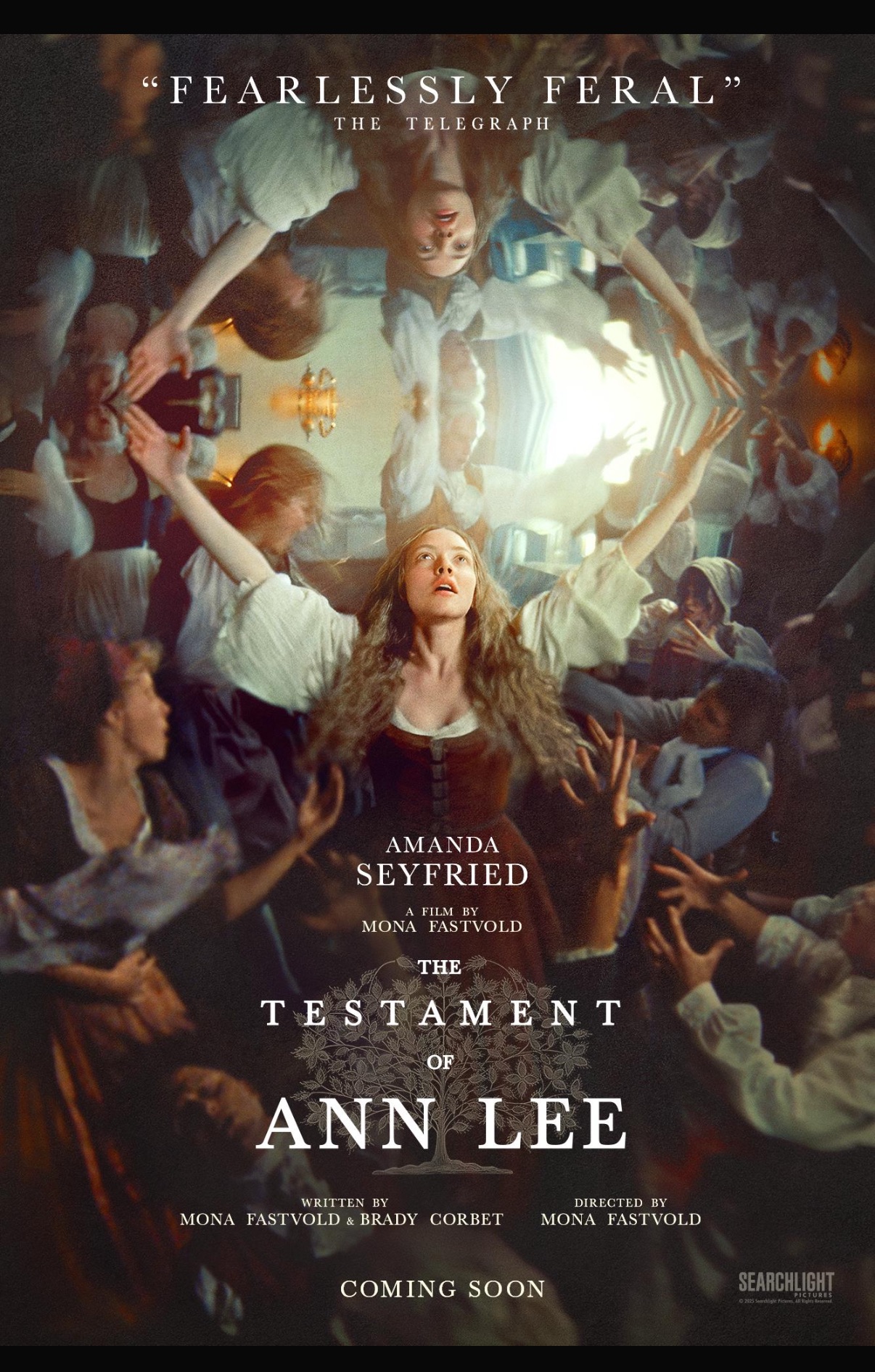
THE TESTAMENT OF ANN LEE (2026)

January 23, 2026

Greetings again from the darkness. One might believe that celibate communal living and worship would have been an easier sell in the 1780’s than today, yet this film from writer-director Mona Fastvold (THE WORLD TO COME, 2020) and co-writer Brady Corbet (THE BRUTALIST, 2024) proves otherwise. It turns out the second coming and extreme shaking while worshipping requires a bit more faith than many possess. The film is based on the true story of Ann Lee, the founder of the Shakers who, along with a small contingency, emigrated to the U.S. from England to spread their beliefs.

That small group of believers who followed Ann Lee (Amanda Seyfried) included her brother William (Lewis Pullman), her husband Abraham (Christopher Abbott), and young Mary (Thomasin McKenzie), among others. Their life is not easy and recruiting a congregation proves challenging. Ann never loses faith and consistently stays true to her beliefs, allowing all to follow … well, except for her husband Abraham who doesn’t much buy into the pure life with no sexual relations requirement. Ann believes that this was Adam and Eve’s sin and is convinced a pure existence is the way to righteous living.

Probably the most unique thing about the film (other than the actual subjects of Ann and the Shakers) is the manner in which the hymns/songs are choreographed and performed. This makes for such an odd visual and there are quite a few of these moments. Tim Blake Nelson plays a pastor who crosses paths with Ann, providing an interesting sequence (as he typically does). The choreography is the work of Celia Rowlson-Hall and the music comes from Oscar winner Daniel Blumberg. Ms. Seyfried delivers yet another standout performance, although this movie certainly won’t be to everyone’s taste. It’s a long film that’s not easy to relate to. Ann Lee saw herself as the female incarnation of God, and the film attempts to show how some believed her.

Opens in theaters on January 23, 2026

WATCH THE TRAILER


THE WORLD TO COME (2021)

February 11, 2021

 Greetings again from the darkness. I’d be hard-pressed to name a movie that is more somber, front beginning to end, than this film from director Mona Fastvold (writer of VOX LUX, 2018) and co-writers Ron Hansen (THE ASSASSINATION OF JESSE JAMES BY THE COWARD ROBERT FORD, 2017) and Jim Shepard (based on his short story). Allowing only a few sparks of hope in the second act, the film’s ending finds us nearly as beaten down as the four main characters we’ve just watched.

Structured as though Abigail (Katherine Waterston) is reading her own journal entries as they play out in real life, the film captures the brutal conditions of working a hillside farm in upstate New York during 1856. But more than that, it conveys the price of a joyless existence on the frontier, when days were spent adhering to chores. For everyone, this meant little social interaction; and for women this meant cooking, cleaning, and giving birth. Abigail mesmerizes with her balletic poetry in describing the drudgery of her life and marriage to Dyer (Casey Affleck). Dyer is a sullen man who says little, but remains dutiful in his responsibilities. He is attuned enough to allow Abigail her space after diphtheria claims their young daughter … though he seems mostly unchanged by the tragedy.

Abigail’s emptiness and unrequited quest for meaning seem her destiny until the day that new arrivals rent the next farm over. As Finney (Christopher Abbott) guides the wagon by, Abigail and Tallie (Vanessa Kirby) lock eyes, signaling to them (and us) that life on the frontier is about to become more exciting than collecting that day’s eggs from the chicken coup. This moment arrives mere weeks after Abigail as narrator has informed us, “With little pride and less hope, we begin the new year.” And just like that, she has hope.

The two women begin to spend days together building a connection first borne from isolation and loneliness, and soon growing into a true relationship. Dyer deals with his wife’s affinity for the new girl with a nonchalance that masks his agitation. Finney, on the other hand, is a quietly simmering man of anger that wreaks of a violent nature just below the surface. These are combustible elements in a world where this type of relationship between women is simply not discussed or admitted.

We witness the beginning, middle, and end of the relationship between Abigail and Tallie. We see how each lights up around the other … although Tallie’s well-coiffed auburn hair always seems out of place in an environment where showers and shampoo would be scarce. It’s really Abigail’s narration and lyrical use of language that propels the story, and as lovely as her words are, the actual pacing of the film is a bit slow at times. Of course, that corresponds to the oppressive bleakness of this world, adding to the challenge for viewers.

The four lead performances are all terrific. The two men have less screen time and certainly less dialogue, but we never once doubt where they stand. Ms. Waterston has been a standout with her work over the past few years, and Ms. Kirby recently posted one of last year’s finest performances in PIECES OF A WOMAN. She’s clearly a star in the making. Composer Daniel Blumberg’s work is a good fit, and cinematographer Andre Chemetoff works wonders with the muted color palette. Bucharest is the stand in for 19th century upstate New York, allowing us to see the harshness. Period lesbian romances are rare, though this is the third in a short period of time along with AMMONITE (2020) and PORTRAIT OF A LADY ON FIRE (2019). Just prepare yourself for an hour and a half of anguish.

In theaters February 12th, 2021 and on digital March 2nd, 2021

WATCH THE TRAILER