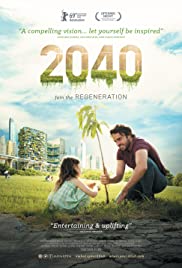
 Greetings again from the darkness. Where do you see yourself in “X” years? That’s a common job interview question, and with a slight twist, it’s the question Damon Gameau asks himself and us … only his question is about our planet, and it’s meant to have us consider life for the next generation. Mr. Gameau makes it personal by structuring this as a (future) video letter to his 4 year old daughter Velvet, and describing what the world could be when she turns 25. What we immediately notice is that Gameau takes an optimistic approach, in contrast to the doom-and-gloom versions of climate change that we’ve come to expect. Rather than scare tactics, Gameau dishes hope.
In 2015, Australian Gameau delivered a documentary (THAT SUGAR FILM) where he dove mouth-first into the evils of sugar in our diet, and it’s his experience and training as an actor that allows him to come across as ‘one of us’ as he finagles his way through complicated topics. This time out, he tackles climate change and the environment, and he does so by focusing on the solutions and approaches that already exist. This is designed to prove to us that making a better tomorrow is within our grasp, and there’s no need for a miracle – and no excuse for waiting for one.
We follow along to different countries, and hear from many experts. The topics include carbon off-set, the oceans’ acidity level, solar-powered microgrids in Bangladesh, soil regeneration, on-demand self-driving electric cars, and doughnut-hole economics. Along the way, Gameau lets us hear from the experts, as well as a group of school kids who tell us what they’d like their future world to look like.
Science is discussed, but true science geeks may find this a bit too light on data and research. Gameau chooses instead to give us a glimpse into some available solutions from around the globe. We do learn that the oceans absorb heat and carbon, so carbon off-set through sequestering carbon and reducing emissions is essential. We learn that one-third of farmland is used to grow food for animals, so the advantage to growing more food is obvious – and it also leads to interesting discussions of soil regeneration. Given our current structure, it’s difficult to imagine if many parking lots and roads could be converted to greenspace again, and the on-demand self-driving electric cars segment was quite enlightening.
Kate Raworth wrote the 2017 book “Doughnut Economics: Seven Ways to Think like a 21st Century Economist”, and the Gameau gives us an animated overview of what this means. Whether it’s a practical solution is unclear, but Gameau has enlisted passionate people to his cause of focusing on existing solutions to provide a better future. Even though his ‘imagined’ year 2040 features him with grey hair, and the score throughout is quite obtrusive, Damon Gameau is to be commended for an entertaining and positive look at what we can do right now to ensure a better tomorrow. There is hope.
The film is available VOD on June 5, 2020, and for more information: https://whatsyour2040.com/
watch the trailer:


 Posted by David Ferguson
 Movie Reviews from the Dark