 Greetings again from the darkness. Playwright August Wilson has a nice string of his stage work being adapted for the big screen. First, there was FENCES (2018), then MA RANEY’S BLACK BOTTOM (2022), and now this latest is the first feature film from writer-director Malcolm Washington (son of Denzel), with a screenplay co-written with Virgil Williams (MUDBOUND, 2017). This thoughtful allegory asks the question, when is a piano more than just a piano?
The film opens on Independence Day in 1911, and as fireworks fill the sky, a group of men steal a piano from their slave owner. We quickly jump ahead 25 years to 1936 and find Boy Willie (John David Washington, also son of Denzel) and his friend Lymon (Ray Fisher, “True Detective”) taking a wagon full of watermelons to Boy Willie’s sister house. The plan is to sell the watermelons and his sister’s piano so that Boy Willie can purchase a plot of land where his ancestors worked as slaves. It’s a simple plan that makes sense … except his sister, Berniece (Danielle Deadwyler, so good in TILL, 2022) has no intention of selling the piano, a family heirloom.
Berniece and her daughter Maretha (Skylar Aleece Smith) live in Uncle Doaker’s (a reserved Samuel L Jackson) home and the piano sits, unplayed, in the living room. Ironically, it’s Boy Willie who talks us – and Maretha – through the piano’s history, including how his grandfather had hand-carved family faces into the front. Maretha was previously clueless as her mother Berniece had chosen to carry the weight of history to herself. The more brother and sister argue, the more activity from the spirits occur – known as ‘Ghost of the Yellow Dog.”
Doaker attempts to keep the peace, while wannabe preacher Avery (Corey Hawkins, THE COLOR PURPLE, 2023) relentlessly woos Berniece. Danielle Deadwyler delivers a remarkable performance as she remains steadfast. With a polar opposite personality to brother Boy Willie, she is a picture of pride and strength, and delivers the film’s best line directed to her brother, “All you ever had going for you in life is talk.” For those who don’t appreciate the stage-to-screen adaptations, the recommendation is to focus on the storytelling, rather than the sometimes distracting staginess. It’s a terrific script and, led by Ms. Deadwyler, the acting is mostly top notch.
Available on Netflix


 Posted by David Ferguson
 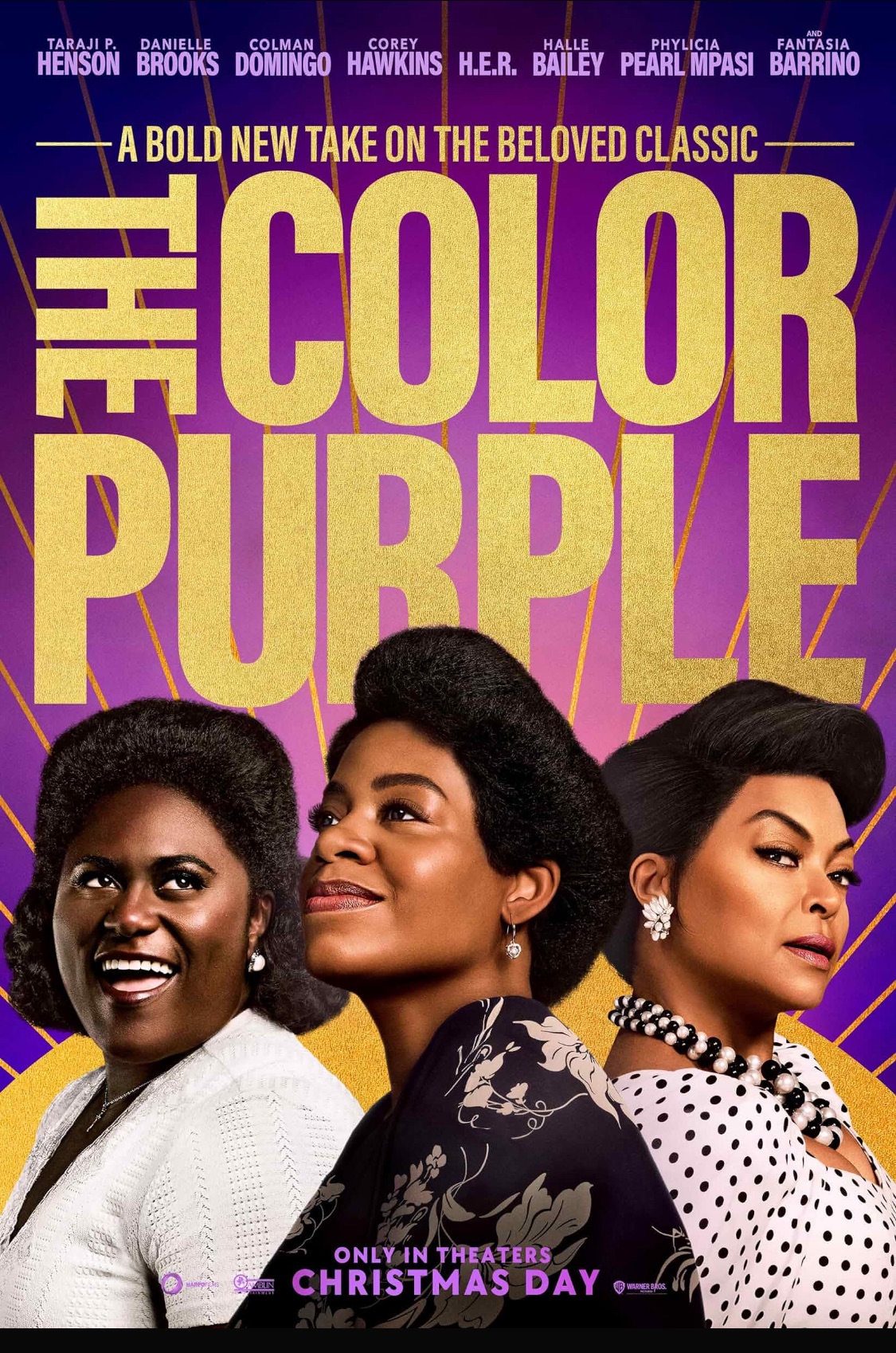 Greetings again from the darkness. It all began with Alice Walker’s 1982 novel, for which she was awarded a Pulitzer Prize. Shortly thereafter, Steven Spielberg turned it into the movie event of 1985, with a memorable cast including Whoopi Goldberg, Danny Glover, and yes, Oprah Winfrey. The film received eleven Oscar nominations, yet was shut out in all categories. Jumping ahead 20 years (2005), Marsha Norman created a musical stage book that turned into a smash hit on Broadway, receiving eleven Tony nominations. It was 2015 when the musical revival hit the stage, re-establishing the story as part of the fabric of the entertainment world. Along the way, Ms. Walker’s book had been frequently banned and censored, and the adaptations were sure to pick and choose what to cover and how to do so. Here we are forty-one years after the book’s publication, and director Blitz Bazawule (Beyonce’s BLACK IS KING, 2020) delivers a moving and bold film version (screenplay by Marcus Gardley) based on the musicals, the novel, and the original film.
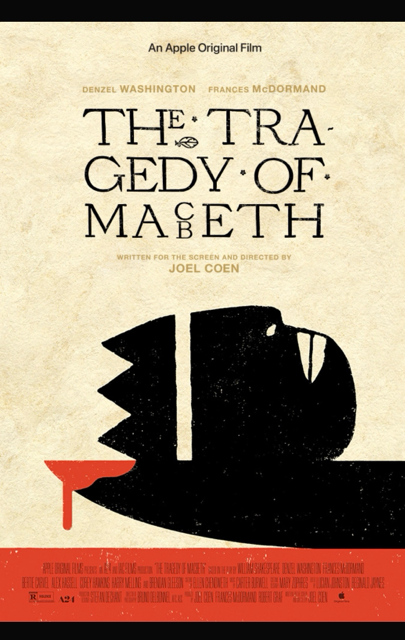 Greetings again from the darkness. The confounding part about screen adaptions of great and familiar literary works is that we have each already formed our mental images of characters and setting. Adapting Shakespeare’s 400 year old play is Joel Coen (4 time Oscar winner, NO COUNTRY FOR OLD MEN), and it’s also his first time to fly solo as director without his brother Ethan. Filmed in black and white on a sound stage, this production may lack the frills we’ve come to expect in modern times, yet while its stark sets recall German Expressionism, the film still manage to deliver memorable visuals.

 Movie Reviews from the Dark