SING SING (2024)

December 31, 2024

Greetings again from the darkness. Since I missed this one on its initial run earlier this year, it became part of my end of year movie marathon where I catch up on the films that slipped through during the previous few months. Even though the premise doesn’t much sound like one I’d embrace, I’m so glad I worked this one into the schedule. On the surface, following a group of prisoners as they work to put on a stage presentation hardly sounds like a desirable form of entertainment, but what a pleasant surprise this one turned out to be.

Buckle up for a second as I try to explain the foundation of this one. John H Richardson had his article “The Sing Sing Follies” published in Esquire magazine. The article was based on Brent Buell’s play “Breakin’ the Mummy Code” which was a prison stage production. The story was enhanced by former prisoners Clarence Divine Eye Maclin and John Divine G Whitfield, and the screenplay was co-written by Cline Bentley and the film’s director Greg Kwedar. Furthermore, Divine Eye and Divine G are both characters in the film, with Clarence Maclin portraying himself. What a wonderfully tangled web of production this is.

The amazingly talented Colman Domingo (MA RAINEY’S BLACK BOTTOM, 2020) plays Divine G, the unofficial ringleader of the local RTA (Rehabilitation Through Arts). While he works as a recruiter and writer for the troupe, it’s Brent Buell (played by Paul Raci, SOUND OF METAL, 2019), who directs and co-writes the productions. The dynamics change quickly when new guy, Divine Eye (Maclin), shows up to audition for the lead role that typically goes to Divine G. The two men couldn’t be much different as Divine G is an energetic and artsy guy who smiles a lot, while Divine Eye is an intimidating hulk of a man whose stone-faced expression only changes when he sneers.

It’s quite interesting to see the new play come together after suggestions from the cast include such aspects as time travel, Hamlet, Gladiators, Robin Hood, and Freddie Kreuger. About the time we get comfortable watching this group of men bond for the purposes of the show, reality strikes back in the form of parole hearings. Despite the distraction, these men never forget they are incarcerated and have little daily freedom. It’s especially tough and unfair and heart-breaking when one has been imprisoned for a crime they didn’t commit.

Much of the cast is made up of men who were previously imprisoned, including Clarence Maclin, who along with Colman Domingo (especially expressive in close-ups) delivers a powerhouse performance. The score by Bryce Dessner (THE TWO POPES, 2019) is terrific, and director Kwedar includes vintage clips at the end of the actual prison shows. Despite the feel-good nature of the prison shows, there is an underlying message that happy endings are not guaranteed. Let’s just hope no parents mistake this for the 2016 PG-rated animated film, SING.

WATCH THE TRAILER


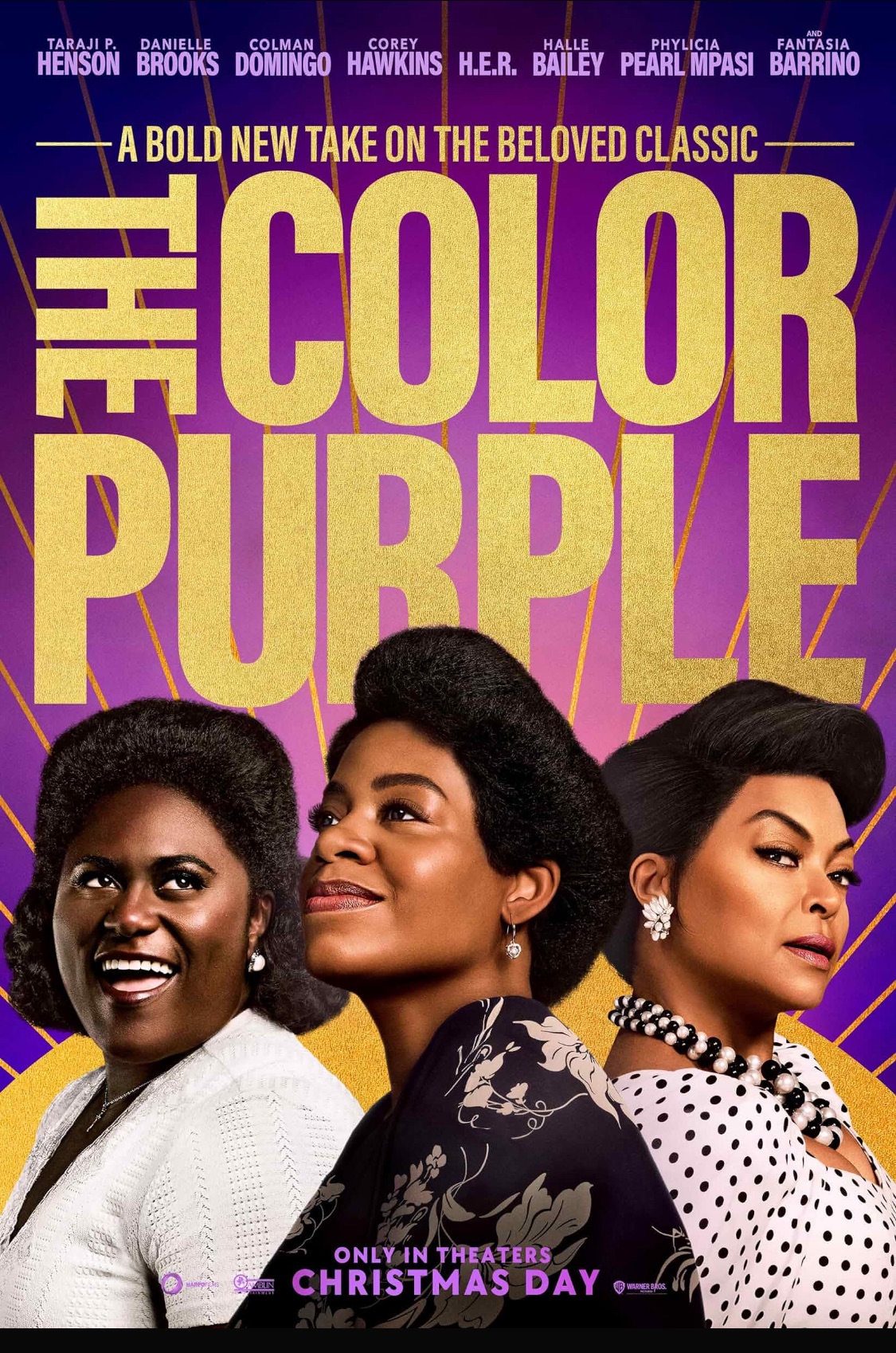
THE COLOR PURPLE (2023)

December 22, 2023

Greetings again from the darkness. It all began with Alice Walker’s 1982 novel, for which she was awarded a Pulitzer Prize. Shortly thereafter, Steven Spielberg turned it into the movie event of 1985, with a memorable cast including Whoopi Goldberg, Danny Glover, and yes, Oprah Winfrey. The film received eleven Oscar nominations, yet was shut out in all categories. Jumping ahead 20 years (2005), Marsha Norman created a musical stage book that turned into a smash hit on Broadway, receiving eleven Tony nominations. It was 2015 when the musical revival hit the stage, re-establishing the story as part of the fabric of the entertainment world. Along the way, Ms. Walker’s book had been frequently banned and censored, and the adaptations were sure to pick and choose what to cover and how to do so. Here we are forty-one years after the book’s publication, and director Blitz Bazawule (Beyonce’s BLACK IS KING, 2020) delivers a moving and bold film version (screenplay by Marcus Gardley) based on the musicals, the novel, and the original film.

The film opens on the Georgia coast in 1909 by establishing the bond between young Celie (newcomer Phylicia Pearl Mpasi) and her sister Nettie (Halle Bailey, THE LITTLE MERMAID). When the two are forcefully separated, Celie loses the hope Nettie always provided, and soon she’s living a miserable existence as one abused by Mister (a powerful Colman Domingo, RUSTIN) who treats her poorly by regularly taking out his frustrations. Assuming the role she made her own on Broadway is Fantasia Barrino as adult Celie, whose presence and spirit contain the heart of the story.

Memorable characters and performances are everywhere we turn in this production. Danielle Brooks (“Orange is the New Black”) is a powerhouse as Sophia, a role she also owned on stage. Sophia is wife to Harpo (Corey Hawkins, STRAIGHT OUTTA COMPTON), one of the few men trying to break the tradition of abuse … not that he has much choice. Taraji B Henson is a jolt of energy as singer Shug Avery, one of the few women from this neck of the woods who gained independence and made a life (mostly) on her terms.

The supporting cast is filled with talent and surprises. David Allen Grier appears as Reverend Avery, Shug’s estranged dad. Aunjanue Ellis-Taylor (ORIGIN) appears in flashbacks as Celie’s Mama. Elizabeth Marvel (“Homeland”) is the unforgiving and racist wife of the Mayor, and one who has such an impact on Sophia’s life. Oscar winner Lou Gossett Jr (now 87 years old) shows us exactly how his son Mister turned out the way he did. As this is a musical, we would expect musicians to play a part, though it’s quite a treat to see H.E.R. as Squeak (Harpo’s girlfriend), Jon Batiste as Grady (Shug’s fashionable husband), and Ciara in a critical appearance as grown-up Nettie. There is also a well-placed cameo early on that harkens back to Spielberg’s movie.

Covering at least the decades of 1907 through 1945, we see how each character changes depending on their circumstances … especially Celie and Sophia, as well as an attempt at redemption by Mister. At least three ‘showstopper’ songs are included here. Taraji B Henson offers a rousing “Push da Button”, and Danielle Brooks is adamant about where she stands with “Hell No.” Fantasia Barrino’s “I’m Here” may be the highlight since it encapsulates her resilience and perseverance. The quality of the film is evident in all aspects: cinematography (Dan Laustsen), score (Kris Bowers), Production and Set Design (Oscar winner Paul D Austerberry, Larry Dias), and Costumes – especially Shug Avery’s – (Francine Jamison Tanchuk, Rashad Corey). Serving as Producers are Steven Spielberg, Oprah Winfrey, Quincy Jones, Alice Walker, and Scott Sanders, to name a few with long time ties to the story. It’s clearly a labor of love and passion for those involved, and ends with a tear-jerker reunion over Easter dinner. Not many follow the production trek of novel to film to musical to musical revival to musical film, and even fewer have ever done it this well.

Opens in theaters nationwide on Christmas Day.

WATCH THE TRAILER


RUSTIN (2023)

November 4, 2023

Greetings again from the darkness. Organizing an event is often tedious and frustrating and stressful. Rarely is it entertaining. Such is the challenge faced by director George C Wolfe (MA RAINEY’S BLACK BOTTOM, 2020) and co-writers Justin Breece and Dustin Lance Black (Oscar winner for MILK, 2007). Take that and add a central character that most have never heard of, and the challenge seems questionable, if not undesirable. What happens if that main character has more charisma than the beloved Reverand Martin Luther King? Well, that’s something we can work with.

Colman Domingo (IF BEALE STREET COULD TALK) stars as Bayard Rustin, the gay, black, outspoken civil rights activist and organizer … and one-time communist … who coordinated efforts for the 1963 March on Washington for Freedom and Jobs. If that doesn’t sound familiar, it’s the official name of the event where MLK gave his “I Have a Dream” speech. That day is remembered for King’s speech, but the event never would have occurred without the herculean efforts behind the scenes by Mr. Rustin and his team. Since it wasn’t easy, there is a story worth telling.

Director Wolfe is a Tony Award winner and his stage roots are on full display. Many scenes play like live theater, and the performances are elevated to the point of over-dramatizing. There is nothing subtle about Bayard Rustin and nothing subtle about the film, with the exception of Ami Ameen as MLK. By watching this, we wonder how King ever became the leader of a movement – and this after an early scene where Rustin urges him to “own your power”. It’s a power we don’t see here, yet understand it existed in real life. The film opens by reminding that it was 1954 when the Supreme Court ruled segregation was illegal.

Most of what we see occurs in 1963, a couple of years after King and Rustin had a falling out. When the friendship and partnership are re-established for the purposes of the march, it brings together the previously disparate organizations (and their egos) that had been striving independently for power. One in particular was the NAACP, with its director, Roy Wilkins, played here by Chris Rock. The behind-the-scenes bickering and posturing is one of the film’s strengths. Other players of interest here include A Philip Randolph (Glynn Turman), Anna Hedgeman (CCH Pounder), Representative Adam Clayton Powell (a properly pompous Jeffrey Wright), and Elias Taylor (Johnny Ramey) as an attraction and distraction for Rustin.

The goal of 100,000 peaceful attendees initially seemed nearly impossible, and of course, history tells us the final number was closer to 250,000. This group of activists not only faced opposition from white establishment, including (according to this) the Kennedy brothers, but there was also an incredibly tight timeline to work with. It’s the group of dedicated and passionate volunteers that go to the heart of a grassroots movement, and these folks are given their due. The film’s weakness is in its attempt to balance the movement with the scandals surrounding Rustin’s homosexuality. That angle simply doesn’t work as well. As viewers, we are bombarded with monologues galore and stagey acting and scenes, but at the center is a man whose story should be told.

https://www.netflix.com/title/81111528

In select theaters November 3, 2023 and on Netflix beginning November 17, 2023

WATCH THE TRAILER


@ZOLA

July 1, 2021

Greetings again from the darkness. As far as I can tell, this is the first feature film based on an actual Twitter thread. Writer-director Janicza Bravo (LEMON, 2017) works with co-writers Jeremy O Harris and the real life Zola, A’Ziah King to mold the viral 148 Tweets (#TheStory) from 2015 into a somewhat coherent film that may just provide a bit more insight into the social media world than we’d prefer in one sitting. A24 movie studio proves yet again their original, creative, and unique films are unapologetically outside the industry norm … and they are generating quite a loyal following because of it.

Taylour Paige (Dussy Mae in MA RAINEY’S BLACK BOTTOM, 2020) stars as Zola, a waitress with perfect certain “features” according to one of her customers. Zola and Stefani (played by Riley Keough, Elvis’ granddaughter who continues to build a strong and diverse resume, including a standout performance in AMERICAN HONEY, 2016), have an instant connection, and the next day they are off on a road trip to Florida to make big bucks dancing at exotic clubs. Accompanying them are X (Colman Domingo, Cutler in MA RAINEY’S BLACK BOTTOM, 2020), and Derrek (Nicolas Braun, “Succession”), Stefani’s doofus boyfriend.

Be forewarned: this is not the zany female buddy comedy the trailer teases. It’s a dark, twisted comedy laced with dangerous situations and violence. While Zola was led to believe this was a dancing trip for real cash, it turns out X is really Stefani’s pimp, and though Zola stands firm in not taking the sex for cash route, she’s prevented from leaving by a forceful X, no longer the charmer she first encountered. Zola’s wise-to-the-world ways allows her to assist Stefani in upping her cash flow, but things go wrong when Derrek socializes outside the group.

After the infamous Twitter thread, “Rolling Stone” writer David Kushner published an article entitled, “Zola Tells All: The Real Story Behind the Greatest Stripper Saga ever Tweeted”. This is an alternate universe to many of us, though it’s pulled from the “pages” of today’s online culture. Much of the dialogue is in Twitter-speak, and the new Tweet ding is used to emphasize certain spoken lines (think rim shots). Director Bravo instills the “B-word” at the same pace that Tarantino uses the F-word, and it should be noted that both actresses are terrific. Ms. Keough will likely make you laugh, while simultaneously making you uncomfortable. It’s a case study in cultural appropriation – especially her dialect, which is purposefully offensive. We aren’t accustomed to seeing this type of humor these days, but Keough is to be commended for going all in. Ms. Paige’s performance is much different, but no less impactful as her Zola tries to make the best of a horrible situation.

This is a wild story with characters I can only hope you don’t recognize from your own life. It begs the question, what kind of relationships arise from social media? We go a bit deeper on Zola, but really we don’t know much about these people. They are as deep as social media allows, while also serving up a warning to those who might somehow believe internet interactions are anonymous and harmless.

Now showing in theaters nationwide.

WATCH THE TRAILER


IF BEALE STREET COULD TALK (2018)

December 23, 2018

 Greetings again from the darkness. Humiliation and disgust register when we acknowledge that James Baldwin’s 1974 book is as relevant today as it was when published. Though the book hardly lends itself to a big screen presentation, writer-director Barry Jenkins (Best Adapted Screenplay Oscar winner for last year’s Best Picture winner MOONLIGHT) brings his cinematic artistry and deft touch to a story that is a touching love story wrapped in a tale of social injustice.

Filmmaker Jenkins has succeeded in delivering the rare film that is filled with both tender, warm, smile-inducing moments and moments of absolute frustration that fill us with outrage. It’s a beautiful film with a sweet story of love between two soul mates, and it’s also a story of race, class, and Harlem in the 70’s. The film begins with a Baldwin quote informing us that “Beale Street” is born from black roots – it’s not geographical, but rather cultural. He’s certainly not referring to today’s tourist destination in Memphis.

Tish (terrific newcomer Kiki Lane) and Fonny (Stephan James, played Jesse Owens in RACE) have been best friends since early childhood. They are now ages 19 and 22 respectively, and that friendship has blossomed into romantic attraction. Their fairy tale love story is shattered when a racist cop (Ed Skrein) falsely accuses Fonny of rape, and Fonny goes to prison. And if that’s not enough, we witness the scene where Tish and her family invite Fonny’s family over to announce she is carrying his baby. Fonny’s judgmental and religious zealot of a mother reacts with indignation and is beyond cruel to Tish. It’s one of the most emotionally explosive scenes of any movie all year. Regina King gives a powerhouse performance as Tish’s mom, and she goes toe-to-toe with Fonny’s mom played by Aunjunae Ellis (Yula Mae from THE HELP). Fonny’s dad (Michael Beach, AQUAMAN) and Tish’s dad (Colman Domingo, SELMA) are stunned by the situation, and wisely take their discussions to the corner bar.

That incredible scene of families clashing is offset by the tenderness and soulfulness of the scenes showing Fonny and Tish together … whether on the neighborhood streets, in their apartment, or talking with a glass barrier between them. As the timeline gets bounced around, we see Fonny and his old buddy Daniel (Byron Tyree Henry) in one exceptional scene, and we also see the bond between Fonny and his café manager friend played by Diego Luna. The depth of these scenes is difficult to relay, and the film acts as both a character study and social commentary relevant to today’s issues. There is so much precision and attention to detail in the story-telling and acting. The color palettes transition depending on the mood of the scene, as does the music – the strings used by composer Nicholas Britell are very much a part of the Tish-Fonny love story, and the brassy jazz music cover the rest.

We get to know Fonny as an artist and charming young man smitten with Tish, who is a gentle and angelic soul. We see his changes while in prison, and we see how others react to her (based on their race, gender and age) as she works the perfume counter at a department story. Baldwin’s writing is spot on as Tish (in her role as narrator) says “I hope that nobody has ever had to look at anybody they love through glass.”

Director Jenkins has delivered a special movie that is brilliantly constructed. It’s a story of love and family and the impact of racism without any of the preachiness we often get. Cinematographer James Laxton expertly captures the tone changes, and having the actors periodically look directly into the camera (at the viewer) proves quite powerful. This is romanticism vs. reality, and speaks to the power and beauty of love … and the strength to carry through even in an unjust situation brought on by a fractured society. It’s a beautiful film.

watch the trailer: